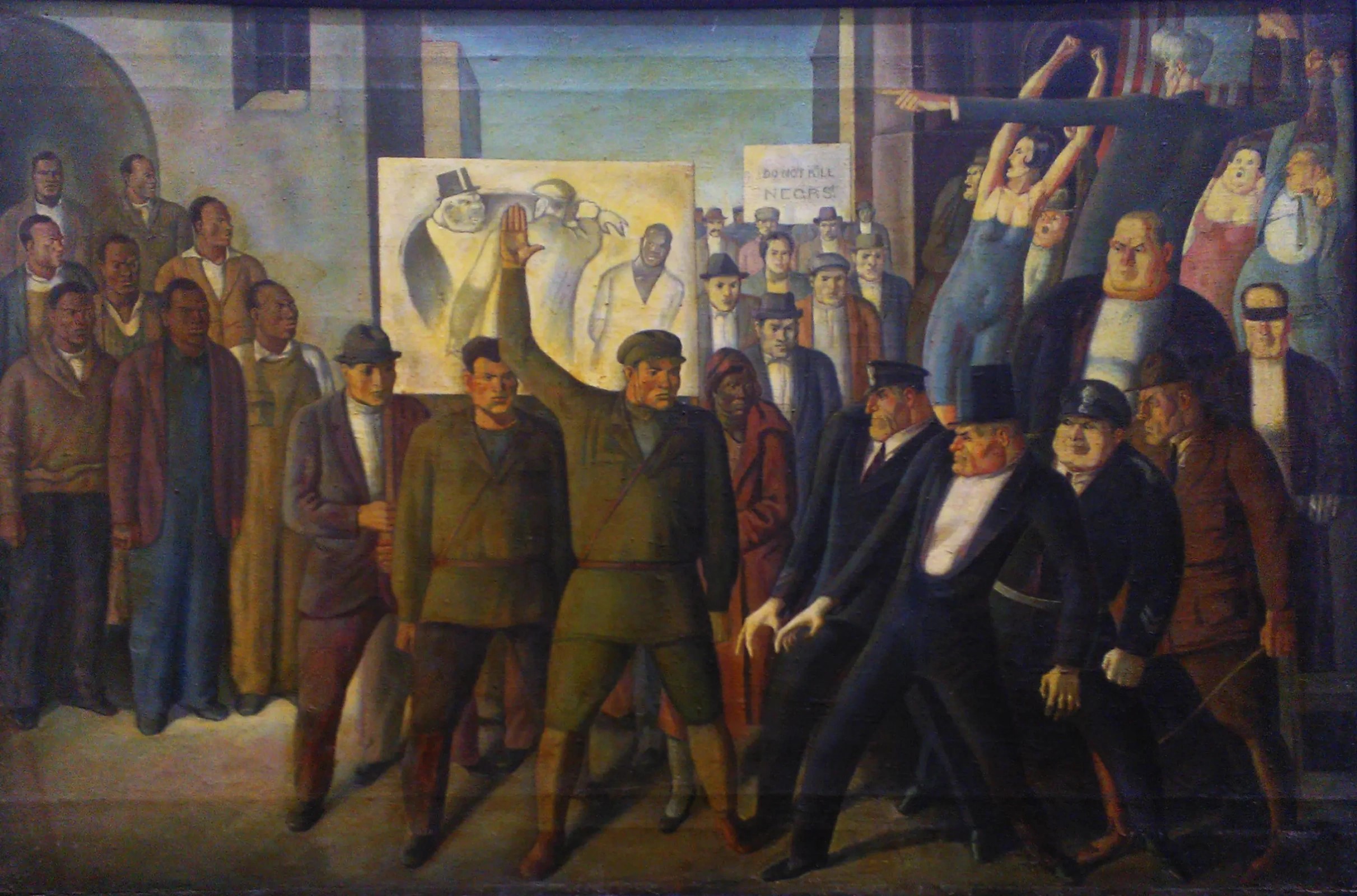
How interesting, and refreshing, to read this explanation of the proletarian dictatorship from outside the usual canon, and from the time when it was first beginning to be consciously practiced, from one such as S. J. Rutgers, so central to formulating the ideas of the U.S. Left Wing in the period of World War One and the Russian Revolution.
‘The Dictatorship of the Proletariat’ by S.J. Rutgers from Revolutionary Age. Vol. 1 No. 9. December 18, 1918.
“POLITICAL power properly so-called is merely the organized power of one class oppressing another,” says the Communist Manifesto. At present the political power of the capitalist class, organized in the capitalist State and capitalist government, serves the purpose of protecting and enforcing the exploitation of the proletariat class. Class division excludes democracy because the interests of one class, the ruling class, must prevail. The ruling class always has been a minority class, as it would not be necessary for a majority class to “rule.” Democracy being incompatible with a society based on class antagonism, no form of bourgeois “democracy” can ever be real democracy.
Real democracy must secure conditions and decisions in accordance with the interests of society as a whole, and if we find that a “democratic” government is used to secure the interests of a minority class, there is something wrong with that kind of democracy. Without going into details how the specific “democratic” system accomplishes its special aims, we know as a fact that there is some scheme to prevent democracy working out democratically. In fact the prevailing institutions, customs, laws, morals, etc., of a class society largely have no other purpose than to create sentiments and conditions which operate to make people support their own oppressors. The working class and those groups whose interests are one with the interests of the working class, largely through intellectual and moral influences, are brought to betray their ultimate class interests. Such is the power of control over the economic conditions and over the instruments of civilization—schools, churches, public opinion, newspapers, science, art, etc.
Only to a very limited extent, only to the extent to which the ruling class needs a certain amount of freedom in its own interest, can the oppressed class counteract this control by propaganda and education. If the capitalists could put each worker in a separate cell to sweat out profits without contact with his fellow-workers, the system might be permanized altogether and no amount of general suffrage and vote casting would be of any effect.
The present situation under Capitalism, is not quite so “perfect,” but still conditions are maintained in such shape as to enable a minority to rule. Even though we may not always be able to find out how it works, we know by its results that the scheme works all right, because otherwise the majority would not accept the minority rule.
Under present circumstances, “democracy” is one of the means used to deceive the workers, is part of the anti-democratic reality, and the strength of this and other means to the same end is the more remarkable since the material means of power largely have to be put in the hands of the underlying class. Even the ultimate power of militarism is in the actual control of the workers if they only could overcome the mental and moral obstacles raised by their masters.
Without going into details of the schemes of bourgeois democratic government and the multitude of ways to accomplish its anti-democratic aims, it may be worthwhile to call attention to the fact that parliamentarism adapts itself to the most brutal forms of autocracy. Even Germany had a parliament elected by general suffrage, a general suffrage more “democratic” than that of the United States. But while the Reichstag is allowed to talk to a certain extent, the bureaucracy acts, and is, moreover, ready to stop this talking machine any moment it threatens to become a nuisance. Another and most instructive example of a bourgeois democratic system serving Capitalism is right at hand and it is unnecessary to analyze its methods in detail. Direct corruption and speculation on personal material interests no doubt often play a role; but by far more important are the mental methods to fool and enslave the worker. Therefore “class consciousness” has to develop so that the material means of power already in the hands of the workers can be used to overcome the class-rule of the exploiters.
This Social revolution, however, is not a matter of material and mental power. While it is perfectly clear that only a large number of the exploited masses with definite and well-defined purposes can bring the change, there is no necessity that this should be a majority of the suppressed class. In fact a social revolution may turn out and has so far always turned out to be a new class rule of another minority. The hope for democracy under Socialism lies not in the Social Revolution as such, but in the fact that the victory of the workers will do away with every form of class rule. During the period of the Social Revolution the two classes continue to struggle and democracy can only be a weapon in this struggle, can only serve the interests of one class against the other. Bourgeois democracy will continue to enlist groups whose ultimate interests are with the proletarian revolution and the democracy of the victorious workers will be based upon the will and action of those groups among the workers that carry the revolution to success although they may form a minority even within the class of wage earners. Revolutions do not depend upon a majority but upon sufficient power to overcome the ruling class. This requires a mass of self-conscious and resolute proletarians acting in accordance with the demands of historic development, but there is no necessity, nor even a possibility, that this should be a majority from the very start. The proletarian revolution develops out of a condition in which the great mass of the exploited class is held in mental slavery and it is only natural that this mentality will first be broken in those workers whose position in the process of production makes them specially fit to see the light. The atmosphere of the social revolution itself is liable to open many eyes but at any given moment there is no logical reason whatever why the revolutionary forces should represent an absolute majority. And even when embracing majority of the working class or even of the population the acts and decisions will not be based on democracy but on the proletarian class position as against the reactionary forces. This period has been called by Marx “the dictatorship of the proletariat,” and he states: “If the proletariat during its contest with the bourgeoisie is compelled by circumstances to organize as a class, if by means of the revolution it makes itself the ruling class, and as such sweeps away by force the old conditions of existence of class antagonism and of classes generally it will thereby have abolished its own supremacy as a class.” Not before then can democracy prevail.
The power in the hands of the Soviets without recognizing the bourgeois interests was the first demand of the Russian proletarian revolution. And the Soviets were by no means organized with the purpose of expressing the most ideal form of democracy but to give the most efficient expression of the Social Revolution. In the Soviets the factory workers are represented through their direct delegates, the soldiers who, under the special conditions of this world war, proved to be an active revolutionary force, have a strong influence, as well as the peasants who want the land and know that the bourgeoisie is not willing to give it to them.
And this Soviet has quite a different character from the old bourgeois parliaments. It is highly important to mark this difference, as a clear illustration of the fact, pointed out by Marx: “that the victorious proletariat cannot seize the ready-made machinery of the state and use it for its own purposes.” It has to build new organizations based, not on the government of persons, but upon administration of things. The Russian Soviet through its many subdivisions and committees controls the actual economic structure of society. Committees in charge of factories send their delegates to the local Soviets and so do the army corps, and the peasantry. Food distribution and the regulation of housing problems, requisitions, etc., are managed through local committees representing a block, a quarter, etc., and finally co-operating with the local Soviets.
All this is an organic structure in course of development under most difficult circumstances and far from complete or perfect, but nevertheless it functions, it has maintained itself already during one year against the solid opposition of the old bureaucracy and it becomes stronger every day. It is a unity of representative and executive functions, a combination also of industrial and territorial government. This is the great lesson and the great hope in the social revolution, all the revolutionary forces grow into one force, all the tendencies in the class struggle come into unity.
There is no longer antagonism between economic and political action, all the revolutionary groups and factions in the class struggle unite against the counter-revolution and for the building of a new society. Development of actual facts and conditions solve problems quicker than debates ever could. What remains however, is the fundamental division in the class struggle: whosoever is not for the social revolution supports the counter-revolution and has to be dealt with as such.
The Revolutionary Age (not to be confused with the 1930s Lovestone group paper of the same name) was a weekly first for the Socialist Party’s Boston Local begun in November, 1918. Under the editorship of early US Communist Louis C. Fraina, and writers like Scott Nearing and John Reed, the paper became the national organ of the SP’s Left Wing Section, embracing the Bolshevik Revolution and a new International. In June 1919, the paper moved to New York City and became the most important publication of the developing communist movement. In August, 1919, it changed its name to ‘The Communist’ (one of a dozen or more so-named papers at the time) as a paper of the newly formed Communist Party of America and ran until 1921.
For a PDF of the full issue: https://www.marxists.org/history/usa/pubs/revolutionaryage/v1n09-dec-18-1918.pdf
 Revolution's Newsstand