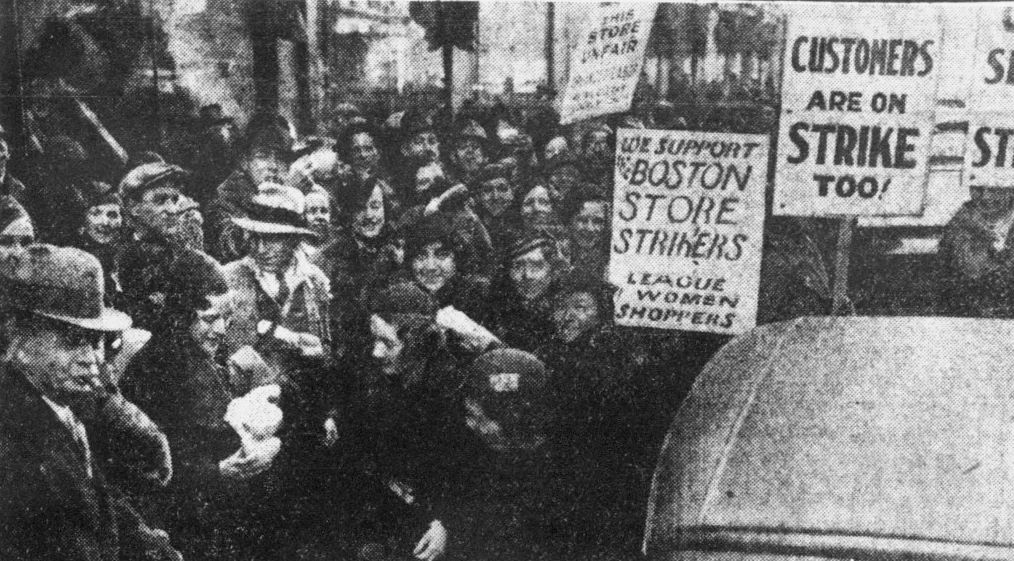
The day before Thanksgiving, 1934 six hundred workers, mostly women clerks, went on strike for a raise and recognition of Retail Clerks Union 1284 at Milwaukee’s largest department store. The strike lasted throughout the holiday season, ending on January 11, 1935 in defeat.
‘The Heart of Milwaukee: The First Great Department Store Strike in America’ from Working Woman. Vol. 6 No. 2. February, 1935.
“PAY DAY is Wednesday–and that means on Tuesday I generally don’t eat.” Anne gave a wry little smile as she made this statement. She is the mother of a 14-year old daughter whom she supports on the $14 she earns at the Boston Store in Milwaukee.
Billy, another striker says: “My first introduction to the Boston Store system came when I was 15. I worked in the packing room. Beside me was a lovely blond girl. She wore a bandage over one eye. An electric bulb in the store had exploded and glass flew into her eyes. Before this, she was the head of her office, but when she returned to work after months in the hospital, she was placed in the packing room. Christmas eve she was fired because, as one of the executives said: “You might become a liability to the store.”
Dad “S” felt sick one afternoon. He had pains in the chest. He went to the store nurse. She gave him one of the inevitable “pink pills,” the cure-all for all store workers’ ailments. The nurse told her patient he was all right and should return to work. Five minutes later, Dad “S” was stretched out on the jewelry department floor, dead from a heart attack.
And so it goes. Story after story. All smack of just the same heartache and desperation suffered by the workers of the Boston Store, called by high-pressure publicity agents “The Heart of Milwaukee.”
A Story of Smoldering Resentment
For more than the thousand workers in the store, the average wage is $12.60 for the 36-hour week; $14 for the women and $16 for the men, for the 40-hour week. The same wages for many who worked for the store 15 and 20 years, for men who support families.
“The Quota and Bonus system is the bane of our existence,” strikers complain. “According to this system, each worker must sell a minimum of about $1,000 each month. A commission of two per cent is allowed for sales above the quota (and very few ever make any). But for those who are deficient in their sales quota-a systematic record, running from one. year’s end to the other, constantly keeps us in fear of being fired.”
Behind the wan smiles of the salesclerks lies a story of smoldering resentment against starvation wages; countless hours overtime without a cent in overtime pay; sudden demotions; personal and family favoritism; firing without notice; intimidation of union members; of N.R.A. maximum made minimum; of a group of sadistic executives who carry out this program for the enrichment of Mr. Stanley Stone.
Marcelled, Manicured–But Hungry
Women are in the majority among store employees. From their meager wages, they must be perfectly groomed if they want to keep their jobs. This includes having their hair carefully dressed; nails manicured; flawless hose and shoes, while dresses must be a uniform black or blue, modishly cut.
Many women come into the store conforming with all these demands, but lacking a dime for a sandwich.
The managers are so mean they have earned nicknames more fitting than their real names. The most common nickname is “Simon Legree,” but more obnoxious characters. Perhaps the most despised of all is “Hitler” Diamond, basement manager who earned this title because of his close physical resemblance to Hitler and the similarity between his terroristic, fascist treatment of the workers. Another “devil” as the workers call him, is “Kreutznauer,” buyer in the yard goods department.
The Union Comes
Last September, the union came. Many joined. As union numbers grew, so panic among store officials. They made desperate efforts to break the ranks of the union members. Even raises were given, as bribes against the union. Known union members and organizers were fired on trumped up charges. The store refused to grant the demands of the grievance committee, and the day after Thanksgiving, the strike was called.
The first days of the strike hopes ran high. Through driving rain, sleet, snow, zero weather, picket lines wound round the four entrances of the store. As the days passed into weeks, the weeks into months, the strikers began to examine the strategy of the strike. They began to question Koerner, Kingsta and Cooper, the officials of the three American Federation of Labor locals leading the strike.
The reactionary officials of the three unions failed to close the store down tight, permitting many crafts to remain in the store; they failed to organize the strikers into a solid unit; they failed to arouse the rest of organized, unorganized and unemployed workers in solidarity actions; failed to arouse the “consuming” public to support the struggle. More. Many offers of help from unemployed groups and others, were rejected by the officials and they did everything in their power to discourage all who came to help. In the last week of the strike the officials refused to permit rank and file delegates elected by the members, to serve on the Bargaining Committee. For a whole week, the officials were secretly closeted with the store representatives and refused to report these conferences to the pickets.
The League of Women Shoppers
A group of women, realizing that they, as consumers, could be a force in the strike, came to the officials offering help.
“We want to shut the doors of the Boston Store real tight,” they said. “Let us conduct a campaign among the women shoppers of the store. We will tell them of the terrible working conditions in the store. We will call large mass meetings, circulate leaflets, send delegations to the management and raise funds for relief.”
The stupid officials refused. Speedy, International representative, said:
“The International don’t allow it,” repeating the catechism over and over.
“There’s some reds in your group, and we don’t want to get mixed up with reds,” said others.
Strikers witnessed this interview. Anger flashed in their eyes.
“If you don’t let these women help us out, then you are either the greatest fool in the world, or the greatest crook in any union,” they said to Koerner, clerk’s president. Pressure from the rank and file removed this obstacle. “Go ahead, do anything you want. anything you want.
We don’t object, we won’t cooperate,” the officials said.
The League of Women Shoppers then stepped boldly forward. Huge banners with the slogan “Customers Are on Strike Too” were printed. Picketing beside the strikers, they shouted this and other slogans into the ears of scabs and customers alike. They picketed through the store appealing to customers and workers to join the ranks outside. A large mass meeting,
One other incident helped to shatter all faith the workers originally had in their “leaders”…and that was their picketed through and that was their attitude towards the League of Women Shoppers. attended by nearly 1,000 heard first- hand reports by the strikers. Nearly two hundred dollars for relief, Christmas and New Years, grocery baskets for needy strikers’ families, toys for the children, were raised by the women. They published thousands of leaflets under the title, “League of Women Shoppers News,” urging the public. to boycott the store until the strikers won. They circulated petitions and sent them to the store. The workers were cheered and inspired by the efforts of this group, which was actually doing the job which, the strikers said, “Our leaders ought to do.” After the distribution of relief baskets, the strikers went to their president and compelled him to send an official letter of thanks to the League of Women Shoppers.
“Our Leaders Betrayed Us”
After nearly ten days of secret negotiations, the leaders brought the so-called “settlement” offer to the workers for a vote. No raise in wages, no real union recognition, an open, discriminatory clause against workers who, the store alleges, were “guilty of acts of violence”–and the officials presented this settlement as if it were exactly what the strikers wanted.
They came to the meeting with a baseball bat for a gavel. Scattered throughout the strike meeting were gangsters who shouted, cheered, yelled and howled every time an official spoke. When any member of the militant rank and file group left his seat, they followed him, menacing. A real intimidation atmosphere filled the hall. Finally, the “vote” was not by secret ballot, nor was it counted. The chairman merely said:
“The ayes have it–they made the most noise.”
The next day local papers carried a picture of the officials and the store managers signing the agreement. Under the picture, these leaders were quoted. Cooper, president of the maintenance local, said:
“The Boston Store again leads…I personally feel that the conduct of the company was one of the fairest…” Koerner, clerk’s union president, said:
“I agree completely with Mr. Cooper. I feel perfectly sure the store officials will do everything and even more than the agreement calls for.”
Support the Rank and File Program!
“These statements by the union officials are an open declaration of treachery,” say the strikers. “We must guard against such officials; we must organize against them. They are just as much our enemies as the owners. of the Boston Store. We must rally our members behind the rank-and-file opposition group program of more wages, 30-hour week, trade union democracy, and unemployment insurance as outlined in H.R. 2827.”
“No pessimism can take root in our ranks,” say others. “The lessons this strike has taught us are costly, but they could never be learned in any school or college. We must make these lessons our guiding light in the coming struggle before us. We must make our rank and file opposition group, guarding and fighting for the ‘interests of our fellow-workers, the real ‘heart of Milwaukee’–and the heart of Milwaukee workers shall beat as one.
The Working Woman, ‘A Paper for Working Women, Farm Women, and Working-Class Housewives,’ was first published monthly by the Communist Party USA Central Committee Women’s Department from 1929 to 1935, continuing until 1937. It was the first official English-language paper of a Socialist or Communist Party specifically for women (there had been many independent such papers). At first a newspaper and very much an exponent of ‘Third Period’ politics, it played particular attention to Black women, long invisible in the left press. In addition, the magazine covered home-life, women’s health and women’s history, trade union and unemployment struggles, Party activities, as well poems and short stories. The newspaper became a magazine in 1933, and in late 1935 it was folded into The Woman Today which sought to compete with bourgeois women’s magazines in the Popular Front era. The Woman today published until 1937. During its run editors included Isobel Walker Soule, Elinor Curtis, and Margaret Cowl among others.
PDF of full issue: https://www.marxists.org/history/usa/pubs/wt/v6n02-feb-1935-Working-Women-R7524-R1-neg.pdf
 Revolution's Newsstand