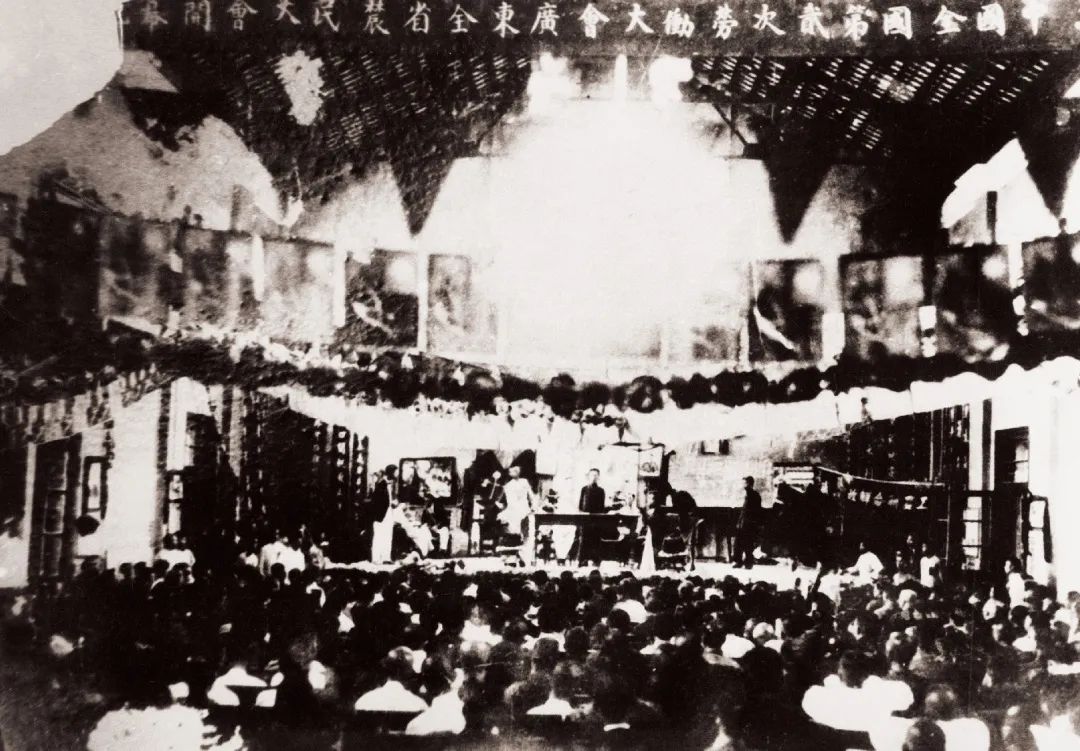
A background and report on the Fifth All-China Federation of Trade Unions held in November, 1929. Founded by the newly-formed Communist Party in 1925, it was the Federation’s first gathering since 1927, and in vastly different circumstances. After the alliance with the KMT had been drowned in blood, with workers uprising in major cities brutally put down and their organizations destroyed that year, the CCP’s focus turned to the countryside, its masses of impoverished peasants, and an armed campaign. Soon the federation would be split into those working in Soviet districts, and an underground organization for White districts.
‘Revolutionary Trade Unions of China’ from The Pan-Pacific Monthly No. 37. June-July, 1930.
THE All-China Federation of Trade Unions, embracing all revolutionary trade unions in China, was organized on May 1st, 1925, at the Second All-China Trade Union Congress. During the course of two years, from the middle of 1925 up to the middle of 1927, the Federation kept increasing its ranks, its membership going up from 500,000 in 1925 to 3,000,000 in 1927.
The Kuomintang, desirous of getting the support of the proletariat during the time of the Northern Expedition, was obliged to give a certain amount of freedom to the labor movement, and this, under the conditions of merciless and brutal exploitation experienced by the Chinese workers, furthered to a great degree its organizational growth.
The Communist Party of China was precisely that force which from the very outset crystalized organizationally the spontaneous movement of the Chinese workers for improving their labor and living conditions.
During the time of the Northern Expedition the trade unions, taking advantage of their legal position, lined up large numbers of the workers in their ranks, and came to be, under the leadership of the Communists, at the head of the developing revolutionary movement. The series of mass strikes and politically armed manifestations of that period (three uprisings in Shanghai in 1927, the seizure of the British concessions in Hankow and Kiukiang, etc.), proved completely the revolutionary spirit and fine militant character of the Chinese proletariat.
However, the rapid development of the labor movement and the threat of the oncoming agrarian revolution pushed the Kuomintang into the camp of the counter-revolution. The first step to be taken by the temporarily victorious bourgeoisie was to prohibit all worker-peasant organizations, those which in any way at all were revolutionary in character. And considering the fact that in reality there were no other organizations in existence at that time in China, consequently practically all trade unions and peasant unions were closed down.
Owing to the cruel reign of terrorism which set in after the uprising, the revolutionary trade unions were compelled to reorganize themselves and go underground. The reaction did not limit itself to merely dissolving the trade union organizations; it started the mass extermination of the trade union leaders and active workers. The labor movement in a whole number of districts temporarily died out.
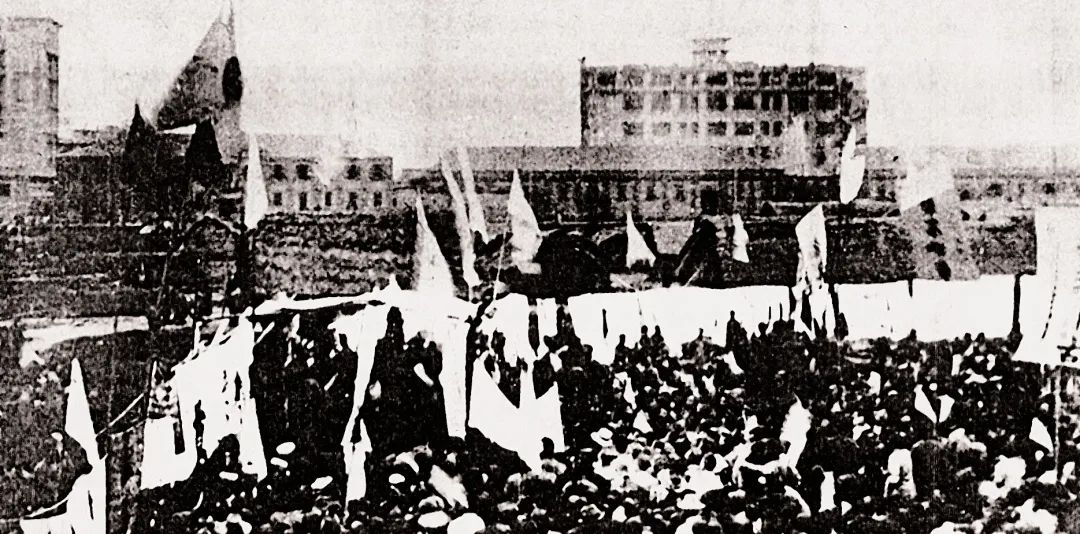
The transfer of the movement from a widespread legal organization to a state of illegality, along with the mass extermination of its active revolutionary workers, had a most severe effect on the organizational state of the revolutionary trade union movement.
The Fifth Congress of the All-China Trade Union Federation, held on November 7-12, 1929, in Shanghai, stressed the fact that by now the revolutionary unions have not yet succeeded in establishing a powerful organization. The scattered state of the trade unions in the different enterprises and branches of industry, their strict group character, their administrative attitude, method of appointments, absence of all trade union democracy, and in connection with this, isolation from the masses such are the principal shortcomings of the Red trade unions.
The rather poor organization of the All-China Trade Union Federation to a great extent protracted the development of mass activities and the intensification of militant leadership in the different centers of the country. This explains the fact that in spite of the growing influence of the Red trade unions due largely to the sharpening economic conditions in China and the growth of the revolutionary mood among the masses, the number of members lined up in the trade unions is very small (according to report of the Executive of the All-China Federation of Trade Unions to the Red International of Labor Unions of January 7, 1930, there are 40,000 members). Besides, more than half of the membership is comprised of professional workers.

This shows clearly that the All-China Federation of Trade Unions has up till now conducted its work along the line of least resistance, for it is much easier and less dangerous to work among professional workers than it is to work among industrial workers, the latter being strictly controlled by the factory administrations and Kuomintang authorities.
Bad organization also exercised its influence in the way of insufficient leadership of the battles of the workers by the revolutionary trade unions; the majority of the strikes as a rule broke out spontaneously and were carried on without sufficient revolutionary leadership.
Besides the above-mentioned shortcomings, a large drawback in the work of the revolutionary trade unions were the mistakes permitted in a whole number of localities in the struggle for winning over the masses from the yellow trade unions. Although the time of completely ignoring the yellow trade unions and not wishing to conduct any work in them is gradually coming to an end, however, the tactics for the struggle against the yellow unions are still not correct from many angles. The whole struggle is generally limited to a fight against some of the individual yellow leaders, and against their treacherous actions. Time and again the fight between the Red and yellow active workers is only based on the desire to replace some one leader, while the character and content of the work in the trade union is not subject to any change even after the yellow union had been changed into a Red one.
In the experience of the revolutionary trade unions, cases can be registered when the toiling masses themselves drove out some of the yellow leaders, while the revolutionary active workers did not agree to take their place, fearing repressive measures on the part of the government, and thus renouncing the leading places to the Centrists, and also, the chief task is not being carried out sufficiently work among the rank and file of the yellow unions.
Thus it happens that the ever-extending labor movement grows out beyond the framework of the revolutionary trade unions and the toiling masses in many districts come to the fore, leaving the leaders of the Red trade unions to drag along at the tail end.

Closely bound up with the struggle against the yellow leaders is the question of setting up factory committees. During the space of two years, although the necessity for organizing factory committees was stressed, only some insignificant work was accomplished. Time and again the comrades inside the Federation and even the Executive of the Federation, under different pretenses, would come forward against the organization of factory committees; these evidently failed to realize the significance of the factory committee as a tool for winning over the wide proletarian masses to our cause. The Fifth Congress of the All-China Trade Union Federation put an end to all waverings with regard to this question, and stressed the necessity of organizing factory committees at all enterprises, like bodies elected by the workers themselves. The sharpening of the economic crisis and the capitalist rationalization processes introduced into a whole number of industries gave rise to a rapid growth of unemployment, with the simultaneous growth of female and child labor. In accordance with this the work among the unemployed, the women workers and juniors comes to be of great significance.
However, the revolutionary trade unions did very little in this direction. Only in Shanghai the revolutionary active workers are carrying on some sort of work among the unemployed. Only in several of the larger cities, in Shanghai and Hongkong, have women’s and children’s section at some of the enterprises been set up. This work still lags behind the demands of actual life.
The Fifth Congress of the All-China Trade Union Federation adopted a resolution about this question for intensifying the work among the women workers and juniors, for organizing sections of women workers and juniors and of electing representatives of the women workers and young workers to all organs of the trade unions.
In spite of a great number of weaknesses and shortcomings, the revolutionary trade unions in China have carried out some fine work,
particularly during the course of the past two years. A great deal has already been achieved tending to make the All-China Trade Union Federation a militant mass organization. The upsurge in the labor movement and the intensifying strike struggles give rise to favorable perspectives for the further development of the revolutionary trade union movement, for winning over and lining up the majority of the toiling masses.
The Pan-Pacific Monthly was the official organ of the Pan-Pacific Trade Union Secretariat (PPTUS), a subdivision of the Red International of Labor Unions, or Profitern. Established first in Ha in May 1927, the PPTUS had to move its offices, and the production of the Monthly to San Francisco after the fall of the Shanghai Commune in 1927. Earl Browder was an early Secretary of tge PPTUS, having been in China during its establishment. Harrison George was the editor of the Monthly. Constituents of the PPTUC included the Australian Council of Trade Unions, the All-China Federation of Trade Unions, the Indonesian Labor Federation, the Japanese Trade Union Council, the National Minority Movement (UK Colonies), the Confédération Générale du Travail Unitaire (French Colonies), the Korean Workers and Peasants Federation, the Philippine Labor Congress, the National Confederation of Farm Laborers and Tenants of the Philippines, the All-Union Central Council of Trade Unions of the Soviet Union, and the Trade Union Educational League of the U.S. With only two international conferences, the second in 1929, the PPTUS never took off as a force capable of coordinating trade union activity in the Pacific Basis, as was its charge. However, despite its short run, the Monthly is an invaluable English-language resource on a crucial period in the Communist movement in the Pacific, the beginnings of the ‘Third Period.’
PDF of full issue: http://fau.digital.flvc.org/islandora/object/fau%3A32140/datastream/OBJ/download/The_Pan-Pacific_Monthly_No__37.pdf
 Revolution's Newsstand