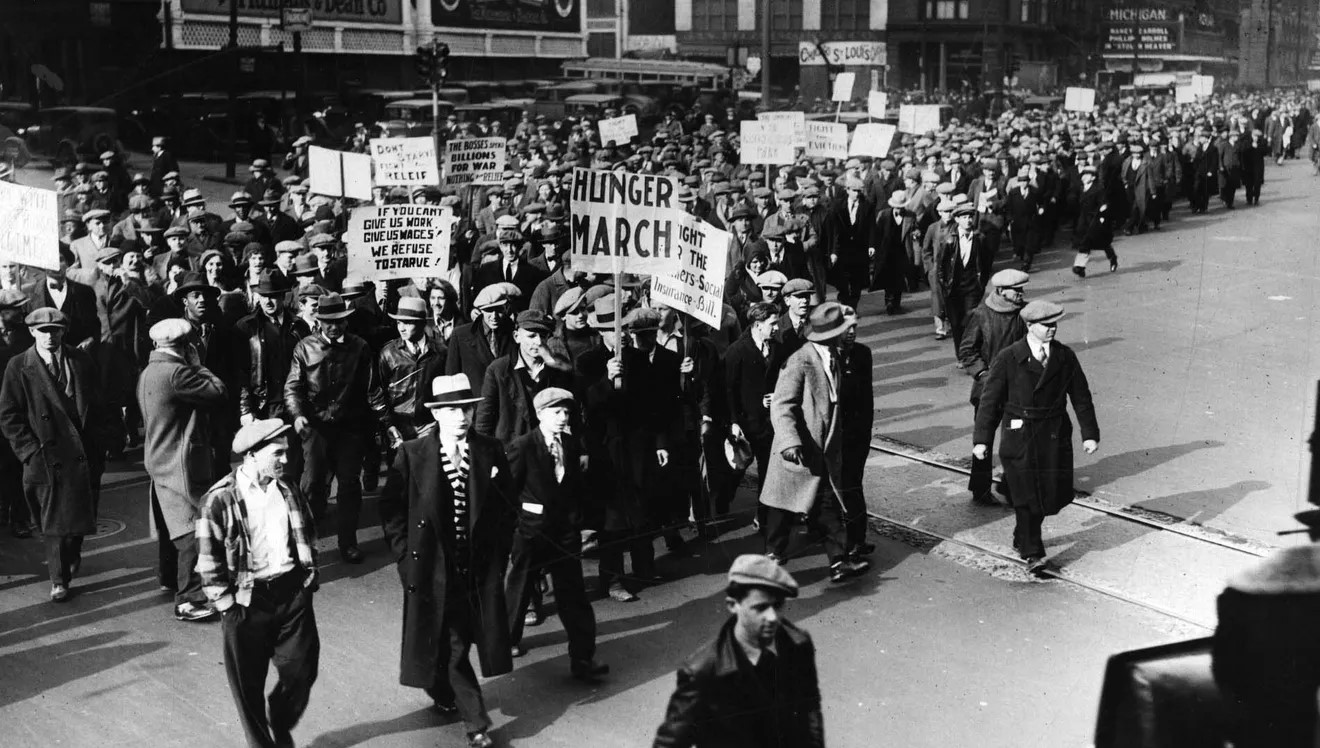
Herbert Benjamin, National Organizer of the C.P.-aligned Unemployed Councils, visits Detroit in the fourth year of the Great Depression on a national tour.
‘The Fourth Hunger Winter: Detroit in Strike Wave’ by Herbert Benjamin from The Daily Worker. Vol. 10 No. 47. February 24, 1933.
(Herbert Benjamin, National Organizer of the Unemployed Councils, is making a tour of a number of principal mid-west cities. He will write short articles summarizing the situation of the unemployed in the cities he visits. This is the first of these articles.)
In rapid succession, one after another of the great automobile plants of Detroit are being tied up by a spreading mass revolt against the hunger offensive of the powerful automobile manufacturers who rule this city. Strike fever is spreading. Even the American Federation of Labor misleaders, who have done their utmost to convince the masses that “strikes in periods of economic crisis are impossible,” are now talking strike. Of course their purpose in pretending to favor strikes is the same as their previous attempts to discourage strikes.
WAVE OF STRIKES
But the masses are not only talking strike. They are striking! One day it is the Murray Body; then Motor Products; Briggs, and then the Hudson plant. Nor is the strike fever confined to the auto industry. Within fifteen minutes reports of two strikes come over the phone of the office of the Trade Union Unity League; first it is a stove factory; two department stores!
THE workers want leadership for their struggles. They turn to those who have been urging, organizing and conducting the fight in resistance to hunger relief doles and starvation wages. The most bitter and skillful enemies of the workers are called in to defeat these struggles. These succeed for a time in creating confusion in the ranks of the strikers: to behead the strike for a time; to divide the unemployed from the employed. But even with the help of the A.F. of L., Socialist Party, I.W.W., Proletarian Party combined, the employers are unable for long to dam the tidal wave of struggle against wage-cuts. Reluctantly, step by step, the employers retreat. One after another, they post notices of wage increases not only in the plants that have already been struck, but in all other plants.
HOW ABOUT THE UNEMPLOYED?
Are they clamoring at the factory gates for an opportunity to scab? No, indeed! They are at the gates; but they are there with their banners and placards. They are there to stand shoulder to shoulder with the strikers in determined action to keep scabs out of the plant! Even when, for the moment, company agents combined with I.W.W. leaders succeed in taking over leadership of the strike, and even when these decide that “no outsider shall be allowed to picket,” the jobless workers under the leadership of the Unemployed Councils persist in staying on the line. At all hours of the day and throughout the night; in sub-zero weather they continue on guard.
THE unemployed, led by their Councils, realize that these strikes are part of the general war against hunger. They are ready to participate in that war no matter on what front it may be conducted at the given moment. They are there to give encouragement, not only to the striking auto workers, but to workers of all industries. They are there to declare “Organize and Fight Against Wage-Cuts! The Unemployed Will Not Scab–They’ll Help You Fight and Win!”
HIGH TIME FOR THE FIGHT IN DETROIT
The fight has not begun too soon in Detroit. In fact we’ve been a little slow there for awhile. Consider! The welfare (racket) experts testified before the LaFollette Costigan Senate Committee that only “18 to 58 per cent of the unemployed are on the relief rolls of the various principal cities.” But in Detroit conditions are even worse Ballenger, the Welfare Director of Detroit, boasts that only 10 percent of the admitted 350,000 unemployed of Detroit are on the welfare rolls.

The welfare experts admitted that the most any city spent for relief during the first six months of 1932 was $3.93 per capita. But in Detroit, the same testimony shows that only $3.53 was spent. Further, the state of Michigan is among those states that have not yet appropriated a single cent for relief. While the city of Chicago has received about $30,000,000 for relief from the Reconstruction Finance Corporation, Detroit received only a little over $2,000,000.
JAIL SENTENCES FOR REFUSING TO FREEZE
During five days, according to the Detroit News of February 7, an average of 200 workers have come individually to the City Hall to complain that they are being denied coal. The city is supposed to be providing coal through its “welfare.” But coal is given according to calendar; so much per month on a given day of the month, regardless of needs. Meantime, the same paper reports, “15 men were found guilty today of stealing coal belonging to the welfare department and sentenced to 15 days in the workhouse. Three other men, convicted of stealing coal from the Michigan Central Railroad, were given thirty-day sentences.”
The same paper reports how an unemployed father of three children, working on his first job in a year, was crushed by a truck. After describing the manner in which this worker was injured, it concludes with the following significant passage: “Physicians at the hospital said that undernourishment still further lessens the slight chances for recovery.”
THESE few facts, selected at random, characterize the situation in Detroit. They also serve to indicate why the workers of Detroit are beginning to fight with such bitterness and determination.
POLICE TERROR, MURPHY’S SOLUTION
Mayor Murphy is well aware of this situation. This, as well as his program for meeting the rising revolt of the unemployed and employed workers is strikingly indicated by another news item. This reports a discussion on the budget. The Director of the Budget pro- posed to cut $408,000, an item covering 162 extra policemen. This was protested by the head of the police department, who is quoted as stating that
“These are very serious times, and the problem of industrial unemployment is becoming increasingly serious. It is not sound policy to skeletonize the police department at this time.” Then the report continues: “The Mayor (Murphy) concurred and the item stayed in.”
The workers of Detroit, employed and unemployed, are now giving their stern answer to the hunger and terror program of Murphy and the auto manufacturers. Out of their present struggles, they are mobilizing the forces that will rally in gigantic demonstrations on March 4 and, in a mass hunger march on the Ford plant on March 7 to fling their answer into the teeth of Murphy and his master, the murderous Henry Ford.
The Daily Worker began in 1924 and was published in New York City by the Communist Party US and its predecessor organizations. Among the most long-lasting and important left publications in US history, it had a circulation of 35,000 at its peak. The Daily Worker came from The Ohio Socialist, published by the Left Wing-dominated Socialist Party of Ohio in Cleveland from 1917 to November 1919, when it became became The Toiler, paper of the Communist Labor Party. In December 1921 the above-ground Workers Party of America merged the Toiler with the paper Workers Council to found The Worker, which became The Daily Worker beginning January 13, 1924.
PDF of full issue: https://www.marxists.org/history/usa/pubs/dailyworker/1933/v010-n047-X-feb-24-1933-DW-LOC.pdf
 Revolution's Newsstand