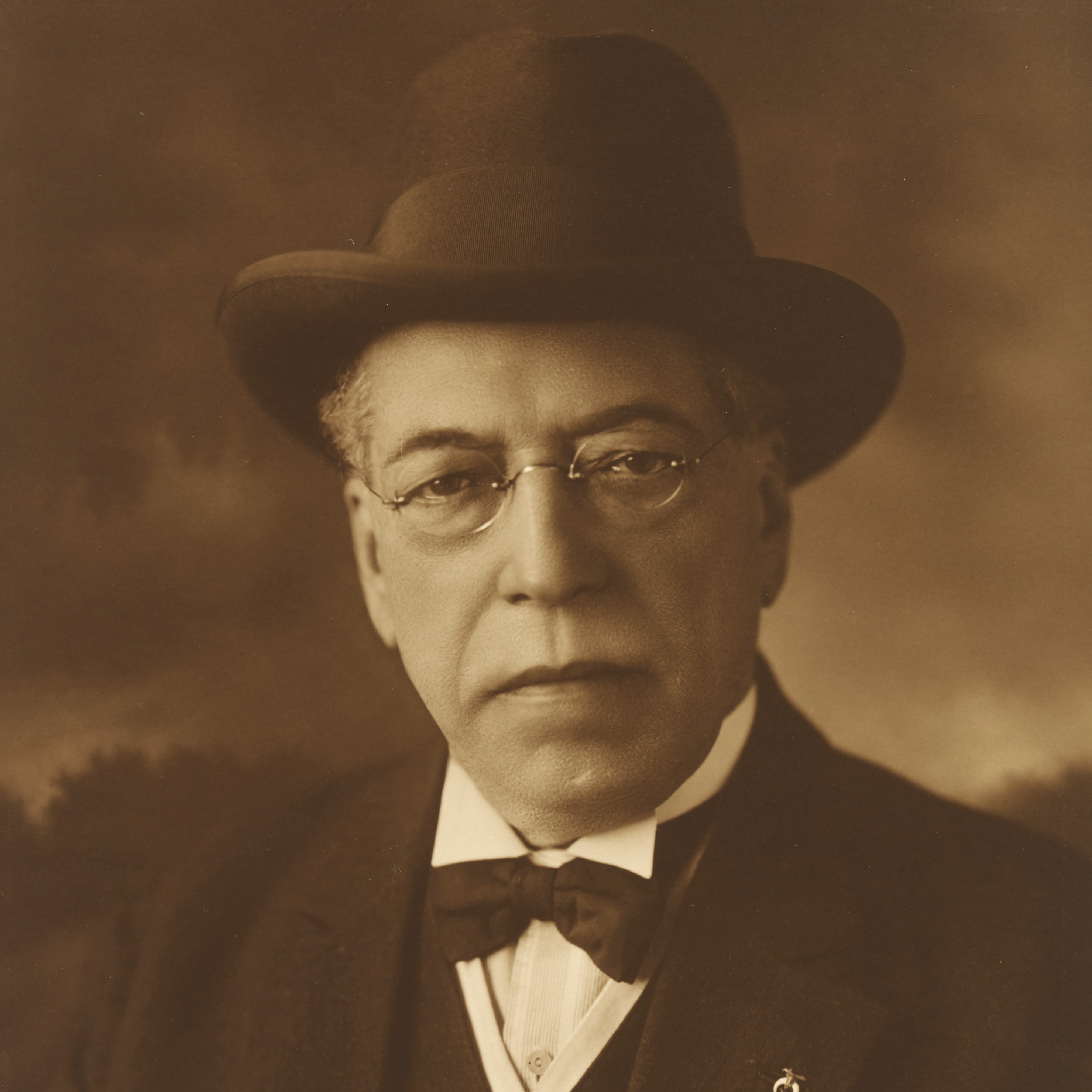
‘The tradition of all dead generations weighs like a nightmare on the brains of the living,’ said Karl Marx when talking about the continuing power of the politics of A.F. of L. leader Samuel Gompers over the U.S. workers’ movement. Covington Hall describes some of its features..
‘Down With Gompersism!’ by Covington Hall from Industrial Union Bulletin. Vol. 2 No. 11. May 9, 1908.
Scared nearly to death by a rapidly awakening rank and file; panic-stricken by the rapid growth of the Industrial Workers of the World, Sam Gompers, John Mitchell & Company have decided to go into politics. Having tried the game of capitalism on the industrial field, and having been whipped to a finish there, the Gompersites, face to face with discredit and defeat, are rushing to the last refuge of fakerdom, and hope, by raising a cry for political action, to defer yet a little while their downfall. Loudly they boast and lyingly that there are 2,500,000 voters enrolled in the American Separation of Labor, when, as a matter of fact, they have not, all told, men, women and children, anything like that number enrolled in their stringhalted and dying organization. Not satisfied with this brazen boast, they also boast of the immense number of votes they can influence, when in truth Sam Gompers and his crew can’t control their own personal ballots.
But even let us admit that they have 2,500,000 votes that Pope Gompers can vote like cattle; let us further admit that the great body of the common people, beholding the wonderful victories that have been won on the industrial fields during the last five years by the splendid and daring tactics of the Gompersites, are so spellbound with admiration that they will fall over each other to follow wheresoever the Pope may lead, when the “victory” will have been won, what will have been gained? Nothing-nothing-nothing.
Nothing; for supporting the capitalist system of production, Gompersism must of a necessity fail as miserably politically as it has industrially.
It must fail, because, in the first place, its so-called organization is inherently wrong. Based on craft autonomy, while production today is carried by an industrial unit, it has and can have no solidarity anywhere, industrially or politically. Every craft is the enemy of every other craft. Each stands on its own little island, with its own little “sacred contract.” crowing lustily while its “brother” in the same line of industry is being done up brown and to a finish by the class-conscious and united capitalists, forgetful of the fact that on tomorrow it will meet the self-same fate. To suppose that such an industrial disorganization can accomplish anything politically is to suppose that an army armed with blunderbusses, each company of which marches as it derned pleases, can attack and overcome on its own chosen battlefield an army magnificently organized, armed with all the latest and most improved implements of destruction and entrenched behind steel-ribbed and stone-bound breast-works.
In the second place, it must fail because it points out no great and final goal to its followers. Unlike the Industrial Workers, it does not demand the world for those who made it-for the workers. It does not proclaim their inherent right to the full product of their toil. It does not preach industrial democracy, nor does it believe in the establishment of the working-class republic. It believes in the wage system, which is the root of all misery. It would not overthrow, but reform, capitalism, which is impossible. Mel- lowed with the wine of Civic Federation banquets, it has become so “safe and sane” that it gets up on its hind legs and howls like an Apache Indian every time the word revolution is uttered in its brainless presence. Having led the workers to defeat after defeat on the industrial field, it now promises to lead them to ruin on the political. Ruin it must be if the workers are fools enough to follow, for out of industrial failure political triumph cannot come, for the political government is not the master but the creature of the economic organization of society.
In the third place, Gompersism must fail politically, as it has industrially, for it proposes to deal with men and not with principles–it proposes to war upon Cannon the man, but not upon the principles for which he stands; and these principles being left intact, hunger and degradation must continue to be the portion of the working class, whether the Cannons are in or out of office. Standing for capitalism, for the wage system, for the right of one man to profit by another’s labor, Sam Gompers himself, great as he is, if he were elected President of the United States, could not lift an ounce of oppression from the backs of the workers, for that oppression comes not from the acts of bad men primarily, but from the exploitation of labor power by the capitalist class–from the worker’s absolute dependence upon those who hold the gateways to the means of life.
For, see you, labor power, like manure, is commodity on the markets of the world, but, unlike manure, its price is not governed by the god of supply and demand, nor by monopoly, for it must be realized from hour to hour, day to day, month to month, year to year, if the sellers and their children are to live–its price is governed, not as the prices of other commodities, which do not have to eat, but by the necessity of the seller, and, under capitalism, the god that fixes it is the god of hunger.
Therefore, that organization which seeks to unify the working class, which, while wringing every immediate advantage possible from the masters, keeps the final goal of Industrial Democracy forever before it, which fights principles with principles, system with system, is the only organization that can immediately affect the price of labor power to the advantage of the workers, is the only organization that can unite them politically and achieve their final emancipation.
Such an organization the American Federation of Labor is not.
Such an organization the Industrial Workers of the world is.
The great question before us is not a question of men, but of systems–Socialism versus Capitalism, the producing class against the robbing class, industrial freedom against industrial slavery.
Which side of the question are you on. You who are reading this–the side of Industrialism or the side of Gompersism, the free side or the slave side? If you are on the free side, get to work today and do all in your power to build up the Industrial Workers of the World, for
The Revolution is already on, and “God,” now as in the past, “is on the side of the heaviest battalions.”
Comrades! Fellow workers! Unite! Unite! Unite!
COVINGTON HALL.
The Industrial Union Bulletin, and the Industrial Worker were newspapers published by the Industrial Workers of the World (IWW) from 1907 until 1913. First printed in Joliet, Illinois, IUB incorporated The Voice of Labor, the newspaper of the American Labor Union which had joined the IWW, and another IWW affiliate, International Metal Worker.The Trautmann-DeLeon faction issued its weekly from March 1907. Soon after, De Leon would be expelled and Trautmann would continue IUB until March 1909. It was edited by A. S. Edwards. 1909, production moved to Spokane, Washington and became The Industrial Worker, “the voice of revolutionary industrial unionism.”
PDF of full issue: https://www.marxists.org/history/usa/pubs/industrialworker/iub/v2n11-may-09-1908-iub.pdf
 Revolution's Newsstand