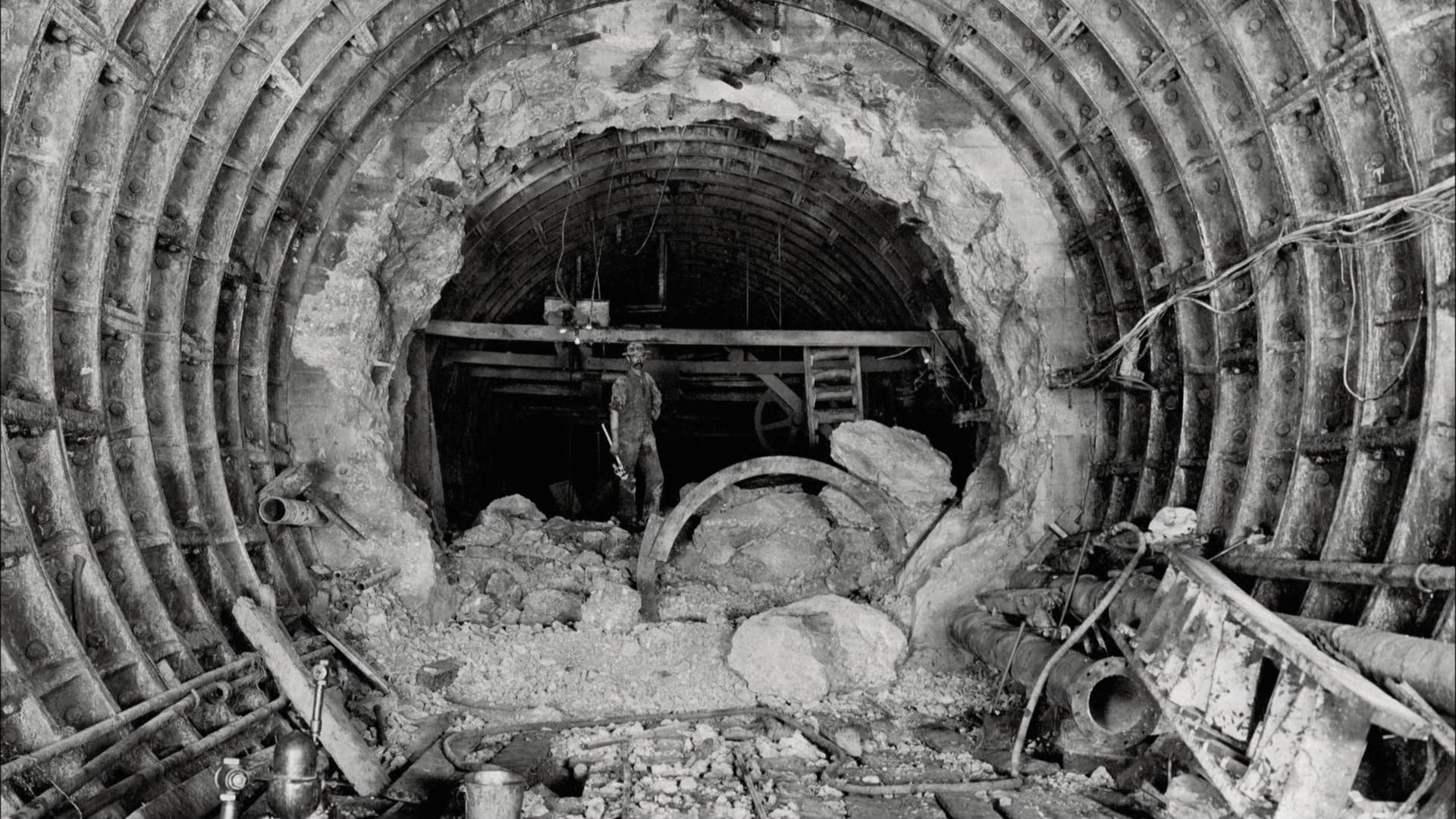
Truly a nightmare; the hell-on-earth conditions of New York’s subway tunnel workers. Every commute cost the lives of our class.
‘In the Central’s Tunnel’ from The Daily People. Vol. 11 No. 42. January 18, 1902.
MEN WHO WORK THERE TAKE THEIR LIVES IN THEIR HANDS
The Dank, Dark, Poisonous Atmosphere Where it Difficult to Breathe–The Danger from Passing Trains–The Safety Manhole Ineffective.
The horror in the “Black Hole”–the New York Central tunnel–emphasizes the fact that despite all the agitation last year the tunnel was allowed to remain as a death trap. The August Grand Jury handed in a presentment declaring that the tunnel was a public nuisance and a menace to life and limb. The Health Board, after an exhaustive examination made practically the same presentment. But what was done? Absolutely nothing. The railroad officials promised much and that ended it. This tunnel was built thirty years ago. It was never meant to accommodate the traffic that now passes through it. The officials concede that the traffic has increased twenty-five per cent. within the last few years and in that time no attempt has been made to improve the tunnel. Hundreds of trains pass daily through the four long alleys bricked and covered in, with the exception of vent holes, which are beyond reach in case of accident. The place is a veritable death trap. It is always dark and filled with steam and gases. Electricity as the motive power would obviate all this.
The following account of how the workers exist in the “black hole,” was printed in the DAILY PEOPLE last August.
In the moist, dark, poisonous atmosphere of the New York Central Railroad’s tunnel in Fourth avenue half a hundred men are working every minute: in the day while passengers in the trains are complaining of the heat, the humidity and the foul air. These men work every day at least eight hours in the air at which the grand jury revolts. The scientists take the state of the air and escape as soon as possible into the free air above, But the men whose living requires them to be there, may gasp and gasp again, and there is no relief for them. In the thick, foggy, humid days the tunnel shows itself at its wort Then the sweating, swearing mob inside the cars think it is undergoing the torments of purgatory, in the four to five minutes’ trip.
In any of the tunnels the smokestacks of the lowest engines clear the roof by not more than five or six inches, and the “hogs,” as the railroad men call the biggest engines, lack only three inches of scraping the roof. When the tracks are re-laid and tamped up, it often happens: the intervening space is closed, and then a gauge car has to go through to make sure that the stacks of the big engines will not be pulled off in the passage. With conditions such as these, the engines, turning their exhaust into the stack, the murderous gases resulting from the combustion of coal are deflected down into the cars, no matter how tightly the latter are closed. In the main two-track tunnel, the belchings from the stack have an occasional chance to escape into the air of Park avenue, but in the side tunnels there is only an occasional chute into which the products of combustion can escape, and this outlet is into the middle of the tunnel. No direct ray of sunlight ever penetrates into the side tunnels; the lanterns burn there forever and a day.
After a train passes there is a violent blast of hot air thrown downward from the smokestack, which strikes a man with nearly enough force to take him off his feet.
Every 200 feet or so manholes in the walls afford tolerably safe places of refuge. They are two feet wide, six feet high, and deep enough to shelter even a stout man. Every third or fourth manhole runs through to the side tunnels, and is large enough to afford safety for three or four men, while the single or blind manholes, whether they are passages or coffin-shaped, often are uneven and unless a man braces himself against the sides he never can be certain that the whirlwind of the train will not sweep him out and under the wheels, for there is a scant foot of space between his squeezed-up body and the cars. That was the fate which came a few months ago to Patrick Grady, one of the oldest and most careful track-walkers in the tunnel. He was seen, upon the approach of a train to enter one of the blind manholes, and after the train had passed the fragments of Grady’s body strewed the tracks. Perhaps the man’s foot slipped, or perhaps he did not brace his arms against the sides of the niche-whatever the cause it was fatal.
“A train can steal upon you from behind and cut you into bits before you know it’s in the tunnel,” said one of the men, “but if you face the train you can see it coming, and make for the nearest manhole.”
Progress through the two-mile tunnel consists of a series of skirmish-like rushes, and most of the way walking on the track is impossible, for the roadbed is full of holes five and six inches deep, the ballast not being laid flush with the ties. A stumble here in the dark, with a train almost on top of you, means almost sure death.
Cool-headed track walkers or laborers do not despair if they cannot reach a manhole. With great care it is possible to line up at the side of the tunnel almost anywhere, and, by buttoning the coat and flattening oneself against the wall, to get out of the way of trains,
if one’s footing is secure. Better yet, one may lie down between the tracks. But there must be nothing loose about the clothing which the whirlwind of the flying train may gather up.
“Of course we get accustomed to the danger and the suffocating air down here,” said one man. “But you ought to be here on foggy days. The trackmen scarcely can see their hands before their faces, and it is impossible to make out where the manholes are. Then they have to feel their way, groping, with their fingers digging into the wall in the search for the manholes. Then the air is so heavy that the smoke and gas and soot do not escape; they simply hang down in the tunnel, making us cough and gasp.”
At Fifty-ninth, Seventy-second and Eighty-sixth streets are signal boxes for the block system. They are reached from the tracks by a six-foot ladder, and occupy a space about ten feet square between the main tunnel and the side tunnels. Here in the hands of men who get about $55 a month rests the safety of the thousands of passengers who daily pass through the darkness to the light and air beyond. Gas burns forever in these little cubby holes, where the men work alone in eight-hour shifts. The block system is worked with electricity, and sometimes it fails. Then the trains stop at the signal boxes and the engineers receive a card, signed by the operator, directing them to proceed with caution to the next station.
In one of the signal boxes drinking water is obtained from a kettle into which some ice has been placed.
“There was one man detailed to this signal work before me,” said this operator, “who got so nervous over it that he had to ask to be relieved; but somehow it doesn’t seem to affect me in that way.
There is no doubt that any change for the better in ventilation and lighting of the tunnel will be welcomed as much by the employees of the railroad as by the passengers.
New York Labor News Publishing belonged to the Socialist Labor Party and produced books, pamphlets and The People. The People was the official paper of the Socialist Labor Party of America (SLP), established in New York City in 1891 as a weekly. The New York SLP, and The People, were dominated Daniel DeLeon and his supporters, the dominant ideological leader of the SLP from the 1890s until the time of his death. The People became a daily in 1900. It’s first editor was the French socialist Lucien Sanial who was quickly replaced by DeLeon who held the position until his death in 1914. After De Leon’s death the editor of The People became Edmund Seidel, who favored unity with the Socialist Party. He was replaced in 1918 by Olive M. Johnson, who held the post until 1938.
PDF of full issue: https://www.marxists.org/history/usa/pubs/the-people-slp/020118-weeklypeople-v11n42.pdf
 Revolution's Newsstand