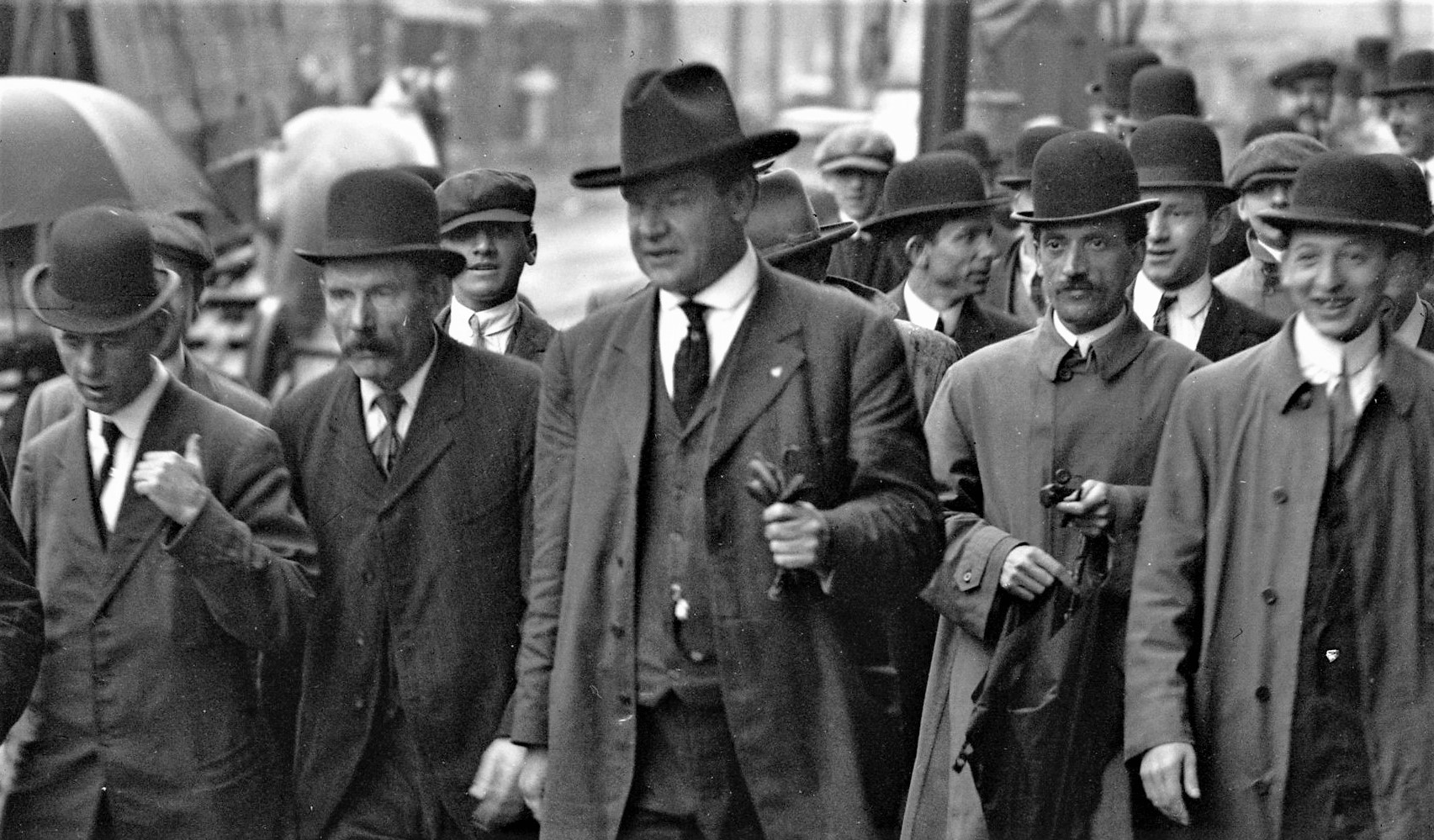
General Secretary-Treasurer, William D. Haywood contrasts the I.W.W. to the A.F. of L. and the labor movements in Germany, France, and Britain.
‘The I.W.W. And Other Unions’ by William D. Haywood from Solidarity. Vol. 6 No. 291. August 7, 1915.
In every so-called civilized country there is a labor movement generally known as Trade Unionism. The English movement is the oldest and strongest numerically, having over three million organized members out of an estimated population of forty-five million. Other countries have taken for example the English form of organization with phases suited to their teaching. For instance, in Germany the Trade Union movement was nurtured in the lap of the Social Democratic Party. Naturally the unions in Germany are dominated by the Socialist Party. It was Karl Legien, General Secretary, who recently said that the Trade Unions were not interested in the affairs of war, that those were matters that should be attended to by Socialist officials-that the Trades Unions were looking after the interest of their members who are at work. Millions of members of organized labor killing other members of the Trade Union Movement because they happened to be of other nationalities, was to Mr. Legien and his ilk a thing that they should not worry about. We are beginning to understand why the German Trade Unionist always opposed the general strike as a means to prevent war. Bernhardi probably tells the truth when he writes that the “working class of Germany are proud of their Princes–proud of this lineage of blood.” The Trades Union movement of Germany has not been a power for the working class, but a strength for the Political Party.
In France the General Confederation of Labor is composed of Syndicats (Trade Unions), referred to as red and yellow, the colors indicating their radical tendencies. The Syndicalist or Trade Unionism is similar in structure to the A.F. of L. The reds being more active and in control of the organization, adopted a revolutionary program, but in action they are far behind the movement in England, as scarcely any effort has been made to organize the women employed in the industries. When I inquired why the women had been neglected, the answer was the men of France do not regard women in the same light as do the men of America. Here the women are not on the same footing, as men, they are thought to be less human. The condition of the workers in France is far behind that of England. The hours are longer; they do not have the half holiday; the wages, generally speaking, are smaller, the Union conditions are not of the same standard, the strength of the Confederation is less than five hundred thousand. They still have the apprenticeship system and enter into contracts and agreements with their employers. They lack the solidarity shown by their British brothers, as for instance, during the strike of the coal miners there was a division among the miners of France, while during the great strike in England over a million miners stood in the sunlight at one time. The much touted Syndicalist movement of France looks to the north for its lead from England.
The British workers have shown a marked tendency for con- centration during the last few years. The National Union Railway workers includes every employee on the railroads. The Miners Federation unites all men employed in the mines. Until recently there were divisions of labor in this industry; the engine. winders and pony drivers and other small sections of labor belonging to independent unions, but a consolidation has taken place. Likewise, the dockers, longshoremen, sailors, and other crafts working at Marine Transportation are beginning to understand what solidarity means. It is the leaders who are milking the “purple cow of politics” that are standing in the way of progress.
The action of the two hundred thousand Welsh miners who have in this, the hour of war, gone on strike for better wages, is noteworthy. They have shut down the steam coal mines of the nation in spite of the orders of the Government, the blandishments of priests and preachers and the advice of their Trade Union officers, and have made the Trade Union world sit up and take notice. If the German coal miners would take such economic action, the general strike would no longer be referred to as “general nonsense,” but would be heralded as the great messenger of peace. The courage and class loyalty of British workers who have laid down their tools, inaugurated the stay-in-strike and adopted other measures for their own betterment, stands as a giant to a pygmy when compared with the workers of any other nation. Agreements are not sacred with the Welsh miners when the chance comes for them to win, and this spirit has been largely developed through the agitation of the I.W.W. throughout the British Isles, where a consistent campaign of propaganda has been carried on for several years. The I.W.W. was the only organization within the war zone to celebrate International Labor Day, May 1st, 1915.

The United States presents the sorriest sight when it comes to comparison with the Trade Union movement of other nations. The A.F. of L. has but one-half the membership of the Trades Unions of England alone, though the population of the United States is much more than double. The A.F. of L. is composed of one hundred and twenty-seven international unions as compared with fifty-two national bodies in Great Britain. It is this jurisdictional division of labor that makes the Unions so weak in this country. The A.F. of L. threatened with Catholic Unions being formed, allows representatives of the churches on the floor of its conventions, while a sky-pilot has but small standing in the Trade Unions of foreign countries. Such a thing as members of a labor organization belonging to a body like the Militia of Christ, or having representatives in a combination like the Civic Federation, would be absurdities never dreamed of. It remains. for the A.F. of L. to enunciate the foolish policy of identity of interest between the employer and the worker, that agreements are sacred documents to be maintained at any cost, and a “fair day’s wage for a fair day’s work.”
The Industrial Workers. of the World having for its basis the class struggle, proclaims that those who take a part of what others produce should be stripped of their power. The I.W.W. says to the workers of England, your love for kings is wrong. To the workers of France we say, you cannot be free until your women stand on the same level of industry and social life. To the workers of Germany, you can never thrive on the love of blood that is dead. You have your own future to meet and make it what you will. There can be no line or boundaries to govern or restrict an awakened working class.
The Industrial Workers of the World is an organization so formed as to meet the change in methods of production, the development of machinery which this inventive age has socialized. It opens wide its doors to every man, woman, or child who toils, no matter what their race, creed, or color may be. It unites the unorganized, unskilled, underpaid, and unemployed; and to them brings a light of hope and tells them what they can do for themselves by an organized effort. It organizes the individuals into industrial unions, and these groups of the entire industry kindred industries into departments, and the departments into one big union–the aim of which is to abolish the wage system, and to operate, control, and manage all industries for the benefit of the entire working class.
The Industrial Workers of the World has a history of its own: In the brief period of its existence it has fought many great battles. It has constantly been the menace of the authorities and employers in its fights for free speech and strikes for better conditions. Many thousands of its members have been arrested and imprisoned, but persecution has but strengthened its virility. The I.W.W. has no exorbitant initiation fees, no examinations, no apprenticeship system, it is of the working class, IT IS THE WORKING CLASS.
The most widely read of I.W.W. newspapers, Solidarity was published by the Industrial Workers of the World from 1909 until 1917. First produced in New Castle, Pennsylvania, and born during the McKees Rocks strike, Solidarity later moved to Cleveland, Ohio until 1917 then spent its last months in Chicago. With a circulation of around 12,000 and a readership many times that, Solidarity was instrumental in defining the Wobbly world-view at the height of their influence in the working class. It was edited over its life by A.M. Stirton, H.A. Goff, Ben H. Williams, Ralph Chaplin who also provided much of the paper’s color, and others. Like nearly all the left press it fell victim to federal repression in 1917.
PDF of full issue: https://www.marxists.org/history/usa/pubs/solidarity-iww/1915/v06-w291-aug-07-1915-solidarity.pdf
 Revolution's Newsstand