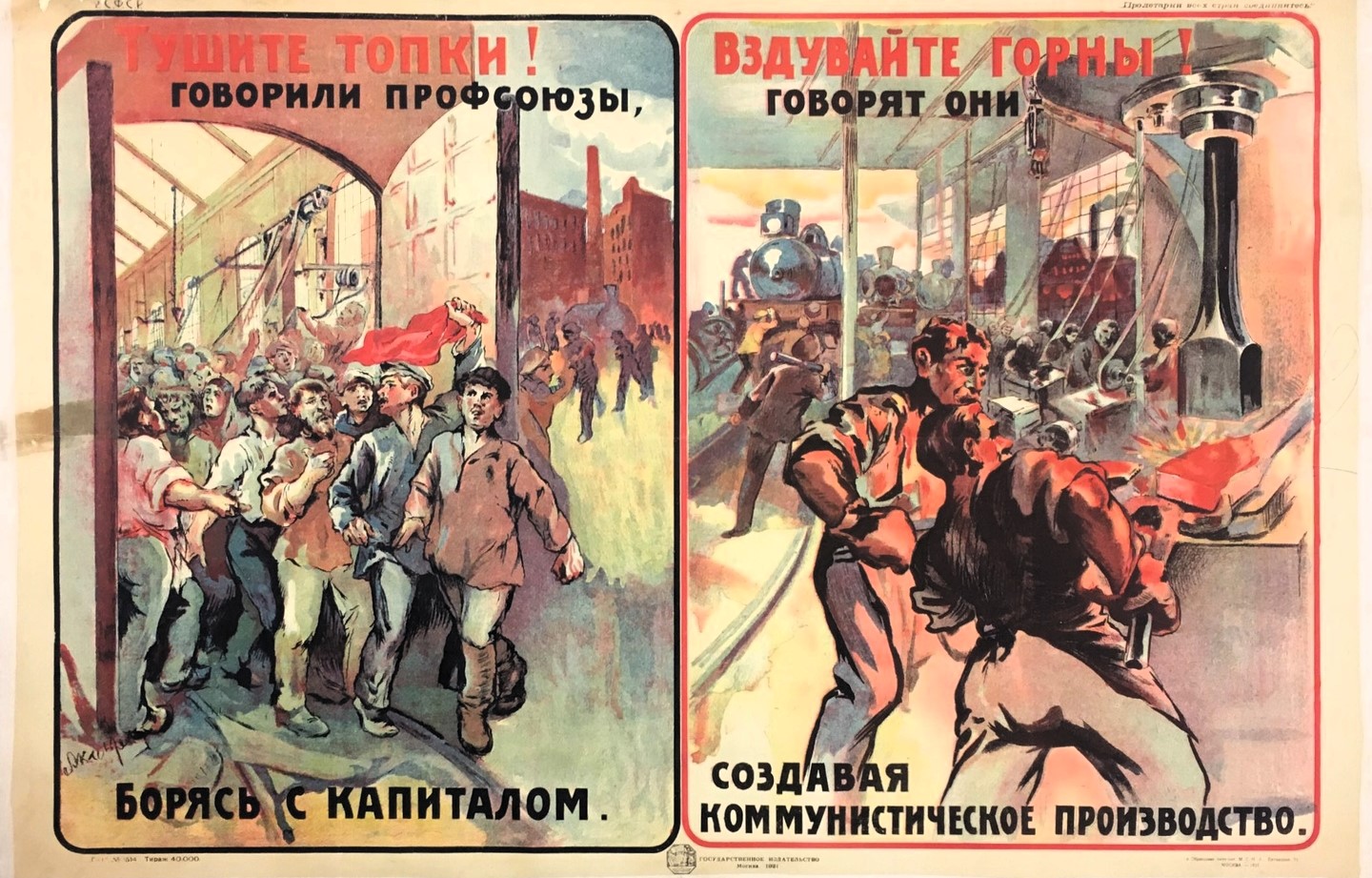
One of the most nuanced and fiercely fought debates of the Revolution in Lenin’s life was the role of the trade unions in the new proletarian state before and during the 10th Party Congress in 1921. The debate was largely held in public, with factory Soviets voting on the various positions. The conflict of the unions had huge implications for the Soviets as they moved away from War Communism to the New Economic Policy throughout 1921. After the debate, Lenin and others drafted these theses which were adopted in December, 1921.
‘The Russian Trade Unions in the Transition Period’ from International Press Correspondence. Vol. 2 Nos. 14 & 16. February 21 & 28, 1922.
The general session of the Central Executive Committee of the Russian Communist Party, which took place at the end of December 1921 discussed the part to be played by the trade-unions and their tasks in connection with the new economic policy. After a debate, a committee consisting of comrades Lenin, Rudsutak and Andreyev was appointed to formulate the theses on this question. These theses were then accepted by All-Russian Central Trade Union Federation and by the Central Executive Committee; they read as follows:
1. The New Economic Policy and its Problems.
The new economic policy brought about a series of essential changes in the situation of the proletariat and consequently also of the trade-unions. The greater part of the means of production in the industrial and transportation fields remains in the hands of the proletarian state. This circumstance together with the nationalization of the land proves that the new economic policy does not alter the nature of the workers’ government; the methods and forms of social reconstruction, however, are affected because they permit economic competition between the Socialism that is rising and the capitalism that is striving for its rebirth. This is done in order to satisfy the needs of the many millions of peasants through the market.
The changes to be effected in the form of the Socialist reconstruction are called for by the circumstance that in the entire policy of transition from Capitalism to Socialism, the Communist Party and the Soviet power are making a strategic retreat in order better to be able to resume the offensive against capitalism. Free trade and capital are now permitted under government regulation and are in the process of development; on the other hand the socialized government enterprises are now transferred to the basis of so-called economic calculation, i.e., they are placed upon a business basis, an act which, with the general cultural backwardness and exhaustion of the country, will inevitably cause the administration of these enterprises to come, in the consciousness of the masses, into more or less of a conflict with the workers employed there.
2. State Capitalism in the Proletarian State and the Trade Unions.
If the nature of the proletarian state is not to be altered, it can permit free trading and the developing of capitalism only. to a certain degree. Private trading and private capitalism must be regulated by the government (supervision, control prescribing of forms, etc.). The success of such control depends not only upon the state, but rather still more upon the degree of development of the proletariat and of the working masses in general, upon the cultural level attained, etc. But even if such government control should prove entirely successful, the conflict of class interests between capital and labor remains the same. That is why it is one of the main tasks of the trade-unions from now on to take up the complete defense of the class-interests of the proletariat in its struggle against capital. This problem must be given first place, and the trade-union machine must be correspondingly reconstructed, modified and supplemented. Arbitration boards and strike and benefit funds must be created.
3. The trade unions and the government enterprises which are to be transferred to the basis of the so-called economic calculation.
The transfer of the government enterprises to the basis of the so-called economic calculation is inevitable, and inseparable from the new economic policy. In the immediate future this type will necessarily be the dominating if not the only one. With the revival and development of free trade, this would actually mean the transferring of the government enterprises to a commercial basis to a considerable extent. This circumstance together with the imperative necessity of increased production and the realization of the profitable working of the government enterprises, inevitably lead to certain conflicts between the working masses and the management of the government enterprises in the question of working conditions. Hence, the trade-unions must take up the unconditional defense of proletarian interests in these socialized enterprises, and as far as possible strive to better the workers’ material conditions, and to carry on a constant correction of mistakes and exaggerations of the economic organs, insofar as they are be brought about by the bureaucratic degeneration of the government machine.
4.The essential difference between the proletarian class-struggle in a country which recognizes the private ownership of land and the means of production and in which the political power lies in the hands of the capitalist class, and the economic struggle of the proletariat in a country which does not recognize the private ownership of land and of the majority of large enterprises and in which the political power is in the hands of the proletariat.
As long as there are classes, the class-struggle is inevitable. During the transition period from Capitalism to Socialism, the existence of classes is inevitable, and the program of the Russian Communist Party is absolutely right when it says that we are taking the first steps in the transition from Capitalism to Socialism. That is why the Communist Party, the Soviet power and the trade-unions must openly recognize the existence of the economic struggle and its inevitability, at least as long as the electrification of the industries and agriculture is not carried out on a large scale, thus undermining the foundation of the petty-bourgeoisie and ending the rule of the market. On the other hand, it is clear that under the capitalist system the goal of the struggle is the destruction of the government machine and the overthrow of the power of the class-government. In the proletarian state of the transition type, however, such as ours is, the goal of every struggle of the working-class can only be the strengthening of the proletarian class power. Such conflicts will take the form of the struggle against the bureaucratic degeneration of the government, against its mistakes and weaknesses and against the capitalists who will strive to free themselves from the government’s control. That is why neither the Communists Party nor the Soviet power nor the trade-unions are to forget or to conceal from the workers the fact that the use of the strike as a weapon in the proletarian state can be explained and justified chiefly through the bureaucratic degeneration of the proletarian government, and through various remainders of the capitalist past in its institutions on the one hand, and by the political underdevelopment and cultural backwardness of the working masses on the other.
That is why it is the duty of the trade-unions to see that whenever there is friction or a conflict between single groups of the working-class and individual institutions and organs of the workers’ government, these conflicts and differences should be settled as quickly and painlessly as possible, with the greatest possible advantage to the workers in question, insofar as these advantages work no disadvantages to other groups of workers or are not detrimental to the development of the workers’ government and its economic management as a whole; for, only out of the development of these can a sound foundation for the material and spiritual welfare of the working-class be built. The only correct and sound as well as effective means of settling disputes and conflicts between single parts of the working-class and the organs of the workers’ government is the mediating participation of the trade-unions, which are to enter into negotiations with the economic organizations in question through their responsible organs, either on the basis of definitely formulated demands and proposals of both sides, or by appealing to the higher government authorities.
In cases where open conflicts arise in the government enterprises in the form of strikes, caused either by an error of the economic organs or by the backwardness of certain groups of workers and the instigation of counter-revolutionary elements, or even by a lack of judgment on the part of the trade-union organizations themselves, it is the task of the trade-unions to end the conflict quickly. They are to do this through measures which are to correspond to the nature of the trade-union work in question: doing away with the irregularities actually existing, granting the legal and feasible demands of the masses and by influencing them politically.
The most important and unfailing criterion for judging how correct and profitable the work of the trade-unions will be, is the degree to which they succeed in avoiding mass- conflicts in the government enterprises; this they are to accomplish through a preventive policy which is to be based upon an actual and complete guarding of the interests of the working masses and upon the timely prevention of all causes that may give rise to conflicts.
5. Return to Voluntary Membership in the Trade Unions.

The automatic enrolment of all wage-earning persons as members of the trade-unions to a certain degree gave rise to a bureaucratic degeneration of the trade-unions and caused a certain alienation of the latter from the great mass of members. That is why it is absolutely necessary to carry into practice the voluntary membership of the individual as well as of the collective joining of the unions. Under no circumstances are any political views to be prescribed for the members of the trade-unions. In this and in religions questions the trade-unions are to be nonpartisan. All that is to be asked of the trade-union members in a proletarian government is their understanding of comradely discipline, of the necessity of uniting forces for the defense of working-class interests and to aid the power of the workers, the Soviet Power. As far as the proletarian government is concerned, it must promote the trade-union solidarity of the workers in the legal as well as material sense. But no rights without duties are to exist in the trade-unions.
6. The Trade Unions and the Management of the State Enterprises.
After the conquest of the governmental power, the increase of production and of the productive capacity of society are the most important and far-reaching problems of the proletariat. This task which is very clearly presented in the program of the Russian Communist Party is intensified by the destruction, the famine and the general disorganization of the post- war period. That is why the swiftest possible reconstruction of the main industries is the fundamental prerequisite without which the liberation from the capitalist yoke and the victory of Socialism are not even to be thought of. But under the present conditions in Russia, such a reconstruction requires the absolute concentration of power in the hands of the factory management. These factory administrations which, according to general rules are based on the principle of individual responsibility, are to be able independently to determine the scale of wages, and the distribution of money, rations, working clothes and every other sort of provisions on the basis and within the limits of the collective contracts entered into with the trade-unions. For this purpose the management is to be given the greatest possible freedom of movement, and the actual success in the increase of productive capacity and in the profitableness of the work is to be carefully tested, and the most capable and expert administrators are to be chosen.
All direct interference by the by the trade-unions in the management of these entreprises must under these circumstances be considered as unmistakably detrimental and inadmissible.
It would be absolutely erroneous to interpret this undeniable truth in a manner that would infer the denial of trade-union participation in the socialist organization of industry and in the management of government enterprises. On the contrary, such participation in a clearly defined form is absolutely necessary.
7. The participation of and the part played by the trade-unions in the economic and government organs of the proletarian state.
The proletariat is the basic class of the state, which is undergoing the transition from capitalism to socialism. In a country where the small peasantry constitutes the overwhelming majority, the proletariat can only succeed in carrying out its task if it proceeds step by step in an unusually skillful and careful manner to promote and cement an alliance with this overwhelming majority of peasants.
The trade-unions must be the most alert and unwavering collaborators of the government, which in its turn is directed by the class-conscious vanguard of the working-class, the Communist Party, in all its political and economic activities. The trade- unions are to be not only schools of Communism in a general sense, but particularly schools for the management of the working masses, and later also for all the working population. Socialist industries (later also of Socialist agriculture), schools for the
Based upon this principle, the following fundamental forms of participation by the trade-unions in the economic and governmental organs of the proletarian state must be formulated for the next period.
a) The trade-unions are to participate in the formation of all trade-union and government organs which are connected with the economic organization, and they are to present a list of candidates together with a report of their previous activities and experiences. The decisions lie exclusively with the economic organs which also bear full responsibility for the work of the corresponding organizations. The economic organs on the other hand, shall take into consideration the description and recommendation of candidates as presented by the respective trade-unions.
b) One of the most important tasks of the trade-unions is to develop a trained corps of future administrators out of the working masses or employees in general. If we now possess a few score such administrators who are doing absolutely satisfactory work, and a few hundred others who are more or less efficient and capable, we shall soon be in need of hundreds of the first sort and of thousands of the second sort. In the future, the trade-unions must more carefully and completely than hitherto register all workers and peasants who are fit for such work and keep perfect control of their progress in the study of management.

c) It is necessary to increase the participation of the trade-unions in the elaboration of economic plans and programs of production and in the distribution of provision funds, as well as in the selection of industries that are to remain under government management and those which are to be let out or given out as concessions. This participation of the trade-unions takes place exclusively through their activities in the corresponding government organs. The trade-unions, however, shall have no direct control of production in the private and leased factories. Besides taking part in the entire work of cultural enlightenment and in the propaganda for increased production, the trade-unions are constantly to draw the working-class and the working masses in general more and more into the structure of the government economic system and to acquaint them with the whole cycle of economic life and industrial work, from the raw material up to the production of manufactured articles. In this manner the working masses are to get an ever-clearer and more concrete conception of the unified government plan of socialist economics, and of the practical interest of every worker and peasant in the realization of this plan.
d) The working out of wage-scales and provision-standards constitutes a most essential part of the work of the trade-unions in the development of Socialism. Working discipline is to be raised chiefly through the disciplinary courts, which are not to interfere with the functions of the civil courts and factory management.
8. Contact with the masses as a fundamental principle for all trade-union activities.
The most important and most fundamental prerequisite to any successful trade-union activity is contact with the masses, i.e., with the overwhelming majority of workers, and later also with the entire working-class. From the very base all the way to the top of the trade-union organization and its machine, a whole system of responsible comrades must be created, which is to be based on many years’ experience. It shall be compulsory for these comrades to live in the workers’ sphere, so that they may know it thoroughly and be ready at any moment and at every question faithfully to register the voice of the masses, their actual desires, needs and thoughts, stripped of all false idealizations, and to be able to determine the degree of their class-consciousness and the influence of this or that prejudice, and this or that remainder of the past. Through comradely behavior and by conscientiously satisfying the needs of the masses they should be able to win the unlimited confidence of these masses. One of the most serious dangers that threaten a Communist Party, which is numerically small and which manages an immense country as vanguard of the working-class during the transition period from capitalism to socialism, is the danger of being cut off from the masses, the danger that the vanguard may advance too far without first straightening out its front, that is without maintaining connections with the entire working army and with the overwhelming majority of workers and peasants. Just as the best-built factory, which may be equipped with first-class machines and have an excellent power supply, must inevitably come to a standstill when the transmission apparatus gets out of order, a catastrophe in our Socialist reconstruction is inevitable. when the transmission apparatus between the party and the masses, that is, the trade-unions, is poorly constructed or functions poorly. It is not sufficient merely to state this truth, to call attention to it and to establish it; it must be organically incorporated into the whole structure of the trade-unions and into their daily work.
9. The contradiction in the situation of the trade-unions under the dictatorship of the proletariat.
From the foregoing results a series of contradictions between the various functions of the trade-unions. On the one hand their form of activity is education and enlightenment and on the other, they cannot withdraw from the sharing of certain governmental powers while participating in certain compulsory activities. On the one hand their main task is the defense of the workers’ interests in the strictest sense of the word. On the other hand, being participators in the government and the builders of the economic system as a whole, they cannot avoid a certain pressure. On the one hand they must work in a very warlike manner, for, the dictatorship of the proletariat is the most embittered, stubborn and desperate class-war; on the other, specific military tactics are least applicable in the trade-unions.
On the one hand they must adapt themselves to the masses and adjust themselves to their level, and on the other, they are under no circumstances to yield an inch to the prejudices and backwardness of the masses, but to raise them to an ever higher level, etc. These contradictions are not accidental, nor are they to be eliminated in the course of many years to come. For, as long as there remains a trace of capitalism and of small-scale production, contradictions in the entire social system between these remainders and the new cells of Socialism are inevitable. The practical consequences are twofold. First, in order to be successful in their work it does not suffice for the trade-unions merely to understand their tasks correctly and to carry them out. Particular tact must be employed in the contact with the masses, a particular sense of understanding which is absolutely necessary in approaching the masses in every single, concrete case, in order to bring the masses with the minimum of friction upon an ever-higher level of cultural, economic and political development.
Second, it is certain, that the above-named contradictions must inevitably lead to conflicts, friction and disagreement. In such cases it will be absolutely necessary to resort to a court of higher instance, which is also to possess enough authority to settle all conflicts at once. Such a court is the Communist Party and the international union of all Communist Parties–the Communist International.
10. The trade-unions and the specialists.
The fundamental theses on this question are to be found in the program of the Russian Communist Party. But if we do not repeatedly point out the facts which determine the degree to which they may be applied in practical life, they will remain mere pieces of paper. Such facts have recently come up in connection with the killing of engineers by workers in socialized mines not only in the Ural region, but also in the Donetz coal basin. Another example is offered by the suicide of the chief engineer of the Moscow waterworks, W.W. Oldenburger, in connection with the impossible working-conditions brought about by the inefficient and inadmissible behavior of the Communist groups and the organs of the Soviet power. The All-Russian Central Executive Committee was compelled to hand over the investigation of this matter to the court.

It is more the Communist Party and the Soviet government as a whole, rather than the trade-unions, that are responsible for such occurrences. But now is no time for determining the degree of culpability; it is rather a question of definite political consequences. As long as the leading institutions, like the Communist Party, the Soviet government, and the trade-unions, do not succeed in seeing to it that those professional men and specialists who work conscientiously and out of love for their profession, are guarded by us like the pupils of our eyes even though in their ideology they may be far from Communists, there can there be no talk of any real success in the Socialist reconstruction. We must absolutely see to it that specialists, who form a special social group until we reach the highest point of development in Communist Society, should fare better under Socialism than under Capitalism, in the material as well as in the legal sense, in the comradely cooperation with the workers and peasants as well as in the sense of being satisfied with their own work, fully conscious of their social usefulness, and independent of the selfish interests of the capitalist class. No one will recognize such a system as well-managed if it does not practically and systematically provide for the all-around safety of its specialists, and if does not give preference to the best among them and protect their interests.
The trade-unions must not consider and perform this work (or the systematic participation in work of this kind) from the point of view of single jurisdictions or provinces, but rather from the viewpoint of labor and economic interests as a whole.
In the specialist question, the trade-unions have the difficult and strenuous task of putting pressure upon the masses daily, and of bringing about the correct mutual relationship between them and the professional men. It is only such work that can lead to real practical results.
11. The trade-unions and the petty-bourgeois influence upon the working class.
The trade-unions have a basis in reality only when they contain very large groups of non-partisan workers. The inevitable result is, particularly in a country with an overwhelming peasant majority, that the relative stubbornness against any political influence forms the superstructure of the capitalist remains and of small scale production. These are the petty-bourgeois influence; on the other hand those of the Menshevist, Social-Revolutionaries (the Russian parties of the Internationals 2 and 2 1⁄2). It is only in these directions that we still have a some- what considerable number of people who defend capitalism not out of selfish motives, but because they continue to believe in the classless significance of the “democracy”, “equality” and “freedom” they preach. The remainder (rarely is it a rebirth) of similar petty-bourgeois ideas in the trade-unions may be attributed exclusively to just such economic causes named above, and The not to the part played by individual groups or persons. Communist Party, the Soviet institutions and all Communists in the trade-unions must therefore pay very much more attention to the intellectual fight against petty-bourgeois influences and tendencies within the trade-unions, the more so, because the new economic policy must necessarily lead to a certain strengthening of capitalism. This capitalist gain must be counterbalanced by an intensified struggle against the petty-bourgeois influence.
International Press Correspondence, widely known as”Inprecorr” was published by the Executive Committee of the Communist International (ECCI) regularly in German and English, occasionally in many other languages, beginning in 1921 and lasting in English until 1938. Inprecorr’s role was to supply translated articles to the English-speaking press of the International from the Comintern’s different sections, as well as news and statements from the ECCI. Many ‘Daily Worker’ and ‘Communist’ articles originated in Inprecorr, and it also published articles by American comrades for use in other countries. It was published at least weekly, and often thrice weekly. Inprecorr is an invaluable English-language source on the history of the Communist International and its sections.
PDF of issue: Plough and hammer are brothers. Long live the inseparable union of a plow and a hammer, a plowman and a worker!
 Revolution's Newsstand