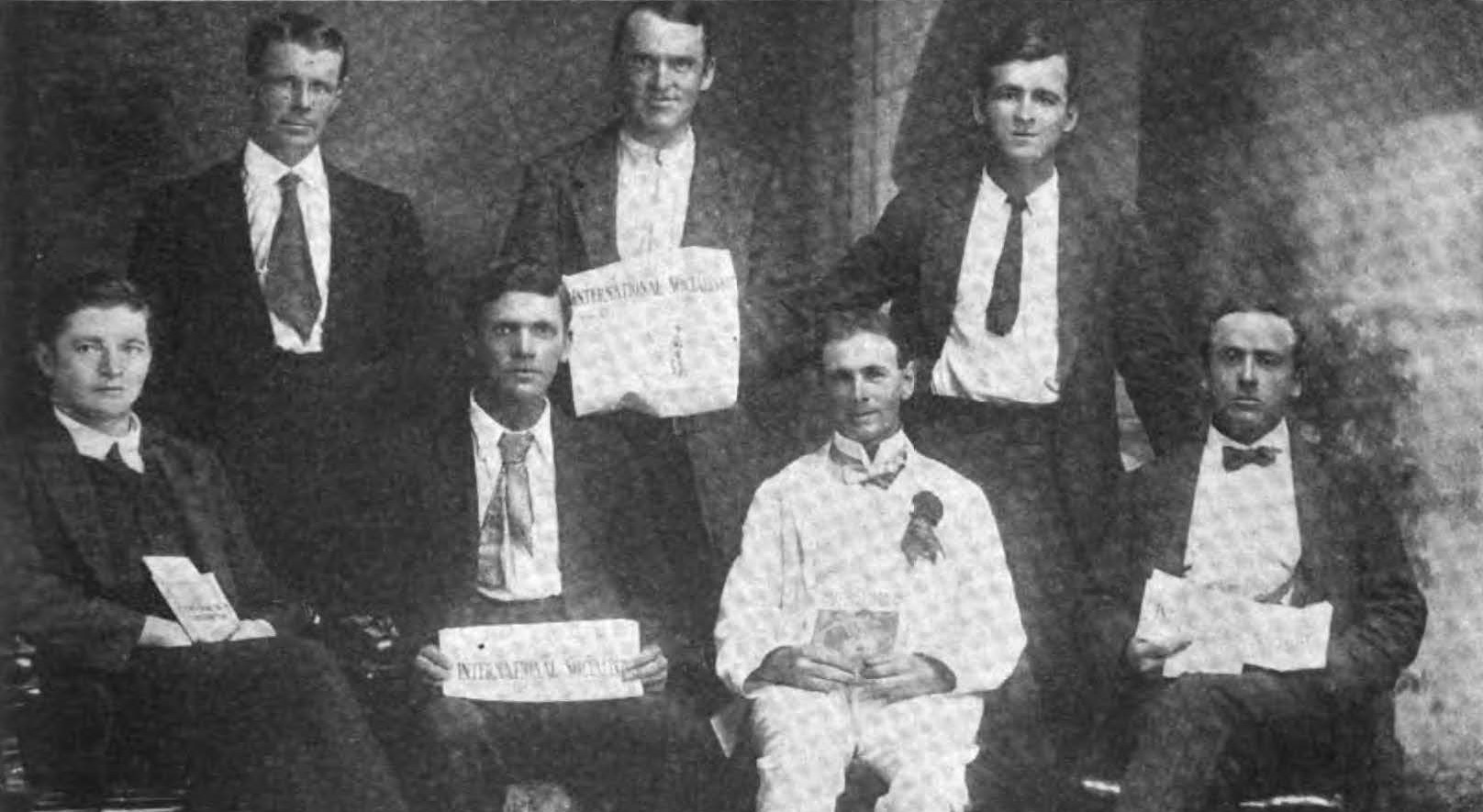
‘Free Speech in Australia’ by Gordon Brown from The International Socialist Review. Vol. 14. No. 12 June, 1914.
The Brisbane branch of the Australasian Socialist Party have been fighting more than eight months for the right to hold public meetings on a Sunday, a right which is extended to religious Organizations but denied to secular bodies. Last June our party held a meeting on a Sunday afternoon. We were allowed to proceed for half an hour; meanwhile the police were making inquiries as to the proper attitude to adopt towards us. Having ascertained that we were breaking the Sabbath and the LAW, five of us were arrested, kept in the watchhouse all night and next morning arraigned before a magistrate, who, after lecturing us on the possibilities which life offered if only we were good, sentenced us to twelve hours’ imprisonment. At our next branch meeting it was decided to exhaust every possible means to gain our end “constitutionally” before again defying ‘Loranorder.”
These “constitutional” efforts being of no avail, it was decided that we speak every Sunday, Cahill’s disapproval notwithstanding.
We picked out the busiest part of the city, a place where the Salvation Army are allowed to speak without let or hindrance. The first comrade (A.J. Brown) had not spoken more than five minutes before an excited “John Hop” demanded his permit, and, not receiving one, arrested him.
The next morning the magistrate informed our comrade that “if only he would express contrition he would be leniently dealt with.” Brown pointed out that he had done no wrong and would certainly speak again when released. Such defiance, coming from a member of the working class, was too much for the magistrate, who, more out of spleen than aught else, imposed a sentence of one month’s imprisonment.
The following week Com. Mandeno performed a peripatetic stunt, which for a space nonplussed the police. He walked up and down the street talking all the time. For fifteen minutes he got home with some good propaganda work. At last he was arrested. Two weeks were his portion. Similar tactics were pursued the following Sunday and for his share in the good work Com. Jenkins was allowed four weeks free board and lodging.
Our next fighter, George Thompson, taking a leaf from the suffragette’s book, chained himself to a veranda post and whilst the police were hammering away to release him Thompson addressed a huge crowd that gathered, drawn thither by the unusual sight of policemen working. Thompson was sentenced to a month. On his arrival at Boggs road jail he refused to eat and for nine days no food was consumed by him. A Dr. Macdonald was called in and declared our comrade to be insane. Thompson, although a sane man, now lies in Goodna Asylum, and if the authorities have their way he will never again be free.
The struggle went on. Every Sunday, in some part of the city, one of us would hold a meeting. On one occasion a comrade chained himself to the bough of a tree and from his arboreal rostrum addressed a huge crowd of people (and policemen). Several spoke from the awnings which cover our (?) sidewalks. For this offense we were not arrested straightaway, but were proceeded against by summons. This allowed us to speak for several hours and good use was made of the time. Once or twice we have spoken without injury to ourselves. This has been accomplished by the speakers quietly disappearing for a while. The authorities do not trouble to bring them back. `
A few weeks ago Coms. Bessant and O’Brien hired a couple of horses, dressed themselves like Russian Cossacks and paraded down the main street of Brisbane. On each side of the horses was a placard bearing a couplet. One piece ran:
“Sorry to say can’t speak to today; Cahill won’t let me.”
The police formed a cordon at the top of the street and succeeded in capturing one horseman. The other, wheeling rapidly to the left and passing round a block, again con- fronted the defenders of “Loranorder.” Riding straight towards the “Johns” Com. O’Brien once more eluded his would-be capturers, who are still looking for him.
Our persistent efforts in speaking despite the jailings have won the admiration of many who were at first bitterly opposed to us. The craft unions for many months hung back, but they are with us today and have organized a “Free Speech” demonstration, which is to take place next Saturday. Nine months ago we were an unknown, struggling quantity. Today, throughout the length and breadth of Queensland, people are inquiring what Socialism and Industrial Unionism mean. For this splendid ad we must thank the thick-skulled authorities who, by their autocratic and stone-age actions, have been the means of advancing our cause and spreading the light to an extent only otherwise obtained by several years of constant effort.
Those of us who have suffered the pain of close confinement in King George’s palatial boarding house make light of it. We are recompensed by the knowledge that ‘out of evil cometh good.” Then, again, have we not enjoyed moments of sweet revenge, especially when fooling the old fogies who dispense capitalistic justice from the bench? It would take too long to tell of the many methods resorted to in order to delay business of the court, of the thousand and of questions we asked of witnesses brought to court who knew not the language and needed an interpreter, etc. All this was done until one magistrate swore he would try no more “Free Speech” cases. In conclusion, the comrades here in Brisbane de- sire to send fraternal greetings to the fighters in the common cause over the water and to inform them that even in this land of eternal sunshine, despite its boast of being in the van of the freedom loving and freedom practicing countries of the world, the same struggle is on —the struggle between Plute and Pleb—for industrial control and ownership of the wealth- producing forces of the country. With best wishes for the continued success of the Review. GORDON BROWN, Organizer, Brisbane Branch, A.S.P.
The International Socialist Review (ISR) was published monthly in Chicago from 1900 until 1918 by Charles H. Kerr and critically loyal to the Socialist Party of America. It is one of the essential publications in U.S. left history. During the editorship of A.M. Simons it was largely theoretical and moderate. In 1908, Charles H. Kerr took over as editor with strong influence from Mary E Marcy. The magazine became the foremost proponent of the SP’s left wing growing to tens of thousands of subscribers. It remained revolutionary in outlook and anti-militarist during World War One. It liberally used photographs and images, with news, theory, arts and organizing in its pages. It articles, reports and essays are an invaluable record of the U.S. class struggle and the development of Marxism in the decades before the Soviet experience. It was closed down in government repression in 1918.
PDF of full issue: https://www.marxists.org/history/usa/pubs/isr/v14n12-jun-1914-ISR-gog-ocr.pdf
 Revolution's Newsstand