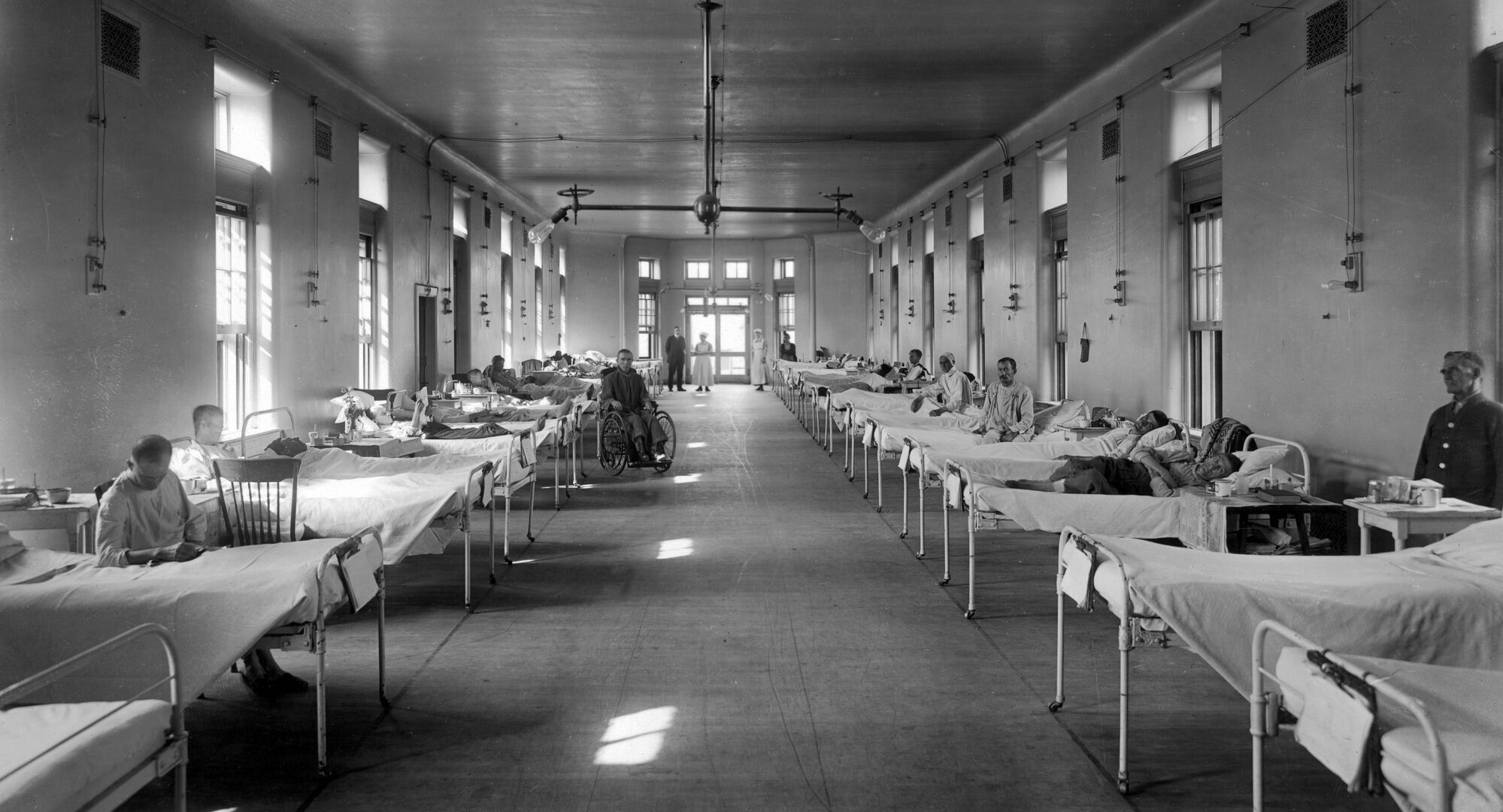
Consumption, T.B., the White Plague; tuberculosis was a constant in the life of our class and killed untold millions of workers, felling many revolutionaries in the process.
‘T.B.—The Workers’ Plague’ from Health and Hygiene. Vol. 1 No. 4. July, 1935.
CONSUMPTION, the “White Plague.” Pulmonary Tuberculosis it is called in more learned circles. But the workers know it as “T.B.” They know what the disease does to them. They know its horrible dread and the toll it takes from their ranks. T.B. is their disease. A system whose chief concern is private wealth, rather than health, has created conditions which impose upon the working class the chief burden of most diseases. And, in doing so, this system has virtually conspired with the germs that cause T.B. In terms of economic oppression, in terms of bad housing, in terms of working conditions, in terms of food and lack of food, in terms of lack of facilities for curing the disease or checking it–in a hundred other ways, the system has said to the tubercle bacillus, the T.B. germ: “You are reserved for workers; they shall be And tubercle bacillus your chief victims.” has observed this injunction because it could not help do otherwise.
Approximately 1,000,000 persons are suffering from pulmonary tuberculosis in the United States alone. Who are most of them? The vast majority of these sufferers are workers. No other disease is as selective as to the class of people it attacks as is consumption. One hundred thousand men, women and children die every year from the “White Plague.” Who are these victms? Most of them are members of the working class. No wonder that, among physicians and other scientists who are willing to look at facts squarely, the term has been changed from the hypocritically sentimental name of “White Plague” to “Workers’ Plague.”
Sentimental “welfare” workers weep over the “White Plague.” But they speak of its existence in “slums” without identifying such sections with any particular class of the population. Where the workers are the chief concern of their own state, the situation is different–as this article shows.
IN THE past few months, articles have appeared in the press and in some health bulletins, boasting about the proportionate decrease of victims of tuberculosis since the beginning of this century. The writers are not naive enough to assume that this fall is due to improved economic conditions. They also know that falling standards of living can have a disastrous effect on the health of the people. They admit they are at a loss to explain the paradox. On the one hand they must admit that living standards are going down. On the other hand, they see a proportionate decrease in the number of T.B. victims.
The more realistic public health officials know, also, that credit for the proportionate decrease of tuberculosis cannot be given to such organizations as the Red Cross or the National Tuberculosis Association. The activities of these organizations are practically confined to two tasks. About all they do is raise money and carry on “educational” campaigns. These campaigns do accomplish one purpose: They spread the cheerful word that good food, rest, and sunshine, will promote health! As if those who have no food, those who work under terrific speed-up and stretch-out those who live in hovels and alleys, those who work in the factories and shops and mines where T.B. lurks constantly–as if these could use information of that kind. Practically nothing is said about how to obtain that food, how to obtain the conditions that would really reduce T.B. The “educational” campaigns peddle the obvious facts. But by so doing, the associations accomplish something else: They raise funds, to pay officers, to carry on campaigns to raise funds.
Well, if these associations do not do anything real about tuberculosis, how about the Public Health services of the Federal government and the various states. Certainly the government and the states have the money and the forces. Read the American press and the various health bulletins issued all over the country, and you are told that America has a magnificent Public Health service. The fact, is, however, that our Public Health service is a disgrace, and has become steadily worse in recent years.
Since 1930, local appropriations for public health have gone down on an average of 20 per cent. And this in a time when hunger and malnutrition are the lot of so many millions of workers, employed and unemployed. Once in a while, the very authorities in the government tell of conditions as they really are. Dr. J.N. Baker, State Director of Public Health in Alabama, made such an incriminating statement last August. Said Dr. Baker:
“The effects of insufficient food will not be mirrored in the mortality statistics of the next few years, but a decade hence. The incriminating finger of a faulty diet for the growing child may point the way to the true cause of many physical breakdowns in adult life, foremost among which is likely to be tuberculosis.”
All over the country, where statistics are avail- able at all, the figures show that malnutrition, particularly in children, has risen rapidly during the depression years. These children, as well as their fathers and mothers in the trades where working conditions are directly responsible for T.B.–these are the candidates for the fine work of tubercle bacillus.
The “Proud” South
NO COUNTRY can boast of its health system when it is true that there are only 528 full-time health services in 3,000 counties in the United States. Approximately one-sixth of the counties in the United States have such health services on a full-time basis. In the entire South, there are only two sanitariums recognized by the American Medical Association as fit for the training of a physician in the treatment of tuberculosis. How frightfully inadequate these two sanitariums are for the entire South is indicated by the fact that one small state like Connecticut has two sanitariums answering these requirements of the American Medical Association.
Public Health service in the South deserves a special damning. But it is enough to point out now that there are very few diagnostic health stations in the South where workers can go for the X-ray and laboratory examinations which must be given for the diagnosis of pulmonary tuberculosis.
It is obvious, therefore, that our Public Health service is not responsible for the improvement in the incidence of tuberculosis. Nor can the skill of our physicians be given the credit. For that skill can be bought by fewer and fewer people today. Workers cannot report to physicians until the disease is well advanced, because they are unable to afford to pay the average fees, excepting for emergency.
Public Health experts, therefore, have fallen back on the assumption that something has happened to the germ that causes tuberculosis, to the tubercle bacillus. They feel that perhaps the germ has lost some of its virulence (or power), so that it causes disease in fewer people and in a less deadly fashion. There is some evidence in favor of this assumption. In the past fifty years, several epidemic diseases have been less severe and have had proportionately fewer victims. This may be due to a change in the character of the bacteria responsible for the diseases, and it is possible that the same thing has happened to the germ of tuberculosis.
The people of this country should not be lulled into a false sense of security, however. In the next few years, we may see not only a net increase in the number of tuberculosis sufferers, but also a proportionate increase. Already there are ominous signs. Dr. Baker’s warning is one of those signs. Another danger signal was raised by the State Director of Health in Illinois, a year ago. He announced that, in his state, those counties which had the largest number of persons on relief also had the highest death rate from three major diseases: Tuberculosis, typhoid fever, and diphtheria.
Negro and White
EVEN NOW, the Negro people, and those white people who live in so-called “slum” areas–neighborhoods where poverty is rife–have a much higher death rate from tuberculosis than do people living under better conditions. At some of the younger ages, the death rates for Negro children are from five times to nine times as high as the death rates for white children.
In the Harlem section of New York City, where the vast majority of residents are Negroes, and where most of those residents are on relief, the death rate from tuberculosis is about five times as great as the death rate for this disease in the city as a whole.
And to show that the white people who are poor are no better off than the Negroes who are poor, let us see what the death rate from tuberculosis is on the Lower West Side section of New York City. There, the Negroes are in the minority. But the whites living there have at least two things in common with the Harlem Negroes. Most of them are also on relief. Their death rate from tuberculosis is also nearly five times as high as the death rate average from this disease for the whole city.
The highest death rates from tuberculosis are found among those workers who are employed in the dusty trades. These include workers in ore mills and mines, in the building industries, among grinders and buffers, stone workers, pottery workers, employees of foundries or other metal industries, and workers in the clay and glass industries. Another group having a high death rate from tuberculosis includes longshoremen, freight handlers, bakers, furniture and wood workers, and textile workers. One occupation that has long been recognized as having a specially high incidence of tuberculosis is the trade of tobacco worker.
But is the lack of adequate health facilities alone responsible for the many deaths from tuberculosis? No, that is not true. On the other hand, are the unhealthful conditions of living and working alone responsible for the sacrifices of so many hundreds of thousands of workers to the “Workers’ Plague”? No, that is also only part of the picture. The complete picture must include the altering of both these conditions. Both must be tackled by the workers.
Josephine Roche, Assistant Secretary of the Treasury, in addressing a group of nurses and social workers recently, admitted that with adequate health facilities alone, without any change in the living and working conditions of the workers, the death rate from tuberculosis could be reduced by half.
In the magazine “Public Housing Progress” (for November 15, 1934), we read:
“One-third of our countrymen are living in scattered hovels, in clustered shacks, in the squalid flats of congested centers, with common toilets, with dark rooms on fetid shafts. We know from statistics that they are easy victims of chronic ailment and devastating disease.”
This is “the richest country in the world.” And yet, in 64 cities in the United States, there are 600,000 homes that have neither bathtub nor shower. There are nearly 450,000 homes in these cities that have no indoor water-closet.
Change in living conditions must go hand in hand with increase in facilities for health.
But, the worker will ask, what now? What shall I do meanwhile, before these conditions are altered through the organized efforts of the workers?
Meanwhile, the worker needs adequate and complete advice about this disease (as well as about others). He needs to know exactly what this germ, the tubercle bacillus, is. He must know about the symptoms of pulmonary tuberculosis, so he can recognize them in as early a stage as possible. He needs to know about how to get proper, truthful and complete diagnosis of his case. And last, he needs to know what are the treatments possible, where he can get them, what are the quackeries that might be peddled to him under the guise of cure. Some of these points will be discussed in future issues of HEALTH AND HYGIENE.
Health was the precursor to Health and Hygiene and the creation of Dr. Paul Luttinger. Only three issues were published before Health and Hygiene was published monthly under the direction of the Communist Party USA’s ‘Daily Worker Medical Advisory Board Panel’ in New York City between 1934 and 1939. An invaluable resource for those interested in the history history of medicine, occupational health and safety, advertising, socialized health, etc.
PDF of full issue: https://www.marxists.org/history/usa/pubs/health/v1n4-jul-1935-health-hygiene.pdf
 Revolution's Newsstand