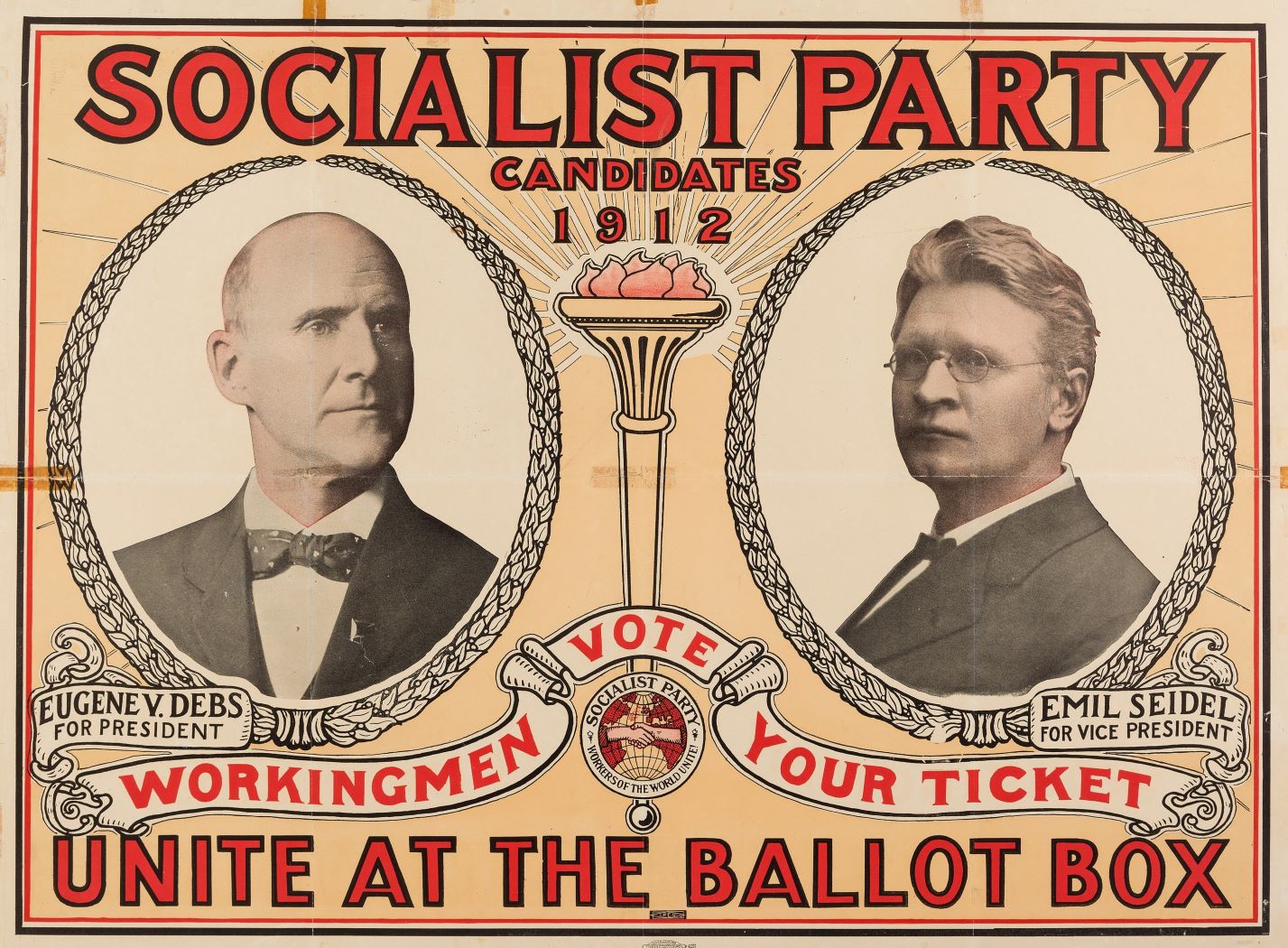
Likely written by its editor Charles H. Kerr, an initial analysis from ISR of the historic 1912 Presidential election which saw Debs and the Socialist Party score close to a million votes or 6% of those cast nationally. Never again would the Left do as well in a national election.
‘The Election’ from International Socialist Review. Vol. 13 No. 6. December, 1912.
From all returns available at present, the outlook indicates that the Socialist party has more than doubled its vote of 1908 and is well on the way toward the million mark.
Never in the history of the Socialist movement in America have we had so much cause for rejoicing over the results of our regular four year showing.
This year it would seem that all things had combined to make clear the Socialist vote. Every Democrat rallied to his party. The Bull Moosers appropriated almost every reform plank from the Socialist platform so that every workingman or woman who hoped for anything from reforms doubtless joined the Progressive constituency.
In spite of this, over 900,000 proletarians felt that their only hope lay in revolution and voted the straight Socialist ticket.
Fortunately for us the Progressive party is here to stay. It will steadily drain off the muddle-headed members of the dying middle class advocates of government ownership, leaving only a band of class conscious Socialists who can be depended upon.
For perhaps the first time in years the Socialist party vote was a clean-cut Socialist vote. For this reason there is everywhere rejoicing in the Socialist camps. We have put ourselves to the test and emerged with our Army augmented over 100 per cent.
The most encouraging signs in the election returns are the splendid showings made in the great industrial centers where the Socialist party has thrown all its strength into the daily warfare of the workers against the capitalist class. Compared to the districts where votes alone were made the ultimate goal, the industrial regions have outgeneraled them in almost every state.
In Allegheny County, where the Socialists are on the job everyday fighting side by side with other workingmen, pointing out new methods of Class warfare in. every strike and lending a hand in every struggle, the vote increased over THREE HUNDRED per cent the Socialists polling being over 26,000-votes in. the greatest industrial center in the-world.
Pennsylvania, as a state, almost trebled her vote, showing that where the economic conflict is keen, the working class recognizes its natural place is in the political field and joins the Socialist party.
Ohio, the second industrial state in the union, shows an almost equal gain in percentage. There, too, the members of the Socialist party and the workers in the industries are becoming more and more the same.
Their able candidate for governor, Comrade C.E. Ruthenberg, was on the road continuously from July 1st to election day and we doubt if any other candidate can beat his record for number of successful meetings held.
Comrades Margaret Prevey of Akron and State Organizer Beery, besides an army of state speakers, covered the ground thoroughly.
The State Office supplied speakers with clean cut scientific literature and with the exception of one or two localities the campaign was an educational one throughout rather than a vote-catching proposition. In Columbus there was a loss of several thousand votes.
In Texas, Arkansas and Oklahoma, where the party has steadfastly fought the battles of the farm laborers and farm renters, the splendid returns were no surprise to anybody, while West Virginia leaped into a militant position through the influx of the striking miners who have learned to apply Socialism to every-day life during their struggles with the mine owners.
Nevada and Montana showed remarkable gains. Here, too, the workers, becoming conscious of their class on the industrial field, reflect their interests on the political side. Authoritative reports are not yet in from Washington, Oregon, and California, but returns to date show solid increases in the straight vote.
Kansas sends her first Socialist representatives to the assembly and Illinois elected three assemblymen. Six were reelected in Wisconsin.
In many cases, Socialists failed of reelection to office. But we are not discouraged. We are learning that only a strong, class conscious movement on the industrial field can show class consciousness on the political field and insure permanent victory to the Socialist party.
Indiana, Kansas, Wisconsin and Minnesota polled nearly 200,000 votes. New York with a showing of 75,000 nearly doubled her vote of 1908. Michigan, New Jersey and Missouri made great gains.
The New York Sunday Call credits Washington with a 300 per cent increase and Oregon with 400 per cent. Wyoming, Utah and Idaho show a steady class conscious gain of nearly 100 per cent.
Florida was a surprise with 15,000 votes and the Louisiana vote of 7,500 was nearly ten times the vote of 1908. As the South develops industrially we may confidently expect to see the working class express itself politically in the Socialist party, when the struggle grows keen as it has in Louisiana.
In writing upon the results in Massachusetts, the New York Call says:
The vote is awful, yet the party organization seems to be sound. It seems to have grown. Twenty years ago, for Harry Robbinson, it polled very nearly as many votes as it did for Roland D. Sawyer. The first Presidential candidate, Simon W. Wing, came from that state: It was among the earliest to swing into line as an organized state. It was the first to elect a Socialist mayor. It had Chase in Haverhill and Coulter in Brockton. Yet this year it makes the poorest showing of all the states. Its vote has dropped. Its organization seems to have been of no avail. In the big industrial towns from North Adams to the Cape it has lost votes. It has nothing to show for its work, in case any work was done.
It is quite evident that there has not been conducted an adequate campaign. The Comrades seem to be unable to do anything themselves and seem to be unwilling to allow anybody else to do anything. They neglected utterly the opportunity they had in the mill towns. They were entirely buffaloed by the presence in Boston of a cardinal: They have done no organization work in Fall River, New Bedford, Worcester or Springfield. The vote shows that they have failed all along the line. Why?
The Leader, the weekly organ of the Socialists of this city, gives the Massachusetts vote for Debs in the recent election as 12,435. Roland D. Sawyer, candidate for governor, received 10,500 votes.
There are still a few small towns missing, but returns from them will not alter the totals twenty votes either way.
The Debs vote of 1908 was 10,781 and that cast for governor two years ago, 14,444.
The Socialist vote in Massachusetts falls below the 3 per cent required by law to keep it alive—thus officially it has ceased to exist, but according to statements made by party officials today, the Bay State capitalists will soon find that it is very much alive.
New Mexico: O.W. Skorkowsky, Socialist Committeeman, of Portales, reports 200 Socialist votes in Rosevelt county and says: “We have a hard row to hoe down here, but we mean to fight to the finish. We have a local that is doing great work and we are making new Socialists fast.”
California: J. Dahlstrom of Contra Costa county, running the second time for the Assembly, received 1,241 votes against 609 last time. The Debs vote was 1,297, nearly three times the 1908 vote. The women cast about one-third the vote. They are going to be a big help in the future Socialist movement.
Pennsylvania: L.W. Woods has that Debs polled 1,464 votes in Erie, the county giving us 1,972 votes. The county vote for 1908 was 1,037. Congratulations to Erie.

The International Socialist Review (ISR) was published monthly in Chicago from 1900 until 1918 by Charles H. Kerr and critically loyal to the Socialist Party of America. It is one of the essential publications in U.S. left history. During the editorship of A.M. Simons it was largely theoretical and moderate. In 1908, Charles H. Kerr took over as editor with strong influence from Mary E Marcy. The magazine became the foremost proponent of the SP’s left wing growing to tens of thousands of subscribers. It remained revolutionary in outlook and anti-militarist during World War One. It liberally used photographs and images, with news, theory, arts and organizing in its pages. It articles, reports and essays are an invaluable record of the U.S. class struggle and the development of Marxism in the decades before the Soviet experience. It was closed down in government repression in 1918.
PDF of full issue: https://www.marxists.org/history/usa/pubs/isr/v13n06-dec-1912-ISR-gog-ocr.pdf
 Revolution's Newsstand