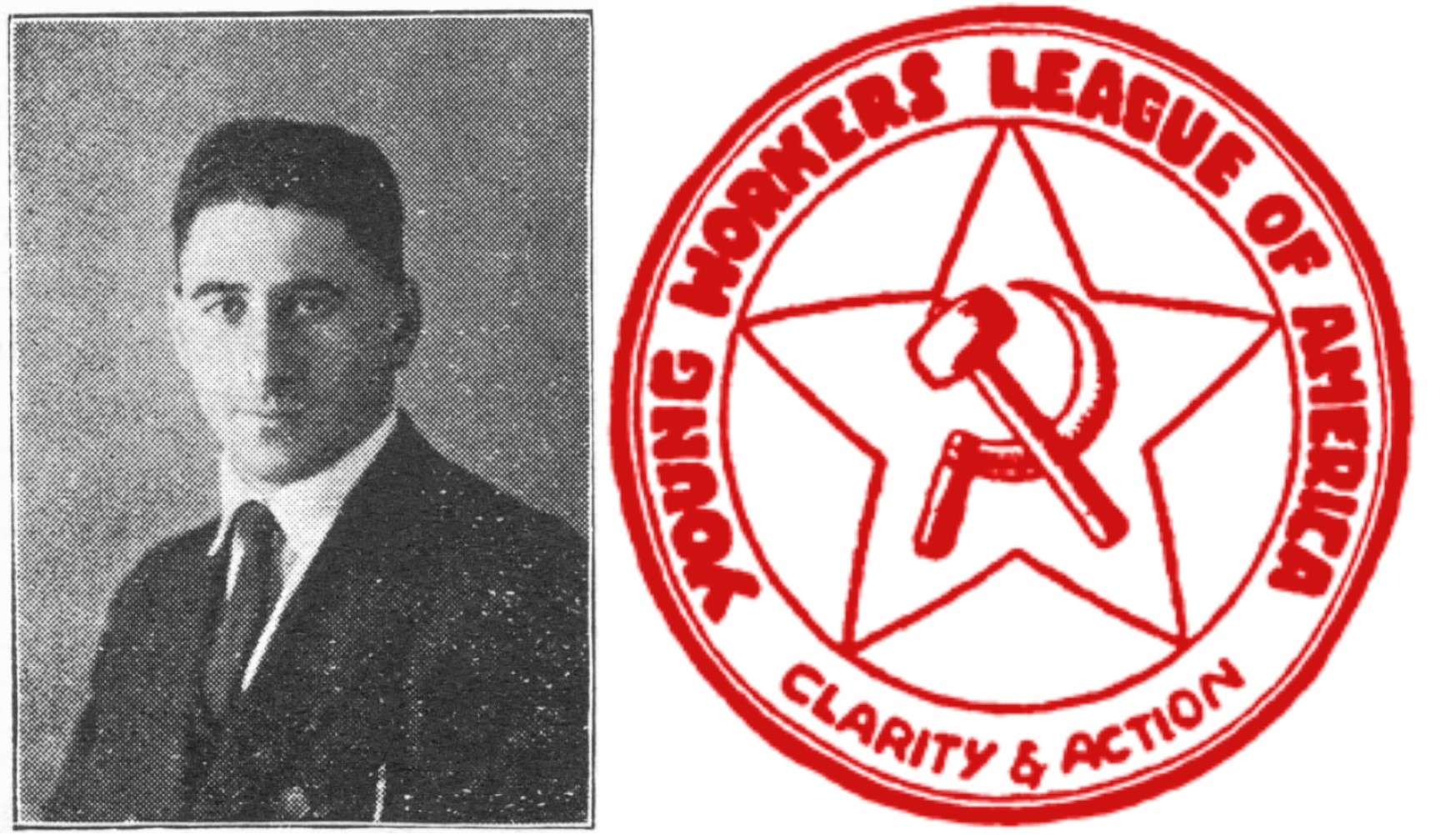
Martin Abern was active for years in the Socialist Party’s Young People’s Socialist League when he and others left in 1919 to found the Communist movement. Abern served as National Secretary of the Young Workers League from 1922-24, and was elected to the Central Executive Committee of the Communist Party, its youngest member at the time. As such he was delegate to, and member of the Executive of, Young Communist International. In this invaluable early report on the League, Abern travels to different locals, from large cities to rural hamlets, to assess their strengths and weaknesses.
‘The Leagues I Visited’ by Martin Abern from Young Worker. Vol. 2 No. 5. May, 1923.
WHAT sort of membership has the Young Workers League? What can be expected of the League comrades? What are their difficulties and their needs? While on tour, I have found the composition of the various branches to be very widely varied in age, in understanding, in abilities, in enthusiasm and willingness to work, etc. If we know clearly what our Leagues are, we can better plan the work for them. It may interest the Leagues to know more of one another; it may, it should help each in their work. Hence here is a brief review of the Leagues I visited.
In Neffs, Ohio, the first town I visited, I found an enthusiastic group of young workers in the League–25 of them, all miners and members of the United Mine Workers of America. Their knowledge is limited, but they are ready to learn and are learning. With the unrest among the miners daily increasing, the field is very fertile for us. miner-comrades live quite a distance from each other, scattered among the houses and shacks on the hills; hence it is not so easy for them to meet, but they do so all right. Our official organ, “The Young Worker,” with simpler articles, with shop and mine stories, would aid very much here.
In another mining town of a couple of thousand, in Daisytown, Pa. is a League membership which is very young–girls and boys thirteen, fourteen to sixteen years of age. The population is widely spread. These young comrades, to be successful at all in reaching the other young people in the vicinity, must combine closely their educational work with social diversion. As in the larger cities, few of the varieties for amusement, recreation, social pleasure (real and alleged) are to be found in these isolated communities. Thus the bourgeois organizations–church, clubs, etc.–will, with their cheap, tawdry attractions, pull the young people to them unless we, along with our education, present to them better and cleaner social diversions. Our literature has been somewhat too heavy and academic for this and some other Leagues. One of the League girls asked, “Won’t you give us more stories and pictures in the ‘Young Worker;’ then we can get many more to read it?” Daisytown League is progressing nicely. With more class struggle stories, simply illustrated, this and other Leagues with similar needs will travel the road toward communism more swiftly and surely.
Nearby Daisytown, Pa. is a steel town, Monessen, Pa. The age average of the League members is about sixteen. Most of the members work in the steel mills and glass factories (the girl comrades mainly in the latter). There are also a number of elementary school students. Thoroly alive, the League is conducting a study class regularly (it has taken up a number of communist pamphlets,–the League program, “Youth Under Americanism,” etc.) and is disposing of much literature. The Workers Party lends all the help it can. The Monessen and Daisytown comrades often co-operate in staging programs, such as Liebknecht Day, etc. Athletic activity, provided thru the gymnasium in the Finnish Hall, keeps the comrades together easily. Its persistent educational work is most encouraging, providing the intellectual basis for holding the comrades to- gether and for getting work done. Communist understanding is increasing here and elsewhere–and that is the strongest chain, the best weapon for our work and aims.
The seventy comrades in the Pittsburg League are chiefly Jewish-speaking. There is not a riper field for the Young Workers League than the Pittsburgh District. The miners in the coke region are strongly aroused over the recent labor developments (the Fayette County Lockout, the miners betrayal by Lewis, the Militant Miners Movement). Thousands of young workers employed in the steel mills in Pittsburg, McKeesport, Homestead and other nearby towns, are overly ripe for radical direction and education. The Pittsburg League needs but to approach these workers to interest them. The Pittsburg League has many capable and clear comrades. They have to push themselves more among the English-speaking workers and their organization will boom. A larger English branch formed by uniting the small English branch with the English-speaking comrades in the language branch will be the first step in that direction. Many of the comrades are attending evening schools, learning English, etc. This is all very well. In the League educational work, the work must take on a definite working class color, and all tendencies to “broaden” communist education by general and variety-house education, must be eliminated. However, the latter danger is slight. The League members are mostly in the clothing trades, organized either in the International Ladies Garment Workers or the Amalgamated Clothing Workers Union. District Organizer Merrick of the Workers Party knows the value of a young workers movement and can be depended upon to lend much support to the League.
In our League in Bethlehem, Pa. the comrades are now taking a better interest in the Branch and becoming more active in the educational work. There had been a tendency to let one or two comrades do all the work. This is bad; for such an organization will never be an independent, self-reliant League, but one learning for support on someone else. This support gone, the organization breaks to pieces. But the Bethlehem comrades are now rousing themselves. The Bethlehem comrades have a hard row to make. Nearly all of them are employed for twelve hours a day in the steel mills of Schwab Time is hence very limited for League work. An athletic and soccer club has been a fine medium for keeping the comrades together. All of them do not speak English yet, but the Hungarian W.P. paper, “Elore,” publishes much youth material. The members thus keep informed.
There is no League in Reading, Pa., one of the few strong- holds of the yellow socialists. I found a few young people, however, interested in the Young Workers League. With cooperation from the Workers Party a League can be formed which will do good work. The best material is to be found among the steel hands. A few telephone operators are in absolute accord with the policy and aims of the Young Workers League, but because they work nights, it is very difficult for them to meet.
Our membership in Philadelphia consists chiefly of members of the Amalgamated Clothing Workers and the International Ladies Clothing Workers. Not enough effort by any means has been made to reach the American and English-speaking young workers. Further, many comrades in the Italian and Jewish branches could speak English, and yet they remained in the League branches. An English branch is being formed of these comrades, and this will better enable them to attract English-speaking young workers. In the small cities, most of the comrades are inexperienced in conducting meetings, in carrying on the educational work. But in the larger cities, there are always to be found a number of comrades with experience and understanding. In Philadelphia there are a number of comrades who are able to take hold of class work and to speak at meetings of all kinds. Here and in other of the larger cities, there has been an unnecessary modesty in these matters. Let Illustrations that appeared in the first City Bulletin gotten out by the Young Workers them but plunge into the work. There will be mistakes and difficulties, but those will remedy themselves. There is no sound reason why Philadelphia cannot have within six months five hundred members.
New York can put over big, anything it seriously tries to. The League has the numbers and comrades who can do things. Many League activities shoved onto a few comrades can easily be performed by any of the members. The Executive must divide up the work more. A willingness to learn from other League’s experiences is more needed. Its members too often have a New York outlook upon the national League activities. This defect can be remedied if the branches will undertake a study of the problems of the young workers in other cities, the prevailing industries, organization of the workers, etc. The New York membership is vastly made up of workers in all lines. Discussing the daily problems of these workers and analysing them in Marxian fashion will result in a greater interest in the members and outsiders. Proceeding to study and to analyse the local and national concrete problems and events in the worker’s lives, is the best way to obtain clarity in thought and action–in practice and theory. Wide reading and study are positive essentials, but is likely that a desire to go more deeply into communist literature will be better stimulated in our membership thru first taking up matters which affect or are close to them in their daily lives. New York has lately awakened to its possibilities and its capabilities. Work will boom there. A prophecy–a thousand members in six months.
The comrades in Providence, R.I. have been together for years. It is a capable and clear membership. But new blood is absolutely essential. In the textile mills are to be found many who will join the Young Workers League if properly appealed to Hitherto, the Providence comrades have made too abstract and general an appeal to young workers. More concrete demands and information to the Providence youth, a bit more social activity together with their excellent (but limited) educational work, will gain recruits and develop in the League a fine virility and strength.
It has taken a number of months for the Boston, Mass. League to get started. It is at last firmly established and organizationally sound. In the past three months it has been much more active. A number of the energetic comrades have been very busy in the Workers Party, but it has now become possible for them to devote the major portion of their time to the League. A stronger English branch is needed and many comrades must come into it from the foreign-speaking branches. From the boot and shoe workers, from the textile mills and metal works can also be gotten an English-speaking element. I found many talents and capabilities among the Boston comrades, but they have unfortunately kept these to themselves instead of putting them to the use of the League. The local and district organizations of the Workers Party are strongly supporting the Young Workers Leagues. Children’s groups can be organized here for whom a children’s paper will be necessary. Considering the high capabilities of many of the Boston comrades and the general clarity of the membership, their activities have not been up to the mark. But now there is a greater enthusiasm in the ranks. Boston should, and I believe will, rank within a few months among the three or four liveliest Leagues in the country.
No League in Lawrence.
There is no League in Lawrence, Mass. There are those sympathetic, indeed wholly to the Young Workers League. The Lawrence labor movement has been badly divided for years. A fine fighting spirit, but its strength has been too often scattered. Any new body trying to make its way is naturally not greeted with much enthusiasm. The few supporters of the League are working quietly; when they find the time ripe, they will organize a League branch.
The branch in Fitchburg, Mass. is but three months old. A much-needed study class is now being organized. But there is a Sunday school class for those under fourteen. The League has a gymnasium club which competes with the Gardner, Maynard and other comrades in nearby towns. Most important, tho, if the Workers Party branch will provide teachers for the League (arrangements for this were being made when I was there) a faster and healthier growth will soon be noticeable.
Some very much alive young comrades are in the Maynard, Mass. League. There is also a YPSL here, but its activities are purely social and athletic. The Young Workers League, however, carries on regularly its educational work and hence is attracting the more thoughtful and intelligent young workers into its ranks.
A willing-to-work group is the Gardner, Mass. League. The comrades, Finnish-speaking, are swiftly learning English and hope soon to be able to conduct their meetings in English. Class work has not gone forward as swiftly as desired because of lack of a teacher. The Workers Party branch will hereafter arrange for this.
Norwood Just Organized.
A branch has recently been organized in Norwood, Mass. I did not get an opportunity to visit this branch. The young comrades, thirty-five of them, got together and organized themselves. This League evidently has initiative, it does not wait for someone else to tell it what to do. Norwood will march forward.
In Worcester, Mass. I found nearly all the comrades in the League to be less than fourteen years of age, but a more enthusiastic group, I did not see. At the meeting they threw questions of every description at me. A junior group organization has fine possibilities. It will grow swiftly. The local comrades in charge deal with most simple thoughts and ideas and the children grasp them readily. A magazine for children–that’s what they want. The minds of these and other children are fertile and wide awake. Our next National convention must get definitely started with a Children’s organization. Else are we indeed guilty of neglect in worker’s education.
An English branch has just been formed in Newark, N.J. At my meeting there, a thoro discussion took place relative to the merits of the Young Workers League and the IYPSL. When it was over, the majority of the YPSL joined the newly-formed Young Workers League branch. Some new comrades enlisted and now we have a live League.
There is no League in Rochester, N. ., but comrades have organized a nucleus toward that end. There is fine material here a number of comrades with a good knowledge of communism. Some are sympathetic toward the Workers Party, others toward the Proletarian Party, others apart form any organization. Should the communist element unite, then there will be the means of building up one of the first Leagues in the country. Meanwhile, our comrades distribute the “Young Worker,” our Program, etc.
Need Simplified “Young Worker.”
A League has been in existence in Buffalo since the inception of the National Young Workers League. It was composed of Finnish young workers and students. These, together with other English-speaking comrades, have transformed their branch into an English branch. Educational work had been sporadic. Now a class has been started which carries on systematic education. A gymnasium club, a dramatic club serve to unify the activities. Here too, a simplified “Young Worker” and a children’s paper is essential. The comrades are very confident of increasing their membership and activity. The formation of the English branch will push forward their plans.
As yet there is no League branch in Erie, Pa. The Workers Party comrades promise, however, to try to organize a branch.
Perhaps a Junior group will be organized first.
The composition of the Chicago League is excellent–in the vast majority, workers in all kinds of industries. A willingness to learn is there. A functionaries (teachers) class must and will be organized to teach comrades how to conduct meetings, take care of the various official positions, etc. It is this lack of functionaries which has hindered Chicago more than anything else. This is not the fault of the local officials. More training is needed. The educational work, too, has not gone forward as swiftly as it might because of lack of teachers, and because of insufficient system and coordination. The Chicago League is working hard to remedy this and hopes soon to have their educational work once again in full swing. A League such as Chicago’s is capable of thoroly hauling itself over, remedying mistakes swiftly and then making fine headway. Sport and dramatic activity is springing up.
New Blood in Minneapolis.
The League in Minneapolis, Minn. is reorganizing itself and getting new blood. Its weakness has been that a few capable comrades never got outside of their own little group and among other workers. Minneapolis has one of the most progressive labor movements in America. A Young Workers League can grow if the hair-splitting over nothings can be done away with. Some younger comrades have recently been added. Appeal is now being made to the sons and daughters of union men. The League is pointing out the possible role of scab, capitalist dupe, etc. of these young people if their parents permit them to receive false capitalist education. Come into the Young Workers League for working class education, is the appeal to these young.
Enthusiastic youngsters, nearly all students, are to be found in the St. Paul, Minn, Branch. A study class, this League’s immediate and most important need, has been organized. These young comrades help the local Workers Party very much with the distribution and sale of literature. They like the “Young Worker” and will be able to increase its sales among other workers as the “Young Worker” becomes more popular and easy in form and content. The St. Paul League is one of our youngest, but is starting out well.
Children’s Paper Needed.
From my trip I find, among other things, the need of a children’s magazine. I believe, too, that it could be made self-supporting very quickly. Further, there is no doubt that the thousands of children of the older comrades can be organized into Children’s sections. They are very eager and alive and their minds are open and plastic. The “Young Worker” must undergo-it is already changing–a great simplification. Stories and illustrations in greater number. In the educational classes, discussion and analysis of the economic and political problems affecting them directly in their daily lives–interest in deeper and wider fields can thus be stimulated.
The young workers of America-in and for the Young Workers League. They are ours if we are determined to reach and to educate them. With simplicity and clarity, in the language of the masses, of the young workers, let us speak to them and they will come to us. Let us talk to the young workers of their daily problems in the shop, school. mill, factory and analyze these problems and events from the Marxian viewpoint. The young workers are ready to listen to the message of the Young Workers League. Enthusiasm, strong sentiments, ability to learn and to thing-the young workers have these much-needed qualities. The Young Workers League will educate them in the principles of the class struggle and of communism. For that is what the Young Workers League-a school for militant education of the youth. Then, like one man, we will march forward toward our goal–a society of non-exploited producers, of free men and women–communism.
The Young Worker was produced by the Young Workers League of America beginning in 1922. The name of the Workers Party youth league followed the name of the adult party, changing to the Young Workers (Communist) League when the Workers Party became the Workers (Communist) Party in 1926. The journal was published monthly in Chicago and continued until 1927. Editors included Oliver Carlson, Martin Abern, Max Schachtman, Nat Kaplan, and Harry Gannes.
For PDF of full issue: https://www.marxists.org/history/usa/pubs/youngworker/v2n3-mar-1923-yw-G-LB.pdf
 Revolution's Newsstand