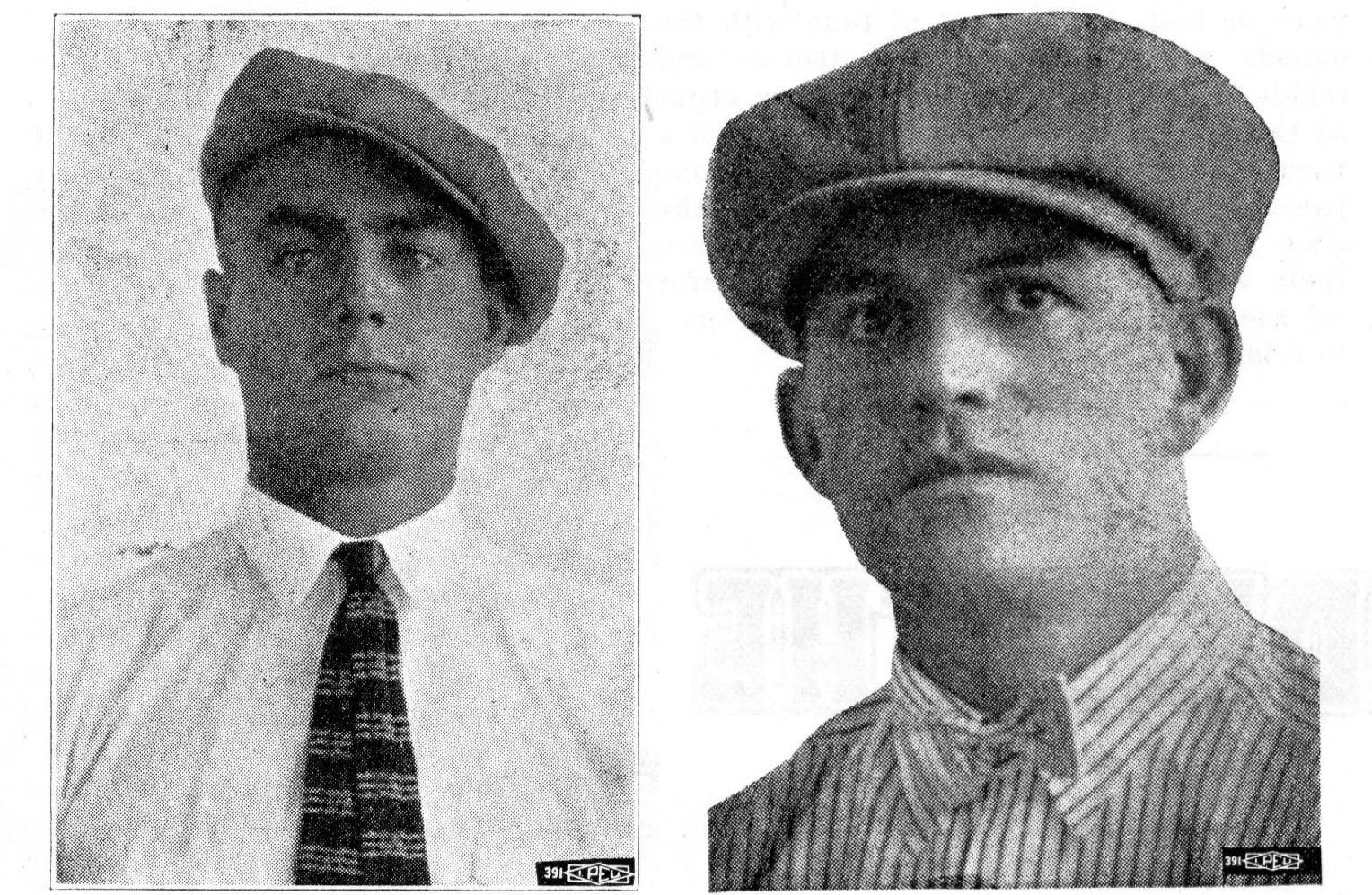
Peter J. Dirks and Danny Fallon, members of the International Seamen’s Union who refused to name names and were abandoned by their union, write to the Labor Defender from behind bars and their case, conditions, and appreciation of the I.L.D.
‘From Two Wobbly Seamen’ from International Labor Defender. Vol. 1 No. 7. July, 1926.
From Peter J. Dirks
Maine State Prison, Thomaston, Maine, May 26th, 1926.
Mr. James P. Cannon, Executive Secretary,
Dear Comrades:
I received the Labor Defender, and your welcome letter. I was just finishing reading the Defender when your letter arrived. Well dear comrade you wish to know how I came to be in prison, and to be frank with my comrades, it was such a double crossing double-cross that I even hate to think back that far.
I was a member of the International Seamen’s Union of America, and we went on a strike May 1st, 1921, because, we would not stand for a cut in wages, and lose our working conditions…
The lawyers made a trade with the county attorney, (that’s what the Chamber of Commerce calls them) and we did not stand trial, in so doing the lawyers could save the state of Maine $50,000, with the result that we all took a ride to the states prison, because we were asking for decent wages, and fair working conditions…
Comrade Fallon was first offered 12 to 17 years, and I was offered 10 to 15 years, which we both refused, then they cut Fallon to 10 years, and he still refused, and the state of Maine lawyers came back again with 3 1/2 to 7 years for Fallon, and Comrade Dirks, myself, received instead of 1 to 2 years I was handed 5 to 7 years. Comrade Thomas Harty had his sentence raised from 5 to 10, to read 7 to 11 years. One comrade was stricken blind and was paralyzed two weeks after coming to prison, and laid in a pig pen of a hospital 3 full years, and when his time was up, he was thrown into the poor house…
Dear comrades, my five years are nearly served and I am hoping to get out on parole in June. I am not complaining of my time, it is just the way that the grand working man outfit treated its members. The Chamber of Commerce were invited to the Court House to hear and see the workers sent to prison. My wife and child in Holland were without bread.
Dear comrades, you may think my letter radical, but this is only an outline of what took place. I have no friends in this country, and I am paid the sum of 25 cents per month for my prison labor, so you can guess how much I will go out with in my pockets after serving five years for standing loyal with my fellow comrades, but, my spirits are still good, and in my heart I would do the same thing over again. I have learned the English language, and I have learned plenty about American laws, and who and what it is that controls them.
Comrades, if my letter is not too long I would like to see it published in the Defender.
There is a warrant for my deportation awaiting me upon my release from here.
Well, dear comrade, I will close my long letter hoping this finds you and all comrades enjoying the best of health, and still defending some poor worker that has the grit to rebel, and demand an even break, even if he is in prison.
With hearty regards to all I.L.D. comrades, and my utmost wishes to those behind the bars that they may be out in the fresh air once more.
I remain fraternally yours,
Peter John Dirks.
From Danny Fallon
Maine State Prison Thomaston, Maine, May 27th, 1926.
Mr. James P. Cannon, Chicago, Illinois.
Dear Friend and Comrades:
Your welcome letter of the 24th inst, received with enclosed check, for which we send our hearty thanks for the spirit in which it is sent. My Comrade Dirks wrote you a few days ago about our trial and the “justice” of the sentences given us in Portland, Maine, in 1921.
I am serving seven years for refusing to tell on a fellow comrade, and the International Seamen’s Union has ditched us just like snakes in the grass after we came to prison. I am here behind bars of steel and walls of stone, and if I have prevented some fellow comrade from working for slave wages I am more than doubly repaid for my sacrifice…
I was forced to work in the woodshop on entering the prison and I had never seen the inside of a shop before in my life. I asked to be changed on account of stomach trouble, but being a so-called kicker and a radical I was refused, with the result that I was badly crippled and lost the first and second fingers on my left hand, and had the third one mangled, this was due to the state’s lack of placing a guard in front of the machine that I was working on, bearing in mind that there is a law in this state to the effect that all machines must be equipped with safety devices. I came into this institution an able-bodied man, but alas I will leave here a cripple for life. The prison commissioners have told me more than once that I was entitled to compensation, but, try and get it, and you know the old saying that two big dogs never fight, they only growl at each other.
When I was committed to this institution they a3ked me what kind of work I did on the outside. I told them that I was a marine fireman, so they undertook to make a harness maker out of me, while working on this job I had plenty of time to do some thinking, with the result that they took me out of the harness shop, and tried to make a wheelwright out of me, from there I was placed in the paint shop, then in turn tried out on the wood pile as a wood chopper, from that to a stationery fireman, then a waiter, in fact they tried to make me a jack of all trades and master of none. At present I am going out to work on the road with the road builders, and let me tell you that not in all the shops that I worked was I ever approached by a shop committee and asked to show my union card. Ha, ha, because union cards do not count in prison, it is your number that does.
In prisons they give out bibles and prayer books to read but comrades I get the joy of life reading the “Defender” it is truth, while the other leaflets are pretty fairy tales for little children. I read where B. Vanzetti is facing the chair, and still shouts out to all comrades that he, Vanzetti, will die as he lived “a radical.” That is man’s courage and I am sorry that there is not a million others with the same spirit. To die for a principle in my estimation is an “honor,” and not a disgrace as the public press would like you to believe.
Peter J. Dirks, my comrade, is to be deported out of this country, because if they were all like Dirks, why the world would be a workingman’s country. We enjoyed reading “Big Bill Haywood’s” message. Though far away, his spirit is still with the workers. Well, dear fellow comrades, my idea of “Happiness” would be to see a general strike in this country, and if the American Federation of Labor had done its duty, at the same time as the English trade unions done, the demands made would have been granted inside of eight hours. The English miners were sold out by those finks they call the “nobility.” A king is a joker to me, and not fit to command people to say “Long Live the King.”
Well dear comrades, I just thought that I would write you a few lines expressing to you my views on prison and labor. I read where the mill owners have refused to even meet a committee of workers to settle the dispute. So, comrades and loyal friends, I will close my letter by wishing you success and happiness, and best regards to all workers and comrades who are serving time.
Fraternally yours,
Danny Fallon,
Box A, Thomaston, Me.
Labor Defender was published monthly from 1926 until 1937 by the International Labor Defense (ILD), a Workers Party of America, and later Communist Party-led, non-partisan defense organization founded by James Cannon and William Haywood while in Moscow, 1925 to support prisoners of the class war, victims of racism and imperialism, and the struggle against fascism. It included, poetry, letters from prisoners, and was heavily illustrated with photos, images, and cartoons. Labor Defender was the central organ of the Scottsboro and Sacco and Vanzetti defense campaigns. Editors included T. J. O’ Flaherty, Max Shactman, Karl Reeve, J. Louis Engdahl, William L. Patterson, Sasha Small, and Sender Garlin.
PDF of full issue: https://www.marxists.org/history/usa/pubs/labordefender/1926/v01n07-jul-1926-ORIG-LD.pdf
 Revolution's Newsstand