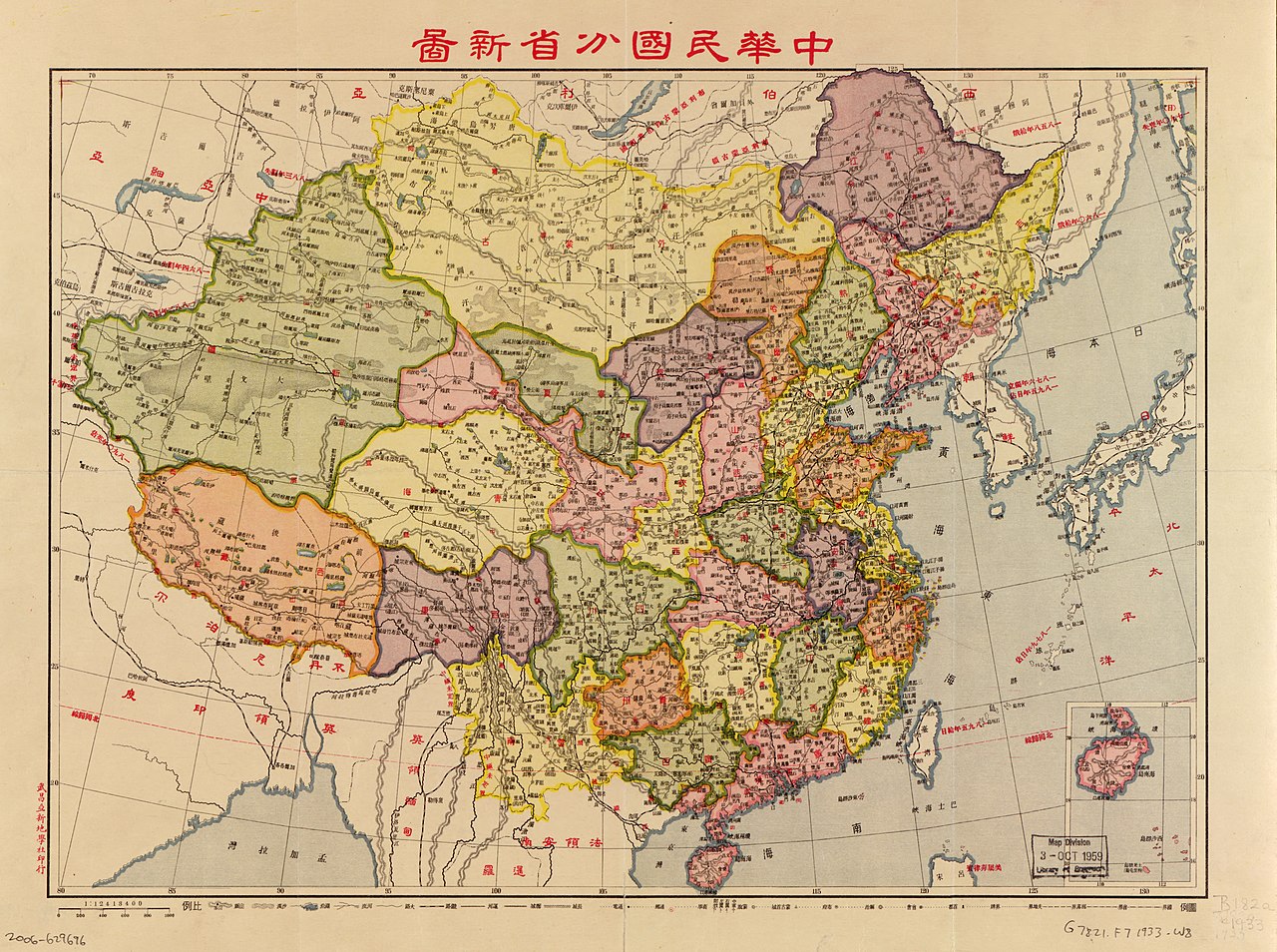
The Constitution of Soviet China adopted at the First All-Chinese Soviet Congress on November 7, 1931 in Ruijin, the capital of the Jiangxi Soviet. The original Soviets developed in a number of non-contiguous, largely rural locations after the defeats of 1927 in the major cities. These Soviets would be the target of the Kuomintang’s ‘encirclement campaigns’ over the next years leading to the retreat now known as the Long March in 1934. The first constitution of the People’s Republic of China was in 1954, with the current one passed in 1982.
‘The Constitution of the Chinese Soviet Republic’ from International Press Correspondence. Vol. 12 No. 2. January 14, 1932.
The first All-Chinese Soviet Congress proclaims before the toiling masses of China and of the whole world the fundamental lines of the Constitution of the Chinese Soviet Republic. It regards the realisation of this Constitution in the whole of China as its fundamental task.
In the existing Soviet districts a commencement has already been made to carry out these tasks. But the first All-Chinese Soviet Congress recognises that it will be possible to carry out completely the Constitution only after the final overthrow of the ruling power of imperialism and of the Kuomintang in the whole of China, only after the setting up of the rule of the All-Chinese Soviet Republic, and that the Constitution can then be made more concrete and become a complete Constitution of the whole Soviet Republic. The first All-Chinese Soviet Congress calls upon the workers, peasants and the toiling masses of the whole of China, to fight under the leadership of the Provisional government of the Soviet Republic of China for their central tasks, the realisation of the following Constitution:
1. The task of the Constitution of the Chinese Soviet Republic consists in securing the political power of the democratic dictatorship of the proletariat and of the peasantry in the Chinese Soviet districts and its final establishment in the whole of China. The aim of the democratic dictatorship of the proletariat and of the peasantry is to destroy all the remnants of feudalism, to destroy the position of power of the imperialist Powers in China, to unite the whole country, systematically to restrict the development of capitalism, to develop State economy, to promote the class-consciousness and the organisation of the proletariat, and to rally the broad masses of the poor peasants round the proletariat until the going over to the dictatorship of the proletariat.
2. The Chinese Soviet Power is establishing a State based on the democratic dictatorship of the workers and peasants. The whole power of the Soviets belongs to the workers, peasants, members of the Red Army and all the toiling masses. Under the Soviet Power, all workers, peasants, members of the Red Army and all the toiling masses of the population have the right to elect delegates, who exercise political power. On the other hand, the capitalists, landowners, gentry, militarists, reactionary officials, big peasants, monks and nuns, all exploiting and counter-revolutionary elements are deprived of the right to elect delegates or to share in political power, and they enjoy no political liberties.
3. The supreme power of the Chinese Soviet Republic is the Congress of the All-Chinese Workers, Peasants’ and Soldiers’ deputies (Soviets). After the conclusion of the Congress, the highest organ of power is the provisional Central Executive Committee of the All-Chinese Soviets, to which is subordinated the Peoples Commissariat for the conducting of government affairs, the promulgation of laws, directions and decisions.
4. In the Soviet districts the workers, peasants, members of the Red Army and all the working masses as well as the members of their families, without distinction of sex, race (Chinese, Manchus, Mongols, Mohammedans, Tibetans etc. and the Koreans, Formosans and Indo-Chinese living in China), and religion are all equal in the eyes of the Soviet law; they are all citizens of the Soviet Republic. In order that the workers, peasants, soldiers and the working population shall be able really to exercise their own political power, the following Soviet election laws have been issued: All the above-named Soviet citizens over the age of 16 enjoy the right to vote and to be elected; they directly elect the delegates to all Congresses of the workers, peasants and soldiers deputies (Soviets), which discuss and decide all national and local affairs.
The election units are: for workers, the factories and works; for the peasants, artisans and city poor, the residential area. The Soviet delegates elected in these election units have a definite term of office; they conduct the work of the commissions and various organisations of the village or town Soviets. The delegates must, within a definite period, give reports to their electors. The electors have the right at any time to replace their elected representative and to hold a new election. As only the proletariat can lead the broad masses of the peasants and toilers on the path of Socialism, the Chinese Soviet power grants to the proletariat the privilege at elections to elect a relatively greater number of delegates.
5. The aim of the Soviet Power is to improve fundamentally the standard of life of the working class, to enact laws for the protection of labour, to carry out the eight-hour day, to fix a minimum wage, to establish social insurance and State benefit for the unemployed, to assure the right to control production by the workers.
6. Another aim of the Chinese Soviet power is to destroy feudalism, fundamentally to improve the standard of living of the peasants, to issue a law for the confiscation of the land of the big landowners and its distribution among the poor and middle peasants, and finally to carry out the nationalisation of the land.
7. Further, the Chinese Soviet Power has set itself the aim to safeguard the interests of the workers and peasants, to restrict the development of capitalism, to free the working masses from exploitation by capitalism and to lead them on the path to the socialist society. It proclaims the abolition of all the onerous taxes and duties imposed by the former counter-revolutionary rulers and the introduction of a uniform progressive tax. It energetically suppresses all secret plans for disintegration and sabotage by the native and foreign capitalists; it conducts an economic policy advantageous to the working and peasant masses and leading to Socialism.

8. The Chinese Soviet Power pursues the aim of freeing China completely from the yoke of imperialism. It proclaims the complete independence of the Chinese people, the non-recognition of the political and economic privileges of the imperialists in China, the annulment of all unequal treaties concluded between the counter-revolutionary Chinese governments and the imperialists and the cancellation of the foreign loans. The imperialists are forbidden to maintain land, naval and air forces in the Soviet districts; the concession and leased areas of the imperialists in China are unconditionally taken back. The banks, customs houses, railways, shipping companies, mines, factories etc., in the hands of the imperialists are nationalised. For the time being the foreign employers are permitted to conclude a rent agreement for various undertakings and to continue production on condition that they submit completely to the laws of the Soviet government.
9. The Chinese Soviet power exerts all its forces to develop and to secure the workers and peasants revolution until its final victory throughout the whole of China. It declares that participation in the revolutionary class struggle is the duty of all the working masses. Military service will at first be voluntary, but will then be made compulsory. Only the workers, peasants and toiling peasants have the right to possess weapons and to take part in the class war; all counter-revolutionary exploiting elements, however, are completely disarmed.
10. The Chinese Soviet power secures to the workers, peasants and toilers freedom of speech, press, meeting and combination; it is against the democracy of the bourgeoisie and landowners, but for the democracy of the workers and peasants. It destroys the economic and political power of the bourgeoisie and the landowners in order to abolish all oppression of the freedom of the workers and peasants existing during the rule of reaction. The printing works (newspaper offices, publishing houses etc.), meeting halls, and other institutions are placed at the disposal of the workers, peasants and toiling masses for their use in order to secure the material basis for the realisation of these liberties. On the other hand, all propaganda and activity of the reactionaries and all political freedom of the exploiters are absolutely suppressed under the Soviet Power.
11. The Chinese Soviet power secures the complete emancipation of women, the recognition of their freedom in regard to marriage, the carrying out of various measures for the protection of women in order gradually to create the material basis for the emancipation of women from the slavery of house work and to render possible their participation in social, economic, political and cultural life.
12. The Chinese Soviet power secures to the workers, peasants and toiling masses the right to training and education. The realisation of universal free schooling for the broad masses is commenced so far as the exigencies of the class struggle permit. The Chinese Soviet power will secure the protection of all rights of the youth and draw the youth elements into the political and cultural life in order to develop the new forces of society.
13. The Chinese Soviet power secures the real freedom of religious belief of the workers, peasants and the toiling population. On the basis of separation of religion from the State, no protection or financial aid whatever is granted by the Soviet State to religion. All Soviet citizens have freedom to conduct anti-religious propaganda. The existence of religious institutions of the imperialists can be allowed only on condition that they are subjected to Soviet laws.
14. The Chinese Soviet power recognises the right to self-determination of the national minorities in China and the right of the smaller peoples to separate from China and to form independent States. Thus, for instance, the Mongols, the Mohammedans, Tibetans, Koreans etc. living in China have the complete right to decide for themselves whether they wish to join the Chinese Soviet Union or to separate from China and to form a State of their own. The Chinese Soviet power will aid these national minorities and small nations with all its power to free themselves from the yoke of the imperialists, Kuomintang, militarists, princes, priests, lamas, etc. and to obtain complete independence. Further, the Soviet Power will encourage the culture and language of these peoples.
15. The Chinese Soviet power grants the right to stay in the Soviet territory to all working Chinese and foreign revolutionary fighters who are persecuted on account of their revolutionary activity, and supports them in recuperating their fighting forces.
16. The Chinese Soviet Power allows all toiling foreigners living in the Soviet districts to enjoy all the rights and privileges granted by the Soviet law.
17. The Chinese Soviet power declares that it stands in a common revolutionary front with the world proletariat and the oppressed peoples, and that it regards the country of the dictatorship of the proletariat, the Soviet Union, as its firm ally.
International Press Correspondence, widely known as”Inprecorr” was published by the Executive Committee of the Communist International (ECCI) regularly in German and English, occasionally in many other languages, beginning in 1921 and lasting in English until 1938. Inprecorr’s role was to supply translated articles to the English-speaking press of the International from the Comintern’s different sections, as well as news and statements from the ECCI. Many ‘Daily Worker’ and ‘Communist’ articles originated in Inprecorr, and it also published articles by American comrades for use in other countries. It was published at least weekly, and often thrice weekly.
PDF of full issue: https://www.marxists.org/history/international/comintern/inprecor/1932/v12n02-jan-14-1932-Inprecor-op.pdf
 Revolution's Newsstand