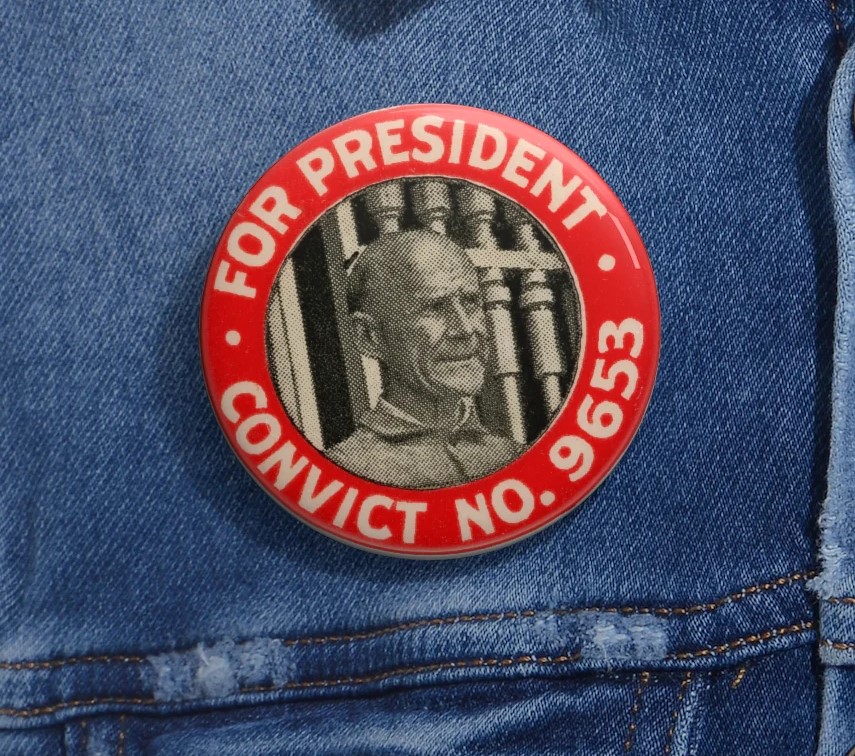
Isaac Hourwich crunches the numbers from the 1920 general election in an analysis of why the Socialist Party campaign, which saw Debs run from prison, fell short of many expectations.
‘The Socialist Vote at the Last Election’ by Isaac A. Hourwich from Socialist Review. Vol. 10 No. 2. April-May, 1921.
THE total vote of Eugene V. Debs last November fell far short of the general expectations which were shared by friend and foe alike. The aggregate vote was only 15,000 in excess of the total number polled by him in 1912, the increase being short of 2 per cent., whereas the total number of voters of all the parties was 77 per cent. in excess of the aggregate Presidential vote of 1912.
It has been sought to account for this failure by the schism within the ranks of the Socialist Party organization. On closer examination of the figures, however, it appears that this explanation does not account for the slump in the socialist vote. Comparison of the votes polled by Debs last November with the Benson vote in 1916 shows an increase of 56 per cent., whereas the aggregate vote of all the parties increased only 44 per cent., which shows that some of the socialist voters who supported Wilson in 1916, returned to the socialist fold in 1920. The others, the greater part, were lost as far back as 1916, long before the party convention in 1919, which was the beginning of the split within the party ranks. The increase and decrease of the socialist vote seems to be a result of the general political sentiment of the country, rather than of internal party politics. This conclusion is confirmed by the comparison of the socialist votes cast in the presidential elections of 1912, 1916 and 1920 in the several states.
From 1912 to 1920
The vote for the head of the ticket in 1916, compared with that for 1912, showed a loss in every state except Florida and North Carolina, where the increase was 1,420 votes, whereas the aggregate loss in all other states exceeded 300,000. At the last election, on the contrary, the presidential vote in a few states showed a greater proportional increase than the total number of votes cast, which indicates that the gain was not due solely to the addition of new voters, but that at the last election Debs received the votes of many persons who had in 1912 voted for Roosevelt or Wilson. These states with the number of votes cast for the socialist candidate for president are shown in the table next following:

It appears from the preceding table that the greatest increase of the socialist vote was recorded in the state of New York, which was the center of hostilities within the party. The second place is held by Wisconsin, where the party is outspokenly reformistic. In Massachusetts, where the Left Wing was very strong, Debs polled nearly three times as many votes as Benson, whereas the aggregate presidential vote in that state increased within the four years only 86 per cent.
If the comparison is confined to the last two presidential elections a few more states come in where the socialist gain was relatively greater than the increase of the aggregate vote for all parties, although the Socialist Party has not fully recovered from its loss in the second Wilson campaign. In other words, this apparent increase does not represent new socialist votes, but rather the prodigal sons that found their way back into their old home. These states are shown in the following table:

The increase of the socialist vote in these states may be accounted for by the personality of Eugene V. Debs. We shall, therefore, compare the gubernatorial votes for 1918 and 1920 in Michigan and Connecticut and the votes for United States Senator in Pennsylvania for the same years. The results of this comparison are shown in the following table:

It can be seen from the preceding table that, although a part of the Debs vote was a personal one, the straight party vote increased in those states from 1918 to 1920 at a higher rate than the vote for the Presidential candidate. In Pennsylvania and Michigan the war sentiment apparently cut the socialist rote between 1916 and 1918 by more than half. On the contrary, since 1918 the socialist vote more than trebled. This occurred precisely after the split in the Party.
Gain in Industrial Centers
These figures show that the Socialist Party gained votes in the great industrial states of the Atlantic seacoast from Massachusetts to Maryland, and in the middle West in the states of Michigan, Wisconsin and Minnesota, with such industrial centers as Detroit, Milwaukee, Minneapolis and St. Paul. On the other hand, the loss of the socialist vote in Illinois, as compared with 1912, seems to be the result of the organization of the Farmer-Labor Party rather than of the defection of the Left Wing. In 1912 Debs polled in Illinois 81,278 votes, in 1916 Benson polled 61,394 votes. The real loss was much greater because in Illinois women voted in 1916. Since that time the socialist vote in Illinois reached the figure 74,747, whereas the aggregate vote cast for all the parties in that state was 4 per cent. below that cast in 1916. The Socialist Party accordingly gained 21 per cent. in comparison with 1916. In addition to this, however, the Farmer-Labor Party polled 49,630 votes, and the aggregate vote for both parties amounted to 124,377, which was more than twice the Benson vote of 1916.
Effect of Farmer-Labor Vote
The effect of the organization of the Farmer- Labor Party is still more striking in the State of Washington. There Debs polled 40,184 votes in 1912, Benson in 1916 polled only one-half of that number–22,800. In 1920 Debs’ vote was 8,913 which was less than he had polled in 1904, but the Farmer-Labor Party polled 77,246 votes. The aggregate vote for both Labor candidates was more than twice as high as Debs’ vote in 1912, whereas the aggregate vote cast for all parties increased only 22 per cent. If the comparison is confined to the last two elections the result is still more striking: The number of labor votes in 1920 was nearly four times as large as in 1916, whereas the aggregate vote cast for all parties increased only 3 per cent.
New Values
The preceding examination thus shows that the comparative failure of the Socialist Party at the last election was not due to party schism or defections to the Communists. The leading question still remains: Why is it that whereas in Europe the socialist parties have won a leading position in public affairs, the Socialist Party of the United States has, on the whole, lost much of the small vote which it had gathered after so many years of agitation? In Finland the Social Democratic Party was organized only one year before our Socialist Party, yet in 1916 it polled a majority of all the votes cast for the diet. Surely no one will maintain that Finland is more highly developed industrially than the United States.
A transvaluation of all values is now going on in the socialist parties of all other countries. A similar revision is urgent in the United States as well.
The Socialist Review was the organ of the Intercollegiate Socialist Society, and replaced The Intercollegiate Socialist magazine in 1919. The society, founded in 1905, was non-aligned but in the orbit of the Socialist Party and had an office for several years at the Rand School. It published the Intercollegiate Socialist monthly and The Socialist Review from 1919. Both journals are largely theoretically, but cover a range of topics wider than most of the party press of the time. At first dedicated to promoting socialism on campus, graduates, and among college alumni, the Society grew into the League for Industrial Democracy as it moved towards workers education. The Socialist Review became Labor Age in 1921.
PDF of full issue: https://books.google.com/books/download/The_Socialist_Review.pdf?id=u40bkMkMRZQC&output=pdf
 Revolution's Newsstand