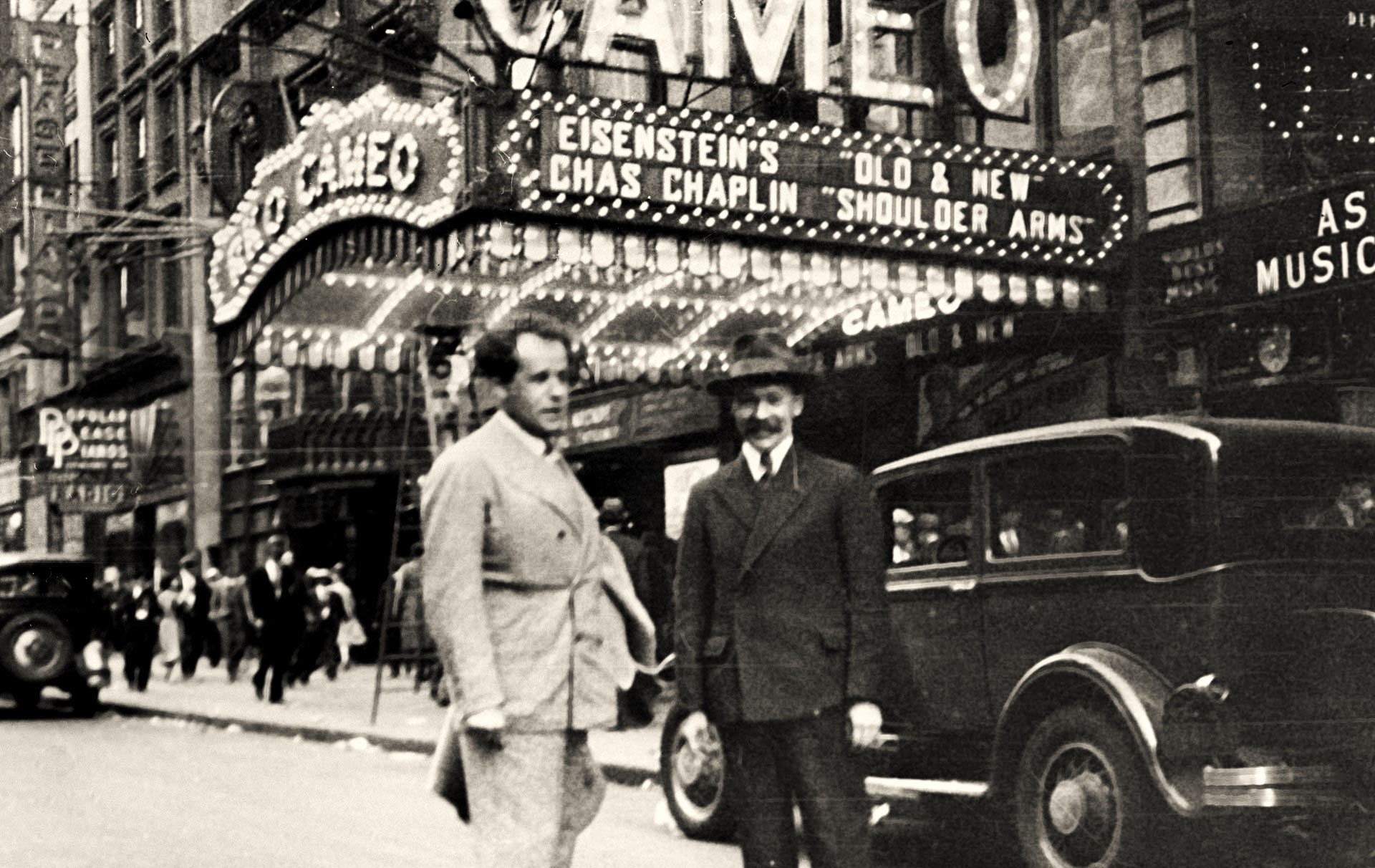
One of the 20th century’s great artists, the pioneering Soviet filmmaker Sergei Eisenstein, came to the the U.S. in 1930 to try and create art in Hollywood; it did not work.
‘Eisenstein, World-Famous Soviet Movie Directory, Leaving Hollywood’ by Allan Johnson from the Daily Worker. Vol. 7 No. 269. November 8, 1930.
Sergy Eisenstein, director of “Potemkin,” “Ten Days That Shook the World” and “The Old and New,” has been discharged by Paramount, for whom he was filming Dreiser’s “American Tragedy.” He left New York last Monday for Soviet Russia.
Six years ago Eisenstein, then an unknown youth came to Moscow from his birthplace, Riga, and became supervisor of settings and then assistant director of the first workers’ theatre, the Proletcult. Among his first tasks was the staging of Jack London’s “Mexicalia.” After a year he joined Meyerhold, leader of the revolutionary theatre in Soviet Russia, but later returned to the Proletcult to take complete charge.
Eisenstein soon developed views which led him inevitably into the movies, where he soon displayed a genius for suggesting mass movement by isolated shots and weird camera angles.
Created the First Mass Films.
Eisenstein’s first picture was a failure. His second, “Potemkin,” created a world-wide sensation and he was hailed everywhere as a premier artist. His artistry was in perfect harmony with his subject matter. The falsely stated problem of “art versus propaganda,” the cause of so many brainstorms in muddled artists who believe that the two mix like oil and water and that to become a revolutionary artist one must renounce art, never perturbed Eisenstein to any great extent. He realized that great art is also great propaganda.
Eisenstein’s “Ten Days That Shook the World” and “The Old and New” further increased his fame. When he was granted a year’s vacation by the Soviet Government, several American movie companies expressed a desire to have him come to Hollywood. He signed a contract with Paramount, along with Alexandrov, his associate director, and Tisse, his brilliant 26-year-old camera man. The contract was a provisional one. If after three months Paramount found Eisenstein’s services satisfactory, he was to be given a three-year contract with a proviso to let him make a picture in Russia for each one he made in Hollywood.
Eisenstein Comes to America.
When Eisenstein arrived in America he was given a welcome by the capitalist press and movie critics that had never before been tendered to any director. Hollywood gave him a great reception and elected him a member of the Academy of Motion Picture Arts and Sciences. His opinions were asked on every conceivable topic relating to the theatre.
It was not until Eisenstein got down to work that his difficulties started. Paramount picked three or four scenarios and then hastily changed its mind, afraid of Eisenstein’s uncanny proletarian touch. Dreiser’s “American Tragedy” was finally chosen. Eisenstein had been working on the production for three months when he decided to come East and view the lake in New York State in which the protagonist in Dreiser’s book is drowned. While he was in New York he was called to a “conference” with Paramount officials. At its conclusion the officials announced that “as a result of a mutual agreement,” Eisenstein’s connection with Paramount had been severed.
Fascist Elements Cause Cancelling of Contract.
Although Paramount and Eisenstein have both declined to comment for publication, the Daily Worker is in possession of information which leads it to believe that the abrogation of Eisenstein’s contract is a direct result of pressure brought to bear on Paramount by fascist elements. The unemployment crisis with its resultant militancy among the 9,000,000 jobless, the wave of anti-Soviet propaganda which is sweeping the country and Eisenstein’s method of realistically portraying the lives of workers, all made it “dangerous” for Paramount to permit the Soviet artist to complete the production.
The most vociferous of those who demanded that Paramount drop Eisenstein, the Daily Worker has discovered, is Major Pease, a Hollywood racketeer who was recently characterized by Variety, a theatrical publication, as a stock swindler. Pease makes a comfortable living by accepting “donations” from fascist and white guard elements in Hollywood for indulging in red-baiting on a large scale and concocting weird scare stories about Russia that the capitalist press is always glad to use. Pease or no Pease, it is inconceivable that Eisenstein would have been permitted to produce a real Eisenstein movie in the United States unhampered by the fascists who censor the American movie industry. Eisenstein is now on his way back to Moscow, where he will film Karl Marx’s “Das Kapital.”
The Daily Worker began in 1924 and was published in New York City by the Communist Party US and its predecessor organizations. Among the most long-lasting and important left publications in US history, it had a circulation of 35,000 at its peak. The Daily Worker came from The Ohio Socialist, published by the Left Wing-dominated Socialist Party of Ohio in Cleveland from 1917 to November 1919, when it became became The Toiler, paper of the Communist Labor Party. In December 1921 the above-ground Workers Party of America merged the Toiler with the paper Workers Council to found The Worker, which became The Daily Worker beginning January 13, 1924.
PDF of full issue: https://www.marxists.org/history/usa/pubs/dailyworker/1930/v07-n269-NY-nov-08-1930-DW-LOC.pdf
 Revolution's Newsstand