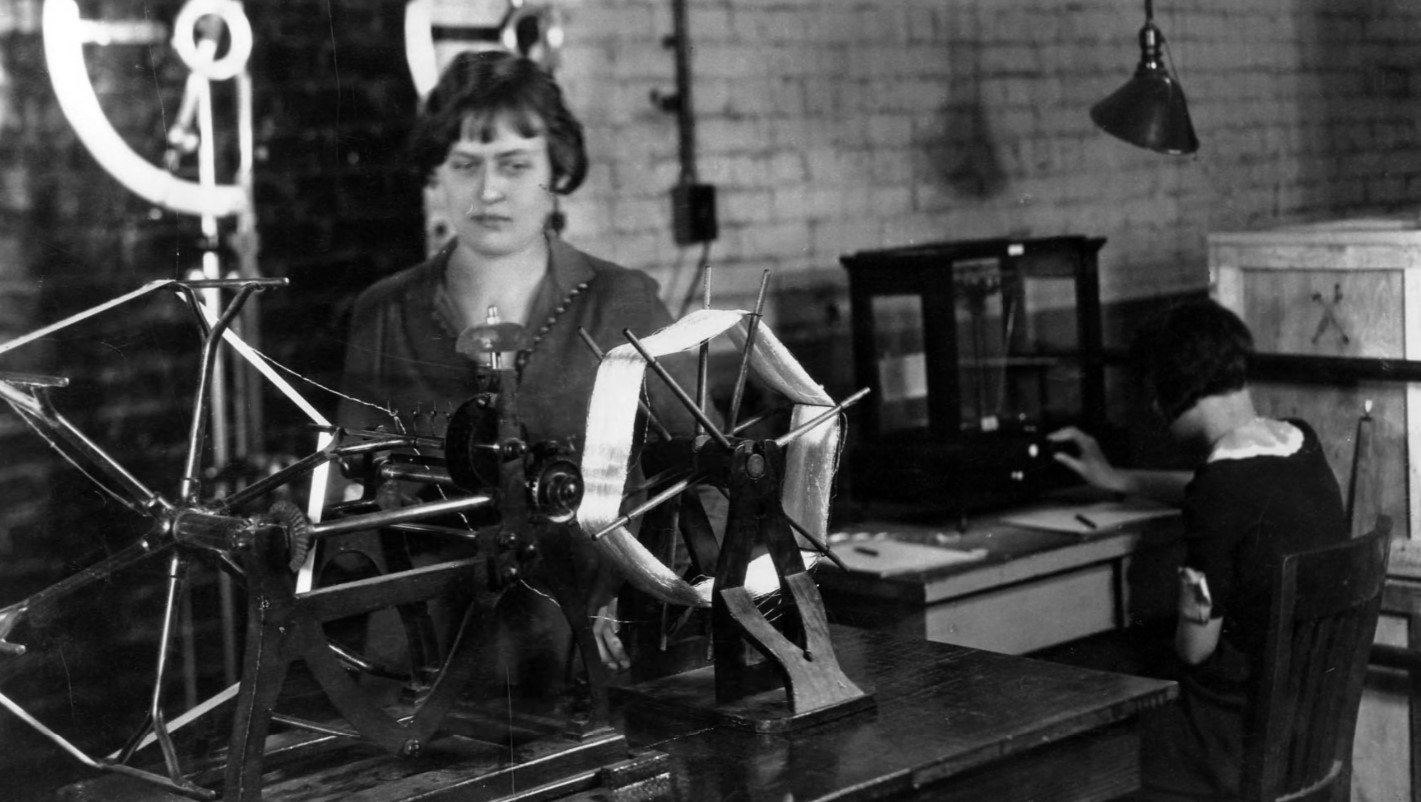
‘Rayon and War’ by Grace Hutchins from Labor Defender. Vol. 5 No. 3. March, 1930.
MARCHING women shouted a cry of revolt, “We want more pay We can’t live and raise families on what we get now.”
It was the spontaneous uprising of over 5,000 rayon workers in Happy Valley, Tenn., that “backward” valley where the boss class thought they had a little paradise of meek, cheap labor to do their bidding. The women’s cry was the spark that started a fire of revolt spreading over the South, lighting these workers and then other workers and still others. Elizabethton rayon workers were sold out by the United Textile Workers and the A.F. of L., but that betrayal could not stop the strike wave. Now under the flaming leadership of the National Textile Workers Union, northern and southern workers are rising, rising, taking from the workers’ arsenal the great weapon of solidarity, standing united with other workers everywhere against the money power of the master class.
Rayon is at present one of the strong castles of the capitalist class. American demand for this artificial silk as a cheap substitute for other fibres as yet exceeds the supply produced in the United States and calls for imports from other countries. In Europe this new industry already begins to show the crisis characteristic in this period of postwar capitalism. But it is not only for immediate use and the resulting profits that giant companies are running vast rayon plants and building new ones, larger still. As a preparation for war, the maintenance of rayon plants is of the greatest importance to the war-making class.
Both rayon (artificial silk) and dynamite can be made from nitro-cellulose. The nitro-cellulose process of making rayon in an artificial silk factory can be changed overnight into the production of dynamite. Under the innocent name of artificial silk factories, munitions plants are extended and maintained. It is probable that equipment in all rayon plants, not only those using the nitro-cellulose process, can be adapted for explosives.
In preparation for war against the Soviet Union, every capitalist country maintains not only plants for the immediate manufacture of munitions, but also rayon plants to be easily converted into munitions plants. Governments are thus directly interested in the artificial silk industry. The Italian government has paid big subsidies to Snia Viscosa, now in the giant international combine with Courtauld’s of Britain. The British government has paid subsidies to British Celanese, now an independent company. It is of vital importance to capitalist states to maintain, along with other munitions plants, strong units for artificial silk manufacture and thus at the same time equipment for the future manufacture of armaments. Rayon then becomes for the working class a signal of the war danger.
One of the most highly centralized industries on an international scale, rayon is mainly in the hands of a gigantic trust or cartel controlling 85 per cent of world rayon production. Two powerful corporations in the cartel, Dutch Enka and German Glanzstoff, have recently merged to form the Associated or General Rayon Union, one of the “Big Three” in the rayon world. The other two most powerful units of the trust are Courtauld’s of Britain, with its American subsidiary the Viscose Co., and Snia Viscosa of Italy. Over against this mighty European cartel, more nearly an international trust than any other known cartel, stands the Du Pont Rayon Co. in the U.S., part of the largest munitions corporation in the world, with General Motors and Morgan millions behind it. Already second to Viscose in American production, Du Pont will be first as soon as its $100,000,000 program is completed. Pulling political wires behind the Washington scenes, Du Pont has just secured an immense increase in tariff on rayon yarn imports (to 45c a pound) so that European competitors will now be at a disadvantage in the U.S. Du Pont, always anti-union in policy, is already exploiting rayon workers no less than are the European companies.
It was one of the Big Three in the cartel, the German company Glanzstoff with its American branch and its Siamese twin Bemberg, that exploited Tennessee women workers until they struck against wages of less than $9 a week. How the international octopus has held European rayon workers in its clutches has lately been revealed. Working conditions have been growing steadily worse.
German girl rayon workers only 14 to 15 years old, employed in Bemberg-Glanzstoff plants abroad, are driven at the highest notch of speed to carry out the company’s new policy of “stretching out” its workers. Wages of these children are from 8 to 12 marks or less than $3 a week. One worker who formerly looked out for one machine must now tend three or four, and keep his eye on no fewer than 8,640 threads. A girl in the thread mill used to tend half a machine with 120 spindles. Now she must care for 2 machines of 480 spindles–four times as much work.
Needless to say, rayon corporations have made stupendous profits out of such methods of exploitation. Bolstered up with millions of dollars’ surplus, their power now may seem almost unbreakable. But the rayon castle already shows signs of cracking with its own contradictions. Over-production in Europe demands a wider world market, while American rayon capitalists put up their new tariff wall to “protect” their own expanding production. Only a war would assure to all rayon capitalists an inexhaustible market for their goods. So of course they want war.
To workers, watching the rayon cartel in competition with independent producers like Du Pont, one outstanding fact is clear–rayon is a signal of the war danger. It is a chemical weapon in the hands of the ruling, war-making class, which wants war in order to sell its goods.
Against this war danger, the working class has a still greater weapon in its armory-the weapon of solidarity. As rank-and-file Tennessee women gave the strike word, so millions of other workers, under the leadership of the revolutionary international textile workers’ unions, will take it up pass it on and make it the signal of revolt.
Labor Defender was published monthly from 1926 until 1937 by the International Labor Defense (ILD), a Workers Party of America, and later Communist Party-led, non-partisan defense organization founded by James Cannon and William Haywood while in Moscow, 1925 to support prisoners of the class war, victims of racism and imperialism, and the struggle against fascism. It included, poetry, letters from prisoners, and was heavily illustrated with photos, images, and cartoons. Labor Defender was the central organ of the Scottsboro and Sacco and Vanzetti defense campaigns. Editors included T. J. O’ Flaherty, Max Shactman, Karl Reeve, J. Louis Engdahl, William L. Patterson, Sasha Small, and Sender Garlin.
PDF of full issue: https://www.marxists.org/history/usa/pubs/labordefender/1930/v05n03-mar-1930-LD.pdf
 Revolution's Newsstand