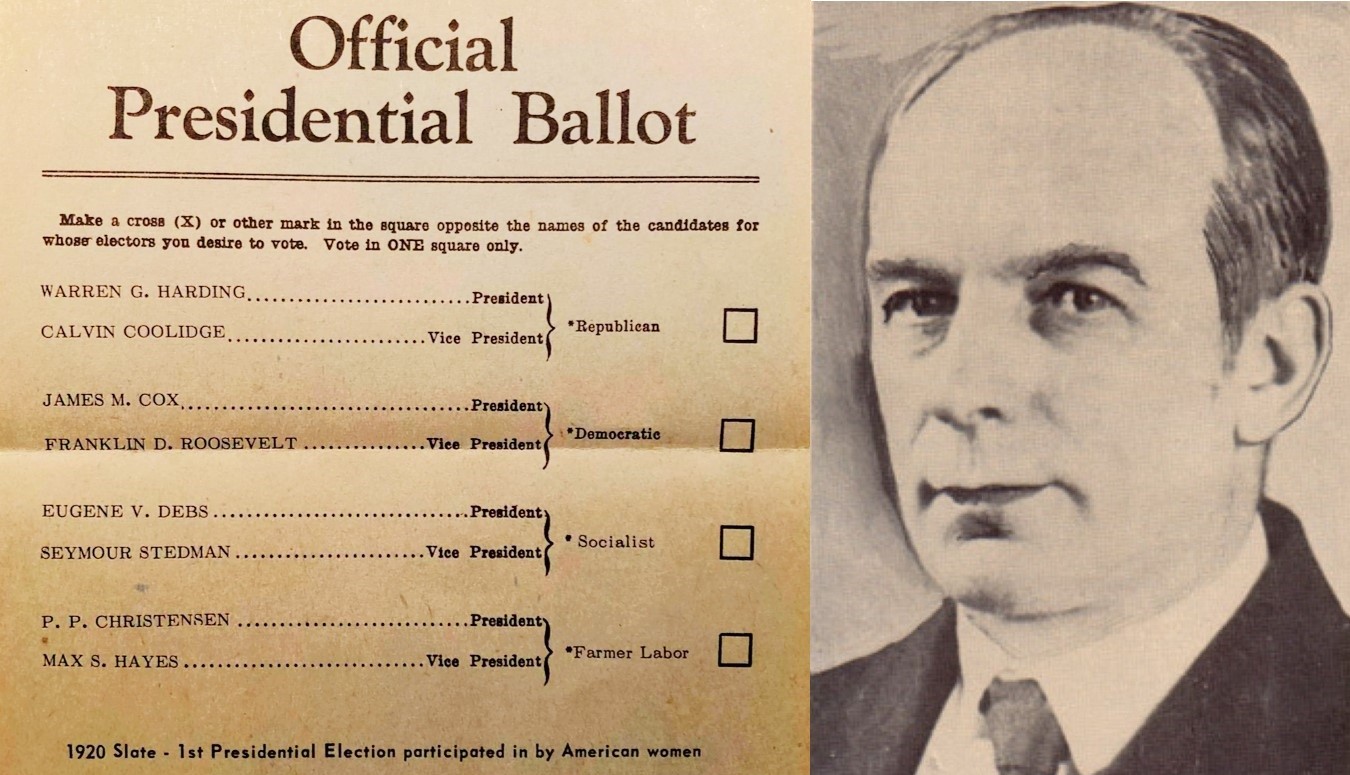
The 1920 elections, in the midst of the Red Scare, saw Debs run as the Socialist Party candidate from federal prison, where he had been during the 1919 splits from which came the Communist movement. Also running was the Farmer-Labor Party, with support from pro-war ‘Socialists.’ Thousands of Communists had been arrested or deported since, with the organizations banned and much of the leadership on trial. Eager to differentiate themselves from the Socialist Party, and perhaps guilty of Lenin’s charge of an ‘Infantile Disorder,’ both the United Communist Party and the Communist Party urged a boycott of the elections. In May 1920, as this was published, Ruthenberg’s wing of the C.P.A. joined the Communist Labor Party, which while accused of ‘syndicalism’ was not opposed to elections and in sympathy with Debs, to form the U.C.P.; causing the C.L.P. itself having a small split (Washington State) over the question. Louis C. Fraina was an outlier. As the C.P.A. international representative he was in Germany when he wrote these theses proposing that the Party run in the elections with Ruthenberg as candidate. Ruthenberg’s reply can be guessed from his pithy editor’s introduction.
‘The Coming Elections’ by Louis C. Fraina from The Communist (C.E.C. Faction). Vol. 2 No. 6. May 22, 1920.
Theses Proposed by Louis C. Fraina for Discussion and Action by the Communist Party.
(Ed. Note: The following article was received from Berlin, and goes to press without discussion of its proposals. This is an individual view of the author who, obviously, can hardly have a definite and realistic conception of the Communist situation in the United States at this moment.)
1. The savage Government repression of the Communist Party, together with the revolutionary redquirements of the general situation, impose three chief and immediate tasks upon the Party:
a) The development of forms of Party organization and means of Party activity enabling the Communist Party to function in spite of the Government repression.
b) More intensive activity in the unions by means of developing extra-union organizations, such as the Workers’ Councils, to carry on the struggle against the reactionary union bureaucracy and organizations, and for industrial unionism; together with the parallel activity of organizing direct branches of the Communist Party in the shops, mills and mines.
c) The struggle to make the Communist Party an active force in the political life of the nation, and particularly in the coming elections.
2. The coming elections, in a national and international sense, in the discussion of vital issues and the revealing of class alignments, are of the utmost importance. The Government repression of the Communist movement; the proposed legislation against strikes and revolutionary activity; the coming of trades unionism to the political struggle (Labor Party); the problems of nationalization and the cost of living; the League of Nations and the Peace Treaty; the relations of the United States to the Russian Soviet Republic in particular and the European revolution in general; all these are questions that must compel a clear, definite expression of class relations and class interests, and that provide a rare opportunity for Communist Party agitation.
3. The Communist Party must participate in the coming elections actively and aggressively, and bend all its resources to that end. Under the prevailing conditions, the revolutionary use of parliamentarism becomes, for the American Communist Party, not the use of the parliament (Congress, Legislatures), but use of the political campaigns for purposes of revolutionary agitation. The prospects of electing representatives are nil; the prospects of agitation in campaigns–excellent. The Party must act accordingly.
4. The Communist Party will participate in the coming campaign on the basis of its revolutionary program. There must be no concessions to immediate demands on the capitalist state; on the contrary, these demands, such as naturalization, must on the ground that it violates the provision in our Party program against making nominations for executives.
But the stubborn fact is that under the conditions of the Presidential elections in general, and under the prevailing conditions of our Party in particular, there can be no real campaign without a Presidential candidate. I would much sooner see no local candidate at all than making no nomination for President. It is absurd, moreover, to argue that our candidate may have to assume responsibility for the acts of the bourgeois state–such an argument makes absurd the Party’s conception concerning executive offices.
The Party must discourage becoming so absorbed in a theory as to develop mongers of phrases instead of doers of deeds.
Theory is not action, but the means to action.
Moreover, the nomination of C.E. Ruthenberg (who in every sense is the logical candidate) would be a revolutionary challenge, considering his innumerable arrests and the fact that now there are four indictments against him and prospects of 30 to 40 years in prison–a challenge none the less real because only of moral value.
Active Communist Party participation in the campaign would:
a) prove an enormous agitational factor.
b) Constitute a means of action against him and prospects of 30 to Party [?] (all the more necessary should Eugene Debs accept the Socialist Party nomination for President tendered to him by tricksters of the worst type).
c) Prove of real value as an answer to the reaction and the repression, impart an impulse to the Party’s recovery, unify the Party and contribute to making it an aggressive factor in the struggle.
The Communist Party is in a favorable or unfavorable position accordingly–to the measure in which it combines concepts and practice, theory and realism.
Not a single opportunity for struggle must be avoided. Not a single means of action in accord with our tasks and our principles must be missed. The test of a Party’s revolutionary integrity is not the formal, mechanical adherence to a Program, but the capacity to use programs for purposes of revolutionary action.
Berlin March 10, 1920.
This ‘The Communist’ was a split from the Communist Party of America in April, 1920 by Charles Ruthenberg, Jay Lovestone, and others, referred to as the Central Executive Committee group, over the majority’s reluctance to unite with the Communist Labor Party as mandated by the Communist International. Laying the groundwork for the May 1920 Bridgman, Michigan convention that would form the United Communist Party, this version of ‘The Communist’ only lasted three issues. The new UCP stuck with tradition and called their official journal…’The Communist. Emulating the Bolsheviks who in 1918 changed the name of their party to the Communist Party, there were up to a dozen papers in the US named ‘The Communist’ in the splintered landscape of the US Left between 1919 and 1923. All them claimed adherence to the new Third International and sought that body’s endorsement. They were often published at the same time and in the same format, making it somewhat confusing to untangle their relationships.
PDF of full issue: https://www.marxists.org/history/usa/pubs/thecommunist/thecommunist4/v2n04-a-apr-25-1920.pdf
 Revolution's Newsstand