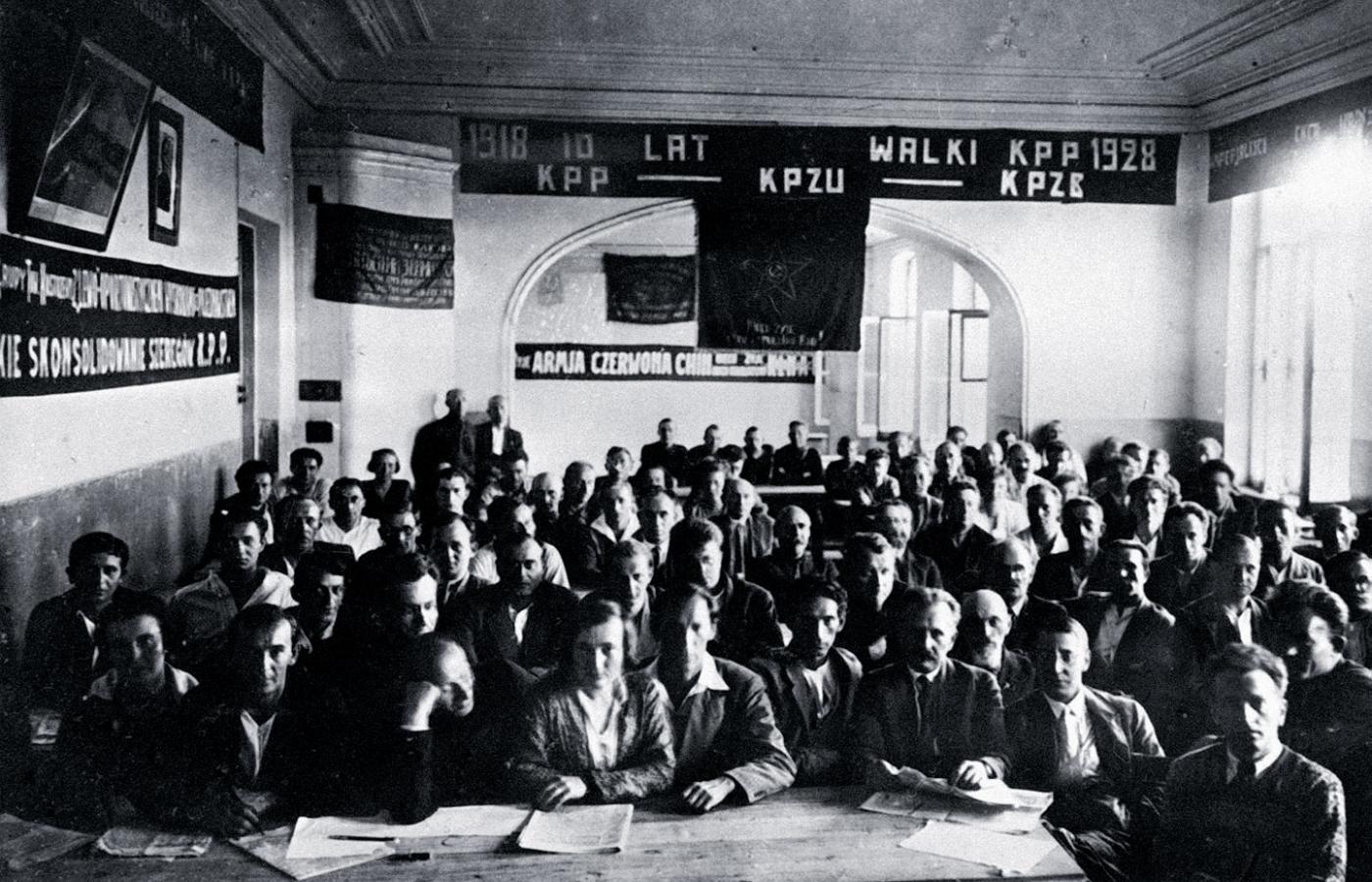
At the 1925 congress of the Communist Party of Poland the left faction led by Henryk Domski briefly ascended to power in the ‘Bolshevization’ process.
‘The Third Party Conference of the C.P. of Poland’ by L. Domski from International Press Correspondence. Vol. 5 No. 33. April 16, 1925.
In March last there took place the III. Party Conference of the Communist Party of Poland.
The outward and obvious feature of this party Conference was the fight against the Right. The Right group which already had been removed from the Party leadership at the V. World Congress, suffered a final defeat at the III. Party Conference. Not a single delegate supported their standpoint. The resolution which condemned the former leading group of the Party, as well as the resolution which expressed confidence in the new Party leadership set up at the V. World Congress, was unanimously accepted.
The task of the III. Party Conference, however would have been a very easy one if it had only been a question of rectifying these mistakes of the Right and of declaring that they would not be repeated in the future. The task of the III. Party Conference was a far more difficult one, it consisted in the reorganisation of the Party, in its bolshevisation.
What have the right leaders made of the Polish Party? They made it a Party of propaganda and agitation.
The II. Party Conference of our Party which took place in 1923, made a great step forwards with regard to the bolshevist slogans in the national and in the peasant question. But this proved to be insufficient in order to render our Party a party of revolution and of the fight for the dictatorship of the proletariat; for the Party Conference placed the bolshevist slogans in the national and in the peasant question in the frame of the general opportunist tactics, whereby they were deprived in practice of their bolshevist character. The slogan of the united front as conceived by the Right Central Committee was to serve as a means for our Party not only to approach the social compromisers, but also the peasant compromisers and the petty bourgeois leaders of the parties of the suppressed nationalities, to provide the C.P. of Poland with a means of pressure upon these parties and to compel these parties to fight.
The disastrous results of this conception of the tasks of the Party made themselves apparent at the time of the October and November fights of 1923. Whilst the movement of the masses underwent an enormous advance, our Party contented itself with exerting pressure upon the P.P.S. (Polish social-democratic Party) and supporting those actions which the P.P.S. people were “forced” to take up. Our Party did not succeed in leading the masses into the struggle and it did not make use of the fighting mood of the masses for decisive revolutionary actions.
It was the task of the III. Party Conference to liquidate this situation and to convert the Party from a Party with bolshevist slogans and menshevist practice, into a Party with bolshevist ideology and tactics.
One of the forms in which this transformation was expressed was the renaming of the Party. The Communist Labour Party was in fact a party which organised the workers for the fight merely for their immediate interests. The Communist Party of Poland must become a Party of the social revolution, which gathers round and under the leadership of the proletariat the huge masses of the peasantry and of the suppressed nationalities for the carrying out of the overthrow of the social order.
The combining of the three main factors of the socialist revolution the proletariat, the peasantry and the suppressed nationalities is the basis of all the decisions of the III. Party Conference.
The resolutions of the Party Conference spread no illusions that it would be an easy matter to carry out the revolution. The resolution on the political situation and the tasks of the proletariat lays it down that the Polish bourgeoisie has consolidated itself compared with the epoch of the inflation crisis (the period of the increased issue of paper money); that the parties of com- promise have not yet lost their entire influence upon the proletariat and are capable of weakening its struggle; that the general political situation at present is characterised by the “peaceable” encirclement of Europe by Anglo-American capital and that there is no prospect in the near future of any international convulsion; that the campaign of reaction which is proceeding throughout the whole world is not assuming the violent forms of genuine fascism, and expresses itself for the time being more in the parliamentary liquidation of the democratic era; that under these conditions the government of Grabski is able to conceal its policy of terror towards the working masses and its support of the capitalist offensive by means of promises of reforms and pacifist ideology.
At the same time however, the resolution declares that the strengthening of the bourgeoisie is taking place at the cost of the working masses; that the financial reform, which appears as the newest stage of this consolidation, promotes the rise of a severe economic crisis; that this crisis before all falls upon the shoulders of the workers, of whom hundreds of thousands are unemployed; that the situation of the peasantry has greatly deteriorated and that the misery of the white Russian and Ukrainian masses has specially increased; that based upon the offensive of capital, a huge strike movement is developing and that a ferment is going on among the peasants, which is leading to the break-up of the peasant Party; that finally, in the Ukrainian and White Russian districts, the revolutionary ferment has already reached the stage of an armed insurrectionary movement.
The theses on the political situation and the theses on the tasks of the Party in the trade unions formulate before all the task of the party among the working masses. They call attention to the fact that the main task of the Party consists in organising the revolutionary united front of the masses on the basis of organising and centralising the factory councils, the attraction of the masses into the trade union organisations and the revolutionising of the trade unions, the centralising of all mass actions of the proletariat, which must be linked up with the actions of the proletariat in other countries.
The theses on the work in the village and the theses on the national question point out the way by which the proletariat becomes the leader of all suppressed classes in the fight for their class and national emancipation. The theses on the work in the village strive to realise the alliance of the workers and peasants.
In regard to the national question, the Communist Party, in opposing the predatory designs of Polish imperialism by the slogan of the right of self-determination of nationalities, fights for the uniting of the White Russian and Ukrainian districts with the adjoining Soviet Republics. The Party participates in the daily struggles of these masses, supports their individual actions, such as the boycott of the taxes, the boycott of the officials, the fight against colonising and against the buying up of the land by the big land owners etc., conducts a fight for use of the mother language in the schools and in the government offices, and strives to give the partisan movement an organised form and to deepen it politically.
The decisions of the Party Conference, therefore, aim at bringing together all the revolutionary forces in Poland into one army of the revolution under the leadership of the proletariat. The decisions, however, constitute only the commencement of the work. The second and decisive step is the creation of a bolshevist Leninist fighting Party, which shall be capable of giving to the proletariat a powerful advance-guard which is really conscious of its aims. The theses on the bolshevising of the party are devoted to this question.
The bolshevising of the Party is before all a political task. It demands the deepening of political knowledge among the broad circles of the party comrades and educating them accordingly in the spirit of Marxism and Leninism. The Party must have before it the broad perspective of the future and must learn the tendencies of development in bourgeois economics and politics. It must acquaint itself with the past by studying the history of the labour movement in Poland, in Russia and in other countries.
In creating in this manner a kernel of politically tried communists, the Party must at the same time bolshevise itself organisatorily by basing its whole organisation upon the factory nuclei, by fighting against burocratism, strengthening the self-activity of the party masses and working out an iron discipline and fighting capacity.
All the theses of the III. Party Conference were the result of long debates and intensive work. They were all adopted unanimously. As in the Communist Parties of Germany and France, the C.P. of Poland also proved that the victory of the real revolutionary line of the Party leads to the disappearance of fractions. If the abolition of the fractions in the Party is one of the main conditions for its bolshevising, then the Communist Party of Poland has in this respect completely stood the test.
International Press Correspondence, widely known as”Inprecorr” was published by the Executive Committee of the Communist International (ECCI) regularly in German and English, occasionally in many other languages, beginning in 1921 and lasting in English until 1938. Inprecorr’s role was to supply translated articles to the English-speaking press of the International from the Comintern’s different sections, as well as news and statements from the ECCI. Many ‘Daily Worker’ and ‘Communist’ articles originated in Inprecorr, and it also published articles by American comrades for use in other countries. It was published at least weekly, and often thrice weekly.
PDF of full issue: https://www.marxists.org/history/international/comintern/inprecor/1925/v05n33-apr-16-1925-inprecor.pdf
 Revolution's Newsstand