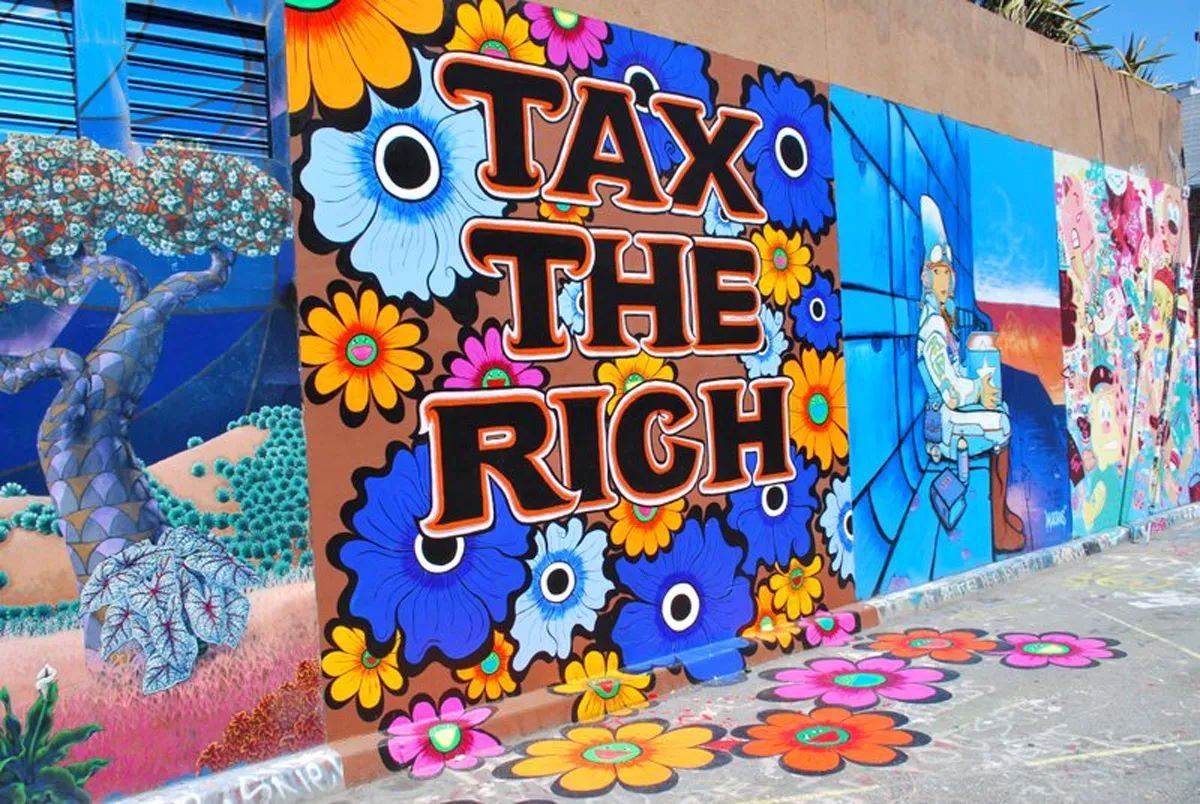
Demands like “tax the rich” and “nationalize rail” are widely heard today. If you are like me, you have been looking for a document like this. From the Executive Committee of the Communist International, a thesis analyzing ‘state socialism’ concepts, taxation under capitalism, state control of industries; their limits and possibilities. Fascinating.
‘Tax Questions in the Periods of the Development and the Decline of Capitalism’ from Bulletin of the E.C.C.I. Vol. 1 No. 4. November 23, 1921.
I.
Before the war the objective importance of the question of taxes was much less than in the epoch of the decline of capitalism. This was due to the fact that the taxes had constituted but had constituted but part of the total sum of the so-called national revenue: thus, for instance, in Germany where the national revenue amounted yearly to a sum of 35-40 milliard marks the expenses of the state constituted but 2 milliard marks, or 5%. In England, with approximately 2,000 million pounds sterling the expenses were 135,000 mill., or about 6. In France the state taxes, by a total revenue of 35 milliard francs, constituted 3 milliards, or 80. This is quite in keeping with what Marx wrote:
“The conditions of distribution, based directly on the bourgeois system of production, the ratio of wages to profits, of profits to the interest on capital, of rents to profits, may suffer but unimportant modifications, owing to the taxes, but they can never undergo a funda- mental change. All the researches, and discussions on the taxes have as their premise that these bourgeois relations will last forever. Even the abolishment of taxes would only accelerate the development of bourgeois ownership and its inconsistencies”. (Marx, Posthumous Works, vol. III, written in 1850).
The struggle of the social democratic parties was directed first of all against duties and taxes imposed on the consumer (indirect taxes), which directly aggravated the conditions of the working class. As to the rest, social democratic parties took their stand from the point of view,–whether or not such tax or the other hampered the development of economic life. While submitting original propositions concerning taxes, which were calculated to be realised within the limits of the existing capitalist order, the social democrats had to consider whether their propositions would not be liable to prevent the accumulation of capital.
II.
In consequence of the extravagantly huge costs of the war, the ratio of the national revenue to the requirements of the state became reversed. Formerly it was 5-10%, while at the present time it amounts to over one half of the entire revenue. In Germany the government estimates government estimates officially the national revenue of the State at 140 milliard marks in paper currency (Experts’ Conference in Brussels). The expenses of the state-including also the payment of the costs of restoration, are about 50 milliards for 1921 amount approximately to 150 milliards. Thus the sum total of the state expenditure exceeds the national income. Hence the necessity arises of spending part of the accumulated riches.
The most extensive application of the system of taxes is unable to furnish all the means that are necessary to a capitalist state. The idea of procuring these means by an unparallelled intensification of the exploitation of the proletarian masses, which would lead to an increase of the revenue and enable the state to cover its deficit from this source, that is to say, the idea of quite an unlimited development of the direct taxes system is an utopian idea. The position of the workers in the countries in which the financial difficulties are the greatest, have grown so much worse in comparison with their pre-war standard that any further aggravation of the same would spell danger for the development of productive labour. Moreover, owing to the depreciation of paper currency, any tax, no matter however high, will be inadequate within a few months. Money taxes, as well as money itself, become a fiction. Only real values can form a solid basis for taxes. All the belligerant countries have reached this deadlock and are compelled to raise the question of the nationalisation (state trustification) of industry with a view to removing the technically superannuated methods of production, reducing the costs of administration and introducing direct profit-sharing by the state. Thus, the Communist parties are everywhere closely approaching the question of state capitalism.
III.
The parties constituting the Second and the Two-and-a-Half Internationals, as well as the Amsterdam International of Trade Unions, have taken up a definite position with regard to this question; they consider the trustification of industry, as controlled by the state which has a share in the profits, as a realisation of the socialist program and call it socialisation. The parties of the Second and the Two-and-a-Half Internationals and the International of Trade Unions as well, set this “socialisation” against the struggle for the dictatorship of the proletariat. “By means of this socialisation it will be possible gradually to realise socialism in a peaceful democratic way”–they are saying. But their position is founded on juggling with facts and on cheating the workers. So long as the power will remain in the hands of the capitalist class it will be impossible to wrest the means of production from the bourgeoisie. If a capitalist state seize even all “nationalised” means of production, this will only mean that the management of the public economy will be transferred from separate capitalists to the entire bourgeoisie as a class. This condition will still prevail and will not be removed in the event of the working class exercising a certain control over industry through the factory committees and by its participation in the management of industry.
It is therefore necessary to destroy the illusions created by the reformists with regard to socialisation, the more so that they are serving only one object, namely: to keep the working class from entering into a struggle against the bourgeoisie. But by our rejection alone of such counterfeit socialisation, we shall in no wise determine the positive attitude of the Communist parties towards state capitalism during the period of social revolution.
IV.
The attitude of the Communist parties towards state socialism is based on the premise that the process of the breakdown of capitalism and the accumulation of the world revolutionary forces is a gradual one and will demand a long period of struggle on a world scale, especially in the countries with strongly developed capitalism. During this period the policy of the Communist International must be such as to enable the latter to conduct the struggle for the satisfaction of immediate and pressing requirements of the working masses.
The Communist International is advancing demands which are directed to the removal or alleviation of the misery of the proletariat, without any regard to the interests of capitalism or the need of accumulation of capital. Capitalism has ceased to be the factor of economic progress it was formerly. The accumulation of capital is at present only a means for prolonging the painful period of the birth of a new social order. The Communist International only considers the fact whether the given demands correspond to the interests of the proletariat and whether they are looked upon by proletarian masses as indispensable. At the same time the Communist International must not allow itself to be stopped by the fact that separate concrete demands may seem double-faced and partly bear a reformist character, if only the struggle for these demands will rally the widest masses of the proletariat and if in its further development it becomes struggle for the power. True, the demands of state capitalism will, on the one hand, strengthen the bourgeoisie–if they be voluntarily met by the bourgeoisie for the purpose of stabilising capitalism, but, on the other hand, they will help to give unity to the front of the class struggle and at the same time to create better conditions for organising the realisation of socialism after the victory of the working class.
When pseudo-Marxists of the Kunow and Renner type declare that the world development of Socialism must pass through a period of state capitalism, their assertion is schematic and proves only that these pseudo-Marxists would like to pass through a period of state capitalism at whatever cost, that is to say, they would like to avoid a proletarian revolution; but if during the period of social revolution there will be a possibility to realise state nationalisation of industry, every step in this direction will facilitate the work of proletarian dictatorship after the victory. The apprehension of many comrades that the state-capitalist organisations will strengthen the bourgeoisie and delay the advent of revolution, are totally unfounded. The world revolution is not a product of the defective organisation of capitalism; it is the result of the inconsistencies between the requirements of the proletariat and the incapacity of decaying capitalism to satisfy these requirements even partially. Therefore the transformation of private syndicates into state monopolies will in no wise be able to defer the crisis of world capitalism or hamper the development of the world revolution. On the contrary, the struggle for the introduction of state monopolies or for “nationalisation” this measure usually is called in the Anglo-Saxon countries—may at present become a starting point for serious revolutionary battles. The bourgeoisie of all countries of all countries is struggling most energetically against all such demands; under the pressure of the proletariat, the state bureaucracy, having become possessed of the means of production, may be compelled gradually to confiscate the profits and enlarge the right of the workers’ control over production.
Whenever the tax system leads to the question being put forth of state syndicates and profit-sharing by the state, the following situation is created, which is charactarised by Marx’s words:
“During revolution the colossally developing tax system may serve for an attack against private ownership, but even in that case it must lead to further revolutionary measures, or return in the end to the old bourgeois system.”
V.
From this point of view, and before the seizure of the power by the Bolsheviks, in his pamphlet on “The Threatening Catastrophe and the Methods of the Struggle Against it”, written in September 1917, Lenin demanded from the coalition government of the mensheviks, the social revolutionists and cadets (i.e. the government of big business, of town petty bourgeoisie and petty bourgeoisie and well-to-do peasants): the carrying out of the following measures.
1. The amalgamation of all the banks into one single bank with State control over its operations, or the nationalisation of the banks.
2. The nationalisation of the trusts and syndicates, that is to say, of the most important monopolies of the capitalists (sugar, oil, coal, metal trusts, etc.).
3. The abolishment of the principle of commercial secrecy.
4. Compulsory organisation of the population in consumers’ societies or the support by the state of such and control over them.
To summarise all this, one must say that, unlike the tax demands put forth by the pro-state-capitalism reformist parties, the tasks of the Communist parties consist in the following:
1. To warn the working masses against the illusion that these measures which can put an end to the distress of the masses.
2. To prove to the masses that these are but transitory measures, which can temporarily alleviate the position of the working class only on condition that on the basis of state nationalisation the proletariat itself will manage to organise strong and militant organs of workers’ control over industry.
3. To urge the necessity for the proletariat to unite into one single front, in order to force the government during the struggle with the bourgeoisie to carry out the radical measures called forth by the economic situation.
The task of the Communists consists not only in criticising the reformist illusions, but also in strengthening the struggle which, although starting from illusionary premises, will inevitably lead to revolutionary consequences. In carrying on the struggle for higher wages the working class is trying to increase its share of the “national revenue”; and in carrying on the struggle against the taxes it is trying to prevent that the higher pay be again confiscated by the capitalist state for the purpose of covering its deficit. The idea of improving the position of the proletariat by means of an increase of the wages is no less utopian, than the endeavour to improve it by means of the confiscation of part of the profits by state nationalisation of industry and state profit-sharing. In both cases the measures are but temporary ones, and their whole importance for us consists in the fact that they enlarge the struggle of the working class and render it more acute.
VI.
In supporting the state-capitalist tax demands and insisting that definite proportions of profits and property be liable to taxation, we may penetrate large masses of the poorer petty bourgeoisie and smaller peasant holders, against whom not only the whole system of indirect taxes, but also the present system of direct taxes is directed; these latter represent an attempt against the incomes and property of the smaller owners in order to make good the extravagant budget-deficit. Of all questions, that of taxes is one which provokes the greatest conflicts between the interests of various groups of the propertied classes, especially between those of the larger bourgeoisie, which is trying to bring order into the state budget and stabilise the exchange, and the interests of the peasantry, which do not want to sacrifice anything to help in balancing the state budget. The tax policy of the Communist parties must therefore be carried on so as to enable the proletariat to act hand in hand with the wider masses of the smaller and middle peasant owners against the bourgeoisie and the big landowners; for this purpose a strict line must be drawn between incomes, derived from personal labour and from the appropriation of surplus value: between property which–as that of the smaller peasant owners–serves for a natural basis for a profitable ulilisation of their own labour forces, and property which serves for the exploitation of the labour force of others. The Communist postulates in the field of tax policy must start from the following theses: the rejection of all indirect taxes, the rejection of all income tax on wages, the rejection of all taxes on consumption and circulation, the rejection of all taxes which may fall on incomes derived from personal toil.
Hence, the fundamental principles of the tax policy of the Communist party in the present period of development of capitalism may be summed up as follows:
1. A most decisive struggle for the complete exemption from all kinds of taxes on incomes, derived from work; a capitalist state may only be maintained at the expense of the ruling classes.
A complete ignoring of the possibility or impossibility of the accumulation of capital and of other interests of capitalist production-for, at the present state, the accumulation of capital has become a brake on the historical development. With the extraordinary growth of the state expenses the latter can be covered only from the surplus value. It is necessary to touch the capital itself, and this can. only be done by levying money taxes. Meanwhile in the present conditions of unchecked depreciation of money, the ruling class is constantly finding ways and means of shifting a greater part of the burden on the shoulders of the proletariat. It is therefore necessary to demand from the state that it utilise capital in its natural from. The bourgeoisie is opposing this with all its forces as it does no longer put any trust in the state apparatus. If this opposition of the bourgeoisie will be broken and the means of production expropriated, the first stage of the social revolution-that of state capital- ism will be reached. The resistance of the bourgeoisie can be broken only when the struggle against the taxes will be carried on simultaneously with the struggle for the control over production. In its struggle against the taxation of incomes derived from personal toil, the proletariat will find a natural ally in the masses of peasants and artisans, who live on their own labour and not by the exploitation of others. The Communist party is carrying on this struggle in the interests of all the workers, while it clearly understands that the complete fulfilment of these concrete demands under existing conditions and within the limits of the capitalist order is impossible, and that this struggle must inevitably pass beyond the limits of its direct aims and lead to the fall of capitalism, to the victory of the proletariat.
The ECCI published the magazine ‘Communist International’ edited by Zinoviev and Karl Radek from 1919 until 1926 irregularly in German, French, Russian, and English. Unlike, Inprecorr, CI contained long-form articles by the leading figures of the International as well as proceedings, statements, and notices of the Comintern. No complete run of Communist International is available in English. Both were largely published outside of Soviet territory, with Communist International printed in London, to facilitate distribution and both were major contributors to the Communist press in the U.S. Communist International and Inprecorr are an invaluable English-language source on the history of the Communist International and its sections.
PDF of full issue: https://www.marxists.org/history/international/comintern/ci/publications/n1-n5-jul-07-1921-sep-08-1922-Bull-Exec-CommCI-Feltrinelli-reprint-1967.pdf
 Revolution's Newsstand