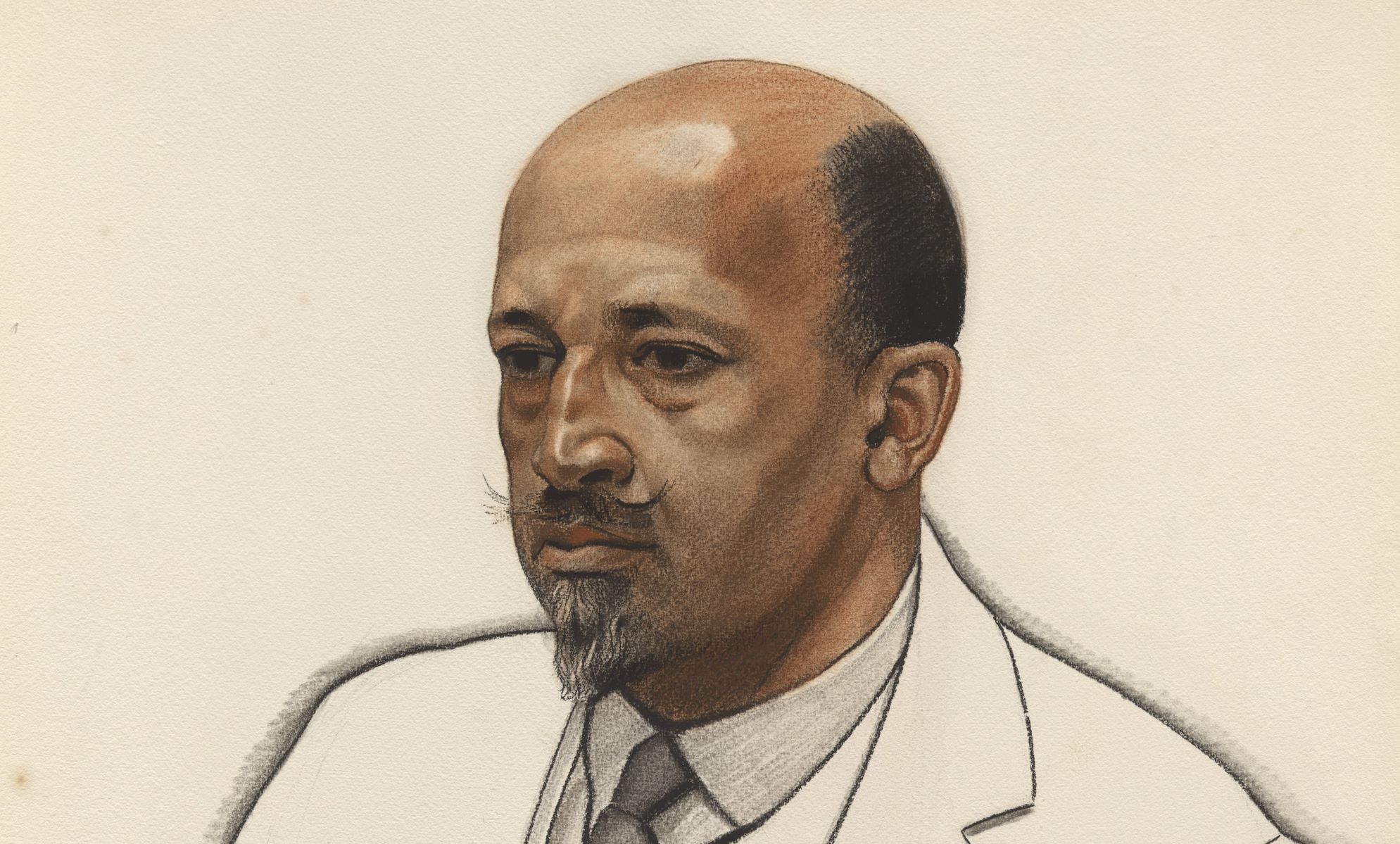
The original publication of this oft-cited essay in V.F. Calverton’s’ Modern Quarterly.’
‘The Social Origins of American Negro Art ‘ by W.E.B. Du Bois from Modern Quarterly. Vol 3 No. 1. October-December, 1925.
Is there any body of artistic expression which can be fairly called American Negro art? There have been, of course, a great many American artists of Negro descent. In the case of some, the Negro blood has been well known and recognized. In the case of others it has been either unknown or unrecognized. So far as these people worked simply as Americans or as human beings it is not fair to call their art American Negro. Our great painter, Henry O. Tanner, has in no sense contributed to American Negro art. He is a painter of biblical subjects, a great American painter or more truly he ought to be classed as a great French painter or a cosmopolite. Charles W. Chestnutt and William Stanley Braithwaite are both American Negroes who have done fine artistic work in the novel and poetry, but they could hardly be classed as contributing to any particular group expression.
On the other hand there is without doubt a certain group expression of art which can be called American Negro. It consists of biographies written by former slaves and colored men of achievement, of poetry portraying Negro life and aspirations and activities, of essays on the “Negro Problem” and novels about the “Color Line.” There are pictures and sculptures meant to portray Negro features and characteristics, plays to dramatize the tremendous situation of the Negro in America, and of course, above all, the group has expressed itself in music. Whence did this art come? The art instinct is naturally and primarily individualistic. It is the cry of some caged soul yearning for expression and this individual impulse is of course back of Negro art. But while in some cases this artistic impulse resulted in an expression which was simply individualistic or which might become national or even universal, in most cases individual impulse was combined with a certain group compulsion, as we usually say, meaning that the wishes, thoughts and experiences of thousands of individuals influence consciously and unconsciously the message of the one who speaks for all. That social compulsion in this case was built on the sorrow and strain inherent in American slavery on the difficulties that sprang from Emancipation, on the feelings of revenge, despair, aspiration and hatred which arose as the Negro struggled and fought his way upward. Whenever a great mass of millions of men have such common memories and experiences they are bound sooner or later to express them. If allowed enough of intellectual freedom and economic wealth they will in time almost inevitably found a school of art and will in this way contribute to the great artistic wealth of the world. They may not bring anything particularly new in method, but the content of such an art contribution must always be new because as every individual differs from another so every group and set of group experiences differs, and the truth about them has something fundamentally new and different from anything else in the world. If this truth then is beautifully expressed and transformed from sordid fact into art it becomes, from its very origin, new, unusual, splendid.
The fact that there is, therefore, a real Negro art expressing the thoughts, experiences and aspirations of the twelve million colored people in the United States is not nearly as extraordinary as it would be if no such self-expression had arisen. If the drama of the transportation of the millions of Africans to the United States and their emancipation could have been accomplished without a gift of emotion and beauty to the world it would have been an eternal proof that the Negro was different from other human beings.
Already this art expression is showing its peculiarities, its unique content. Lately this is being acknowledged widely so far as the Negro music is concerned. After all has been said about imitation of white music and transmission of the songs of white folk and the like we all know that the Negro has given the world new music, new rhythm, new melody and poignant, even terrible expression of joy, sorrow and despair. The world dances and weeps at the beating of the black man’s baton.
It is not so clear to most people how the same thing is happening in literature. To black people it is clearer because they are beginning to feed themselves upon a mass of literature which deals with themselves and their experiences in a particular way. Peculiarly and quite apart from Negro dialect, new phrases, new uses of words, experiences, unthought of and unknown to the average white person, are coming to furnish the content of the new Negro literature and this literature is expressing itself not simply in the unconscious methods of the weekly newspaper but also in the more conscious forms of writing. The new and younger Negro poets and novelists are finding a distinct norm and a new set of human problems. They are hindered as yet somewhat by their audiences–their white audience which does not understand, their black audience which wants no art that is not propaganda. Despite this, however, they are pushing and pulling through.
On the stage we are even more hampered. We are not used to seeing black players and even the black parts in plays are “made-up” so light that most folk do not realize that Aida was an Ethiopian princess or Othello a black Moor. But the black play is coming with the black problem makers and problem solvers as the “Emperor Jones” and “Granee Maumee” warn us. In drawing, painting, and sculpture the modern Negro artist is beginning rather late and half shamefacedly to paint himself and find himself not simply humanly beautiful but tremendously interesting in the dark and infinitely varied new types of this much mixed American Negro race. And in this he differentiates himself from white artists only in point of departure and object and ideal.
Whither now is all this art impulse pointing? Manifestly as it has come out of the social conditions under which Negroes have found themselves in America so those same social conditions are going to determine its future very largely. Art expression in the day of slavery had to be very limited, a matter of wild strains of music with still wilder laughter and dancing. But as the Negro rises more and more toward economic freedom he is going on the one hand to say more clearly what he wants to say and do and realize what the ends and methods of expression may be. A more studied and purposeful restraint is going to change his method of art expression and yet the grim truth burning through will not for generations permit the mere stylist and dilettante. We have with this generation just come to the time where there is a very small but very real group of American Negroes with minds enlightened enough and with sufficient fine carelessness concerning their mere bread and butter to be about to be real artists. And their names and works are beginning to appear and to compel recognition.
To these two things may happen: on the one hand the walls of race, class and economic hate and prejudice may grow more strait and dark so as to shut out the light from these prophets and makers of the Word; and on the other hand this same stone may crumble away before reason and decency and the spreading of real civilization so that the very blaze of coming light may illuminate the former darkness and make the intricate path over which this group has come all the more thrilling for its shadows, turns and twists. The American who wants to serve the world has unusual opportunity here.
Modern Quarterly began in 1923 by V. F. Calverton. Calverton, born George Goetz (1900–1940), a radical writer, literary critic and publisher. Based in Baltimore, Modern Quarterly was an unaligned socialist discussion magazine, and dominated by its editor. Calverton’s interest in and support for Black liberation opened the pages of MQ to a host of the most important Black writers and debates of the 1920s and 30s, enough to make it an important historic US left journal. In addition, MQ covered sexual topics rarely openly discussed as well as the arts and literature, and had considerable attention from left intellectuals in the 1920s and early 1930s. From 1933 until Calverton’s early death from alcoholism in 1940 Modern Quarterly continued as The Modern Monthly. Increasingly involved in bitter polemics with the Communist Party-aligned writers, Modern Monthly became more overtly ‘Anti-Stalinist’ in the mid-1930s Calverton, very much an iconoclast and often accused of dilettantism, also opposed entry into World War Two which put him and his journal at odds with much of left and progressive thinking of the later 1930s, further leading to the journal’s isolation.
Access to full issue: https://hdl.handle.net/2027/mdp.39015053598705
 Revolution's Newsstand