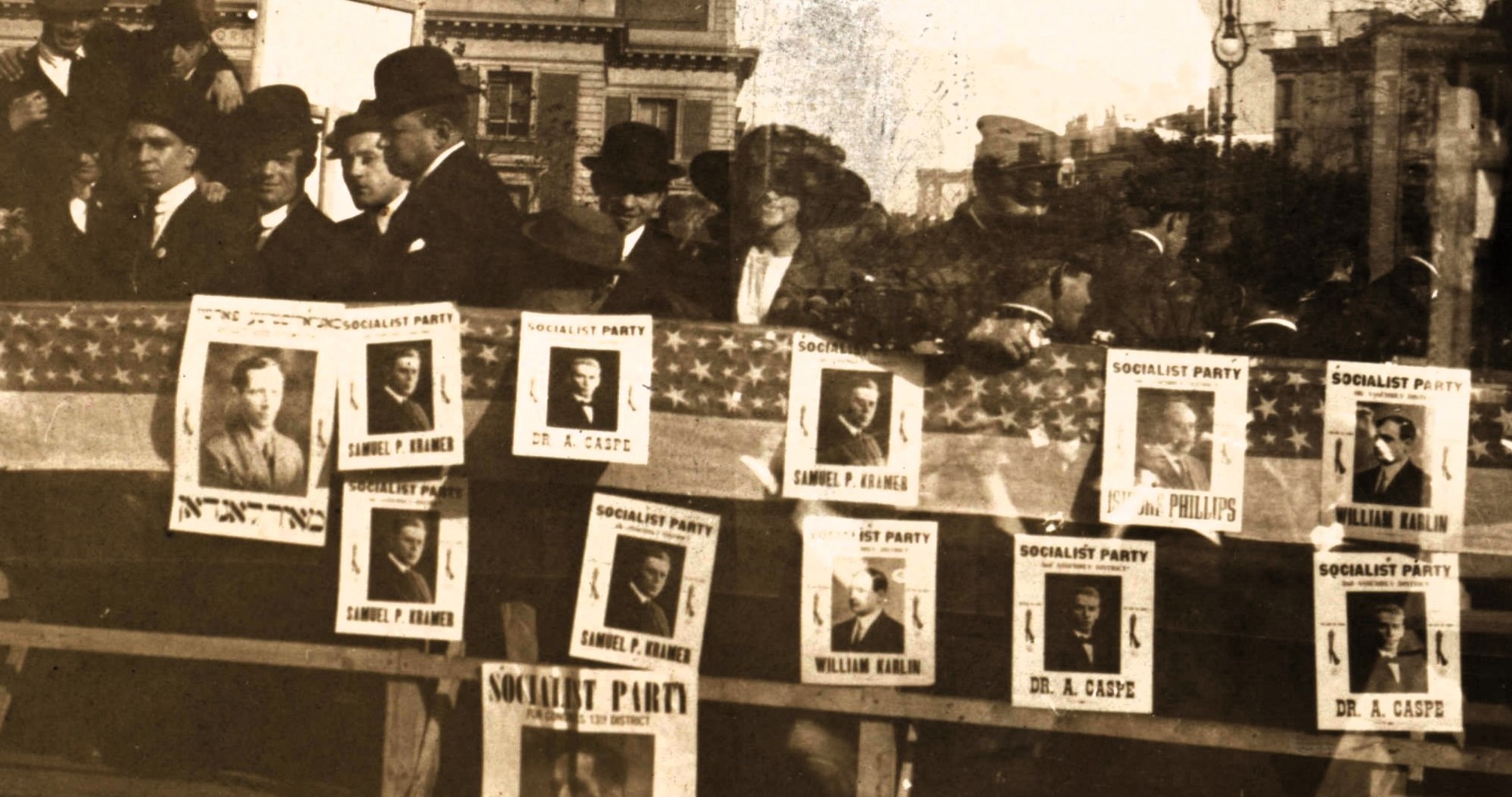
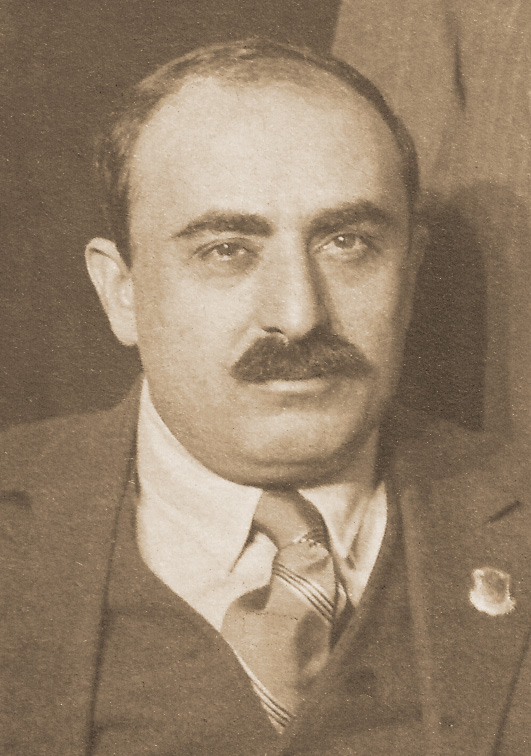
Alexander Trachtenberg was a veteran of the 1905 Revolution who joined the movement here on his emigration to the U.S. Here he became a major figure in both the Socialist and Communist Parties throughout his life. A Yale-educated historian, he was central to the Rand School and its Labor Research Department. Trachtenberg was a central figure of the ‘Workers Council’ group which stayed in the S.P. though it supported the Third International, not leaving until after the Party’s December, 1921 convention in which the right wing again won. They then joined the new legal Workers (Communist) Party. In the Communist Party Tracthenberg is best known for his role as editor of International Publishers. Here, he comes to terms with the Party he built for over a decade on leaving.
‘The Socialist Party–A Victim of Inner Contradictions’ by Alexander Trachtenberg from Workers Council. Col. 1 No. December 15, 1921.
THE forced and voluntary exodus of revolutionists from the Socialist Party did not make the party entirely useless.
Tho only a shadow of the old organization, the party can yet serve a necessary purpose in American political life.
The party has become too discredited among the militant portion of the American working class to parade as a revolutionary organization.
If it should attempt to play such a role, it would be our duty to mercilessly expose it and warn the workers against the snares and delusions of the party’s reformism.
A RESPECTABLE PARTY
On the contrary, the ruling elements in the party are now anxious to advertise the organization as thoroly cleared of all “anarcho-communists” (a darling expression of a Socialist historian who lost his historical sense in the scuffle) and that it is ready to accept the adherence of all those who prefer the “native” Jefferson to the “foreigner” Marx, and are willing to do something for poor brother Labor.
It is precisely this function that the “S.P.” can now perform without fear of being disturbed by troublesome elements within its fold, and it should do the job most admirably.
Many theories have been advanced to explain the disintegration of the Socialist Party as a revolutionary organization.
The sundry reasons always appeared to the writer as results rather than causes of the party’s undoing. The Socialist Party was never a homogeneous organization, and its attempt at Socialist efforts was neutralized by the incessant struggle of the two mutually antagonistic elements which comprised the organization.
A POLITICAL CONGLOMERATION
The party never had the chance. It was never allowed to develop as a revolutionary and class party.
Middle-class social reformers and proletarian revolutionists made the Socialist Party the vehicle of their political activities and aspirations.
Jeffersonian ideologists, who were trying to adapt bourgeois democracy to the class struggle were found in the “S.P.,” together with Marxian Socialists who denied the existence of abstract liberties and put forth proletarian hegemony as against capitalist dictatorship.
All parties of the Second International had an admixture of elements fundamentally hostile to the ultimate aims of revolutionary Socialism, but the American party was blessed with an overdose of them.
Unlike other countries, there never developed in the United States a liberal political party which could act as a receiving station for the disillusioned in the conservative camps.
Both the Republican and Democratic parties were instruments of capitalism and reaction. The periodic change from the administration of one to the government of the other was only a pro forma change. Real power always rested with the same interests—the two parties only taking turns in representing them and carrying out their commands.
JUMP TO SOCIALIST PARTY
Those who sought to promote political and economic improvements and realized that that was not possible of accomplishment thru either of the two political parties, wended their ways to the Socialist Party, because there was no intermediary agency better suited to these political interlopers and their pet millennial reforms.
Those who desired to check the control of government by the vested interests and believed they could accomplish it thru direct election of U.S. Senators, the initiative, referendum, recall, woman suffrage, the primary, corrupt practices acts, civil service regulations, public ownership of public utilities, etc.; or those who wanted to make the burden of the worker lighter or protect his life and limbs by compensation and safety legislation, minimum wages, shorter hours, restriction of woman and child labor and other labor laws, and found that they could not obtain these reforms thru either the Republican or Democratic Party, looked to the “S.P.” for succor.
During the period of muck-raking in various fields of political and economic endeavor, the “S.P.” was receiving numerous additions to its ranks from among disillusioned doctors of variegated social ills.
FARMERS AND SOCIALISM
When the farmers of the middle and southwest became once more embattled (this time against the railroads and the banks) and clamored for lower freight rates, state elevators, cheaper credit and insurance, they found that they could not obtain these remedial measures thru the old parties and joined the “S.P.” in droves.
When the European war broke out, the “S.P.” became the rallying center for anti-militarists, pacifists, and free speech defenders of all sorts.
Had there been a liberal party when the leftward migration of erstwhile Republicans and Democrats began, the “S.P.” would have been spared this assortment of reformers and radicals who entered it not because of its Socialist program, but because it was the third party.
To those with whom the party was a vogue during that period, the ultimate aim to abolish the capitalist system thru a social revolution did not matter.
PARTY SERVED AS OASIS
In the midst of a corrupt political desert the “S.P.” was an oasis for all who heard the call of social service and civic duty.
As far as they were concerned the party stood for clean government and for improvements in the various fields of social and economic relations.
It served the purpose which European liberal parties served for many years and, tho the “doctrinaire” attitude of the Marxian contingent often gave the radicals cause for worry, they were willing to put up with their obdurate fellow-members in order to have a political roof over their heads.
It is needless to say that such elements could not furnish proper material for the building of a well-knit and disciplined revolutionary party. In times of peace the organization, which looked more like a social club than a political party, was able to get along. But when it was put to the test, the structure collapsed like a house of cards.
The emphasis on parliamentary action was primarily due to the influence of the middle-class reformers, who were out for “results.” Didn’t they join the “S.P.” because the other parties would not listen to their importunities?
“PRACTICAL” POLITICS WON
Being the most articulate portion of the member- ship, because of their ability to speak and write, they directed the course of the party along the road of “practical” politics.
Instead of revolutionary Socialist propaganda and participation in the struggles of the workers, vote catching became the alpha and omega of the party’s activity. Everything was directed toward that end. All the resources of the party were saved for the most important period of the year–election time, and if the returns showed an increase in the vote, or the election of a candidate, great was the glory of the party and happy were the leaders.
The methods used in the campaigns never worried those who controlled the destiny of the party. Elections were not means for Socialist propaganda, but ends in themselves, and no chances were to be taken with the outcome of the campaigns.
WRITE THE LAST CHAPTER
The Detroit Convention was the last chapter the party was able to write under the old nom de plume. Complete disintegration followed.
The American Socialist Party bargained away its Socialist soul in its hunt for popularity thru political success. It stands now before the American workers, deprived of its Socialist heritage and barren of even those political results which it set out to achieve.
The inner contradictions have brought the party to its Socialist Waterloo.
The withdrawal of all the Socialist elements makes it impossible for the organization to serve as a dumping ground for all the nondescript liberals and radicals.
The American revolutionary movement cannot but profit by it. It will be removed from the danger of being contaminated by these elements.
The Worker’ Council purpose was to win the Socialist Party of America to the Third, Communist, International and later to win locals and individuals. Published (mostly) weekly by the International Education Association in New York City, Workers Council included important members of the SP, mainly from its Jewish Federation like. J. Louis Engdahl, Benjamin Glassberg, William Kruse, Moissaye J. Olgin, and J. B. Salutsky, editor of the radical Jewish weekly, Naye Welt. They constituted the Left Wing that remained in the Socialist Party after the splits of 1919 and were organized as The Committee for the Third International. Most would leave the SP after its1921 Convention, joining the Workers (Communist) Party after a short independent existence later that year.
PDF of full issue: https://www.marxists.org/history/usa/pubs/workers-council/10-workers-council-1921.pdf
 Revolution's Newsstand