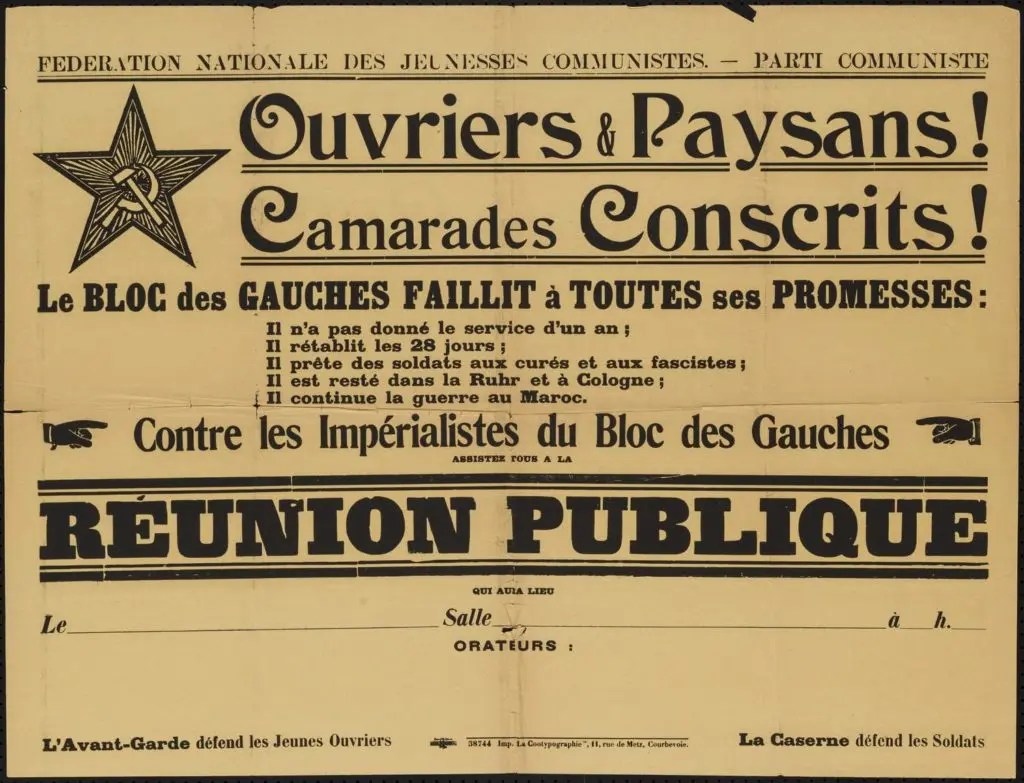
A valuable report on the work during the 1920s of the Fédération des jeunesses communistes de France between congress of the Young Communist International.
‘Young Communist League of France’ The Young Communist International Between the Fourth and Fifth Congresses, 1924-1928.‘ Published by the The Y.C.I., 1928.
The turning point in the life and activities of the French League was the 1924 Congress. This Congress signified the final break with the theoretical and journalistic character of all the work of the League which had been conducted since the split. At this Congress a programme of activities was drawn up and demands for young workers, peasants, soldiers and sailors put forward. The Congress adopted a number of decisions which served as a basis for the energetic work of the League for the period 1924/26.
From 1924 the Y.C.L. officially participated in strikes in defence of the demands of the young workers.
Donarnez. 1,500 young workers struck work. Two of our demands were satisfied (Labour Safeguarding Code, and two hours education for apprentices). Our activities in this conflict assisted considerably the influx of new members into the League.
The strike of young telegraphists. 3,000 young workers took part in this strike. We were officially represented on strike committees and at all meetings. A partial success resulted and a Y.C.L. group was organised among the young telegraphists.
Bootmakers in Nancy. 1,000 young workers participated in this strike. The reformists who were at the head of the movement, under pressure from us were compelled to pay attention to our demands. After the strike we formed a district organisation in Nancy, where previously we had no contact. During the strike many young workers joined the Y.C.L.
Chateau Reguault. In this strike 1,500 young workers participated. This is an extremely important industrial district in the North-West of France. At that period no movement existed here. We were able to bring into the League in this District nearly 50 per cent. of the local youth and to organise a number of groups in the neighbouring districts. At the end of the strike we had recruited 200 new members.
A series of small strikes took place in a number of small places in the provinces, and the League took active part in these.
The second positive feature of the economic work of the French League is the organisation of district conferences and national conferences of young workers. Campaigns for the organisation of these conferences were conducted from February to May and from June to October. The agenda of the conferences was the following: (1) The position of the youth and their demands. (2) Anti-militarist struggle and the defence of the interests of the soldiers. (3) The role and importance of the Young Communist League. Apart from this, questions of local importance were of course also discussed.
During the first period, from February to May, 16 conferences were held, 1,600 youth delegates taking part; of these, 600 being unorganised. Representatives of Trade Unions were present at all Conferences. Over 2,500 young workers and peasants entered the League.
The Conferences called from June to October were better prepared and met with greater success. For instance, in the Paris District, 23 local conferences were called. Seven hundred and fifty delegates took part, 345 being unorganised. Following on the local conferences a Paris District Conference was held in which 500 comrades participated, over 60 per cent. being unorganised.
Fifty-one conferences were held in the provinces with 2,500 delegates participating; 850 being unorganised. Apart from the aforementioned conferences, six peasant youth conferences also took place. The object of these was the preparation of a national congress of workers and peasants. At this Congress 5co young workers and peasants participated, 450 being delegates from various organisations, 106 delegates belonging to no organisations. There were also delegates from the army and the navy. At this Congress the first French Youth Delegation to the S.U. was elected.
In the sphere of trade union work important successes were made. Relations with the General Unitary Confederation of Labour were strengthened, and we first took active part in its Conference in 1925. A resolution on the question of the youth greatly aided us in our further work. This Conference served as a starting point for wide activities on the part of the League in trade union work. All our demands for equal rights, etc., were adopted.
ANTI-MILITARIST WORK.
During the first half of 1925, after the decisions of the Party Congress, the question of anti-militarist work was discussed. at conferences of young workers, and corresponding agitation conducted during the preparations for these conferences. In 1924-25 the colonial wars in Morocco and Syria began Together with the Party and trade unions, the Young Communist League was very active in Committees of Action fighting against the wars, and during the organisation of Conferences by the Committees of Action the League agitated for the calling of parallel Conferences of young workers. The aim of these conferences was the struggle for “elementary demands,” anti-militarist agitation and struggle against war. Several such conferences were held, over 700 delegates taking part.
The anti-militarist work of the League and its fight against the war in Morocco were not limited to participation in the Committees of Action. We conducted three special anti-militarist campaigns having clear and definite aims. Drawing into the campaigns all recruits, acquainting the workers with the demands of the soldiers, the struggle against militarism–such were the aims of our campaigns. During “Anti-War Week” (2nd August 1925), we popularised our slogans and Bolshevist tactic of war against war. This activity greatly increased our influence among the young workers, soldiers and sailors.
EDUCATIONAL WORK AND TRAINING OF LEADING CADRES.
The Central Committees endeavoured in every way to train district functionaries (district secretaries, organisers, etc.). For this purpose six eight-day courses and one central course was held. 180 comrades went through the eight-day courses. The basis of these courses was theoretical training, clarification of the tasks of the Y.C.L., and also preparation for practical work. In 1924 the first central course was organised, 22 comrades taking part. The second course, organised, in 1926, had 55 participants, amongst whom were representatives of the Belgium and Italian Leagues. In 1927 five, eight, and fifteen-day courses were organised. Despite several defects, in general these courses were productive of good results. Our experiences have taught us, however, that a central school demands good preparation and careful selection of comrades participating.
PROGRESS OF THE PRESS.
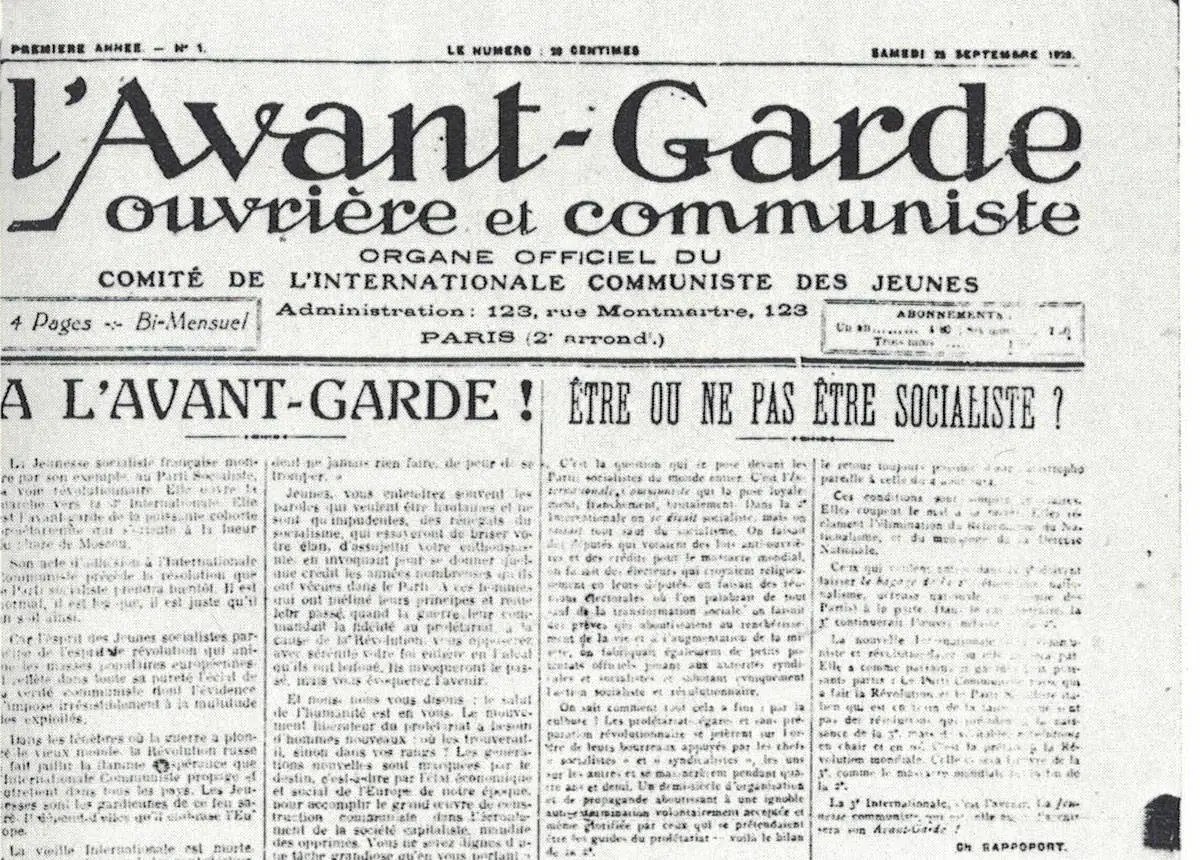
During the last few years our Press has considerably improved. The official organ of the League “L’Avantgarde,” published in 1924 as a fortnightly, had a subscribers’ list. of 1,000 and a circulation of 8,000 copies. In September, 1925, it was decided to publish the paper weekly. At the end of May the sale increased to 11,000, and the number of subscribers increased to over 2,000. In connection with strikes taking place at that period special editions were issued, and some weeks the sales increased to 12 and 13 thousand copies. In 1927/28 the sales increased, though slowly. The average sales are 13,000 copies, with a subscription list of 3,000. The character of the paper has altered somewhat; a network of young worker correspondents has been organised. A special weekly was issued for the Paris district with the idea of obtaining a sale of 8,000 copies. Amongst the young workers our organ attains greater and greater popularity. Letters from various localities, and the successful fight of our sellers, particularly with the Fascists in the Paris district, prove the possibility of spreading our paper. With regard to our other publications, the sales of Conscrit ” (Conscript), published by the Y.C.L. twice yearly, are as follows: 1925, 30,000 copies; 1926, 40,000; 1927, 60,000 copies. “Liberté,” also published twice a year, had the following sales: in 1925, 20,000 copies in the first half and 25,000 during the second; in 1926/27, 50,000 copies.
Regarding publications affecting the army, the sales of “La Caseme Barracks grew in the following manner: 1924, 6,000; 1925, 12,000; 1926, 16,000; 1927, 18,000; 1928, 21,000. Despite the great difficulties which accompany the spreading of this publication, it is widely read in the army. The 21,000 copies published at the present moment, cater for not less than 60-80 thousand soldiers. “Jean le Gouin” is published in 4,000 copies in 1928.
THE PERIOD 1926-1927.
Here we must mention two important aspects of our work: economic trade union struggle and anti-militarist work. Regarding the first, Our League has played an active part during the struggles in the period of the economic crisis of 1926. Our activities amongst the masses of unemployed young workers are to be seen in the industrial conferences organised under the auspices of the Y.C.L. Several of these meetings met with satisfactory success, and they had great importance in view of the fact that a great number of unorganised young workers participated in them. These conferences enabled us to determine methods of contact with young workers still employed in industry, for the struggle against capitalist rationalisation. The Unitarian Trade Unions were prepared to support the initiative of the Y.C.L. and to assist us. Meetings took place between the committees of the various Trade Unions and the League in order to divide the work of preparation of these conferences. The Y.C.L. was able, in a number of places, to organise a United Front with the Young Socialist League and several reformist trade unions. The Y.C.L. repeatedly took upon itself the initiative of organising demonstrations of unemployed young workers before the Municipal authorities and the Ministry of Labour. Despite the absence of experience in this work, successes can be recorded in so far as the organisation of the struggle is concerned, and also in that several demands were conceded. We also played an energetic part in a number of economic struggles. Our trade union work in the General Unitary Confederation of Labour made great strides. Our participation in the congress of September, 1927, was fairly successful. During the congress a conference of youth delegates was held, 60 delegates taking part. Some important resolutions were adopted; our programme of economic demands was agreed to, and the problem of anti-militarist activities was, for the first time since the commencement of the war, put forward for consideration, on the initiative of the League, thus making possible the adoption of a number of extremely important decisions (organisation of a trade union commission for anti-militarist work, etc.).
In order to obtain an understanding of our position in the trade union movement, and of the possibilities of our work in this field together with our successes, we will cite figures of youth representation in the leading organisations.
In the Central Executive Committee of the General Unitary Confederation of Labour the League has two numbers, in Central Committees of Unions–engineers, five members; textile union, three; woodworkers, two; clerks, two; miners, five; food workers, three; builders, three; chemical workers, two; leather workers and furriers, two; postal and telegraph clerks, two: Total 29. In regional organisations, of which there are 25, the League is represented at the most by two-three young workers, by this means the number of youth representatives is nearly seventy. There are nearly 1,500 district trade unions. We have at last succeeded in obtaining youth representation in more than 700 of such unions. Eighty-five per cent, of these youth representatives are members of the Y.C.L. It is true that our fractions are weak, but nevertheless they conduct some work. At the same time, in the majority of cases, our work is conducted in the trade unions through our contact with the youth officials. Our advantageous position in the trade union movement and the wide possibilities of work have made possible in a new phase in the economic work of the League, which is striving to develop it in the field of the trade union movement.
The most important factor in our work during 1927 was the struggle against the calling-up of reserves for training. During that year there were sixty cases of protests of regiments or divisions against this: Ranging from collective refusal to shave to destruction of prisons, collective attendance on the doctor, walking through the town with red banners, mass refusal to form up, etc. The discontent amongst the soldiers caused by the first attempts at war training, found its echo throughout France. This caused an energetic attack by the bourgeoisie on the soldiers, sailors, and our Party and Y.C.L. Severe repressive measures were adopted. Penal servitude from ten to twenty years was inflicted upon many soldiers. Hundreds of active members were tried, many for their struggle against war, others for anti-militarist work during 1927. Anti-militarist work among new conscripts was also a feature of this activity.
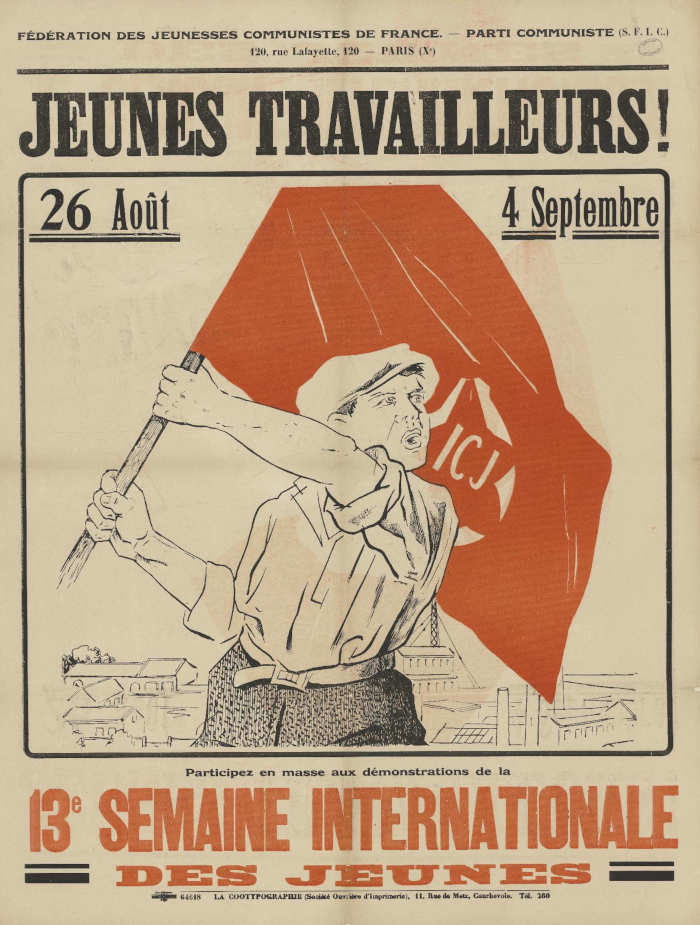
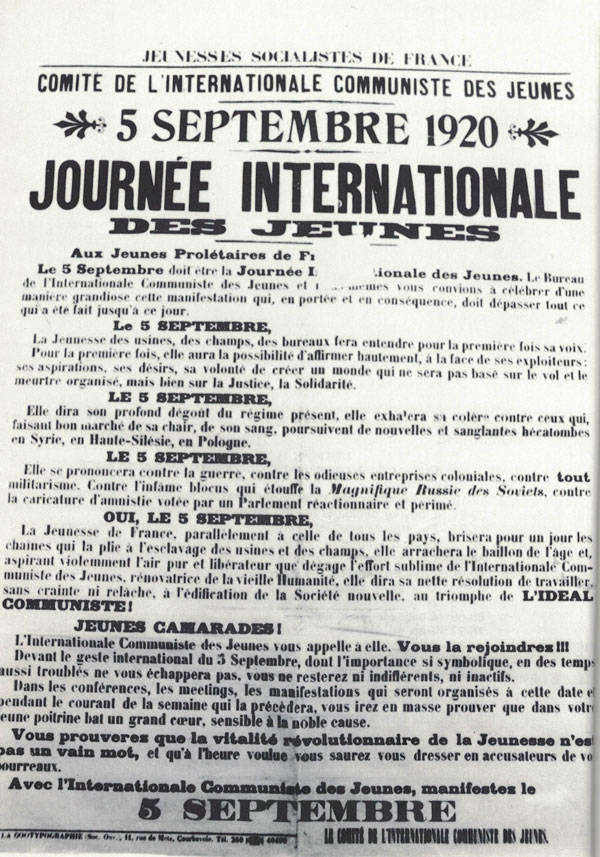
Our national campaigns. The yearly organisation of International Youth Week became the real monopoly of our League. Every year the importance of this campaign increases. Huge meetings are organised in the centre of the town, and numerous local and factory meetings held, and at the end of the week in all large districts a central demonstration is held. This Week grows in popularity and becomes a tradition.
Anti-militarist campaigns are organised twice yearly; namely during each recruiting period. In March and October twenty propagandists are sent for a month all over the country. It is necessary to remark amongst the forms of this work the organisations of new conscripts, meetings of Communist conscripts and sympathisers; at all such meetings a speech on the role of the army is made, and on the importance of struggle and the necessity of organisation within the barracks, etc. These campaigns become traditional, and at the end of each such campaign the results are carefully considered in order to find out the defects and mistakes in the work.
Apart from this, the Party and trade unions conduct other campaigns in which our League takes active part, puts forward its own slogans and demands and sends its propagandists to meetings and demonstrations (Day of the Commune, Anniversary of the imperialist war, Demands for amnesty). The Y.C.L. was able to use the election campaign for its anti-militarist agitation and for preparation of 1st May celebrations.
MEMBERSHIP FOR THE LAST YEARS.
On the 31st December, 1924, there were 11,876 membership cards in existence with 44,836 stamps. 31st December, 1925, 16,000 membership cards with 55,980 stamps. It can be seen that the membership of the League considerably increased. This growth was the logical outcome of the economic and anti-militarist agitation, conducted by the League after the 1924 Congress. But in the following year there is a numerical decrease in the membership. A considerable number of new members were made, but at the same time the number of fluctuating members increased. This demanded special attention, and it was necessary to seek out such methods of work as would strengthen the loyalty of young workers to the organisation, and to open a wider field for political activity. These questions stand before the League. An improvement is noticeable, but it is necessary to say that we have not yet completely settled this extremely complicated problem.
At the 31st May, 1926, we had 11,785 membership cards and 35,350 stamps. These were confiscated in the middle of the year. In October, 1927, 14,800 membership cards were registered and these figures go to prove a certain stabilisation in the membership.
At the present moment the membership remains stationary. This stagnation is apparently a temporary phase, as the Y.C.L. undoubtedly has great influence on the masses of young workers. But there is a discrepancy between our influence and our membership. It is necessary to pay serious attention to this, and to rid ourselves of this difficulty.
Access to full book: https://hdl.handle.net/2027/uc1.$b812215
 Revolution's Newsstand