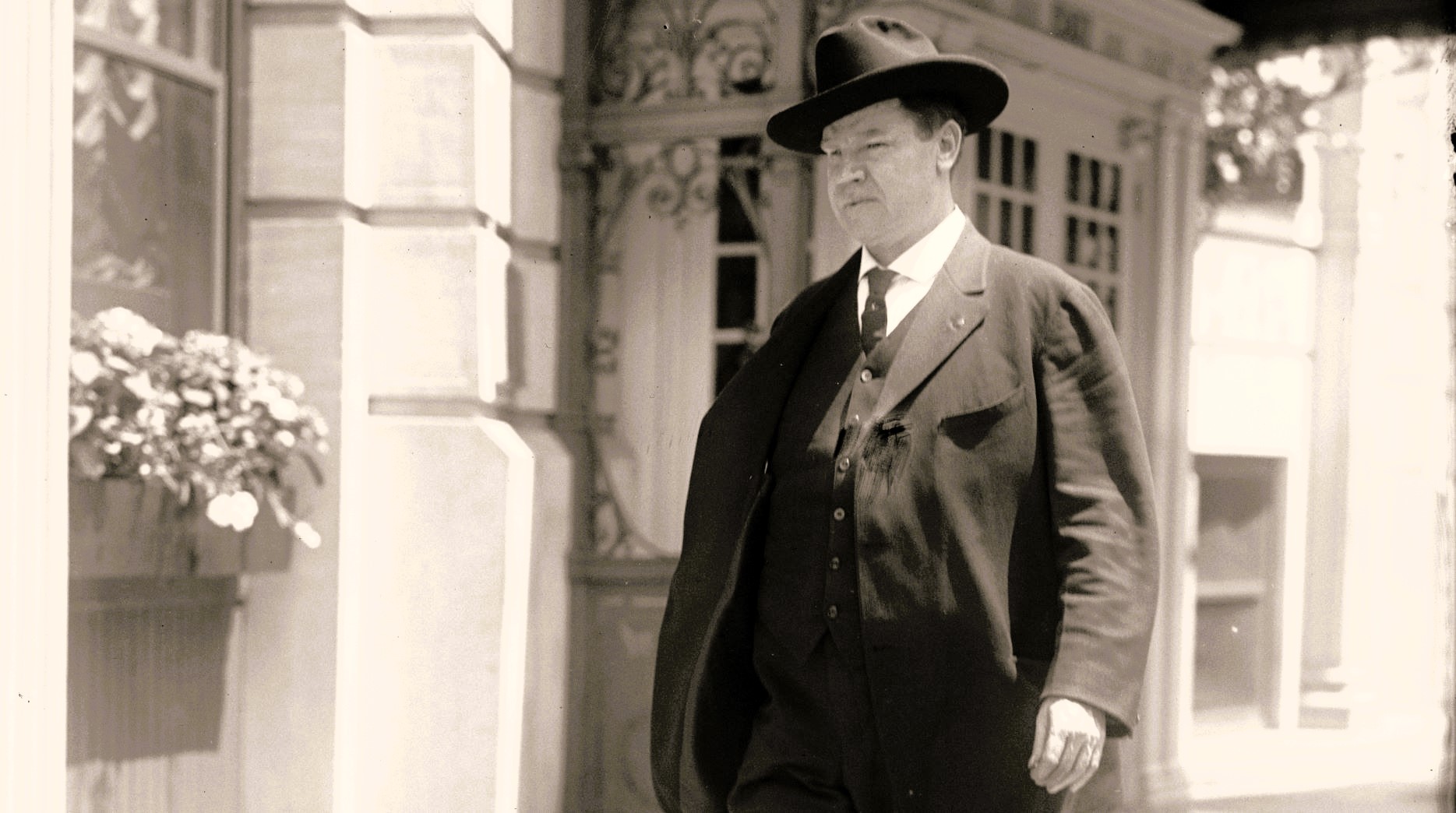
George Hardy, also a leading wobbly who became a Communist, with a political biography of William D. Haywood, a central figure in U.S. working class history, on his March 18, 1928 death in Moscow exile.
‘The Death of William D. Haywood’ by George Hardy from Communist International. Vol. 5 No. 13. July 1, 1928.
COMRADE William D. Haywood, whose death occurred at Moscow on May 18th, recalls the class struggles of the American working class, especially those in the metal mines of the Western States and during the world war.
“Big Bill,” as he was known to all his comrades and associates, was born in Salt Lake City, Utah, 59 years ago, when this State, among others, still formed part of the frontier of rapidly developing American capitalism. He lived through a period in his early life when the various public officials of the Western States were giving away the country’s raw materials, minerals, timber, etc. to the dominant capitalists such as Guggenheim, Meyerhauser, etc., These resources were developed by these competitive capitalists, who afterwards formed trusts in every industry. Such industries attracted the most adventurous, aggressive and rebellious workers. Bill entered the mines at an early age and rapidly developed the spirit which animated these workers, many of whom had drifted westward because employers had blacklisted them for their union activities in the Eastern States. Being courageous, he soon became a fearless champion of the Western workers, and afterwards became an official, and finally the General Secretary of the Western Federation of Miners, which was organised in Butte, Montana, in 1893.
Comrade Haywood was not a great theoretician, but a practical worker amongst the masses. He never once left the masses. And what is more, he preferred to give his whole attention to the large masses of semi-skilled and unskilled workers. This, while not altogether a correct estimation, can easily be explained. In the West, where most of his time was spent, modern industry did not exist, and the semi-skilled and unskilled lumberjack, miner and the builders of roads, tunnels, railways, etc., almost constituted the working class. Nor was his theory together a short-sighted one, for he believed the “skilled workers would be forced to ally themselves with the unskilled to obtain protection,” standardised industry eliminated many skilled as workers.
The Western Federation of Miners affiliated to the American Federation of Labour, but in 1897 it disaffiliated. The rebellious and revolutionary workers regarded the craft policy of the A.F. of L. as too reactionary and narrow for them to be associated with. Thus it is seen that this failure to estimate the value of remaining inside reactionary unions is almost traditional in the United States.
The Western Federation of Miners was an industrial union and organised every person working in the mines. It soon came into conflict with the ruthless administrators of the mines. Battle after battle took place very rapidly, and all the forces of the employers and the State were employed to beat the miners. In 1893 strikes broke out at Cour d’Alene, at Cripple Creek in 1894, Leadville 1896 and 1897, again in Cour d’Alene in 1899, Telluride in 1901, Idaho Springs in 1903 and again at Cripple Creek in 1903-4. Following these last two strikes during which the miners engaged in armed struggles, comrade Haywood was kidnapped and taken from Colorado to Idaho in February, 1906, where he was framed-up on a charge of murdering an ex-Governor of the State named Steunenburg. He was acquitted in 1907, when an agent provocateur, the chief witness. against “Big Bill,” was thoroughly exposed and finally, to save the face of the prosecution, sentenced to a term in prison which he never fulfilled.
“Big Bill” never harboured any pacifist illusions, in spite of being rather sentimental, and this made him all the more dangerous in the eyes of the ruling class. Nor was he at any time completely in the category of the anarchist-syndicalists. He defended the need for a political party, and the Western Federation of Miners decided, according to Bressenden’s “History of the I.W.W.” to adopt the principle of “socialism without equivocation,” and this principle was reaffirmed in the 1903 and 1904 conventions which recommended “the Socialist Party to the toiling masses of humanity.” “Let us all strike industrially here and now, if necessary,” said a resolution signed by comrade Haywood, “and then strike with unity at the ballot box…putting men of our class into public office.” The temperamental side of comrade Haywood can be seen in a message he wrote to the Western Federation of Miners from Ada County Jail, Idaho, in September, 1906, while awaiting trial on the above murder charge:
Organised industrially, united politically, labour will assume grace and dignity, horny hand and busy brain will be the badge of distinction and honour, all humanity will be free from bondage, a fraternal brotherhood, imbued with the spirit of independence and freedom, tempered with the sentiment of justice and love of order: such will be…the goal and aspiration of the Industrial Workers of the World.”
Comrade Haywood was one of the founders of the I.W.W. (Industrial Workers of the World) in 1905. He represented the Western Federation of Miners in the preliminary conferences which was the most powerful union that became a foundation unit of the I.W.W. However, when comrade Haywood was in jail, the reactionary right-wing obtained a decision to disaffiliate in 1907, notwithstanding the fact that the I.W.W. was the logical development within American industry. Trusts were now rapidly developing and rendering ineffective isolated and sectional unionism.
Comrade Haywood did not become deeply involved in the split which took place in 1908 which occurred after the political clause was eliminated from the preamble, and he still retained his membership in the Socialist Party. He was a member of the National Executive Committee of the Socialist Party at the same time remaining active for the I.W.W. in leading large mass strikes. He was a leader of most of the great spontaneous strikes which took place in the years just preceding the war, was arrested many times, and saw scores of I.W.W. workers brutally murdered in the class struggle.
With the adoption of sabotage by the I.W.W. as a weapon in the class struggle, and the indiscriminate propaganda following from it, sabotage soon became an issue within the American Socialist Party, and comrade Haywood, as an Executive member, defended it. The development of this issue clearly showed the bourgeois character of the Socialist Party and marked a turning point in the Party, for it had been regarded as more or less under Marxian influence. Victor Berger led the fight against the left-wing which not only resulted in a decision against sabotage as a class weapon, but also in the following far-reaching decision:
“That any member of the Party who opposes political action or advocates crime, Sabotage, or other methods of violence as a weapon of the working class to aid in its emancipation, shall be expelled from membership in the Party…”
Haywood leaves Socialist Party
This decision was adopted by 191 to 90 votes after Victor Berger had delivered himself in real reformist fashion as follows: “I want to say to you, comrades. I do not believe in theft as a means of expropriation (of the capitalist class), nor in a continuous riot as a free speech agitation.” As a result of the passing of this resolution, comrade Haywood was in effect expelled from the Socialist Party. Thus we see the commencement of the decline of the American Socialist Party which, from the point of view of practical working-class activity, culminated in its total and complete collapse, and was inevitably supplanted by the formation of the Communist Party after the Russian revolution.
The I.W.W. had been fraught with internal crisis from its very inception. After the 1908 Convention, the organisation harboured many anarchist elements who nearly destroyed the organisation in 1913. “Decentralisation versus Centralisation” became a real political question inside the movement, although outwardly the I.W.W. maintained its anti-political bias. The I.W.W. had been influenced in its policy to some extent by French syndicalism, but nevertheless there were enough Marxists at the Convention in 1913 to decide upon centralisation as the structural form of organisation. Vincent St. John led the fight correctly against the decentralisers, who were beaten, but afterwards resigned the General Secretaryship and comrade Haywood again resumed the position in 1914.
Preceding the election of comrade Haywood in 1914 the I.W.W. had been more of a propaganda body than a real labour union. It had engaged in scores of free-speech fights, and to call or enter unorganised strikes always kept the I.W.W. in front of the revolutionary struggle. The I.W.W. did the work every real revolutionary organisation should always be engaged with, but it was done too haphazardly. Careful preparation for strikes was lacking, and notwithstanding the militance and revolutionary fervour exhibited in the strikes, free speech fights, etc., the “folded arms strike” was sometimes advocated by I.W.W. leaders including “Big Bill,” which again showed the need for a revolutionary Communist Party to bring clarity and a good tactical line in the movement. However, notwithstanding the bad strike tactics of the I.W.W., and, at times, somewhat confused leadership, comrade Haywood with the Western Federation of Miners and the I.W.W. will go down as having fulfilled a revolutionary role in this period of American history, and upon many revolutionary fundamentals they were absolutely right.
It was comrade Haywood who entered the timber workers’ strike in Louisiana where negroes predominated, and finding that two meetings had been arranged according to the law, one for “whites” and the other for negroes, he immediately suggested one meeting, “for you are all exploited by the one boss, in the one industry and under the same rotten conditions.” Bill’s correct attitude regarding immigrants is also well worth noting. He urged the first conference of the I.W.W. to establish information bureau for abroad for distribution of literature and to prepare for meeting the immigrants upon arrival in America so as to direct them into the union.
Results of the War on I.W.W.
The war gave a new and great impetus to the I.W.W. and completely changed its character. It developed rapidly into a labour union movement, and the propaganda side inevitably became a secondary question. Large numbers of agricultural, mine, lumber, marine, construction and other workers flocked into the organisation. Full of enthusiasm, Big “Bill” sought to invade every industry, sending organisers into industries where the “closed shop” existed for the American Federation of Labour, such as the building, printing and coal mining industries. A small minority tried to press upon him that he was spending money uselessly and urged concentration upon industries where. the character of the workers, and the industries in which they worked, was most favourable to the I.W.W. However, due to the successes made, this question never became an issue nationally, but was certainly by far the best policy.
Another part of the I.W.W.’s traditional but wrong policy was never to sign any kind of collective agreements. This proved a controversial question when the I.W.W. had a mass character during the war, but no change took place even when offers were made in the lumber industry in the great strike of 1917 which involved over 70,000 workers. When the men were driven back to work they practised. guerilla warfare and established the eight-hour day, etc. The continuous interruption by I.W.W. strikes in one industry after another during the war led to many arrests, and in 1917 Bill sent his famous telegram to President Wilson, which no doubt stimulated the pending crisis for the I.W.W. He threatened to call a general strike of agricultural workers and “let the wheat rot on the ground,” if I.W.W. prisoners were not released from jail. The apex of the I.W.W. had been reached, and with the arrest of 112 of its leaders, it constantly declined. As we have seen, much confusion and unclearness prevailed before the arrests, but it became chaotic afterwards when the anarchist influences once more became the dominant features at meetings and conventions.
The I.W.W. became a defence organisation in defending those arrested, as it was made illegal in nearly every place of importance where the organisation existed. Still professing anti-political doctrines, it was noticeable how the I.W.W. now became engaged, unconsciously, in political action, utilising every avenue of political propaganda in spite of its professed policy. It sent delegations to the State officials, presented a long petition to the United States President, and correctly utilised bourgeois Liberals to write articles for the press to influence public opinion.
It became clear to many of the arrested leaders, including comrade Haywood, that all mass strikes assume a political character, and with the coming of the October revolution in Russia, a definite cleavage began to develop around the question of the need for a revolutionary political party to direct mass movements. This did not only affect the leaders: to cite one confused instance and tendency, a candidate for Mayor of Seattle, Washington, announced himself favourable to freedom of speech and the right of open and legal organisation for the I.W.W. On hearing this the rank and file dropped their anti-political stand and voted to elect him. Comrade Haywood correctly saw in this opportunist candidate a manœuvre for office and as the I.W.W. members who voted learned only after he was elected, for the city policy continued to suppress the organisation. However, some good must have been done for many must have learned from their participation in the election of an independent bourgeois office-seeking politician, the need for a real revolutionary political party.
Some of the I.W.W. leaders under arrest with “Big Bill” adopted an over-diplomatic attitude, but others were equally tactless. Still, Bill, to my knowledge, was never heard to attack the defiant as he was defiant himself, but he did attack the over-zealous “diplomat,” the one who sensed the need for political manœuvring but was not sure how to act as a revolutionary worker. One instance brought Bill out correctly he had rightly sent a message to the United Mine Workers’ Annual Congress asking them to vote for a general strike to release I.W.W. prisoners throughout the land. J.P. Thompson, an arrested leader, thought this very unwise as we were charged with this very act of calling strikes to hamper the Government’s war programme. As Bill was in another part of the jail I was asked by J.P. Thompson to tell Bill “to put ice under his head and cool off.” When I informed “Big Bill” of this, back came the reply: “Tell the big—to take the ice from under his feet.” And this was comrade Haywood’s courage and determination shown preceding the trial which lasted 138 days and resulted in his 20 years’ sentence from which he escaped by going to the U.S.S.R.
Comrade Haywood was an internationalist and heartily endorsed the policy of the Communist International and the formation and continued organisation of the R.I.L.U. He must have clearly seen the inevitable decline of the I.W.W. He joined the Communist Party of America while in the United States, although he still remained a strong believer in the need for a revolutionary union movement along the structural lines of the I.W.W. He died in Moscow, the capital of the world proletariat, believing in the need for strengthening the Communist Party of America. He witnessed the decline of the Socialist Party from the day he was thrown out. He also saw the rise and fall of the I.W.W. the latter being due to a failure to respond to the changed conditions. But small as the I.W.W. is today, as the recent Colorado strike shows, it is still a political problem for the Communist Party of America, especially in the Western States. The decline of both the I.W.W. and the Socialist Party, however, marks a transitional stage from one period of capitalist development in America into the post-war period of American imperialist expansion. These organisations have not changed and therefore, as was inevitable, have been superseded by the revolutionary Communist Party in the United States of America, which is responding to the need for a revolutionary leadership of the exploited masses.
The ECCI published the magazine ‘Communist International’ edited by Zinoviev and Karl Radek from 1919 until 1926 irregularly in German, French, Russian, and English. Restarting in 1927 until 1934. Unlike, Inprecorr, CI contained long-form articles by the leading figures of the International as well as proceedings, statements, and notices of the Comintern. No complete run of Communist International is available in English. Both were largely published outside of Soviet territory, with Communist International printed in London, to facilitate distribution and both were major contributors to the Communist press in the U.S. Communist International and Inprecorr are an invaluable English-language source on the history of the Communist International and its sections.
PDF of full issue: https://www.marxists.org/history/international/comintern/ci/vol-5/v05-n13-jul-01-1928-CI-grn-riaz.pdf
 Revolution's Newsstand