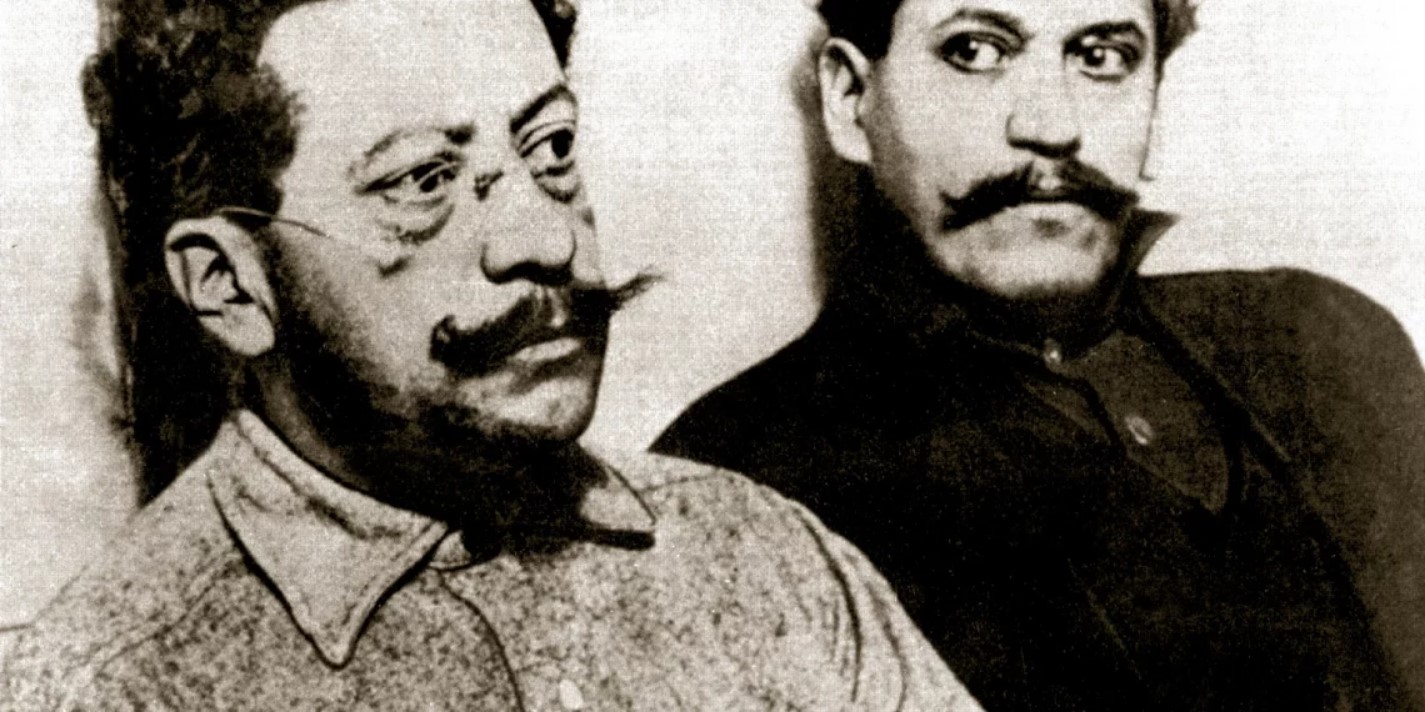
John Reed on the arrest of Partido Liberal Mexicano leaders Enrique and Ricardo Magon in Los Angeles and the suppression of their newspaper El Regeneracion. Ricardo Magon would dies in U.S. prison under disputed circumstances in 1922.
‘The Persecution of Mexican Refugees’ by John Reed from The Masses. Vol. 8 No. 8. June, 1916.
THE desperate anxiety of the Wilson administration to bring peace in Mexico at all costs is exemplified in the methods by which they have supported the Carranza government in this country. Through the Carranza party, which the President has supported in Mexico, no longer will or can support the President, we keep on shipping ammunition to the Carranza troops, trying to smooth down friction between Queretaro and Washington by negotiations–and now finally prosecuting Mexican exiles in this country who continue to advocate the only principles on which the Mexican revolution can be won.
On February 15, in Los Angeles, California, United States secret service men entered the office of El Regeneracion, organ of the Mexican Liberal Party, seized the papers and arrested two of the editors, Enrique and Ricardo Magon, beating up Enrique Magon so frightfully that he had to be sent to the hospital. The paper was suppressed and the two Magon brothers and William C. Owen were indicted by the Los Angeles Grand Jury, charged with using the mails to incite “murder, arson and treason”; the indictment is based upon certain passages published in a recent issue in which Mexican peons are warned against trusting in the good faith of the Carranza administration, and encouraged to continue the struggle for “land and liberty.” The two Magons are in jail, their bail being fixed at $7,500 apiece. William C. Owen, who was in the state of Washington, escaped and is in hiding–from where he is writing thousands of letters all over the country to acquaint the American people with the circumstances.
This looks like the good old days of Diaz, when under Presidents Roosevelt and Taft, United States Federal officers and secret service men relentlessly pursued the Mexican Liberals exiled in this country, and without legal procedure hustled them across the border to be stood up against a wall by a Diaz firing squad.
Since the days when Porfirio Diaz himself launched his armed revolution from American soil, the attitude of the United States toward political refugees from Mexico has changed. Three times during President Taft’s administration the United States troops, contrary to all precedent, were ordered to the border to drive back into the hands of pursuing Diaz soldiers fugitives who attempted to cross the Rio Grande and save their lives on Texas soil. Those that were not driven back were captured by United States military authorities; in some cases the soldiers themselves led their prisoners to the border and drove them across, and in some cases handed them over to the civil authorities, who kidnapped them without legal procedure or instituted proceedings against them on the charges of “murder and robbery somewhere in Mexico,” or delivered them to the Immigration Department to be deported as “undesirable immigrants.”
Under the “murder and robbery” excuse, whenever there was an uprising somewhere in the interior of Mexico, the Mexican government would have some Liberal who had long been residing in the United States arrested, and charge him with “murder and robbery” on that occasion. Often neither the time, the place, the victims, or the booty were named; and yet again and again men so accused in the United States were convicted and turned over to the Mexican authorities. Even some United States Federal judges before whom these cases were prosecuted declared that the accused had only committed political offences and thus could not be extradited.
Under the immigration laws a foreigner who has resided in this country three years cannot be deported as an undesirable alien. But in the fall of 1906, for example, ten Mexican Liberals were so deported, although most of them had been living in this country for many more than three years, and one of them had been editing a paper in Douglas, Arizona, for thirteen. They were of course arrested on crossing the line, some of them killed, and others given long terms of imprisonment. The charge against them was that they were members of the Liberal Party! In the Los Angeles District Court there was on file for many months a warrant for the arrest of Señor de Lara, his wife, a Mexican woman and an American, ready for service at any time; the charge was “violating the neutrality laws by having circulated a manifesto printed by the Liberal Party.“
The suppression of El Regeneracion is the first instance since Taft’s time of the wholesale persecution of Mexican Liberal publicists that went on in this country under Roosevelt and Taft. But then it was common. In 1909 Punto Rojo, a Mexican anti-Diaz paper of Texas, was suppressed and ten thousand dollars reward was offered for the capture of its editor. The suppression of nine other Mexican papers along the border was accomplished through the agency of United States officials, as violations of United States laws.
In 1904 the Magon brothers and a small group of followers crossed the Rio Grande and established their paper El Regeneracion in San Antonio. The journal had been going a few weeks when a Mexican tried to murder Ricardo Magon with a knife. Enrique Magon grappled with him, and was arrested and fined thirty dollars in the police court; the attempted assassin was not arrested. After that the Magons moved to St. Louis, where they reestablished their paper. There the Furlong Detective Agency put operatives into the post-office and waylaid their letters, put operatives into their office and stole their subscription list, and set out to hunt for someone to bring libel proceedings against the paper. Then the Post Office Department revoked second-class mail privileges that had been granted El Regeneracion, saying that it objected to the “general tone of the paper.” Two different parties were brought from Mexico to institute charges of civil and criminal libel against the editors, who were thrown into jail. The offices of the paper were broken into and the subscription list seized, and three hundred Liberals in Mexico were jailed and shot as a consequence.
After the Magons’ attempted revolution, which was to have been launched from El Paso in October, 1906, and the betrayal and death of most of their companions, the Magons filed in disguise to California, where in Los Angeles they finally revived the paper under the name of Revolucion. There the detectives found them out, and while arresting them beat them brutally with pistols until Ricardo Magon lay bleeding and insensible on the ground. There was evidently a plot on foot to kidnap them, but they made such an outcry that the detectives were forced to take them to the police station, where the only charge against them was found to be “resisting an officer.” The officers in question were detectives from the Furlong Agency. Attorney General Bonaparte was so interested that he wired the District Attorney in Los Angeles: “Restrict habeas corpus proceedings against Magon et al., on all grounds, as they are wanted in Mexico.” The Diaz government hired the best lawyers in California to prosecute the chief Mexican Liberals, and all sorts of flimsy charges were brought against them of imaginary crimes committed on the “blank day of the blank month in the blank State of Mexico.” De Lara took their place as editor of Revolucion, and he, too, was soon arrested on a “murder and robbery” charge. After that only the printers were left to publish the paper; which they did until they. too, were arrested on the same kind of accusations. De Lara, when the absurdity of the charges against him had been proved, was finally released, but Ricardo Magon, Villarreal and Rivera remained in prison for nearly three years, for almost a year incommunicado. After all this time in jail the three Liberals were found guilty of “conspiracy to violate the neutrality laws of the United States,” and sentenced to eighteen months’ imprisonment in the penitentiary at Florence, Arizona–which they served. In 1908 various departments of the American government made public the government’s conviction that the charges of “murder and robbery” and of “undesirable alien” were too clumsy, and that it was the desire of the administration to deport Mexican political refugees as “common criminals.” Failing that, our Department of Justice concentrated its energies on securing imprisonment for “violation of neutrality laws” or “conspiracy to violate neutrality laws.” Half a hundred Mexicans were tried and kept in prison for months on these grounds; but when they came to trial the prisoners were almost always acquitted.
Now the Magons are again arrested, under the same kind of indictment as that which used to be handed down against Mexican Liberals in this country in the old days–the days before we allowed Madero to launch his armed expedition from El Paso, whereby Diaz was overthrown. In the confusion resulting from the European war, perhaps the authorities, the backers of Carranza, hope that this incident will pass unnoticed. But it is up to all the friends of liberty and to the working class in this country to realize that the Magons are friends of Mexican liberty, and that a blow struck at Mexican liberty is a blow struck at liberty everywhere.
The Masses was among the most important, and best, radical journals of 20th century America. It was started in 1911 as an illustrated socialist monthly by Dutch immigrant Piet Vlag, who shortly left the magazine. It was then edited by Max Eastman who wrote in his first editorial: “A Free Magazine — This magazine is owned and published cooperatively by its editors. It has no dividends to pay, and nobody is trying to make money out of it. A revolutionary and not a reform magazine; a magazine with a sense of humour and no respect for the respectable; frank; arrogant; impertinent; searching for true causes; a magazine directed against rigidity and dogma wherever it is found; printing what is too naked or true for a money-making press; a magazine whose final policy is to do as it pleases and conciliate nobody, not even its readers — There is a field for this publication in America. Help us to find it.” The Masses successfully combined arts and politics and was the voice of urban, cosmopolitan, liberatory socialism. It became the leading anti-war voice in the run-up to World War One and helped to popularize industrial unions and support of workers strikes. It was sexually and culturally emancipatory, which placed it both politically and socially and odds the leadership of the Socialist Party, which also found support in its pages. The art, art criticism, and literature it featured was all imbued with its, increasing, radicalism. Floyd Dell was it literature editor and saw to the publication of important works and writers. Its radicalism and anti-war stance brought Federal charges against its editors for attempting to disrupt conscription during World War One which closed the paper in 1917. The editors returned in early 1918 with the adopted the name of William Lloyd Garrison’s The Liberator, which continued the interest in culture and the arts as well as the aesthetic of The Masses/ Contributors to this essential publication of the US left included: Sherwood Anderson, Cornelia Barns, George Bellows, Louise Bryant, Arthur B. Davies, Dorothy Day, Floyd Dell, Max Eastman, Wanda Gag, Jack London, Amy Lowell, Mabel Dodge Luhan, Inez Milholland, Robert Minor, John Reed, Boardman Robinson, Carl Sandburg, John French Sloan, Upton Sinclair, Louis Untermeyer, Mary Heaton Vorse, and Art Young.
PDF of full issue: https://www.marxists.org/history/usa/pubs/masses/issues/tamiment/t62-v08n08-m60-jun-1916.pdf
 Revolution's Newsstand