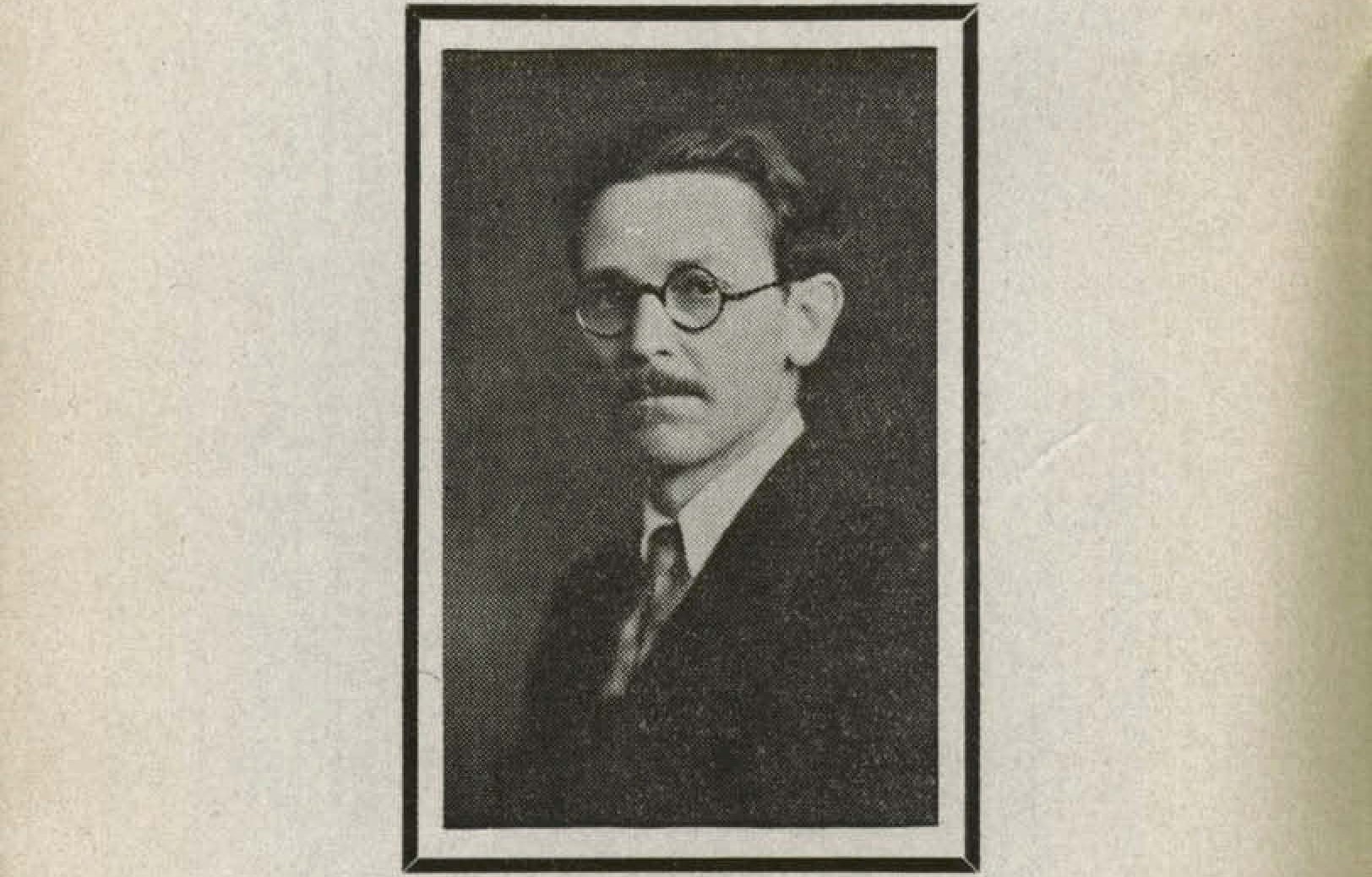
Haim Kantorovitch gives us much to think about as he steps back to take the materialist’s long-view of psychology’s emergence as a school of modern thought, from Socrates to Vladimir Bekhterev, in this major essay for V.F. Calverton’s ‘Modern Quarterly’.
‘The Social Background of the New Psychology’ by Haim Kantorovitch from Modern Quarterly. Vol. 4 No. 1. January-April, 1927.
I.
AS a separate science, psychology is very young. Its modern history only begins in the nineteenth century, and its real history is no more than fifty years old. There are even some psychologists who believe that everything that has been done in the field of psychology till now has been only of a preparatory nature. John B. Watson and his followers in America and the objectivists all over the world, for instance, believe that psychology is only now beginning, with the publication of their works. Watson thinks that his behaviorism marks the beginning of real psychology. Professor Bechterew is, on the other hand, sure that the real history of psychology only begins with his Reflexology. They are of course not the only pretenders for the honor of being the “first real psychologist.” Professor Barnes, who knows of every book that is published in the world, could tell us, I am sure, about numerous other beginners. There are, nevertheless, other historians who refuse to begin their histories with Watson, or Bechterew, or Freud. They look for the beginning of their science in the beginning of human speculation in general.
One is simply unable to believe that the great thinkers of antiquity and the Middle Ages, those ingenious philosophers who sought to create a harmonious picture of the entire universe, should have nothing to say about the spiritual and intellectual life of man. The saying of Socrates “Know thyself” means in modern language, “Study Psychology.” The works of Plato are full of psychological hypotheses and speculations. The first distinctly psychological work is really the De Anima of Aristotle. There is really no philosopher of any significance from Socrates to our own day who does not have something to say about human psychology.
It would be a mistake, however, to declare that the history of psychology begins with Socrates. Until late in the nineteenth century psychology was only a part of metaphysics. The time was when nearly all sciences were no more than chapters of general philosophic systems. But, while other sciences have left philosophy to lead their own independent lives, very early psychology contented itself with the position of a subordinate branch of philosophy. This cannot be an accident; there must have been valid causes that have prevented psychology from becoming an independent science. There must have been some valid causes that have prevented the development of the objective investigation of the mental activity of man.
What were the causes? The usual answer is, “The complexity of the human soul–the late development of biology and physiology,” and the like. But this cannot be the reason why psychology did not develop as a separate, independent science; at best this could have caused psychology to be “bad science,” but it could not have prevented its very existence. There surely must have been other causes. The most important of the causes is to be found in the subject matter of psychology. Psychology was until late the science of the soul, but the soul cannot, according to its nature, be the object of objective investigation. Everyone knows nowadays that the soul is nothing but fiction, created by primitive man as a help in his effort to get a rational explanation of phenomena. But in antiquity and in the Middle Ages nearly everyone believed in the reality of the soul. There is really no difference whether one believed in a soul-substance or in a purely invisible spirit. To study the soul objectively and experimentally, without the help of the new modern instruments and laboratories, was really impossible. All that psychologists could do was to spin hypotheses to their mind’s amusement.
If the scientific student of the soul could not achieve real scientific knowledge, he could certainly achieve the thorned crown of the martyr. Due to certain social causes, the soul fiction has become a part of organized religion, a very important pillar of the church, a social factor of great significance. A conflict with the soul-concept meant a conflict with the church and consequently with the state. It would really mean a revolt against one of the most important strategic positions of the social order. The history of science knows of many martyrs–martyrs for astronomy, physics, and other positive sciences.–but none for psychology. Why? Simply because astronomy, physics, mechanics, are serving the industrial needs of society. It is true the developments of these sciences have also greatly weakened the religious beliefs of the time; organized religions have tried with all means at their disposal to prevent their development, but with no success at all. The development of industry demanded the development of the exact sciences; the merchant and manufacturer classes became the adepts of science, even though they had to change somewhat their tactics as to the church. Enlightened theism became the philosophic rationalization of these social needs. The strange synthesis between materialism and deism, with the English philosophy of the seventeenth and eighteenth centuries, is an excellent proof of this fact. It was different with psychology. There was no social necessity for its development, but plenty against it. The social relations of feudal society were relatively very simple. People may have lived in social subjection, but their lives were quiet, simple, and healthy. People knew each other, and their own minds. People had their own inner conflicts, of course, but they never had any social consequence. Mental conflict today is a social problem. A century ago it was a purely personal matter, a matter of health for the individual. This stimulated the development of physiology and medicine, but psychology still remained a matter for metaphysics. Of all sciences, however, psychology is the most social, even though some psychologists do not understand that even now.
With the nineteenth century the entire scene changes. The Industrial Revolution was really an all-inclusive social revolution. It changed not only industry but social life in general. With the new industry new social relations arose, a new morality, a new esthetic, a new education. The modern big city arose. The individual became more and more an insignificant part of a huge machine. Human life became complicated beyond control. The new ruling class had created a new ruled class–with a new mentality. One must know the material which one wishes to control. The problem of capitalist efficiency becomes a problem of management–management not so much of a factory as of the workers. One must know human nature to conduct the class struggle–an urgent need to know the real nature of man arises. Organized religion and the church are not strong enough to prevent it–the way for the development of psychology is free.
In 1825 Weber’s Psycho-Physic appeared. The name in itself is revolutionary. Fechner, Helmholtz and others prepared the way for Wundt. The latter’s book Physiological Psychology was published in 1874 and marked the beginning of real scientific psychology. In 1874 the first psychological laboratory was opened and was soon followed by others in Europe as well as in America. Psychology at last begins to tread the way of all other sciences. But tradition is strong. The scientist is only human. It is so hard to break at once with an age-long tradition. Unconsciously, the first psychologist felt the urge to make a compromise with the soul. Consciousness took the place of the soul,–a something just as unknown and unknowable, just as mystic, as the soul itself.
II.
Capitalism, just as feudalism, or any other social order, is not simply a special mode of production and distribution of wealth: it is, indeed, a state of social life, a specific way of living and thinking, a homogeneous whole, a state of society that shapes into definite forms not only social life but also the life of every individual. Capitalism does not only mean a particular kind of social and economic relation; it means also a particular kind of rationalization, of art, of philosophy, of science, etc. Marx and the Marxists, especially Engels and Plechanov, have shown how capitalism, while it had to fight the feudal order and try to conquer political power for itself, had to be revolutionary, and, as a result, an esthetic of revolt was created. In philosophy, and in what psychology there was at that time, materialism reigned supreme.
But the scene was entirely changed when the capitalist society became well established. Its revolutionary spirit has had to make place for the new bourgeois respectability. The church and the state, instead of being enemies as before, became not only friends of the new order, but its main support. Capitalism needed both. A new bourgeois esthetics developed, a new bourgeois philosophy made its appearance; consequently materialism, which always bore in it the seeds of atheism, had to make place for agnosticism, where a place for the Deity could always have been found; capitalist ideology had now not only to justify it, but also to rationalize it as the best and above all the only possible social order. Vulgar evolution began to pervade all science and philosophy. This evolutionism of Darwin and Spencer had the merit of serving, while being scientific, the needs of expanding capitalist industry. It also excluded every thought of revolution.
The soul of capitalism is individualism—so must its ideology also be. Private property, the competitive principle, the right to exploit and subject individuals, classes and peoples, could find its justification only in an individualistic ideology. The principles of “everyone for himself” in ethics, utilitarianism in politics, laissez-faire in economics, these are all typical rationalizations of capitalism.
When modern psychology began its chaotic career as a separate independent science, it was due to complexities of capitalist civilization, but it not only had to satisfy the need of the capitalist and his efficiency agent, and his advertising department, but also to try and fit in with capitalist ideology as a whole. It had to be individualistic and subjective. The theory of consciousness as a mythical something that can neither be proven or disproven experimentally makes it possible for religion to use psychology for its own purposes, and the method of introspection makes individualism obligatory for psychology. Introspective consciousness, psychology, is typical of that phase of capitalism when it is strongest and seems to be so eternal, so unchangeable, that only incurable utopians could dream of changing it.
III.
The subjective nature of psychology has been the most effective obstacle in the way of the further development of the science of psychology. Its individualism has prevented it from becoming socially effective. But in the period of the advancing march of capitalism no other psychology could be developed.
Psychology became more and more enmeshed in the maze of metaphysics, speculations and hypotheses multiplied, but they added very little to the science of psychology. No two psychologists as yet agree as to what psychology is, or as to the methods to be used. There are, of course, differences of opinion in all other sciences; there are, of course, many different schools and interpretations in biology, physics, etc. But no one can begin a book on physics with the question, “Is Physics a science?” In psychology, nevertheless, it is possible for Professor Kantor to ask this question in the preface to his Principles of Psychology. It is true, he replies in the affirmative; nevertheless he admits that “the workers in this youthful and growing science have not yet become thoroughly satisfied as to what constitutes even the data of psychology, or the methods by which they shall be investigated.” And a few lines later he remarks that “It is the belief of many that we have not yet stilled the doubt as to whether psychology is a science at all.” This does not, of course, mean that Professor Kantor admits a history of scientific psychology–ah, no! he only believes that “we can see the possibility of psychology for the first time entering upon such a career.” This, and nothing more, and, remember, this was written as late as March. 1924. On what evidence does Professor Kantor base his hopes for the developments of scientific psychology? Only on the hope that “we may now confidently hope to depart from the animistic conception which for centuries has been the chief stumbling block in the path of psychology’s entrance to the realm of natural science.”
More emphatic in his criticism of existing psychology is Professor Watson. “Psychology,” he says, “has failed signally during the fifty years of its existence as an experimental discipline to make its place in the world as an undisputed natural science…we have become so enmeshed,” he goes on further, “in speculative questions concerning the elements of mind, the nature of consciousness, that experimental students are beginning to feel that something is wrong with the premises and the types of problems which develop from them. There is no longer any guarantee that all mean the same thing when the terms now current in psychology are used.” Watson is no pessimist. Seeing that everything in psychology is wrong, he made it his business to set it right. The result is Behaviorism. “The time seems to have come,” declares Watson, “when psychology must discard all references to consciousness.” With this we agree. The time has surely come for such a revolution in psychology. It is surely time that psychology should turn from metaphysics to materialistic science. But we are not satisfied just to say that the “time seems to have come.” If the time has only just arrived, we must infer that psychology, before “the time” arrived could not be anything else than what it has been. Something must have changed during the time from Wundt to Watson, a revolution must have occurred somewhere, and made the “real scientific” psychology possible. What has changed? Watson is too much permeated with bourgeois psychology himself to understand the social changes which have made his Behaviorism possible.
Capitalism for the utopian socialist or the modern revolutionary romantic is usually bad. It is and always was bad. There is not, and there never was anything good about it. But this, of course, is a very unhistorical and undialectical view of society. Capitalism, in comparison with feudalism, was progressive, a forward step in social evolution and beneficial to humanity. What is called our civilization, our culture, the high standard of our arts and sciences, would be impossible without capitalism. Capitalist industry is entirely dependent upon the development of modern science; without physical science there could be no development of the great industries. Capitalist society must keep up universities, endow laboratories, finance various research councils. If this cannot be done without academic freedom, this freedom will be granted. If it may lead to irreligion, it is of course very bad; an antidote must be found somewhere, but the development of the sciences must go on. The evolution of scientific knowledge has its own logic. In spite of the sophistry of bourgeois metaphysicians, science cannot but thrive, and an advance in one science must influence all other sciences. A truth discovered in a science forces itself on all other sciences. Some may ignore it for a time, but in the end it must be recognized and incorporated.
In spite of the revival of subjectivism and idealism in philosophy, of spiritism in popular psychology, science has advanced with giant strides, demolishing one prejudice after another. Many of the so-called eternal problems have been solved in the laboratories. The developments in the various sciences have not yet been systematized, brought together and synthesized; they still wait for their Spencer; but the general trend is obvious. The general trend, the spirit, is materialistic. A synthetic system of philosophy that should base itself on contemporary science cannot be other than materialistic. It is true this cannot be simply a return to the old materialism either of the eighteenth century or of Buckner and Moleshat. It cannot even accept Marxian dialectical materialism in its entire purity, though this is the only philosophy which, instead of becoming obsolete in the face of the new sciences, has been really strengthened and confirmed by them. Old materialism, in spite of the many ingenious truths that it has expressed, was metaphysical, dogmatic and atomic. The new materialism, on the other hand, must be scientific, dialectic, and must do away with the old conceptions of matter. The most important thing for old materialism was to show that matter is the only reality in matter, and that matter is real; for the new materialism the question whether matter is real is only one of the problems of physics. What is important for new materialism is that our world is ruled by natural laws, that there is nothing supernatural, nothing divine either in the universe or in society. The new mateialism can just as well be called scientific realism, but this will be discussed later.
What are the most important achievements of modern science in relation to psychology? Anthropology and comparative history have uncovered the hidden causes that created our religious and metaphysical beliefs. They are social myths, their origin and existence are due to their social, survival value. In primitive society, and partly also in mediæval society, they satisfied urgent social needs. These needs are no more. These myths have lost their survival value for society. But they have shown themselves to be of great value as instruments of class-domination. Hence the desperate effort to find a new basis for them in modern science. Zoology, biology, and comparative anatomy have once for all destroyed the legend of the divine character of man. It may be sad, but it is nevertheless true that there is nothing divine, nothing supernatural, to be discovered in phenomena. Man is an animal and differs from all other animals only in his grade of development. Man is a machine, La Mettrie asserted. He was ridiculed and condemned for it, but modern science has brought us back to La Mettrie. Man is a living machine, ruled by natural laws which he must obey, which he can use to his advantage, but which he can neither change nor disregard. The special, experimental investigation of the various sense organs have shown that there are no mysteries about them. No matter how much experimental science tried to find in man anything corresponding to a soul or a conscience, they could discover nothing. Animal psychology as well as human psychology found that all mental life could be reduced to stimulus and response, to unconditioned and conditioned reflexes, or in other words to a certain form of reaction to the environment, or to a certain form of behavior.
Meanwhile, psychiatry came more and more to the conclusion that consciousness does not play as great a role in human life as was formerly supposed. Unconscious motives influence human life to a greater degree than do conscious.
IV.
Could psychology remain in the face of all this as before–subjective and metaphysical? Obviously not; a revolt was impending, especially since the latest phase of capitalist development has created a social basis for the coming revolution in psychology as well as many other sciences. This social basis is the growth of the working class. Workers, of course, there always have been, but it is only in capitalist society that the workers become conscious of themselves as a class, and begin consciously to conduct their struggle for the transformation of society. Every labor organization, no matter how conservative or reactionary, is a challenge to the existing order. It does not matter how long it will take for the working class to conquer its enemies and abolish capitalism. What is important for our present study is the fact that labor is no more the meek, unorganized, submissive mass, but an organized fighting part of society. What organized labor has already accomplished is this: the capitalist class, though still economically and politically the ruling class, is socially and intellectually nothing more than one class among others. State, church and science, all realize that the working class is a factor with which to be reckoned. The intelligentsia–a group of people that do not constitute a class of themselves, and have no class interests of their own–have always served one class only: the ruling class. Woe to those who dared to betray the ruling class, who dared to place their gifts at the service of the poor and downtrodden! We know what price these solitary rebels had to pay for it. There was only one ruling class, and whoever did not serve it was lost. Neither wealth nor fame, nor even mere appreciation, could be expected by the artists or scientists from slaves, serfs or unorganized or uneducated workingmen. It is different now. One may assert his individuality without becoming a social outcast, express his heretic beliefs without risking his life, undermine the present order of society, and, nevertheless, get fame and appreciation, and sometimes even wealth. Capitalism has entered into its last phase, into its period of decay. Even the staunchest supporters of the present order feel it— and when Spengler predicts the downfall of our civilization he is quite correct. The present capitalist civilization is going downhill. It is decaying; a new and better order is growing up before our eyes. Very few intellectuals as yet realize it, but they already lost their respect for the existing order. They have at last realized that “whatever now exists” is neither true nor rational; new ways must be found. Instinctively they feel that our epoch is the one of revaluation of all values. The most advanced of this group try to justify this spirit of our time, each in his own field. One of the most important efforts to find new ways toward knowledge and power is the new psychology. Its most important achievement is Behaviorism.
V.
Behaviorism is more significant for what it attempts to do than for what it has already done. “Psychology as the Behaviorist sees it,” says Watson, “is a purely objective, experimental branch of natural science. Its theoretical goal is the prediction of human behavior.” (Behavior, pages 1-6.) The easiest way to bring out the contrast between the old psychology and the new is to say that all schools of psychology, except that of Behaviorism, claim that consciousness is the subject matter of psychology. Behaviorism, on the contrary, holds that the subject matter of human psychology is the behavior or activity of the human being. Behaviorism claims that consciousness is neither a definable nor a usable concept; that it is merely another word for the soul of more ancient times. The old psychology is thus dominated by a kind of subtle, religious philosophy. This is quite revolutionary. I hazard the conjecture that the advent of Behaviorism is as revolutionary and important for the creation of the new social order as the founding of, say, the Communist Internationale. Both are incomplete, both are only indications of what is bound to come, both are transitory to higher stages–one of science, the other of the organized class-struggle.
We in the United States take Professor J.B. Watson as the father and founder of Behaviorism. So does Professor Watson himself believe. In 1912 he wrote: “The Behaviorists reached the conclusion that they could no longer content themselves…with the old psychology.” If I shall bring evidence that Professor Watson had forerunners of which he seems to be ignorant, I do it not because I want to minimize his significance for the history of our science, but simply to correct an historical error: V. F. Calverton has already indicated in his Rise of Objective Psychology that “hints of the Behaviorist method with actual attempts in that direction are to be discovered in many of the various texts on psychology and philosophy that were written during the last three centuries.” (See The Newer Spirit, page 254.) I wish to draw attention to one direct forerunner of Professor Watson, a man who expressed the main credo of Behaviorism in nearly Watsonian words as early as 1907. In the essay on the Foundation of Objective Psychology, the Russian Professor Bechterew (in 1907) declared: “The subject matter of psychology, as it was and is now, is the so-called inner world, and as this world could be known only through introspection, it is clear that introspection must be the only method.” But, Professor Bechterew continues, “experience teaches us that introspection could not afford us an adequate view even of our own inner world, let alone the inner world of other persons. The psychic life of other persons must, for the introspectionist, always remain a closed book. The most he can do is try and comprehend the inner world of other people through analysis,” i.e., he can at best replace science by imagination. “The objective psychology on the contrary leaves out the concept of consciousness entirely…its aim is to study and explain the relations of the living organism to its environment. This behavioristic concept has become the foundation of his new and original system of psychology which he calls Reflexology.
Professor Bechterew is a man of a much wider culture, and more philosophically minded, than Professor Watson, and is therefore more interesting than the latter. But just this culture of his has led him astray. Even with his scientific rigidity he cannot free himself entirely of certain metaphysical vestiges (as his mystic concept of universal entelichism). A founder of a new school, just as a founder of a new religion, must be a narrow fanatic. Never mind his faults, his disciples will correct them afterward. Watson seems to be of this type, and has therefore more success than the less narrow Bechterew.
“Behaviorism,” says V. F. Calverton (The Newer Spirit, page 255,) is a philosophy as well as a psychology.” I would modify this statement, and say that “Behaviorism will eventually become a philosophy.” Neither Watson nor his followers have as yet realized the larger, philosophic possibilities of Behaviorism. The Behavioristic philosopher has not yet come. Dewey has made, it is true, one step in this direction, but then stopped.
The Behavioristic philosophy will have to take as its starting point the Behavioristic view of man, as “an animal, born with certain definite types of structure”…with no such thing as “an inheritance of capacity, talent, temperament, mental constitution and characteristic”; that man is really what his training and environment make of him. But both training and environment are social. To complete the Behaviorist philosophy we shall have to find out the laws of this environment. Social environment is of course not static but dynamic. It evolves. It changes. We would have to find out, in other words, what the laws of social environment are, or, what is the same thing, we should use psychology to create a scientific sociology. But Professor Barnes warns us, and even attributes the decline of American sociology to the fact, that the “pure and pious” look upon sociology as a subject which undermines morality and leads to atheism. Even professional sociologists, according to Professor Barnes, are afraid of the consequences of their own science, due to the fact that they are “thoroughly solid” in their defense of the capitalistic system and the theories of the leisure class (MODERN QUARTERLY, Vol. 3, No. 2, pages 110-111). It seems that this job will be left for the radicals to do.
Well, what of it–are not we ready for even greater things?
Modern Quarterly began in 1923 by V. F. Calverton. Calverton, born George Goetz (1900–1940), a radical writer, literary critic and publisher. Based in Baltimore, Modern Quarterly was an unaligned socialist discussion magazine, and dominated by its editor. Calverton’s interest in and support for Black liberation opened the pages of MQ to a host of the most important Black writers and debates of the 1920s and 30s, enough to make it an important historic US left journal. In addition, MQ covered sexual topics rarely openly discussed as well as the arts and literature, and had considerable attention from left intellectuals in the 1920s and early 1930s. From 1933 until Calverton’s early death from alcoholism in 1940 Modern Quarterly continued as The Modern Monthly. Increasingly involved in bitter polemics with the Communist Party-aligned writers, Modern Monthly became more overtly ‘Anti-Stalinist’ in the mid-1930s Calverton, very much an iconoclast and often accused of dilettantism, also opposed entry into World War Two which put him and his journal at odds with much of left and progressive thinking of the later 1930s, further leading to the journal’s isolation.
PDF of full issue: https://hdl.handle.net/2027/iau.31858045478306?urlappend=%3Bseq=384%3Bownerid=117563945-402
 Revolution's Newsstand