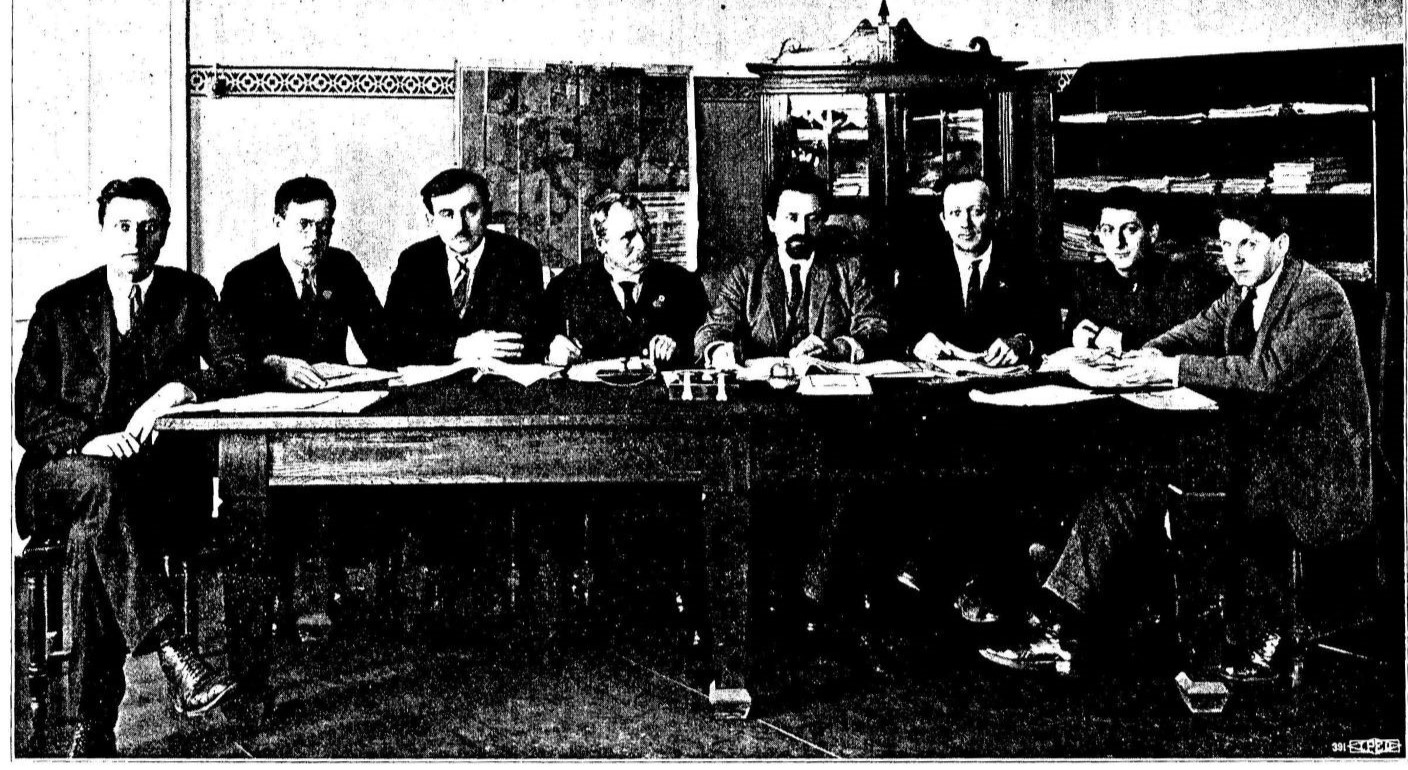
Resolution emerging from the Fourth R.I.L.U. Congress in 1928, the first for four years, on the tasks of the Trade Union Educational League.
‘The Tasks of the T.U.E.L. in the United States’ from Report of the Fourth Congress of the Red International of Labor Unions, 1928.
1. THE TASKS OF THE R.I.L.U. ADHERENTS IN THE UNITED STATES.
The growing industrial depression in the U.S.A. is determining the capitalists and the Government to attack the unions (mineworkers, needle trades, etc.) to speed up the process of production in all industries, and to make extensive preparations for war.
Such military preparations by American imperialism indicates a more aggressive role on the part of the U.S.A. in the struggle for markets, raw materials and spheres of influence. All points to a sharpening of the class struggle and intensification in its conduct. It is therefore necessary to prepare for more frequent clashes between the working class and the capitalists, and the T.U.E.L. as the leader in the struggle of revolutionary trade unionism in the U.S.A. shall build its programme upon such a perspective. It is the main task of the T.U.E.L. to organise and lead the workers in these struggles; in order to successfully accomplish this task it is necessary:
(a) To expose to the masses the reactionary character of the leadership of the A.F. of L., the Railway Brotherhoods, the Amalgamated Clothing Workers, etc., who betrayed the interests of the workers, and do not even struggle for the most elementary demands. On the contrary, they act jointly with the capitalist and the capitalist State against the workers.
(b) Refusal of the bureaucrats and the socialist leaders to organise the masses in the last five years of unprecedented capitalist prosperity in the U.S.A. in order to resist the attacks upon the living standards of the workers, reproductive efficiency unionism and class collaboration policy has the inevitable result of reducing the membership of the unions whereas these objective situations should have resulted in large increases in the membership.
(c) The existing membership of the trade unions in the U.S.A. is made up mainly of skilled and privileged workers.
Notwithstanding that there are approximately thirty million organisable workers, of whom approximately nineteen million are industrial workers, less than three million are actually organised. This decisive factor must determine the orientation of the T.U.E.L. towards the masses of unorganised workers.
The development of the productive methods in the U.S.A. has given a decisive role to the masses of semi-skilled and unskilled workers employed in the basic industries, who are entirely or almost entirely unorganised, and whom the trade union bureaucracy refuses to organise.
A whole series of big and small struggles which have taken place since 1925 (needle trades, Passaic textile, coal mining, Pennsylvania and Colorado, and Haverhill shoe workers) show that the masses are more and more willing to fight against the capitalists, the capitalist state and the bureaucrats.
The T.U.E.L. united front policy shall be based upon the united front from below and mass pressure on the so-called progressives to involve them in the struggle.
2. STRUGGLE AGAINST CLASS COLLABORATION.
The T.U.E.L. shall immediately launch a wide campaign amongst the broadest masses of workers, against the class collaboration policy of the treacherous reformist leadership, now utilising the unions as instruments of capitalist production. It shall lead in the fight for the defence and improvement of the workers living and working standards, and shall fearlessly expose the harmful effects of Trade Union Capitalism, and management cooperation plan, which are demonstrating themselves to be bankrupt and futile. (Locomotive Engineers’ Bank, B.L. & O. Plan, etc.)
3. PROGRAMME OF ACTION.
(a) ORGANISATION OF UNORGANISED.
The vital and immediate task of the T.U.E.L. is to become the leading organisation struggling to organise the unorganised, concentrating especially in mining, steel, oil, automobiles, rubber, textile, chemicals, marine transport and lumber industries. In all of these industries definite plans of work must be drawn up and carried out around programmes of concrete and immediate demands.
Failure on the part of the T.U.E.L. to take the leading role in this task will lead to a repetition of the recent Colorado strike experience, where the I.W.W. took over the leadership of the struggle, and to failure to organise resistance to wage cuts such as have taken place in the textile industry.
The organisation of the unorganised is the most vital task which the T.U.E.L. has now to face. At the same time it must use all the possibilities of working inside existing unions, participating in the daily life of these unions and fighting for the leadership (the workers organised) in them. The members of the T.U.E.L. must undertake this two-fold task under the slogan of “No task too big, no task too small.” This means they must train the revolutionary workers to be able to effectively participate in local and national trade union work, and to lead the workers in the struggle against capitalism.
This main line in the carrying out of our policy in relation to the unorganised must not be one-sided. Further appeals to the bureaucracy and dependence upon the so-called progressives in the reactionary unions is useless and wrong. The T.U.E.L. must itself become the basis organisation for the organisation of the unorganised. It must openly and definitely occupy the leading role and be the arming force concentrating especially in such industries where the workers are not organised at all, or are very badly organised. The T.U.E.L. when necessary may fight for the affiliation of the organisations to the A.F. of L., but only on conditions which guarantee class leadership and a militant programme.
(b) NEGRO WORKERS.
In the work of organising the unorganised, great attention must be paid to the organisation of Negro workers. Owing to the refusal of the majority of white unions to admit Negroes to membership, steps must be immediately taken to set up special unions for Negroes. At the same time, however, the struggles for the inclusion of Negro workers into the existing unions must be intensified and concentrated upon, special attention being given to those unions in which the statutes and rules set up special limitations against the admission of Negro workers. In places where the Left Wing is in control of the local section of the existing unions, Negroes must be admitted to membership on the basis of equal rights, notwithstanding any barrier which constitution of the union might contain. In industries in which Negro and white workers are at present organised into separate unions, efforts must be made to secure the amalgamation of such unions on the basis of equal rights. In those industries where new unions are being set up, Negro workers must be included in the same unions as white workers.
(c) LATIN AMERICA.
The T.U.E.L. must maintain in close organisational relations with the Latin-American Secretariat and in cooperation with this body it must conduct special work amongst the large masses of Mexican immigrant workers in the U.S.A., especially those engaged in the metal, oil and railway industries, the T.U.E.L. must fight against discrimination against Mexican workers by American unions.
(d) CANADA.
There must be the closest relations between the R.I.L.U. Sections in the U.S.A. and Canada, especially for work in those unions having members in both countries, such as the A.F. of L., Railway Brotherhoods, etc., the T.U.E.L. of the U.S.A. must support the fight of the T.U.E.L. of Canada for the independence of Canadian Trade Unions, and autonomy of the Canadian locals. In carrying out the task of organising the unorganised sections should assist each other, but under no circumstances shall new organisations which may be set up in the U.S.A. by the T.U.E.L. bring into existence Canadian locals in initiation of the practices of the reactionary A.F. of L.
(e) MINING.
In the mining industry of the T.U.E.L. must at once commence to organise new local unions in the unorganised districts, and in these sections where the reformist union has disintegrated. These local unions should demand affiliation to the U.M.W., in no case sacrificing the Left Wing leadership and programme. If this is refused the local sections must be linked into independent district organisations for common action.
(f) NEEDLE TRADES.
In the needle trades consolidation of the Left Wing must be secured; only on such a basis can the left wing in those unions face the attacks of the A.F. of L. bureaucracy and the demagogues and socialist leaders in these unions.
(g) AGRICULTURE.
The T.U.E.L. must give attention to the organisation of the agricultural workers. This is a field for work which is not utilised by the reactionary unions, or the T.U.E.L., notwithstanding that there are millions of these severely exploited wage-earners. Α definite policy for work amongst this exploited section of workers must be drawn up and operated.
(h) WOMEN AND YOUTH.
American rationalisation of industry to an ever-increasing degree tends to utilise women and youth in industry at the expense of a reduced standard of living for the working class as a whole. Women and young workers are discriminated against by the trade union bureaucracy in many ways. The T.U.E.L. must immediately organise these workers, giving special attention to the trustified industries. Our chief slogan in this work must be “Equal pay for equal work.”
4. STRIKE STRATEGY.
Strikes of a national or local character must be actively supported by the T.U.E.L. The categories of strikes we must expect in the present circumstances can be summed up in the following groups:
(a) More or less sporadic strikes amongst unorganised workers, mainly in large trustified industries.
(b) Strikes by organised workers conducted in spite of and in opposition to the trade union bureaucracy (so-called outlaw strikes).
(c) Strikes into which sections of the bureaucracy may be forced by rank and file pressure.
It is mainly with the first two categories that we will be faced in the immediate future, and of these the first will be the most frequent, and of greatest value to us in our efforts to organise the unorganised. In such struggles the T.U.E.L. must come forward as an organisation and as the organiser of these strikes, and must avoid the mistake of coming in only after the revolt of the workers had actually taken place. The T.U.E.L. must, whilst assisting in the conduct of the strike and its direction, at the same time build up definite organisations of the T.U.E.L. Due to our weakness among the unorganised at present we shall not, for some time, be able to determine or manœuvre time and place of these strikes in accordance with our conceptions of stragetical advantages. We must, however, utilise these strikes to establish and consolidate our influence among the workers in the particular industry affected. But we must make it clear to the workers that fundamental demands can only be realised by strong national organisations covering each industry linked up with strong bodies of industrial workers and having effective revolutionary international connections.
5. COMPANY UNIONS.
The T.U.E.L. must struggle against company unions. The slogan “smash the Company Unions” and the mere issuing of literature on the subject is not sufficient. Concrete organisational steps in which the shop and factory committees should play a leading part must be taken, and a flexible programme of action adopted. The T.U.E.L. must follow two tactics with the same objective; penetrate to destroy them wherever they have a mass membership, and smash them by pressure from without, or both.
6. SAVE THE UNIONS.
The slogan “Save the Unions” is no longer correct. It is incapable of rallying broad masses for decisive struggles in the U.S.A. Our policy must be to fight against the treachery of the trade union bureaucrats and the attacks of the capitalists. Our slogans must be in accord with these objectives. “Save the Unions” from the corrupt trade union bureaucracy and organise the workers against the capitalist offensive.
The T.U.E.L. must now become the genuine organisational centre of the unorganised workers as well as being the centre of the left wing in the reformist unions.
The amalgamation movement must be stimulated locally and sectionally, as well as nationally. Wherever it is possible to amalgamate local unions and sections of the unions it should be done without waiting for the national movement to come to its full development.
7. UNEMPLOYMENT.
In face of the rapid growth and permanent character of unemployment in the United States in consequence of the rationalising processes adopted in American industry, the T.U.E.L. must take definite action in order to organise the unemployed workers into Councils of the unemployed. They must be rallied around such slogans as: “Work or full maintenance at trade union rates,” etc. The closest possible relations must be maintained between the employed and unemployed workers.
8. ORGANISATION.
We must pay great attention to the task of creating and building up shop and factory committees which are capable of becoming vitally important factors in the organisation of the unorganised, and can be the basic units for the industrial unions. Every endeavour must be made to make these committees the organisational units in the respective localities.
The National Committee of the T.U.E.L. should at once intensify the work in metal transport, mining, food, textile and needle industries. The local groups in the T.U.E.L. must be strengthened in every possible way. They must admit into membership all workers prepared to fight against capitalism and the bureaucrats. The local general groups of the T.U.E.L. must be established in every industrial centre.
The National Industrial Committees of the T.U.E.L. must be made to function as the actual leading organs in the respective industries with which they are connected. They must include in their composition representatives of the unorganised workers, both Negro and white as well as representatives from existing separate Negro and white unions. The steps taken in the recent National Convention of the T.U.E.L. in this direction must be continued and strengthened.
Each industrial section must establish its own mass paper. Industrial conferences of union members, together with the unorganised workers, must be held regularly under the auspices of the industrial sections of the T.U.E.L., and systematic reports presented to the appropriate sections. within the organisation.
The central organ of the T.U.E.L. must be expanded to become a weekly agitational and propaganda publication.
The whole apparatus of the T.U.E.L. from top to bottom must be broadened and strengthened, and the forces consolidated under the direction of the National Committee of the T.U.E.L. Immediate preparations must be made for the calling of the next National Conference in order to deal with the urgent problems now facing the workers in the U.S.A. The National Conference should be preceded by Conferences called by the National Industrial Committees. Every effort should be made to draw into the conference more organised workers from the reformist unions, as well as unorganised workers from the reformist unions, as in addition there should be conferences of the local general groups along the same lines, thus preparing for the National Conference, out of which should be gathered new elements to assist in the conduct and direction of the work of the T.U.E.L. For these conferences new slogans and programmes should be worked out. They should be of a positive and concrete character in keeping with the actual issues facing the workers, and calculated to raise the level of their class consciousness. (Examples–organise the unorganised, fight wage cuts, build militant unions, one industry one union, smash the capitalist offensive.)
9. INTERNATIONAL.
The T.U.E.L. must maintain and strengthen its international contacts. It must point out to the workers of the U.S.A. that it is the only organisation with organisational contact with the workers of other countries. It must show that affiliation to Amsterdam is not a step towards international solidarity, and must point out that in the countries where the workers’ organisations are affiliated to Amsterdam, the leadership of the trade unions is adopting American methods of class collaboration. The T.U.E.L. must maintain in the closest possible relations with the R.I.L.U., and the National Industrial Committees must have close organisational contact with the I.C.C’s. The reports to the I.P.C’s. and the National T.U.E.L. from the National Industrial Sections must be more systematically organised.
The T.U.E.L., together with the Latin-American comrades, should develop a fight against the Pan-American Federation of Labour, dominated as it is by American imperialism. It must be regarded as an instrument of imperialism and an agency of the reactionary trade union bureaucracy and the Mexican labourists now leading the C.R.O.M. The T.U.E.L. must render all possible assistance to the workers and peasants of the Philippines and Hawaiian Islands, and must maintain close organisational contact with the workers there.
The T.U.E.L. and its adherents must cooperate fully with the Pan-Pacific Trade Union Secretariat, bringing to the attention of all workers in America the struggle of the masses of the Far East against American imperialism.
10. The U.S.A. section of the R.I.L.U., the T.U.E.L., is now faced with extremely difficult circumstances, but if the above programme is serious applied to the rapidly developing class struggle it will rally important sections of the masses to its support, and thus be enabled to direct the resistance to all phases of the capitalist imperialist offensive. It will strengthen the whole labour movement of the U.S.A., which is urgently necessary to resist the attacks on the workers at home and the impending war danger. It will root itself deeply in the masses to be a resolute force in the struggle against Capitalism at home and in the struggle as part of the world proletariat against world imperialism.
Report of the Fourth Congress of the Red International of Labor Unions, 1928.
PDF of original book: https://books.google.com/books/download/Report.pdf?id=pfBaAAAAYAAJ&output=pdf&sig=ACfU3U2IOegkwdTMugHLQx-AB1bggAacmg
 Revolution's Newsstand