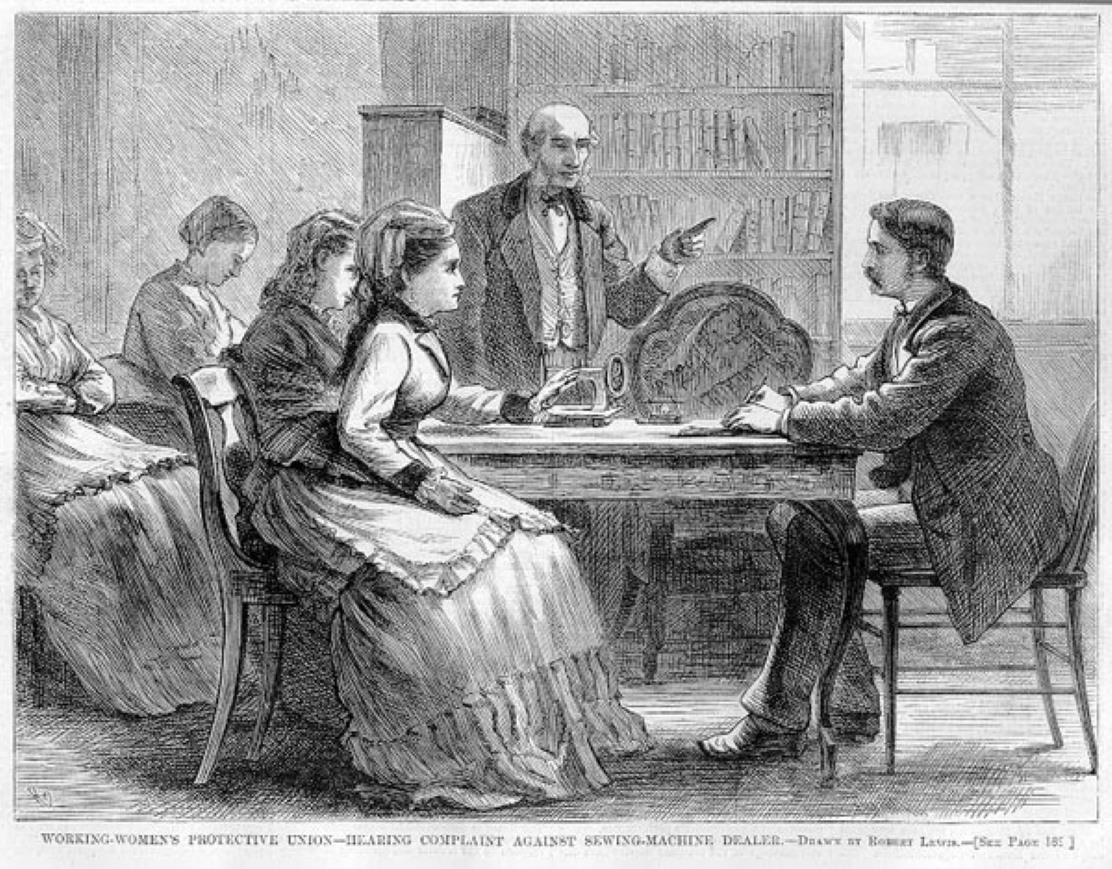
Women’s Trade Union League’s Ruth Delzell uncovers some the earliest women’s labor organizations for this piece written during the great wave of garment strikes in the early 1910s.
‘1825-1851-Organization of Tailoresses and Seamstresses in New York, Philadelphia, Baltimore, and Boston’ by Ruth Delzell from Life and Labor (W.T.U.L.). Vol. 2 No. 8. August, 1912.
The year 1825 saw the beginning of many movements in the world of woman and child wage earners, and among the first trades to organize was that of the seamstresses and tailoresses. Mr. John B. Andrews has gathered what scanty information there is about these trades, into Volume X of the Government report on conditions of woman and child wage earners in the United States, and it is there we learn that as early as April, 1825, the tailoresses of New York were holding meetings. The newspapers of other cities predicted that this would result in a “turn out for higher wages,” and the “Boston Transcript” on February 22, 1831, criticizes as “clamorous and unfeminine declarations of personal rights, which it is obvious a wise providence never destined her to exercise.” From the beginning sweat shop conditions existed in the tailoring and sewing trade and it has always been one of the most poorly paid of all the industries. The insanitary conditions under which the garments are so often made have led to the double movement for higher wages and sanitary working conditions which we know so well.
New York.
In June, 1831, the United Tailoresses’ Society of New York went on strike for an increase of wages. There were sixteen hundred women involved and they remained out for at least four or five weeks. Again their case was helped by newspaper discussion, and a letter published in the “Workingman’s Advocate” of June 11, 1831, signed “A Friend of Justice,” encouraged the members of the society to stand together and made the suggestion, probably for the first time in America, of establishing a co-operative shop. Five weeks after this letter was published a spirited meeting was held in Congress Hall with Miss Louisa M. Mitchell as secretary. Resolutions were passed that “the society steadfastly adhere to their own bill of prices,” and that “a committee of three be appointed to wait upon the secretary of the Employers’ Society and inform him of their determination to discontinue their work until their bill is adopted. The committee appointed included the president, Mrs. Phoebe Scott, Mrs. Eliza Trulin and Mrs. Lydabach.
Did these women win or lose this particular strike? We do not know, but we do know that the spirit of organization went marching on.
Five years later, in 1836, the “New York Era” took up the matter and urged that the seamstresses of New York organize, stating that their condition would “never be ameliorated until they co-operate together and systematize a union and co-operative combination, where the junction of their interests and the knowledge of their rights would enable them to struggle with confidence for a fair participation of the profits which result from their labors.” In graphic language the helpless condition of the isolated woman in bargaining with her employer was pictured.
Baltimore and Philadelphia.
Meanwhile the working women of Baltimore and Philadelphia were demanding their rights. There had been a great deal of disturbance among the laboring people in Baltimore and it is not surprising that in September, 1833, the tailoresses and seamstresses of that city attempted organization. They went about it in a very businesslike manner, calling a general meeting of all the women in their trade. The working women of Fells Point called a meeting at which the following resolutions signed by their president, Eleanora Wherett and their secretary, Mary T. Ennis, were passed:
Resolved, That in view of the very low prices which we at present are obtaining for work done by us, we determine to strike for an increased rate of wages.
Resolved, That we most strenuously advise and request all those in the same avocation with ourselves, throughout the city, to call meetings immediately for the purpose of co-operation with us in the present attempt to establish such a bill of wages as shall remunerate us for our labor.
Resolved, That more effectually to accomplish our purpose, we enter into a positive agreement to take out no work from the shops until proper rates shall be established.
Resolved, That we appoint and recommend that delegates be appointed by other meetings of the working women in our line to meet in convention at a time and place to be hereafter designated.
Five women were duly appointed as delegates to the general meeting which was held on Friday evening, September 20, 1833. No report of the proceedings of this convention is available, but ten days later an adjourned meeting was held where they drew up a new bill of prices, adopted a constitution and by-laws and formed a permanent organization by the election of officers. Susannah L. Stansbury was elected president, and Hannah Moran secretary. This organization was called the Female Union Society of Tailoresses and Seamstresses, and on the following day the journeymen tailors of Baltimore issued a call for a special meeting for the purpose of assisting the women in their stand for higher wages. It is no doubt this spirit of co-operation between the men and women which in 1835 created the United Men’s and Women’s Trading Society. Another interesting bit of information is given us, for we are told that “Mr. Booth will perform one evening for the benefit of the Seamstresses’ Society.”
Matthew Carey.
It was Matthew Carey, famous as the first investigator of conditions of work of women in America (see “Life and Labor,” November, 1911) who worked for better wages for the women of Philadelphia. He began as early as 1828, but it was not until June 30, 1835, that a committee of eighteen women organized a large meeting of working women of Philadelphia including tailoresses, seamstresses, binders, folders, milliners, stock makers, corset makers, mantua makers, and so forth. At the request of the committee Matthew Carey presided and Dr. A.C. Draper delivered the address. About five hundred women were present and they formed an association called “The Female Improvement Society for the City and County of Philadelphia,” with committees representing each branch of employment. These committees were instructed to meet and form a scale of prices, and at a later meeting at which Matthew Carey again presided, reports were received and a special committee was appointed to submit the increased bill of wages to the employers and to publish in the newspapers lists of those who would and those who would not grant the advance. Another committee was instructed to send to the Secretary of War a protest against the low prices paid for the making of army clothing. The Commercial Bulletin in referring to this situation said, “This is indeed a case in which stripes should be legalized.” The Female Improvement Society was practically a City Federation of working women’s organizations, the first of its kind in America.
Boston.
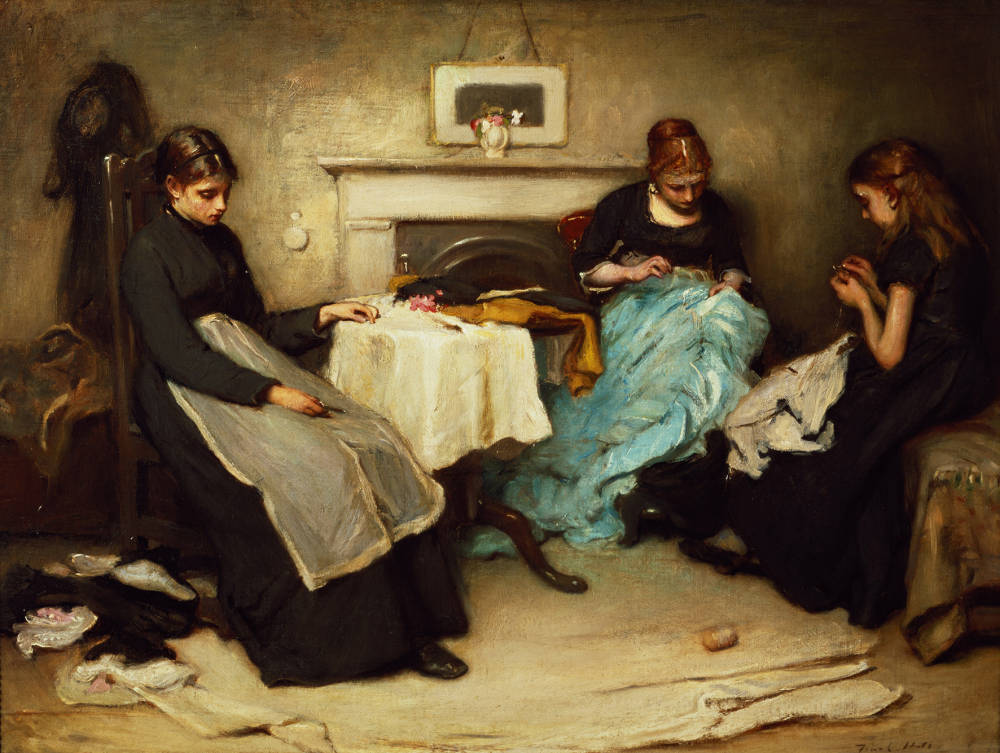
In the summer of 1844 the tailoresses and seamstresses of Boston were out on strike against a reduction in wages. On July 12th the largest “auditory” in the city, Marlboro Chapel, was filled to overflowing when the seamstresses and tailoresses met to “consider” the subject of their reduction in wages in connection with the proceedings of the journeymen tailors of Boston. To the “Boston Times” the mere presence of so great a number of women appearing before the public and petitioning and consulting for a redress of grievances was sufficient evidence that there was great suffering and injustice somewhere. But the report cites such instances as the following in detail:
“Mary Mannid, 3 Battery Street, works for George Simmons, Oak Hall; makes pants for 25c a pair, makes one pair in a day, which means $1.50 per week.”
“Hannah Silesy works for Andrew Carney, lives in Hatters’ Square. She makes navy shirts at 16c apiece; has to work fourteen hours per day to earn $2.00 a week; and at making stripped shirts at 8c apiece, can only earn $1.00 a week.”
“Mrs. Oaks, 321 Ann Street; she works for Gove and Lock; makes pants for 12c a pair and shirts at 8c apiece; she earns on an average $1.12 1⁄2 a week.”
These examples of hardship aroused such indignation that the following resolution was unanimously passed:
Resolved, That we solicit the assistance of the ladies, the seamstresses and tailoresses of the city, in the undertaking to secure a fair compensation, and that they be invited to raise a committee who shall confer with the association of journeymen tailors upon the subject of their common oppression and wrongs.
Again on the evening of September 29th the Boston tailors, tailoresses and seamstresses were called to meet in Faneuil Hall, “the old cradle of liberty and strike another blow for the rights of common humanity.”
New York, 1851.
Just twenty years after “A Friend of Justice” had advised the tailoresses and seamstresses to establish a co-operative shop the Shirt Sewers’ Co-operative Union was established with a permanent depot on the second floor at No. 9 Henry Street. It had become known a few years before that women were obliged to make shirts at four cents apiece, and it was estimated that there were six thousand shirt sewers in New York City. The Board of Managers of this co-operative establishment consisted of four women thoroughly convinced of the advantages of co-operation, but too poor to advertise the business. However, fortunately for them the press of New York City published their letters of appeal. They asked the public to remember that thousands of these women were “sewing at once with a double stitch a shroud as well as a shirt.” Thomas Hood’s Song of the Shirt was quoted by them in the New York Daily Tribune of July 31, 1851:
Oh, men, with sisters dear;
Oh, men, with mothers and wives;
It is not linen you’re wearing out,
It’s human creatures’ lives.
And the appeal was heard. A public meeting was called, astounding disclosures of prices were made to the public, funds were collected, a store was taken and a directress was appointed; business was firmly established, and in spite of the predictions of failure made by manufacturers and business men, the venture was continued and two years later with headquarters in Bleecker Street was regarded as “among the successful combinative efforts at work in New York City.”
It is interesting to note that the Female Industrial Association of New York, which was formed in 1845, was the second City Federation of working women’s organizations, and consisted of tailoresses, plain and coarse sewers, shirt makers, book folders, stitchers, cap makers, straw workers, dress makers, crimpers, fringe and lace makers and in the preamble of their constitution they stated:
“Whereas, The young women attached to the different trades in the city of New York, having toiled a long time for a remuneration totally inadequate for the maintenance of life, and feeling the truth of the gospel assertion that ‘the laborer is worthy of his hire,’ have determined to take upon themselves the task of asserting their rights against unjust and mercenary employers.”
Life and Labor was the monthly journal of the Women’s Trade Union League (WTUL). The WTUL was founded by the American Federation of Labor, which it had a contentious relationship with, in 1903. Founded to encourage women to join the A.F. of L. and for the A.F. of L. to take organizing women seriously, along with labor and workplace issues, the WTUL was also instrumental in creating whatever alliance existed between the labor and suffrage movements. Begun near the peak of the WTUL’s influence in 1911, Life and Labor’s first editor was Alice Henry (1857-1943), an Australian-born feminist, journalist, and labor activists who emigrated to the United States in 1906 and became office secretary of the Women’s Trade Union League in Chicago. She later served as the WTUL’s field organizer and director of the education. Henry’s editorship was followed by Stella M. Franklin in 1915, Amy W. Fields in in 1916, and Margaret D. Robins until the closing of the journal in 1921. While never abandoning its early strike support and union organizing, the WTUL increasingly focused on regulation of workplaces and reform of labor law. The League’s close relationship with the Amalgamated Clothing Workers of America makes ‘Life and Labor’ the essential publication for students of that union, as well as for those interest in labor legislation, garment workers, suffrage, early 20th century immigrant workers, women workers, and many more topics covered and advocated by ‘Life and Labor.’
PDF of issue: https://books.google.com/books/download/Life_and_Labor.pdf?id=epBZAAAAYAAJ&output=pdf
 Revolution's Newsstand