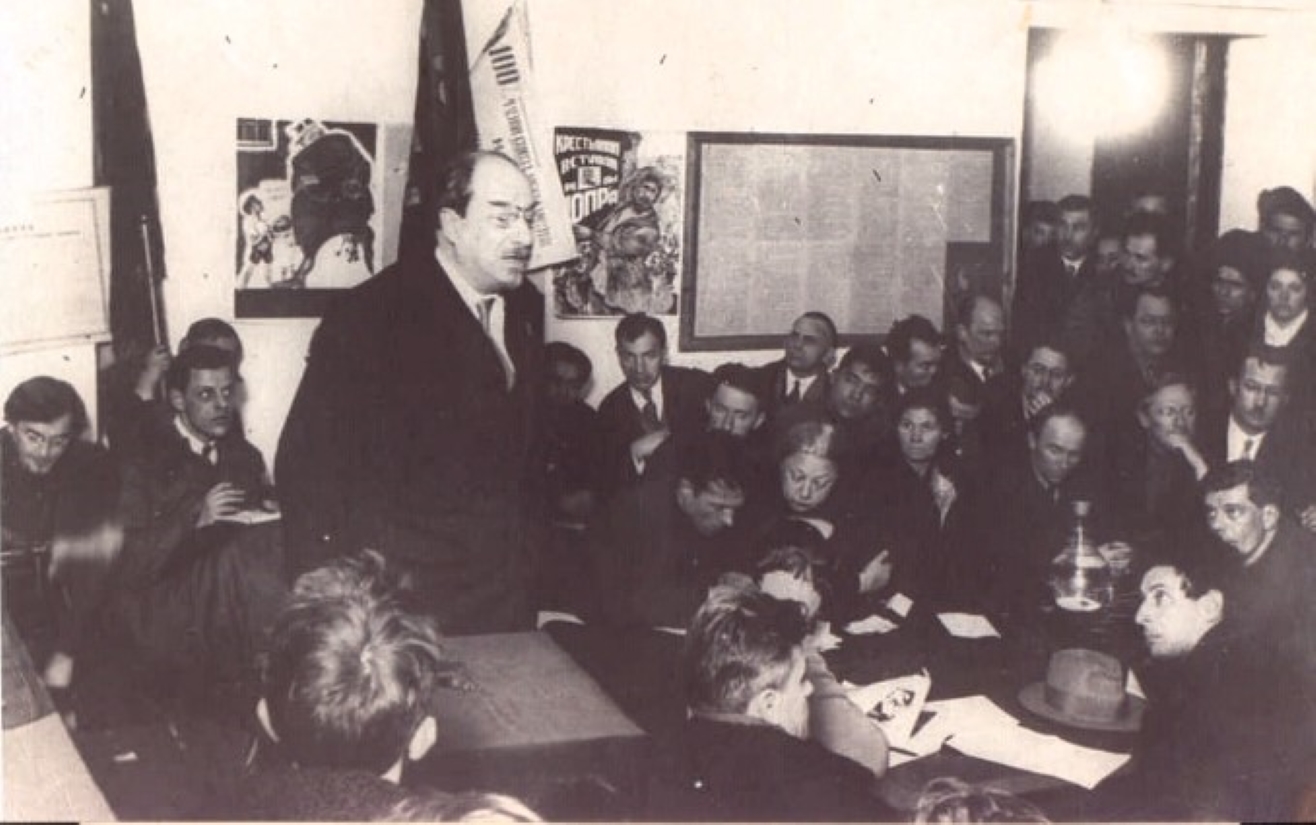
Commissar of Education Lunacharsky acts as art guide for delegates arriving in Moscow for the Third Comintern Congress with this remarkable survey of that city’s post-Revolution art scene for the English-language conference publication.
‘Art in Moscow’ by Anatoly Lunacharsky from Moscow. Vol. 1 No. 15. June 11, 1921.
Our Comintern comrades arriving in Moscow will unfortunately see the latter in rather an unfavourable aspect as far as its artistic life is concerned. All the large theatres will be closed, although, we have arranged for five of them to give special performances for the Comintern from the 1st to the 5th of June. The more important concerts are coming to an end, and artistes of all kinds are dispersing to the provinces and country villas or sanatoria for rest.
However, we can state with pride that, from an artistic point of view, Moscow last winter, was the centre of great cultural activity, and as far as I can judge from the papers and journals which reach me, it was a centre bubbling with more internal activity, and a more e harmonious outward appearance than that or of any other European city. Of course, I do not wish anyone to infer from this that Moscow has become a new Athens, or that it as yet, comes up to the standard that would be demanded by a cultured communist. There are many defects in our lives, but our Comintern comrades will realise the strength of the current against which we have to struggle. The very fact that we are struggling against this current is in itself worthy of note.
However, I do not wish my series of articles to assume the form or a guide through artistic Moscow, particularly that of a guide, who, drawing attention to the closed doors of a theatre would say: Such and such a play was given here during the winter. On the other hand I want to acquaint my comrades to a certain extent with the structure of our artistic life and its internal problems.
Let me then begin with selective art, a sphere that has not yet been fully surveyed. It is still impossible to give a detailed account, as all the so-called progressive research into this sphere of art primarily found a refuge, and expressed itself in its most virulent form in the sphere of painting and partly in sculpture.
A Marxist can very easily explain the rise of academic art at the end of the 19th Century, and the cause of the renaissance of impressionism, and its rapid replacement by cubism, futurism, expressionism, etc., etc. It is not surprising that this phenomena did not confine themselves to selective art but spread into literature, music etc.
Why is it that a new development in e art expresses itself first of all in painting? Why does it create such a sensation, why are their creations spat upon and ridiculed and then later exalted to the very heavens, their pictures sold for large sums, and their names became the most popular in all Europe, even in circles where it is not thought much of. For everyone knows that when one has to speak of the history of art dating from the nineties of last century one immediately begins to enumerate the most important leaders of the tendencies to which have just referred.
The painters were the first to make of the expressions, “impressionist”, “symbolist”, and “cubist”.
I state this merely in passing and will not yet analyse it, I assert that even in Russia up to the present day a most desperate struggle is indisputably being fought out amongst our artists on the question of the trend of selective art. Int general the main differences in our world of selective art and such: there is a group of artists which still produces few but green shoots which are true to the principles of “Peredvizhnetchestvo” (“locomotive art”), “Peredvizhniki” is a name assumed by a group of artists with popular tendencies, who superseded the outlived Western European type of Russian Academism. This is the extreme right wing of our art. Essentially these people did not betray their populist traditions and they believe that they stand near to the popular heroes, that they are the champions of the people’s will, which found its prophets in Tchernishevsky or Saltikov, its heroes in Jelabone or Lopatine; it would have appeared easier to them to assist proletarian culture, which cannot but belong to illustrative art.
We will assume that illustrative art exists, what its highest function may be, we will not discuss; the fact however is that the proletariat is extremely interested in the artistically expressed history of the revolution, the reflection of his dreams for the future, the portraits of his new heroes and leaders and the scenes of his struggles. It is clear then that the realistic artists, of the Repin type, the Jaroshenko types, or even the Makovski type, no matter how they may be condemned by other artists, if they had turned over their brushes to this new genre, they would have had a wonderful reception from the ranks of the proletariat. The backwardness of the proletariat, a very fruitful backwardness however, might have then found expression. Nevertheless, our Comintern comrades know that many of our “narodniki” in large numbers drifted into the current of Social Revolutionist reaction.
That was the case with many of our older artists. The majority of them were alien to the new movement, they rejected the October movement and did not stretch forth their hands to help. We are now taking steps to give a kind of “academic ration,” etc., to the best of our artists; but we have no close ties with them. There are of course exceptions. For example, the prominent artists Pasternak, Tolstoy’s friend, is making both individual and collective portraits of the workers’ leaders with his usually fine likenesses and in his own peculiar style, neither realist not impressionist. Malinin, of the same school of artists also paints portraits. Then there is the younger, more modern, Maliavin, but of the same school, who is also working very energetically, in Riasan, producing few new pictures and working more in the sphere of drawings; he is an anarchist by conviction and we expect much from him in the near future. At any rate he has the taste and the talent which no one will deny.
Most likely the main group of our selective artists is that originating from the sensitive Europeans, and grouping themselves around the so-called world of art, whose mainstay is A.I. Benoit, who is a theoretician, historian, aesthetic, and artist, and is one of the most accepted and cultured personalities of Russia–our friend of the “Diamond Ballet” and other post-impressionist tableaux, who approaches very closely to such European artists as Van-Gogh, Mattice and even Picasso, in a word the right wing of cubism.
This large army of artists by no means confined to any particular unit. Many of the most distinguished representatives of this group and direction, and t also for example the highly talented Kustodieff, and Petroff, Vodkin, remarkable in his own way, took part in the decoration of Petrograd during public holidays and have fulfilled one or another of the governments commissions. Benoit himself and many others work in the Soviet museums. Similarly, the famous artist and art historian Igor Grabar, is working exceptionally well in the investigation of ancient ikons.
The most significant thing is this however, that the advent of the social revolution has in no way reflected on these artists, this flow of waters does not seem to have troubled the calm surface of Russian art. Perhaps only the panegyrics written by Kouchalevski–a pupil of the left wing of this group–for the Cossack congress and even that was comparatively casual, or some of the work of Kannenkov, the most talented sculptor of Russia, as for example, his memorial tablet on the Kremlin wall, but all this is comparatively insignificant.
For some time now the artists of the centre have been trying to group themselves into a special art circle, whose principles at least seem to aim to an expansion into the whole world of art thus assuming for themselves the best conditions with the help of the People’s Commissariat for Education–and at the same time a desire to work hand in hand with the Soviet Government. Some of the right element, in the artistic sense, have attached themselves to this alliance, for example, the two brothers. Vassnetzov and others, and the group with such artists as the ardent Mashkov, the all ready mentioned Konchakov, the highly cultured and interesting artist decorator Jakalov, and the left wing have come over to a man including, not only the Russian, but the German expressionist Comrade Kandinski. This group may be the beginning of a revival of selective art, Just now, I repeat, there is little to be satisfied with in this respect. There were small independent exhibitions after the revolution, but they were insignificant, no new departure being observed in them. Last winter there were no exhibition of any size or note. This winter large exhibitions will be organised and everything leads us to believe that the red rays of the still rising sun of the social revolution will shine over these exhibitions,
The left wing appears as the third division. Here, the central figure appears in the form of the Communist-futurists. The objectless supermatists have come over to them from the left and from the right, the stylistic artists somewhat like the very talented Altmann, the present head of the department of selective art, and the talented Sternberg, the former head. They were somewhat driven into the circles of the Russian bourgeoisie, they were young, they regarded themselves as revolutionaries in the technique of nature they quickly felt sympathy for the revolution and were carried away by it when it stretched forth its hand towards them. But how did it extend its hand to them? I confess that at first it was my hand. I extended it because I admired that kind of research. True, I do not belong to those who simply raise their hands in horror at the futurists, who snort with contempt, and abuse them. I know the deep social roots, which begot this peculiar plant, and I by no means deny that the fruits of that plant can be of peculiar use to the general growth of Art, that their stupendous one-sidedness, and their extremely analytical approach to art, will finally have a beneficial effect. Nevertheless, their art must be regarded, as a product of the ruin of the previous art, and as a field scattered with the skeletons of the past which must arise at the trumpet of some synthetic genius. I cannot regard this art, other than a laboratory, other than a kitchen from, which it was necessary to enter out of the musty air, of academic and realistic art which completely decayed, and lost its soul. I extended my hand, in so far, as it was necessary to the general policy of the Commissariat for Education, to rely on the serious, collective creative artistic powers. These I found almost exclusively here, amongst the so-called left artists. This repeated itself even in Hungary. It takes place even in Germany, and the Hungarian comrade Kitts, if I am not mistaken, a member to the congress of the Third International said to me not without pride, and sorrow. The Government of Bela Kun wanted to improve its relation to art and began to patronise the “right” artists. At the deposition of Communism, the best of them washed their hands of us, the worst became informers. We, the left hid underground, but remained loyal to the flag. At present, the Soviet power in Russia is consolidated, but if it should ever collapse something like that will happen here also with such a policy. At present a change is taking place.
As I have already pointed out, among the artists of the centre, there is a movement of sympathy to the Soviet regime, and they can give us a deal more.
Yes, I extended my hand to the left, but the proletariat and the peasantry have not done that yet. On the contrary, even when futurism will become thoroughly imbued with revolutionary ardour, the worker who is revolutionary will pull terrible grimaces at the admixture of futurism. The futurists say “he has not grown up yet.” There are various kinds of growths. Futurism is the crooked growth of art. It is the continuation of the bourgeois art, with certain revolutionary wrappings. The proletariat will also continue from the art of the past, beginning from the healthy sculpture, perhaps direct from the renaissance, and will carry it forward, further, and higher, than all the futurists and entirely in a different direction.
The greatest appeal that Moscow made to the artists, was the erection of large number of temporary memorials in the streets and squares. One must admit frankly that this effort was a complete failure. Artists of various tendencies, particularly the left, put up some repulsive creations many of them to be taken down again with the utmost speed. It is doubtful if even a single one could be recognised as a work of art.
One must admit however, that this attempt only ended in failure in Moscow. Not so in Petrograd. There, there were few bad ones, a few unacceptable ones but there were also some excellent meorials. Everybody will deplore the destruction of Radisheff and Lassalle memorials, and every one would wish that they would be re-erected. Such memorials, the busts of Herzen, Shevshenko, Malyeeff’s statue of Karl Marx, in front of the Smolny Institute, and many, others are worthy of being reproduced in bronze. The really greatest artistic memorial erected by the Soviet Power in Moscow is the figure on the “Zvetnoi Bulvar”–the memorial of Dostoevsky, and the statute of “Thought”, but they were completed before the revolution by the sculptor Mepkoff. Our merit lay in acquiring and erecting them.
There is another tolerable memorial, facing the Moscow Soviet, the work of sculptor Andreeff, who also did an interesting memorial of Gogol.
About our proposals in this direction, I will not speak at the moment. I will only say that a number of memorials, in my opinion very interesting ones, have been commissioned and are being executed, amongst these is a monumental memorial to Marx on the Tealtralny Ploschad. Generally, the failure of numbers of temporary memorials did not discourage us, but to admit the failure frankly, was necessary. The decoration of the streets and squares of Moscow and Petrograd, previous to important holidays, when we did not have sufficient materials, used to be extremely lively, and in Petrograd particularly artistic, as there, all sorts of artists participated. without taking their tendencies into consideration. In Moscow, the extreme “left” tendencies of the decorations offended many people. At the present moment, on the occasion of the arrival of our dear guests, we abandoned the project of decorating the town for the occasion of the arrival of our guests from abroad, owing to lack of material. The greatest difficulty in the matter of creating something like order from art, is the terrible disagreements amongst the artists. Recently a big meeting was arranged for artists. My speech was received with open sympathy by some, and by others the “left” mensheviks–with reserve. After I left the theatre, Sodom and Gomora was raised, the artists abused each other to their hearts content. Nevertheless, the fact that the mass of central free artistic organisations are now coming forward makes me think, that even in this difficult province, we shall be able to approach to something like organised construction.
We would invite those comrades of the Comintern, interested in art, to visit our museums, and the Tratyakovskaya Gallery, which has had many valuable additions, but which still suffers from a lack of space, the collection of our patrons. which we culturally improved, are open for all, and are enriched with new acquisitions. In the “Moscow” special notices will be published by the Chief Department of the Museum, when and how it is possible to see these collections, well as the various collections of antique. The Museums of Moscow and Petrograd and in the whole of Russia have greatly developed since he Revolution. We have taken extra measures to preserve the art collections of the Tzar, the nobles and the Church. As a result of these measures, the number of our museums have decreased, but they have increased in value, and are attracting an increasing number of people including workers, by Army men and students.
In a future article, I will endeavour to describe the theatre and its position in Moscow.
Moscow was the English-language newspapers of the Communist International’s Third Congress held in Moscow during 1921. Edited by T. L. Axelrod, the paper began on May 25, a month before the Congress, to July 12.
PDF of full issue: https://www.marxists.org/history/international/comintern/3rd-congress/moscow/Moscow%20issue%2015.pdf
 Revolution's Newsstand