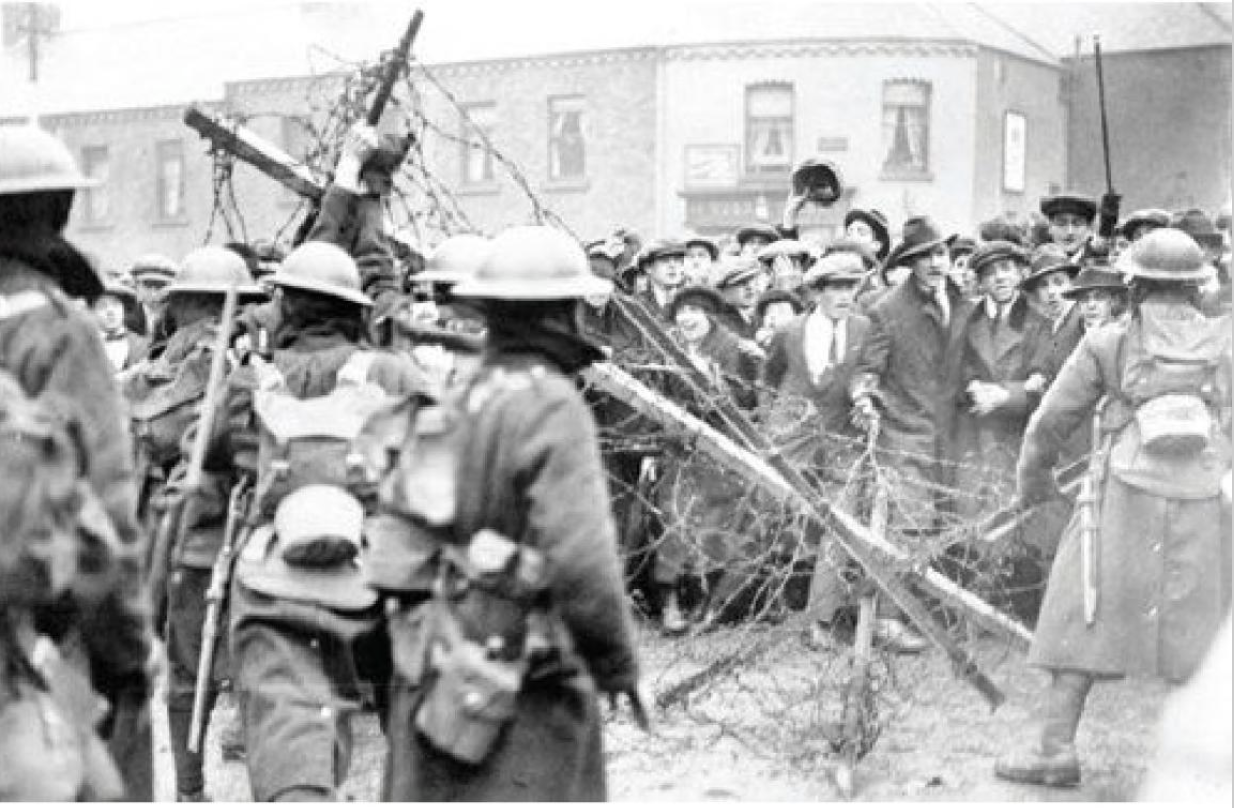
A rare article from the enigmatic Irish revolutionary Rose McKenna on the April 12, 1920 political general strike to free I.R.A. prisoners from British hands during the Irish Revolution. If there was a place to find this article, it would be in Duluth, Minnesota’s ‘Truth’ newspaper, edited by Dublin-born Jack Carney, which closely followed events at home.
‘The Dublin Victory’ by Rose McKenna from Truth (Duluth). Vol. 4 No. 23. June 4, 1920.
WATCH THE IRISH!
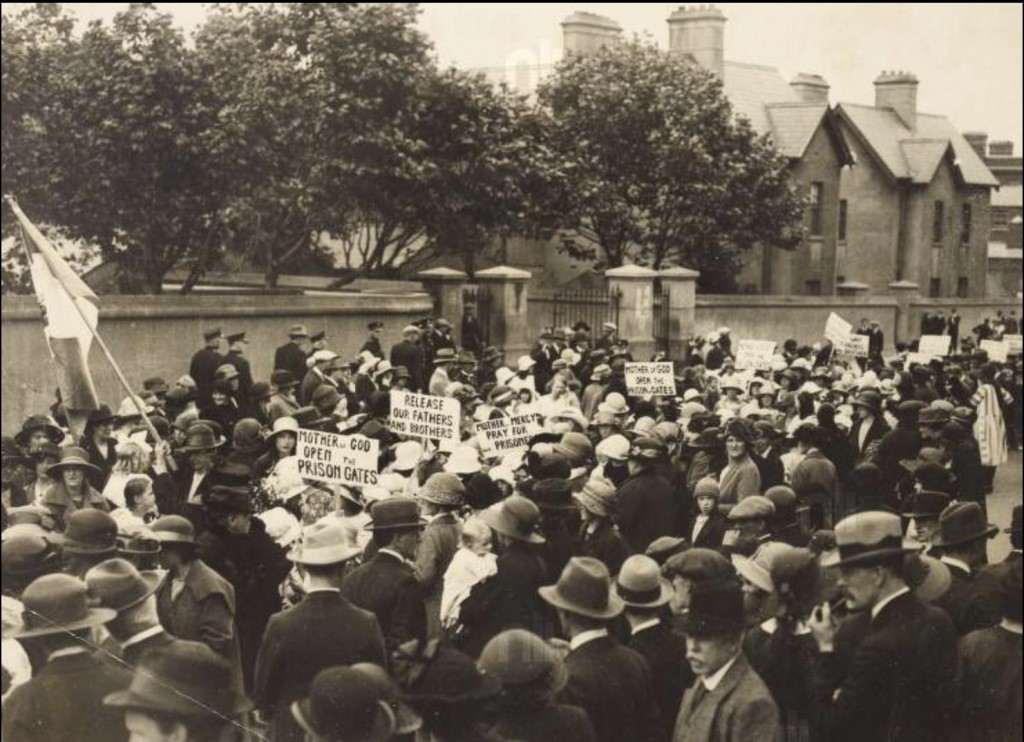
The British Government is fully determined to crush the Irish. The Irish are equally as determined NOT to be crushed, so naturally enough there is a fight going on in Ireland. Pursuing its policy of terrorism, the British Government arrested hundreds of Irish workers and cast them into Mountjoy prison. The Irish workers refused to eat and so placed the responsibility of their coming out alive, upon the shoulders of the British Government. When some of the workers were death’s door, Bonar Law, or Bonar Jaw as we used to call him, was interrogated regarding the expected deaths of these men and women, he simply replied that it they chose to commit suicide, that was their look out. We will let Rose McKenna tell the story of how Bonar Low was brought to his senses. J.C.
The Dublin Victory.
Never in the history of Labor has a strike, general or otherwise, been so successfully called, within practically a few hours, as was the strike to obtain the release of the Sinn Fein prisoners in Mountjoy. Before the strike Bonar Law cynically declared that the law must take its course, and that over seventy heroic men fighting for a principle might die for all he cared, The House of Commons, with a few exceptions, laughingly agreed with him and applauded his decision. But a quick volte face was made when news came that the whole of Ireland, save Belfast, was paralysed. Then we heard something of ameliorative treatment, release on parole, etc. We had won a great and grand triumph, the triumph of direct action over Parliamentarianism!
After such an exhibition of savage cruelty amongst our law-makers, can anyone, not in his dotage, still advocate constitutional methods for the redress of grievances? This strike has advanced the cause of Labor more in one week than a generation of Parliamentary prattlers.
Think of it, ye timid, compromising Labor leaders–railways, trams, motors, every means of locomotion down to the humblest donkey cart standing still at a moment’s notice! Fields, shops, factories deserted and idle. Think of it, ye trade union officials who require a lengthy period of negotiations, meetings, resolutions, ballots, and all the paraphernalia of strict Constitutionalism before calling even a section on strike.
We Irish are said to be impulsive, featherbrained and hot-headed, but these qualities stand us in good stead when something has to be done, and done quickly. We had struck and achieved the end for which we struck in about less time than it would have taken the English unions to discuss preliminaries.
It was not a strike for wages or shorter hours, but for the lives of comrades who are being done to death for adherence to their principles. How often did your comrades in Russia pitifully beg you to refrain from making and loading the deadly munitions which were sent to Russia by Churchill and Company. It was in vain that Lenin and Trotsky painted in terrible colours the sufferings which you trade unionists of England could so easily have prevented, by declaring a general strike. But to your shame be it told–you never passed the Pious resolution stage. Good wages were paid to make and ship those munitions; therefore, to hell with the Bolsheviks! What did it matter to you how many Socialists were murdered and butchered in Russia so long as you got good wages.
As luck would have it, the strike was declared on the very day of Punchestown Races, the greatest racing day of the year, as important in Ireland as the Derby and Grand National in England. Dublin was packed with visitors, the hotels full to overflowing. The bourgeoisie certainly learned the power of the workers, when the staffs down to the messenger boys turned out and left the quests to fend for themselves. Perhaps the most significant feature of the day was the display made by the Post Office officials, who marched a thousand strong through the city, calling at the various offices to take out the more timid members who, through fear or want of sympathy, had remained at their posts.
Our masters and pastors, especially the latter never tire of telling us that Ireland is the last country to which the foul germ of Socialism will spread. They tell us we are by nature conservative, too much obsessed with national and spiritual affairs, and therefore, have no time for the consideration of material grievances. Let them not be too sure of that. Already the spirit of the general Strike, the new-found power, is bearing fruit. Already the Labor Party Executive, forced to action by the dockers and quay laborers, who still remember the lessons taught by Larkin, have taken steps to lower prices and stop profiteering. A manifesto has been issued to prevent the export of bacon, butter, and other necessary commodities which were being shipped to England, not for the benefit of the English workers, but for the wealthy, who could afford to pay $1.25 per pound for butter and 84c for bacon. This will hit the rapacious Irish farmers, who have been gleefully rubbing their hands, since control was removed, in anticipation of making large fortunes on the top of those they made during to war; who fought like rats against the few shillings rise demanded by the laborers some time ago!
Yes, when Socialism comes to Ireland it will come with a vengeance. There will be no half measures. Provided the leaders are trustworthy, their commands will be obeyed to the letter. Ireland is getting used to revolutionary action, swift, decided and unquestioning, and therefore, once awakened, will fall into line and maybe outstep other nations at present more advanced in Socialism.
The Irish workers have given the greatest demonstration of solidarity and comradeship. It was magnificent, glorious, something which will stand for ever to the credit of the workers of Dublin. An object lesson to the timid-minded, an incentive to spur them on to similar action, should the occasion arise.
Mind you, this strike took place in Catholic Ireland! The only section of Ireland that REFUSED TO STRIKE was the anti-Catholic section. Not that we are advocating that all workers become Catholics, but just to point out to some of our superintellectual comrades that revolutionary activities can be engaged in, without going through an anti-religious campaign.
If we get down to business ON THE JOB, we will be able do far more than by segregating ourselves from the rest of the working class and closeting ourselves within the four walls of some small class room. It is all very well and good to know Marx, but a knowledge of Marx without a revolutionary feeling is of no use. In many cases it is a hindrance to a movement.
The American working class should study the activities of the Irish working class. If the American workers would immediately adopt the same tactics as the Irish workers, then there would be no necessity for us to make pilgrimages to the White House and to the office of that mental and political pervert, Attorney General Palmer. Let us in this hour take off our hats to the Irish. Let us do more than that, let us be Irish when it comes to releasing class war prisoners.
Truth emerged from the The Duluth Labor Leader, a weekly English language publication of the Scandinavian local of the Socialist Party in Duluth, Minnesota and began on May Day, 1917 as a Left Wing alternative to the Duluth Labor World. The paper was aligned to both the SP and the I.W.W. leading to the paper being closed down in the first big anti-I.W.W. raids in September, 1917. The paper was reborn as Truth, with the Duluth Scandinavian Socialists joining the Communist Labor Party of America in 1919. Shortly after the editor, Jack Carney, was arrested and convicted of espionage in 1920. Truth continued to publish with a new editor J.O. Bentall until 1923 as an unofficial paper of the C.P.
PDF of full issue: https://www.mnhs.org/newspapers/lccn/sn89081142/1920-06-04/ed-1/seq-4
 Revolution's Newsstand