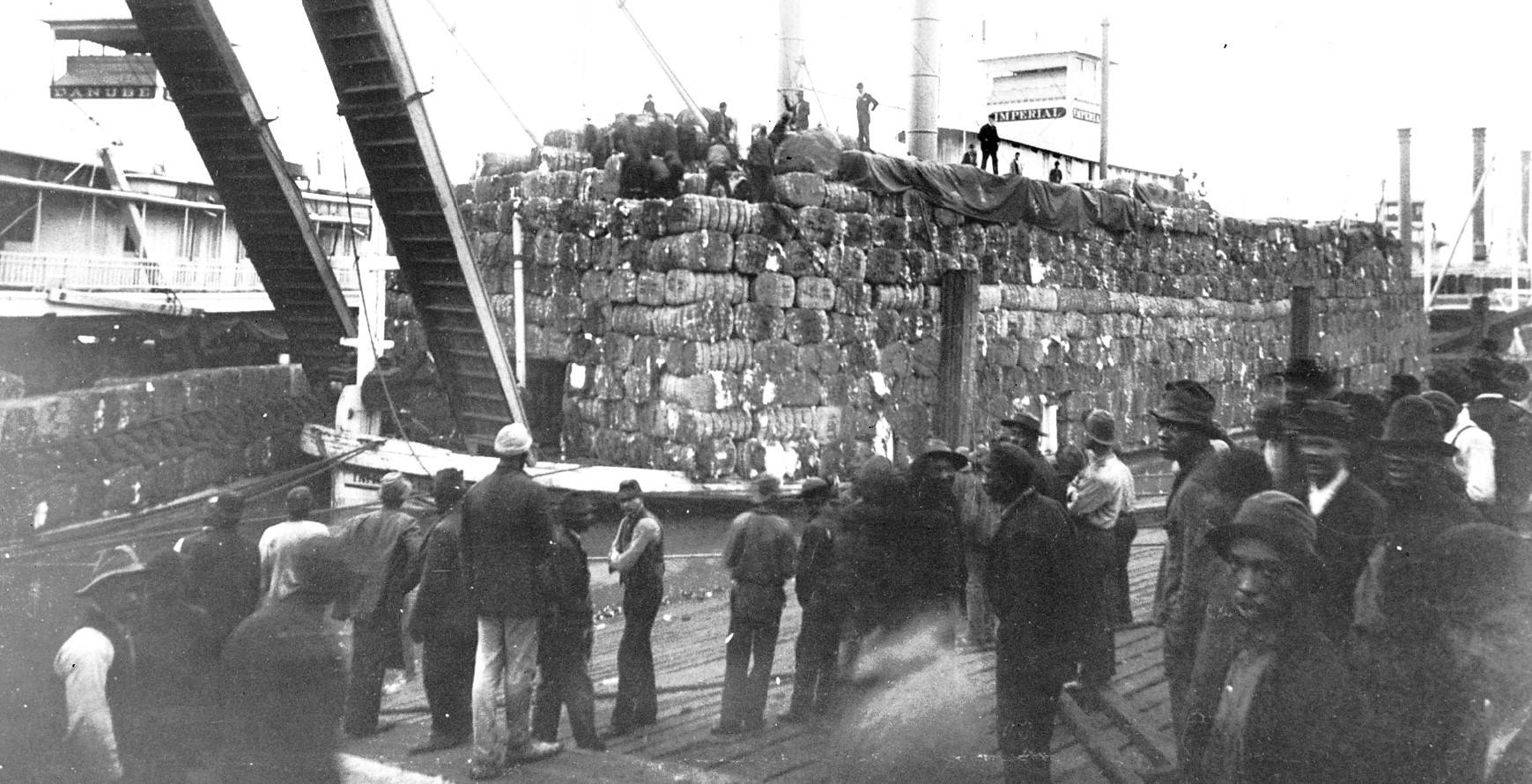
A report from the first month of 1923’s inter-racial New Orleans general dock strike involving both the I.W.W. and craft unions. The month following this article, the strike would go down to defeat and the waterfront an open shop.
‘The Great New Orleans Strike’ by Sidney Terry from Industrial Pioneer. Vol. 1 No. 7. November, 1923.
ON the night of September 12th the colored and white longshoremen of New Orleans held a joint meeting regarding wages and working conditions. Their agreement had expired the end of August, and they had been working for a few days with no agreement. At the meeting a vote was taken and a strike declared, to take effect the next morning. All foremen were notified of the action of the meeting, and told not to hire men the next day. Not one longshoreman was working on the waterfront Tuesday September 13th.
The shipowners were electrified, no notice of the strike had been given, just a vote, and like a flash, every longshoreman on the waterfront was on strike. The bosses were frantic, they were caught unprepared. For two days they tried to get the longshoremen to go back and let their demands be arbitrated. This was refused. The longshoremen wanted their demands, and would not go back until they got them.
While the shipowners were trying to get the longshoremen to go back, five hundred cotton screwmen walked out for more wages. Conditions on the waterfront were critical, the boss had not been notified of a strike, and had no strikebreakers in readiness.
MTW Acts
Just when the bosses were going to hire scabs, the MTW of the IWW acted. Dodgers were broadcasted along the waterfront on every ship advertising a mass meeting. The meeting was held, and unanimously declared a sympathy strike with the longshoremen and screwmen, only one demand was made, the release of Class-War Prisoners.
Like a thunderbolt out of the sky came the strike call. The papers came out with big headlines, and large editorials were written denouncing the IWW for its action. But the IWW was in the fight with all the power at its command.
The IWW immediately got committees functioning, including one which got the news right from the waterfront, and published it daily in bulletin form. The bulletin had a good effect, and served its purpose by counteracting the lies of the daily press.
Bulletin Makes Hit
The bulletin met with such an outburst of approval from the strikers that the press published the contents of the bulletin for three days. Everybody wanted a bulletin, there was a steady stream of workers coming to the hall for them. The number of bulletins was doubled, trebled, and then there was not enough.
A piece was published in the bulletin to the effect that the Yellow Cabs had been seen hauling strikebreakers. This met with instant denial by the road superintendent of the company, who declared he would dismiss any driver carrying strikebreakers. The superintendent used to come to the hall every day to see if any drivers had been reported to the bulletin, a few were reported, and the drivers dismissed.
A bakery advertised as supplying bread to scabs, sent a letter to the bulletin denying any such thing, also stating that they would not supply scabs with bread at a dollar a loaf. The sentiment in favor of the strikers was tremendous.
The IWW took advantage of the nervous tension of other marine workers to propagate the necessity of a general strike in the whole industry. On September 25 the teamsters took a vote, and a sympathy strike was declared. The ranks of the strikers were swelled by six hundred. Would it never stop? Craft after craft coming out and no settlement in sight. On September 26th one thousand two hundred freight handlers walked out in sympathy, followed the next day by one thousand one hundred plate handlers. The general strike on the New Orleans waterfront was on.
Membership Increases
The press quoted the IWW as the instigators of the strike. The cap fitted. One hundred new members were taken in the first three weeks of the strike. An attempt was made to get the cotton screwmen’s hall for an IWW meeting, the president refused the use of the hall. The next day the white longshoremen’s hall was obtained for the meeting. The meeting was a great success, each IWW speaker was greeted by terrific applause. The officials of the craft unions were powerless to stop it. Four hundred were at the first meeting, and several were turned away.
A bigger hall was needed, so the colored longshoremen’s hall was obtained. This meeting was attended by eight hundred black and white strikers. The meeting will be remembered as the greatest meeting ever held with colored and white present. New Orleans was talking IWW and literature was in great demand. 200,000 pieces of literature have been distributed since the strike started. The IWW commanded the respect of all workers. An IWW card worked wonders. The card was abused to a certain extent, by irresponsible individuals, but a piece inserted in the bulletin soon stopped this.
Tied Up Solid
As this article is being written, it is the first week of October. There are about seven thousand men on strike, and there are less than three hundred strikebreakers on the waterfront. The harbor is tied up solid. Ships are laying two and three abreast. All one can see when looking up the river is ships. No crews, no longshoremen, desolated like a graveyard. “When is it going to stop?” cries the press. “When the longshoremen and screwmen get their demands,” answer the strikers.
The strikers are standing solid, very few have broke ranks. The morale of the strikers is wonderful. Strikes on the New Orleans waterfront are usually very violent. This strike is almost free from violence. Violence is being condemned by the IWW both by bulletin and by word of mouth. It is severe in restraining some of the more foolish strikers from committing acts which would only harm themselves.
Agents of the steamship owners visited the reporters of all the daily papers and asked them “if they wished to make money.” Some refused, but the majority accepted. All the reporters had to do to make money was to be at a certain place when asked by the agent. About one hundred scabs would be placed on a ship, and then the reporter would be called upon to take pictures and make a story. The “planted” story was supposed to be an example of how every ship in the harbor was being worked. The reporter got fifteen dollars a column for his story. Wishing to “make money” quick, it was an everyday occurrence to see a story about a ship working cargo, covering four and five columns. The plan was uncovered a few days after it started, and was advertised both at meetings and in the daily bulletins. The solidarity of the strikers could not be broken. The costly “planting” of stories was discontinued. The grossly exaggerated statements, and the barefaced falsehoods which appeared in the daily press, did more to solidify the strikers than to weaken them. A few days ago an injunction was applied for by the Steamship Owners’ Association. The injunction went into effect immediately. A counter-injunction has been applied for by the strikers, it has been delayed for ten days, for a hearing. Several conferences have been held between the strikers and the steamship owners during the past few days, but the strikers are standing solid behind their every demand. The steamship companies have lost over four million dollars since the strike started, and are losing about one hundred thousand a day now. The strikers are standing more solidly now than they did when the strike started. Everybody who went on strike must be reinstated. All demands must be granted. The cry is, “We came out in a body, we will go back in a body”.
New Orleans, La., Oct. 13. Judge Boatner, in civil district court, today made permanent the injunction obtained by striking harbor workers against the dock board to prevent enforcement of a rule of the board barring strikers from the wharves. The court declared there was nothing unlawful in abandoning work to obtain higher wages, that the docks are public places and that “the ex-employes have the right to enter them and communicate with men at work in lawful efforts to persuade them to join their ranks in an economic struggle.”
The Industrial Pioneer was published monthly by Industrial Workers of the World’s General Executive Board in Chicago from 1921 to 1926 taking over from One Big Union Monthly when its editor, John Sandgren, was replaced for his anti-Communism, alienating the non-Communist majority of IWW. The Industrial Pioneer declined after the 1924 split in the IWW, in part over centralization and adherence to the Red International of Labour Unions (RILU) and ceased in 1926.
PDF of full issue: https://www.marxists.org/history/usa/pubs/industrial-pioneer/Industrial%20Pioneer%20(November%201923).pdf
 Revolution's Newsstand