
A valuable early history from Soviet Russia’s military analyst Roustam Bek on the formation of Red Navy, with deep revolutionary roots among sailors, and its role in the Civil War up to that point.
‘The Red Navy’ by B. Roustam Bek from Soviet Russia (New York). Vol. 3 No. 15. October 9, 1920.
IN MY book, “Panama de la Marine Russe”, published in 19081, I foretold the approach of the Social Revolution in Russia. Disclosing the mischievous deeds of the officers of the imperial Russian navy, I described the true conditions of the Russian seamen, whose lot was not better than that of the convicts serving sentences at hard labor. It was the first public disclosure of conditions in the Russian imperial marine, described from within, and it produced a great scandal in higher circles at Petrograd. Naturally, the circulation of this book in Russia was strictly forbidden. Dealing with the life of the Russian bluejackets, I stated positively that these sailors would accomplish the most important part in the approaching struggle for liberty and that they would be uncompromising revolutionists because they had endured real slavery and knew better than anybody else in Russia what the rule of the bourgeois class meant.
As I foresaw twelve years ago, so it happened. The conditions under which the Red Navy acted during the Revolution, from a purely strategical point of view, required great secrecy; therefore for a certain period there was almost no information about it. Nevertheless, the part played by the Red Navy during the Revolution, during the armed intervention of the Allies, and during the civil war, was of great importance. It must not be forgotten that the victory of the Revolution in February and in March, 1917, was due chiefly to the activity, firmness, and self-sacrifice of the members of the Baltic Fleet. The revolutionary sailors remained inflexible even at the moment of compromises when the eloquent Kerensky tried to persuade the Russian people to act together with the capitalistic coalition. The famous Kronstadt Republic, which remained faithful to the principles of the Soviets, made a desperate fight against reaction and became a real terror to the bourgeoisie. The working class of Russia looked on the sailors as their most faithful brothers. Finally the Baltic and the Black Sea Navies became the backbone of the young Soviet Republic.
As far back as the winter of 1917 the Baltic Fleet, in spite of all the existing disorder in the naval structure of Russia, succeeded in steaming from Reval to Helsingfors, thus saving the Russian warships from the German invaders, while the Black Sea Navy, being menaced by the enemy, preferred to sink their best ships rather than surrender them to the Germans. In both cases, however, the enemy met a most fierce resistance from the Red Navy of Soviet Russia.
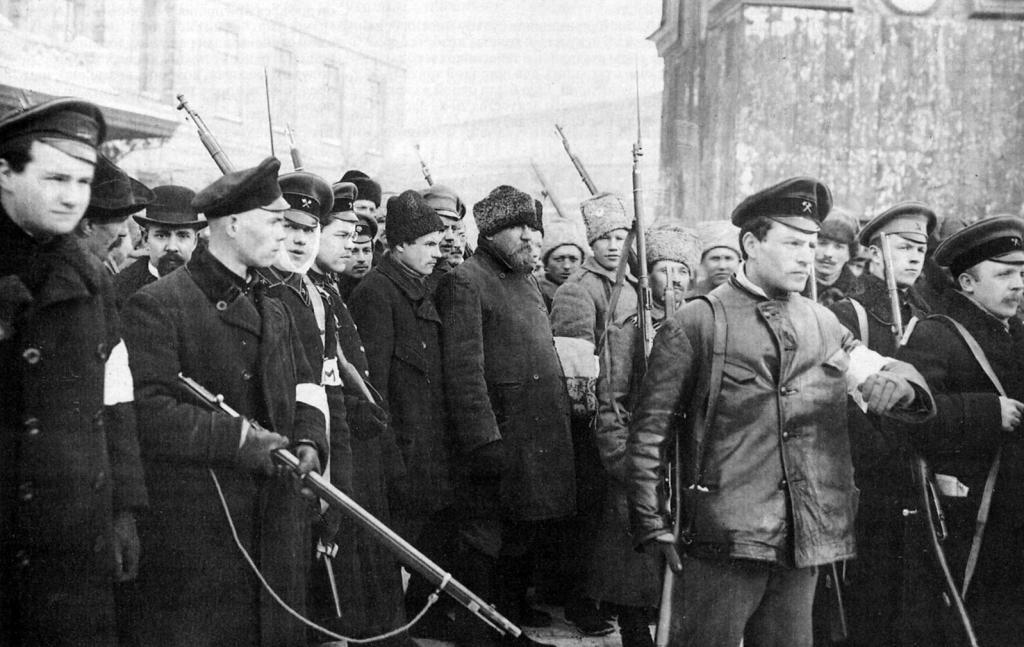
The Naval Commissariat of the Republic even in the early days of its existence showed great activity. In order to arrest the movement of the invaders a rather powerful flotilla was created on Lake Chudskoie, while a great part of the sailors, on several inner fronts, together with the Red Guards, were engaged in fighting the invaders and counter-revolutionists, covering themselves with glory.
Allied intervention forced the Soviet Government to reorganize the Red Navy on new lines suitable to the new regime. The volunteer system introduced in the naval organization was found to be weak and unpromising. The Red Navy had to be a strong and stable organization. Therefore the revolutionary committees which were in existence on every warship were dissolved, and the Soviet of the Commissars of the Baltic Fleet was replaced by the Revolutionary Military Soviet, which, in the beginning of 1918, appointed to every warship a naval commissar who worked with the naval commanders in the same way that the commissars worked in the army.
The result of this reorganization was excellent. In the autumn of 1918, the warships Oleg and Andrei II successfully supported the operation of the Red Army along the Baltic shores. During the famous Anglo-Yudenich dash on Petrograd in 1919, these warships successfully repulsed all attacks of the British torpedo boats directed on Kronstadt, with heavy losses for the aggressors, three of seven English torpedo-boats being sunk by the Russians. It was the Baltic Fleet which recaptured Krasnaya Gorka, treacherously surrendered to the enemy by its commandant Nekludov, an officer of the Czar’s army who had succeeded in winning the confidence of the Soviets. This was at the most critical moment of the struggle for Petrograd.
In spite of all alleged weakness and all existing difficulties, the Red Baltic Fleet inflicted upon the British navy blockading Russia considerable damage, sinking a large British destroyer of the latest type, the Victoria, as well as one submarine. There were also some losses in the navy of our enemy, which remained unknown to the public. The Red torpedo-boat Gavriil heroically beat off an attack of four enemy torpedo-boats, while the Baltic Navy, during all the battles near Tsarskoye Selo and Peterhof, bombarded the siege batteries of the enemy, in spite of the presence of the 15-inch guns of the British navy, and protected the coast line of the Finnish Gulf as far as Yamburg.
The famous Krasnaya Gorka, key to Kronstadt, after it was recaptured from the White Guards in one day by naval contingents supported by the bombardment of the Red Navy, was henceforth defended by Red seamen, and it was they who so stoically repelled all attacks of the enemy directed on this strategical point from land and sea. Neither Yudenich nor the Allies were able to break down the heroism of the Red sailors in spite of all the superior technical means at their command. Meanwhile on Lakes Ladoga and Onega the newly created Red flotillas were actively distinguishing themselves as the watchful guardians of these waters, gradually clearing them from the enemy. The Kolchak offensive in Siberia also forced the Soviet Government to create naval forces on several rivers, and the Volga was the first where the Red Flag of the revolutionary navy was hoisted. Here the Red sailors cooperated with the Red Army in perfect harmony, repulsing the attacks of the Kolchak hordes along the river.
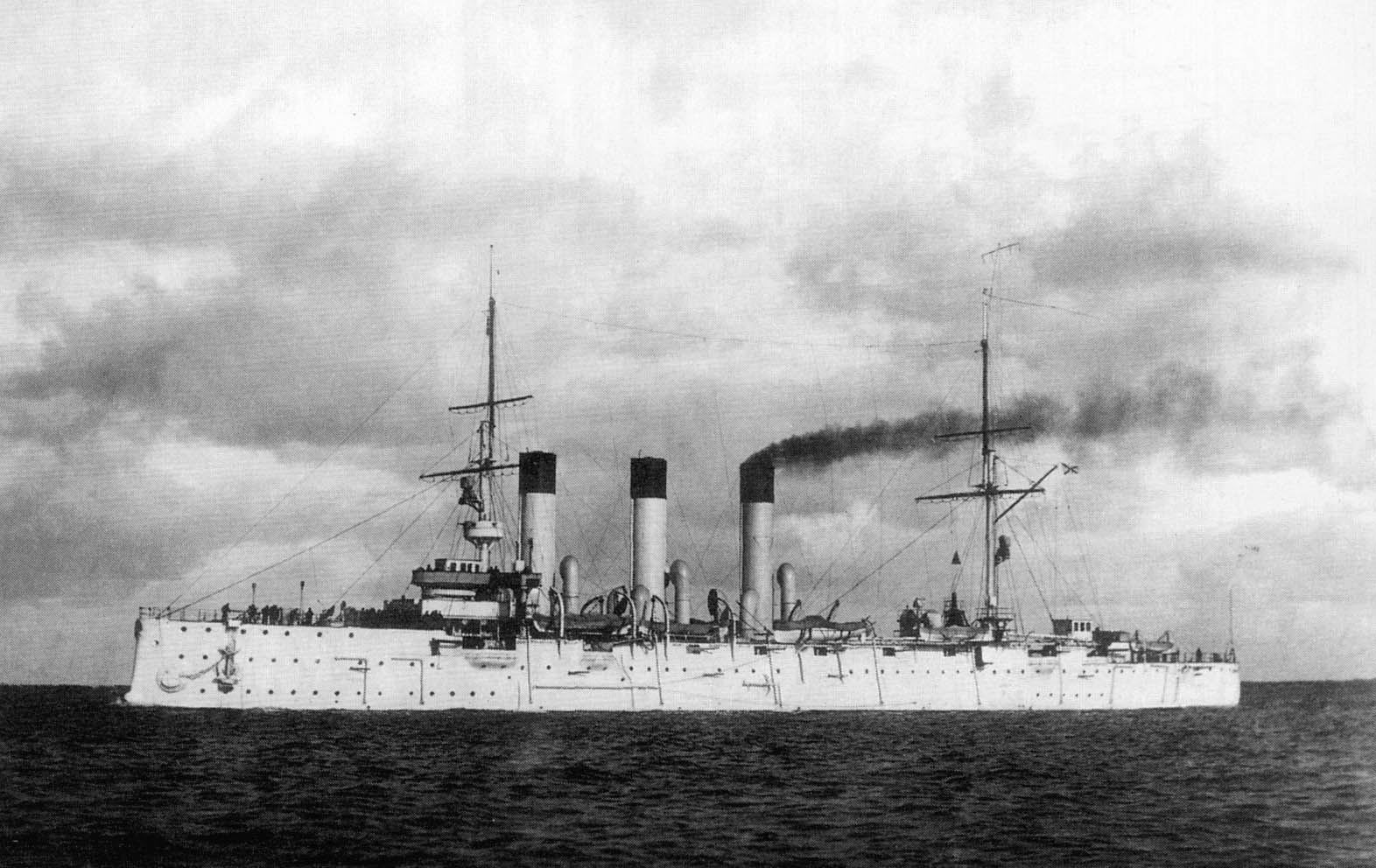
The military operations in Russia, gradually increasing, required the assistance of naval forces in the other regions of the Republic. So in 1919 Red naval units were established in the Caspian Sea and it was no easy task to transport destroyers and submarines from the Baltic Sea to Astrakhan, partly over the waterways, and partly by rail.
The iron ring of the Allied blockade forced the strategy of the Soviets to counter-balance it by a similar ring formed of a series of flotillas established on several lakes and rivers throughout the territory of the Republic. Great was the surprise of the Allies and of the reactionary generals when they met along the whole system of the water communication of Soviet Russia the most stubborn resistance of the newly created Red naval force. Thanks to the superhuman energy of its members, the Red naval administration succeeded in establishing flotillas on the Lower Dnieper and Dnieper, on Chudskoie Lake, on the Northern Dvina and on the Western Dvina, on the Don, and later on the Pripet, Berezina, as well as on the other rivers, according to military circumstances and demands of the army command. And everywhere the enemy was met successfully, and in many cases suffered tremendous losses.
All this was accomplished in spite of disorganized industry and without the necessary number of experienced specialists. Besides these difficulties, there was another obstacle, perhaps the most important of all for a naval organization. There was a general shortage of coal in Russia. Denikin became the master of the Donets industrial region and practically left the Russian Navy without fuel. The difficulties which the Red Naval administration had to overcome can be imagined if we will take into consideration that the active part of the Baltic Fleet alone required more than 300,000 tons of coal annually without considering the necessities of the numerous lake and river flotillas. Only the revolutionary spirit of the Red Navy could have kept its guns constantly active and brought the Red ships where their help was required. After the October Revolution the whole naval apparatus of the imperial ministry of marine was taken over by the Soviets and a great majority of the existing employes submitted to the new regime. This to a certain extent helped the Soviet naval administration in their work of reorganization.
Comrade Dybenko was appointed Commissar for Naval Affairs, replacing the former Marine Minister, and a board was formed under his control with one specialist, M. Ivanov, and three political representatives: Raskolnikov,2 Saks and Kovalsky. Also a special board was established under the name “Centrobalt”, which took the supreme command of the Baltic Fleet.
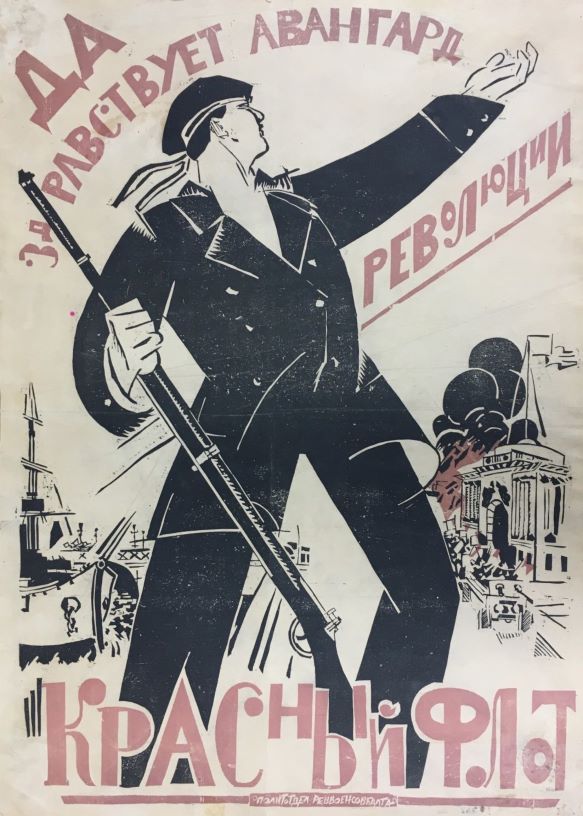
At the end of January, 1918, the imperial navy was completely liquidated and replaced by the “Workers’ and Peasants’ Red Navy”. In the spring of 1918, Trotsky was appointed Commissar for the Military and Marine Affairs of the Republic.
When the Soviet Government established its headquarters in Moscow the center of the naval administration with the Naval Commissariat, the Marine General Staff, and all the technical and other administrative and supply branches of the naval management left Petrograd, where only one member of the Naval Commissariat remained as representative.
The former Admiral V. M. Altvater was appointed by the Soviets a member of the Supreme Naval Board. The appointment of one of the most famous admirals of the old regime produced a great impression on the reactionary elements of the Russian Navy. Altvater was known not only as a foremost expert, but as a man of high character and as a man of honor. It is said that when Kolchak learned that Altvater had joined the Soviets he was much upset and said: “If Altvater is with the Bolsheviki it is a very bad sign.”
Admiral Altvater succeeded in attracting to the Red Navy many important experts, who henceforth became devoted and industrious elements in the organization for the support of the cause of the Russian workers.
Anticipating an attack from both land and sea by a numerous enemy, in the autumn of 1918 the Soviet Government undertook a general reorganization of the defense forces of Soviet Russia. The Red Navy with all its administrative machinery was placed under the control of the Revolutionary Military Soviet. Altvater and Raskolnikov became members of this Soviet and formed its Naval section. Strategically Altvater was the head of all naval forces of the Republic. The Chief of the Red Naval General Staff was also an expert, a former officer of the imperial navy, E.A. Berens. a man of great ability, who is at present the Commander-in-Chief of the Naval Forces of Soviet Russia, having succeeded Altvater, who remains on the board of the Supreme Revolutionary Military Soviet.
Comrade Berens has at his disposal a special staff and is delegated with purely strategical and executive power, practically as an assistant of the Commander-in-Chief of all military forces of the Republic, who is, as we know, Comrade Trotsky. The administrative and supply departments are centralized under a Commissariat of Naval Affairs under N.I. Ignatiev, subordinate to the Revolutionary Military Soviet of the Republic.
Thus it is clear that the Revolutionary Military Soviet of the Republic is the supreme authority of the military and naval organization of Soviet Russia. To this institution the Commander-in-Chief of the army and navy is subordinate. By this organization was secured the coordination and cooperation of the land army and the marine, which is so important for Russian strategy.
The organization of the command of the Baltic Fleet is similar to the organization of the military command in the army. The chief commander of the naval forces is assisted by two political commissars, while in the flotillas one commissar is attached to each commander. This organization is considered as the most suitable to the existing regime.
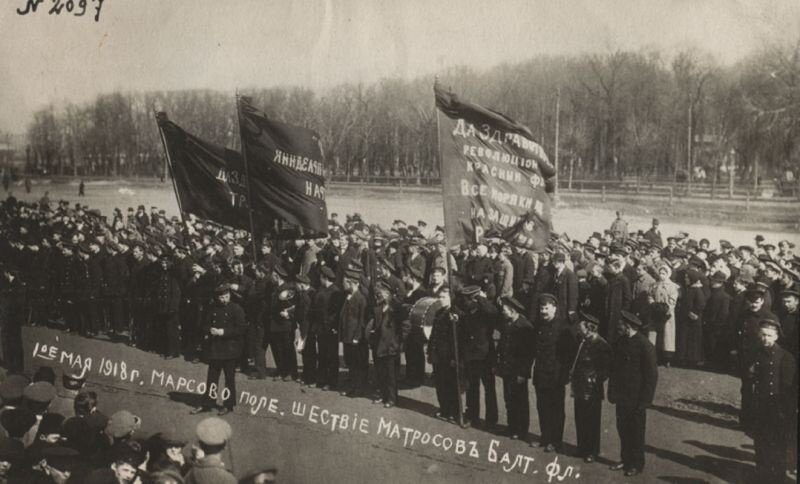
The Naval General Staff, besides its purely strategical and scientific purposes, is also an advisory institution to the Revolutionary Military Soviet and under its control the general and special naval education is conducted.
The most important branch of the Naval Commissariat is certainly its technical department. The supply of the Red Navy with all kinds of the material, as well as the work in the shipyards is of the foremost importance. The task is a most difficult one in the presence of the economic conditions in which the country finds itself at the present critical moment. The Technical Department of the Naval Commissariat is divided into eight sections: shipbuilding, mechanical, ordnance, mining (torpedoes), submarine, radio-telegraphy, naval aviation, and fortifications. This institution, during the period of the civil war, had built and equipped on the rivers Volga, Kama, North Dvina, Dnieper, and Don as well as on the lakes Ladoga, Onega, and Chudskoie, more than ten ports, up to 1920, and had supervised the reconstruction and armament of more than one thousand commercial ships. Such a gigantic work could not have been accomplished without the most efficient organization for the distribution of material.
NOTES
1. Roustam Bek. “Panama de la Marine Russe”, Nice, France, 1908. Librairie Rozanoff, 3, Rue Longchamps. This book was printed in the Russian language and was suppressed in Russia. A year later Captain Semenov’s book, “Rasplata”, appeared in Russia describing the cause of the failure of the Russian navy during the Russo-Japanese War. The information in this article has been taken mostly from official publications of the Soviet Government which have recently arrived from Moscow. B.R.B.
2. Comrade Raskolnikov was later captured by the English during a raid undertaken by the Baltic Fleet on Riga in October, 1918, when the Red Navy lost two torpedo-boats Astril and Sparta.
Soviet Russia began in the summer of 1919, published by the Bureau of Information of Soviet Russia and replaced The Weekly Bulletin of the Bureau of Information of Soviet Russia. In lieu of an Embassy the Russian Soviet Government Bureau was the official voice of the Soviets in the US. Soviet Russia was published as the official organ of the RSGB until February 1922 when Soviet Russia became to the official organ of The Friends of Soviet Russia, becoming Soviet Russia Pictorial in 1923. There is no better US-published source for information on the Soviet state at this time, and includes official statements, articles by prominent Bolsheviks, data on the Soviet economy, weekly reports on the wars for survival the Soviets were engaged in, as well as efforts to in the US to lift the blockade and begin trade with the emerging Soviet Union.
PDF of full issue: https://www.marxists.org/history/usa/pubs/srp/v3n17-oct-23-1920-soviet-russia.pdf
 Revolution's Newsstand