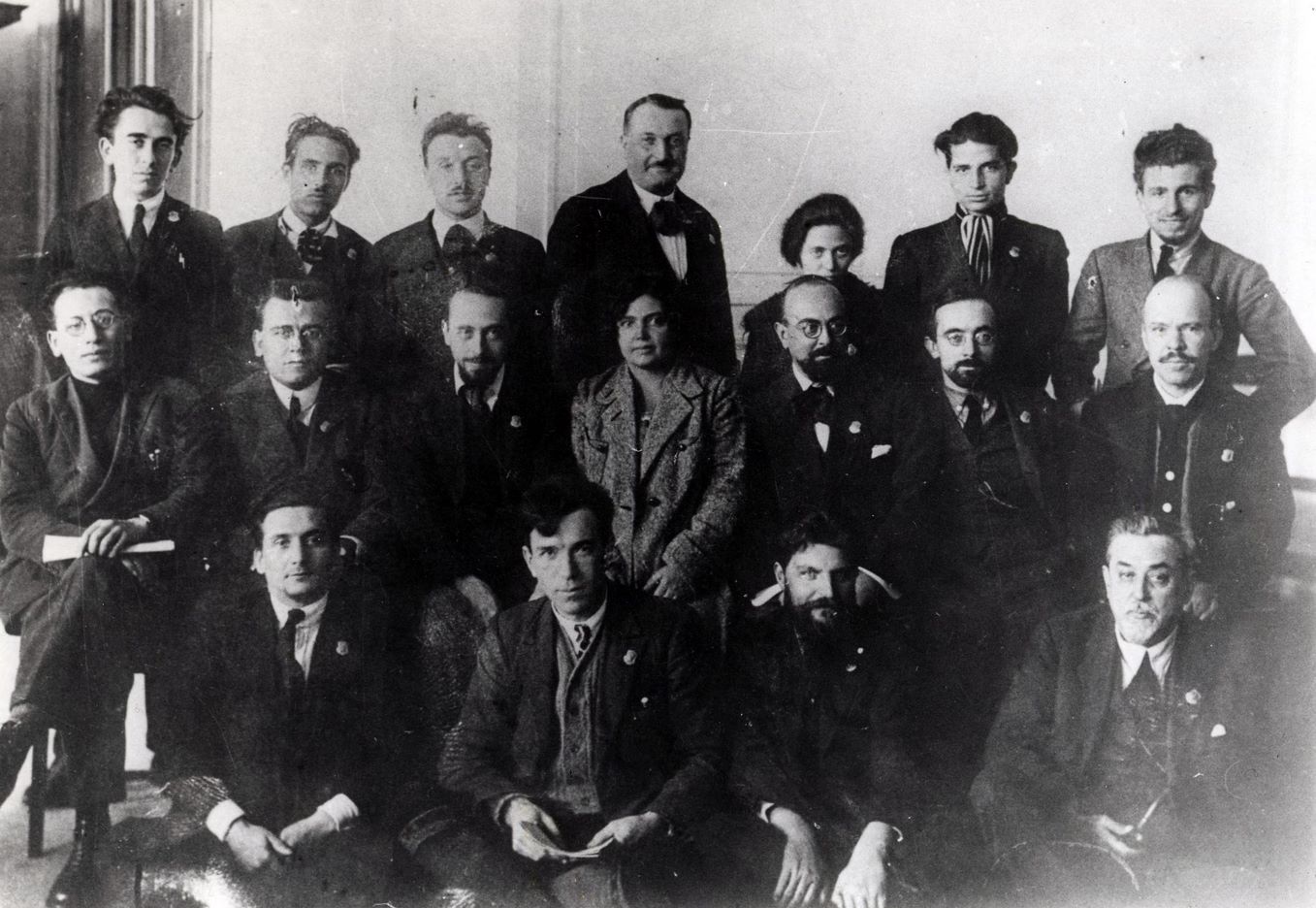
A long disaster for the Italian working class unfolds after the unfinished revolution of the Biennio Rosso.The Communists, divided and too isolated for power; the Socialists, corrupt and divided with no thought of power; the Fascists, organized and confident in their increasing power. No other country had a struggle internal to the working class over fascism like Italy, where it was noteworthy for its ‘syndicalist’ pretensions and Black unions–with more than a few ex-radcials joining its ranks. Repossi was a veteran revolutionary and internationalist who was a central leader of the Italian Communist Party. Associated with Bordiga’s positions in the Comintern, he was expelled in 1928 while in serving years in prison. He remained a Left Communist after his release.
‘The Trade Union Movement in Italy after the Fascist “Revolution”’ by Luigi Repossi from International Press Correspondence. Vol. 3 No. 5. February 8, 1923.
The trade union movement in Italy has suffered much through the “revolution” of the Fascisti. The railwaymen’s trade union has lost one half of its members, the Federation (C.G.L.) now comprises no more than 200,000 to 300,000 organized workers; the Italian Trade Union Alliance (Unione Sin dacale Italian) practically no longer exists, apart from a few small groups in certain places; the Popolari (Christian), although affiliated with the Fascisti, also reports a reduction of membership. Only the membership of the Fascist trade unions has increased.
These circumstances make it particularly necessary for all those who meet on the common ground of class war to unite. But the reformists, who are much worried over the influence gained by the communists among the organized masses, and are besides anxious to find a possibility of alliance with the Fascisti, while talking of the unity of the trade unions, in reality utilize the political situation for avoiding the convocation of congresses in which they would inevitably suffer defeat. They are making use of their position as leaders in order to dictate alterations in the organization and in the fundamental program of the trade unions, alterations in complete contradiction to the whole line of development of the unions. They seek to unite with the nationalists, and launch a campaign for driving out the communists. The Fascisti have never had better allies, the proletariat never more efficient betrayers. The program of the “Committee for Trade Union Unity” (Comitato per l’Unità Sindacale) now formed in Italy, bears witness to the truth of this statement. In this committee we find Rinaldo Rigola, Ettore Gaetani (reformists), Alceste de Ambris, Olivetti (national syndicalists), Ronzani (d’Annunzio syndicalist).
At the meeting at which this committee for trade union unit, was founded, they laid down their programmatic principles by proclaiming above all, adherence in the most decisive form to the principle of nationalism; the trade unions must never act against the nation; the trade unions wage the class war for the improvement of the position of the proletariat, but only on cultural lines. Co-operation with the bourgeoisie, where this is in the interests of the proletariat, was also emphasized as a fundamental principle. Silence was preserved as to international relations, as also on the organizations of the Fascisti. But on the other hand the program distinctly declares that those who decline to recognize the nationalist principle and the cooperation of the classes, cannot belong to the trade unions. Trade unions as such must have no connection with any party; besides this, it is prohibited to form nuclei within the trade unions.
From all this it may be seen that the main endeavor is to exclude the communists from the trade union movement. The official leadership of the C.O.L. raises no objections to this policy; in the last number of its organ, the Battaglie Sindacali, it is clearly stated that only “pure criticism” is permitted in the free trade unions; if the communists intend continuing their struggle for the revolutionizing of the movement, they will be driven out. And while all this is being undertaken against us, every effort is being made towards unity with the Fascisti. At one time the Fascisti pretended to be willing to join a movement towards unity, but now they set difficult conditions, and demand that the whole organization declares itself for Fascism, and abandons all connection with the Amsterdam or any o her International. Will the reformists refuse to do this? Yes, to-day they will refuse. But later? They have already made many concessions. The trade union movement has been stripped of all idealism, nothing remains but the business side, and it is to be feared that the leaders of the C.G.L., for the sake of being permitted to remain at the head of the movement, will accept everything the Fascisti choose to dictate.
At the time when the Fascisti commenced their offensive, they invariably insisted that they had nothing against the proletariat, on the contrary, they would always defend the legitimate interests of the proletariat. The methods employed by the Fascisti for obtaining members are well known; to these they have now added fresh methods; state assistance, the state appointing them to all positions in the commissions, and granting state contracts solely to cooperative societies founded or managed by Fascisti. The labor exchange, for instance, has been left to them, by which a large part of the proletariat is forced to enroll in the Fascist trade unions in order to obtain work. This is the reason why the membership of the Fascist trade unions has so increased, and is now alleged to approach a million. Edmondo Ressoni, general secretary of the Fascist trade unions, declared a few days ago that he has distributed 250,000 new cards of membership. It must be further observed that the Fascist trade unions not only count workers among their members, but the owners of industrial undertakings, so that they are not trade unions at all in the strict sense of the term.
The program and methods of the Fascist organizations are as follows: To the class war they oppose the struggle of “individual capacity”; an individual in order to be spurred on to work must not be paid in accordance with a wage scale, but in proportion to his performance. This is the whole basis of their program, whose identity with the theories of bourgeois capitalism is perfectly obvious.
In the Fascist trade unions the members have no choice whatever; the episode of the seamen is characteristic of this. In the treaty of alliance entered into between d’Annunzio and Giulletti for the “socialist” seamen, and Mussolini for the Fascisti, it is expressly stated that every demand and action of the seamen must first receive the approval of the Fascist party!
At the present time the situation of the workers in Italy is one of political and economic slavery. No liberty, no justice, no rights. Imprisonment, blows, starvation wages–this today, is the fate of the Italian proletariat. And despite this the social traitors dare to say that we are the enemies of the proletariat, and must be driven out. And with regard to the Fascisti, d’Arragona states that their program is not antagonistic to that of the trade unions…
International Press Correspondence, widely known as”Inprecorr” was published by the Executive Committee of the Communist International (ECCI) regularly in German and English, occasionally in many other languages, beginning in 1921 and lasting in English until 1938. Inprecorr’s role was to supply translated articles to the English-speaking press of the International from the Comintern’s different sections, as well as news and statements from the ECCI. Many ‘Daily Worker’ and ‘Communist’ articles originated in Inprecorr, and it also published articles by American comrades for use in other countries. It was published at least weekly, and often thrice weekly.
PDF of full issue: https://www.marxists.org/history/international/comintern/inprecor/1923/weekly/v03n05-feb-08-1923-Weekly-Inprecor-loc.pdf
 Revolution's Newsstand