
When has U.S. health ‘care’ not been a nightmare? Never. A worker at New York City’s Broad Street Hospital, today’s Downtown Hospital, tells the history of, and conditions in, that institution.
‘Waterfront Hospital’s Lowest Fee Is Larger Than the Income of a Worker’ from The Daily Worker. Vol. 5 No. 20. January 25, 1928.
EMPLOYE TELLS THE HISTORY OF N.Y. INSTITUTION
Broad Street Got Boom in Wall St. Blast
By a Worker Correspondent. The Broad Street Hospital was a one-horse institution with 30 beds until the Wall Street explosion of 1919 gave it a big income.
The story of this hospital and the way employes and patients fare there will illustrate to the worker-readers of The DAILY WORKER the causes back of the unhappy conditions, the long hours at starvation wages and the kennels provided as living quarters which are the portion of the hospital workers.
Knowledge of graft and unfitness among hospital officials of this city will help the worker to understand why he is asked to pay $25 a week and more when he seeks hospital admission, and, unable to do so, finds the doors of the hospital slammed in his face.
At the Waterfront.
The conditions for workers and patients at the Broad Street Hospital are the conditions existing in any hospital in New York.
The Broad Street hospital is at the junction of Broad and South Sts., at the East River waterfront. It serves a district in which thousands of longshoremen work and which at the same time includes the Wall Street financial section. It serves also the dismal living quarters of Washington St., screened from the eyes of big business by skyscrapers.
The Broad Street Hospital was founded 11 years ago, thru the agency of one A.J. Barker Savage, a former Canadian medical student. Casting about in New York for a steady job, he succeeded in interesting several wealthy men, notably James Barber, the senile head of the Barber Steamship Lines, one of the worst exploiters of seamen, and William Hamlin Childs, a capitalist with hands in many a financial pie.
Explosion Profitable.
For a few years the sledding was hard for the Broad Street Hospital with its 30 or so beds located on the site of a former warehouse. Then came the celebrated Wall Street explosion in 1919, which the government and the bankers attempted to blame on revolutionary workers. The Broad Street Hospital with its few beds happened to be but a few blocks away and rendered emergency treatment to most of the injured.
Savage Cashes In.
A.J. Barker Savage cashed in on this fact. In a campaign he sent out donation-seeking circulars by the thousands. He failed to mention that most of the sufferers in the explosion were workers, unable to pay hospital bills. They were, of course, sent to Bellevue, the city “slaughter house.” Wall Street, scared by the “red plot” invented by the William J. Burns International Detective Agency, responded generously and the money rolled in. An addition bringing the bed capacity to about 120 was built. Savage was superintendent of the hospital at a salary of $12,000 a year. His policy was to fawn upon the rich, especially the Wall Street business men.
The Workers Paid.
The men of business were given the best private rooms and the best of attention and the hospital bills were “taken care of” by Savage. The poor had to pay or go to Bellevue. The attention of most of the hospital’s medical staff was showered on any broker or financier or a member of his family, often ill with some minor complaint such as the grippe. Little care and poor food continued to be given to the ward patients. The excitement of the Broad Street Hospital when James Barber, the hospital’s “sugar-daddy,” or some Standard Oil official or a relative of Elisha Walker, of Blair & Co., was a patient forms a neat contrast with the welcome accorded some South Street jobless seaman, brought in dripping with blood after a beating up by two or three policemen from Old Slip Station.
Finances Drained.
Savage’s assistants, whose number was legion, received large salaries. The hospital, ostensibly founded for the treatment of the workers of downtown New York and their families was steadily being drained of its finances due to mismanagement, high salaries and, according to the employes of the hospital, graft. Even the hard-boiled board of directors got tired at last, and in the winter of 1923 Savage and his clique were dismissed. A professional reorganizer was called in. At a salary of $12,000 a year and with a gang of high salaried officials he accomplished nothing. The hospital kept losing thousands of dollars annually. Masons Fill Beds. In 1924 the Masons decided to take over the hospital and its deficit. Men were appointed officials at sumptuous salaries. Members of the Masonic order, scenting something for nothing, swarmed down on the hospital, taking nearly every bed for themselves, their families, their relatives and their friends. A sick worker had a hard job getting in. The hospital beds were full of Masons. A line of workers, injured on the job and waiting to receive dispensary treatment, would be forced to wait if some Mason with a headache or stomachache came rushing in demanding instant treatment. Chronic alcoholics and syphilitics would be accepted because they were Masons while workers and their families continued to be sent to Bellevue.
Workers Turned Away.
The hospital, almost exclusively treating Masons free of charge, got into an inextricable financial fix. The Masonic officials of the hospital knew nothing about operating a hospital. Having milked the hospital dry, they gave it up in 1925.
Another professional efficiency expert, Cornelius Loder, was called in. His salary too was $12,000 a year. He fired the Masons from their soft berths and brought in his own gang. A $100-a-week job here, a $50-a-week job there and the payroll had nearly doubled. Loder instituted a speed-up system, and was constantly at the elbow of the workers, firing and hiring right and left.
Spies Are Hired.
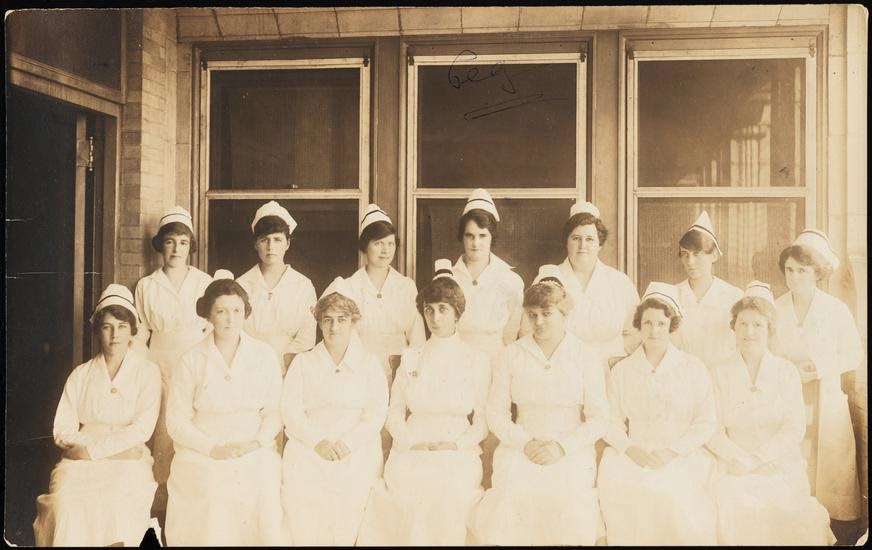
Nearly every day the entire hospital force would be called together and given a “pep and efficiency” talk by Loder. Stool pigeons were introduced among the workers. The Loder clique ran things as they liked until forced out in 1926. Savage was recalled, with a man named Torelli as his dummy. And now the old gang reigns at Broad Street Hospital once again. Since Savage’s return the hospital has had to relinquish its nurses’ training school and nurses’ home.
Kitchen workers-cooks, dishwashers, kitchen porters, and waiters receive $50 a month for 12 hours daily labor. The porters and orderlies who clean up the hospital 12 hours a day get $50 a month.
Quarters are Firetraps.
The ward maids who clean up after the female patients get $30 a month. There is no hope for a raise for these workers and none has been given since the hospital opened over 10 years ago. Sometimes at Christmas a dollar or two is given as a bonus. The helps’ quarters at Broad Street Hospital are firetraps located in the same building as the wards for workers. Six or seven employes must sleep in the same room. The plumbing is out of order so often that a decent bath is rare. The toilets are filthy, as are the toilets in the wards. The I workers are subject to instant dismissal for any reason or no reason.
Epidemic Traced.
The workers in the kitchen, who handle the food, are supposed under the law to be examined thoroughly when hired. A few years ago a typhoid epidemic broke out in the Broad Street Hospital, in which several employes became severely ill. One student nurse died. The epidemic was traced to a kitchen worker who was a typhoid carrier. Had he been properly examined before being hired the epidemic would not have occurred. Men with venereal diseases can secure employment in the kitchen, where the patients’ food is prepared, in any hospital in the city. The starvation wages and long hours cause a huge turnover in hospital labor, the average worker staying less than two weeks.

The trained nurses, who must attend a training school for two years, receive an average of $80 a month. Untrained nurses who have not finished training school, get $50 a month. All slave 12 hours a day. The clerks average about $20 a week.
The rates for patients are $3 a day for ward beds, $4 a day for semi-private rooms, and $6 to $12 a day for private rooms. Charges are made for urine examinations ($2), X-rays ($5 a plate), for use of operating room ($15-$25) and for drugs. With these extra charges a hospital bill averages at least $35 weekly, which a worker can pay only with heart-breaking sacrifices and borrowing, if at all. In addition a doctor’s bill of $100 to over $1,000 must be paid.
Bellevue for Workers.
If a worker cannot afford a private doctor he is placed on the routine service of a member of the staff of the Broad Street Hospital, who visits him perhaps twice a week, leaving him at other times to the interns.
On South Street are thousands of jobless seamen. They face daily clubbings by the police for no apparent reason. Are these men, battered and bleeding, accepted as patients at Broad Street Hospital? They are sent to Bellevue. On Washington Street, behind the canyons of Wall Street, are the quarters of poverty-stricken workers of Greek and Syrian descent, dwelling in hovels owned by millionaire realty corporations. It is Bellevue for these too when illness comes.
The Daily Worker began in 1924 and was published in New York City by the Communist Party US and its predecessor organizations. Among the most long-lasting and important left publications in US history, it had a circulation of 35,000 at its peak. The Daily Worker came from The Ohio Socialist, published by the Left Wing-dominated Socialist Party of Ohio in Cleveland from 1917 to November 1919, when it became became The Toiler, paper of the Communist Labor Party. In December 1921 the above-ground Workers Party of America merged the Toiler with the paper Workers Council to found The Worker, which became The Daily Worker beginning January 13, 1924.
PDF of full issue: https://www.marxists.org/history/usa/pubs/dailyworker/1928/1928-ny/v05-n020-NY-jan-25-1928-DW-LOC.pdf
 Revolution's Newsstand