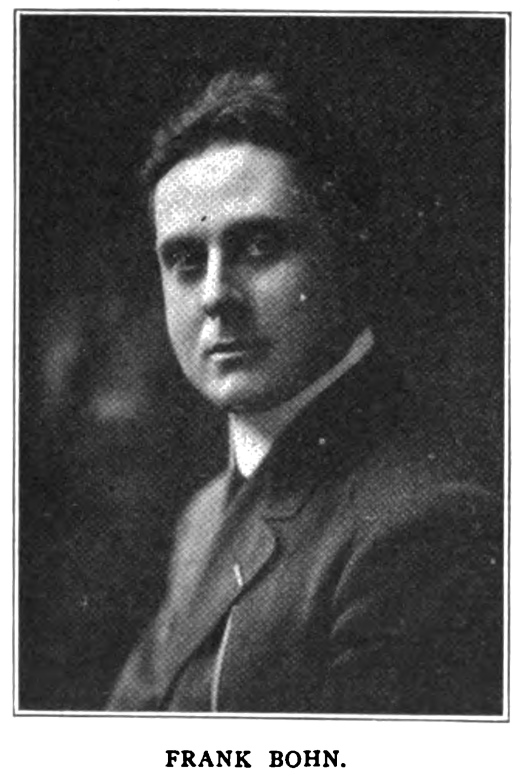
The Socialist Party had more than its fair share of lawyers in leadership, to the the disdain of left-wing comrades as Frank Bohn then was. That disdain is on display in this fine essay on a persistent question; what should revolutionary’s attitude be to the law and its institutions? Bohn answers, ‘contempt.’
‘Law and Socialism: Should We Try to Change The Constitution?’ by Frank Bohn from Revolt (San Francisco). Vol. 1 No. 9. June 24, 1911.
Several Socialists, for whose learning and good intentions we have every regard, are just now devoting considerable attention to a disputation’ over the law of the Constitution of the United States. The questions asked and answered have to do with what the Socialist party can do and what it cannot do under the Constitution. They also concern certain proposed changes in the Constitution and in the laws which will permit the Socialist party to do more for the working class than our present form of government permits.
What is this all about? What is the government of the United States? How far shall Socialists concern themselves with it?
Political government is an expression of physical power. It is just as strong and stable and no more so than the force back of it. It is sometimes said to be a club in the hands of the capitalists which they use upon the workers. This comparison is overdrawn. Political government is not the club. Political government is a set of rules according to which the club is used by the capitalists on the workers. The national club of the capitalists is constituted of the force of United States marshals and the army and navy. Except on rare occasions the system of capitalist rules comprehended in the political form of government suffice to keep the workers in subjection without the use of the club.
Suppose the cat makes a rule that the kitten shall not wander more than four jumps from the basket. Only when the kitten wanders beyond the prescribed limits does the cat pounce upon it and bring it back to its proper place. By and by the kitten grows, its legs become long enough to outrun those of the cat and thus government is destroyed. Its constitution and laws are ignored when the physical power back of them are not great enough to enforce them.
Lawyers and students of constitution history are ever prone to over-emphasize the importance of formal law. From the beginning of written laws, the dry forms have been profoundly respected by those who have been forced to obey them. It is quite different with those who make and enforce the laws. The ruling classes in all ages have realized the true nature of the rope of sand which they have been successful in making the worker believe to be an everlasting institution.
Did space not forbid it would be a very simple matter to list one hundred cases of the breaking of the Constitution and laws of the United States by the political parties and, leading statesmen who helped make them or were charged with the duty of their enforcement. I shall confine myself to a dozen of the most important instances in the history of the United States.
The Constitutional Federalist party which favored the adoption of the newly written Constitution of the United States in 1787-9, broke most fundamental laws in a number of cases in order to secure their ends. States were Gerrymandered and ballot boxes tampered with. But capitalism secured its political Constitution.
The Federalist party, during the administration of John Adams, passed the Alien and Sedition laws, which outraged the accepted principles of the Constitution. The Supreme Court permitted them to stand as law.
The Jeffersonian Anti-Federalists bitterly opposed the centralization of the National Government, but the greatest and most far-reaching act of Thomas Jefferson was the purchase of Louisiana. The Constitution gave to Congress and the President not the slightest power to do this. Jefferson, in thus throwing overboard the first political principle he had stood for during the fifteen years of the Federal Government, meekly pleaded for an ex post facto amendment to the Constitution, legalizing the Purchase Act. But ex post facto laws were forbidden by the Constitution itself, so Jefferson and his majority in Congress hurriedly changed the subject of conversation after the deed had been committed. The Federalist party fiercely opposed the doctrine of state sovereignty and urged the greater centralization of government. This was when they held power. When they were turned out of power, their principles of constitution interpretation were quickly changed. They stood for states’ rights against the nation and in 1814 we find them organizing a secession movement in New England.
In 1819 came the Supreme Court decision in the famous Dartmouth College Case. It was one of a series of famous decisions handed down by Chief Justice John Marshall, and which added more to the Constitution of the United States than it originally started with. This decision interpreted that clause in the Federal Constitution which prevented a State from passing a law endangering the inviolability of contracts. The Supreme Court held that this clause made it impossible for a State to annul a charter creating a corporation. By so doing the Court permitted the Government of the United States to restrict the power of the States to a degree that must have seemed ridiculous to any of the, then living members of the Convention which wrote the Federal Constitution.
In 1832, President Andrew Jackson delivered an opinion which with the Socialist party should bear more weight and furnish sounder precedent than any which has ever come from the Supreme Court. John Marshall had prepared and handed down one of the last of the weighty opinions which had marked his long dominance of the Supreme Court. It was in the case dealing with certain lands held by the Cherokee Indians and claimed by the people of Georgia. Marshall said that the white settlers must give up the lands.
“John Marshall has delivered his opinion, now let us see him enforce it,” was the opinion handed down by Andrew Jackson, the real Supreme Court at that time. The Supreme Court could do nothing, it can do nothing, and it will always be able to do just nothing, when the President refuses to enforce its decisions.
The Slavocrat party, dominating both the Whig. and Democrat parties, developed and forcefully defended the States’ right theory of the Constitution. But in 1850 they secured the passage of the Fugitive Slave Law. Now slave property was created by the laws of the States only. But the Fugitive Slave Law forced the citizens of the Northern free States to become slave catchers whenever they were called upon to serve in that capacity by the officers of the law.
In 1857 came the Dred Scott Decision. That decision declared, first, that the Supreme Court had no jurisdiction over the Dred Scott Case, as Dred Scott was a black man and therefore not a citizen of the United States. Then the Court went on to perform an act wholly without precedent. It delivered an opinion when there was no case being adjudicated, declaring that slaves might be legally held throughout the Union.
The Republican party, organized in 1854, went into power in 1860 charged by a majority of the people of the North to overthrow the opinion of the Supreme Court in the Dred Scott Case. How the decision was overthrown is a matter of some record in the history of the United States.
During the Civil War Abraham Lincoln was forced by the exigencies of the situation to avail his office of powers far beyond those provided for by the Constitution. He called for troops without an enabling act of Congress. Also without precedent and in defiance of law, he suspended many of the forms of legal procedure, arrested hosts of citizens in loyal and peaceful States, imprisoned some of them for long periods and exiled others to the South. He freed the slaves as a war measure, but until then he had firmly declared that the Nation’s difficulty was not in the nature of a war to be controlled by the laws of war, but merely an insurrection which gave to the offending citizens of the United States none of the belligerent rights guaranteed by the law of nations. In ignoring the Constitution and laws of the United States to gain necessary ends Lincoln was as bold as Jackson.
During the Reconstruction period the Republican party, having a two-thirds majority of both houses of Congress, practically destroyed the powers of a co-ordinate department of government–the executive.
Finally, what hath Plutocracy wrought with the sacred Constitution and laws of the United States? Since the organization of the Standard Oil Trust in 1872 we had better ask what has it NOT done. What it HAS done makes the whole Government of the United States ridiculous to the intelligent portion of the working class. And yet we Socialists argue as to what we CAN DO and what we CANNOT DO, under the forms of law.
The capitalist class of America, in matters of government, is no more guided by the Constitution and laws of the United States because it observes some of its forms, than the Senate is guided by the Sermon on the Mount, because its sessions are opened with Christian prayer… What is the Government of the United States? The Government of the United States is an old, broken, but still rugged stone wall back of which are concealed bayonets which are the substance of organized mis-government in America. Back of that wall lies the actual physical state of capitalism–the Nation’s wealth and those who possess it. It is the business of the Socialist party to help break down that wall to the end that the working class may enter into the enjoyment of the powers and resources of the industrial and social state.
Concerning constitutions, laws, lawyers, books of law, constitutional history and the students of constitutional history, there is this much to be said. A too long and too intensive engagement with those disciplines tends to obscure in the mind of the student his vision of things fundamental. The lawyer who does not overemphasize the importance of the law is not of this earth. For the legal mind, with rare and fine exceptions (there are several exceptions in the Socialist party), the Constitution, the laws and court decisions are the veritable structure of the state. This erroneous view has been largely imbibed by a simple and confiding working class. Nothing is farther removed from the truth. Constitutions and laws are the clothing which covers the body of the state. They are not the state. They have their uses, of course. But history soon tires of them and demands that the state be clothed anew. Never yet has there been a great political revolution which has not been forced to trample upon the holy robes of the legal fraternity. Lawyers exist for the purpose of explaining and defending the law.
Revolutions come for the purpose of destroying the law.
A study of government and law, unless one is extremely careful to avoid contamination, cannot but result in the development of a respect for the law on the part of the student. For instance, one who has spent a lifetime in understanding that great law, the Constitution of the United States, naturally comes to admire so majestic a pillar of the social order. He cannot bear to hear it spoken of lightly. He is apt to be pained upon hearing a crowd of street urchins cry out that they “don’t care a damn for it.” Yet that crowd of dirty urchins, on strike against the newsdealer, proclaiming that they “don’t care a damn” for the law, is a bigger fact in social progress than all the laws of the land. It is so much more vital and powerful and hopeful and creative than the Constitution of the United States, that history and philosophy bare their heads when they hear it afar.
The Socialist party should have no more respect for the Constitution than for Morgan’s instructions to his valet.
Methinks I hear some one saying, “If government is of so little consequence, why be troubled by it at all? Ignore it.”
We cannot ignore facts. The police and military power of the nation is mighty, as the workers have often had occasion to learn. The Socialist Movement needs all the powers of government during the smashing process, and specifically, the powers of the executives. Besides this we must control the governments of cities, because they are created by modern social life for a distinctly social purpose. Municipal government comprehends much more than the police power. Through the governments of cities the working class must supplement the government of the shop by the labor union.
But agitate now for a Federal Constitutional Convention, or for amendments? A hundred times no! The Constitution of the United States just suits the present writer–so long as capitalism prevails. It is better than all the books that Marx and Engels ever wrote as a cure for Socialist political reform. There it stands, an easy mark for capitalist ruling parties, but impregnable granite to a weak and inexperienced Socialist party. Thank “all the gods there be” for that. “The Fathers” builded better than they knew. The Constitution of the United States will force the Socialist party to be revolutionary in action. Whatever weakness comes from the mouths of any of its leaders, political reforms and pet schemes will dash themselves to pieces. against the old wall. No English Liberal-Labor coalition here!
“A Constitutional Convention is needed,” says someone.
Yes, so it is. But when the Socialists get it, it will be needed no longer.
The present powers of government are quite sufficient for our present purposes.
During a strike it is the duty of a Socialist police, judge or sheriff to break every law that stands in the way of the interests of the working class.
During a strike it is the duty of a Socialist governor to suspend any sheriff who is on the side of the capitalists, and if necessary to use a battalion of militia on him and turn him out of office.
Finally, in the sacred name of the ever great and glorious Andrew Jackson, the capture of the Presidency of the United States by the Socialist party would simply be the signal for the seizure–of every capitalist stick and stone, down to the last cubic inch of private property now being used in the exploitation of the working class. But, dear reader, long before that time, however, really–we are not prophesying.
Revolt ‘The Voice Of The Militant Worker’ was a short-lived revolutionary weekly newspaper published by Left Wingers in the Socialist Party in 1911 and 1912 and closely associated with Tom Mooney. The legendary activists and political prisoner Thomas J. Mooney had recently left the I.W.W. and settled in the Bay. He would join with the SP Left in the Bay Area, like Austin Lewis, William McDevitt, Nathan Greist, and Cloudseley Johns to produce The Revolt. The paper ran around 1500 copies weekly, but financial problems ended its run after one year. Mooney was also embroiled in constant legal battles for his role in the Pacific Gas and Electric Strike of the time. The paper epitomizes the revolutionary Left of the SP before World War One with its mix of Marxist orthodoxy, industrial unionism, and counter-cultural attitude. To that it adds some of the best writers in the movement; it deserved a much longer run.
PDF of full issue: https://www.marxists.org/history/usa/pubs/revolt/v1n09-jun-24-1911-Revolt.pdf
 Revolution's Newsstand