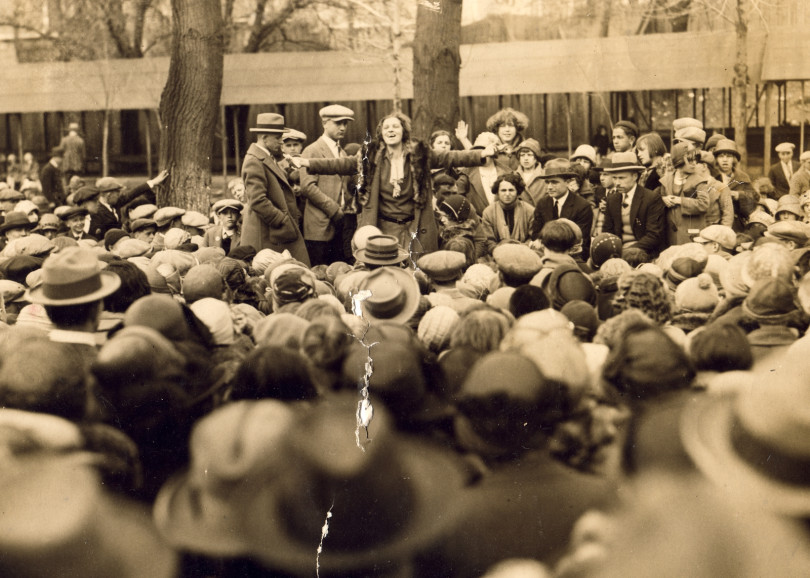
Albert Weisbord looks at the similarities and differences in three key strikes led by by the left in the latter 1920s; in many ways a radical rehearsal for the C.I.O. explosion the following decade.
‘Passaic–New Bedford–North Carolina’ by Albert Weisbord from The Communist. Vol. 8 No. 6. June, 1929.
THREE important steps forward have been taken by the left wing forces in the textile industry since first we took upon ourselves the task of organizing the unorganized textile workers. These three steps have been marked by three struggles: Passaic, 1926-27, New Bedford, 1928, and North Carolina, 1929.
PASSAIC AND NEW BEDFORD
Let us compare these three steps forward each with the other. In what respect did the New Bedford strike advance us beyond Passaic?
1. In Passaic we had 12,000 strikers. In New Bedford we had 25,000.
2. In Passaic we were tackling the silk, dye and wool and worsted section of the industry. In New Bedford we were tackling the cotton, the basic section of the textile industry.
3. Passaic was near the center of militant unionism, New York City. In New Bedford we were much further away and isolated.
4. In Passaic we had nationalities–Poles, Slavs, Ukrainians, Hungarians, Italians, who in other industries and in other places had already experience in strike struggles. In New Bedford we had mainly Portuguese and French Canadians, entirely unused to strike struggle, being on the whole new and fresh forces.
5. In Passaic we had some militant traditions, rather fresh; in New Bedford we had very few and faint militant traditions.
6. In Passaic, in the strike field, we had not come into violent conflict with the American Federation of Labor as such; in New Bedford from the beginning our task was to wrest the leadership from the faker officialdom of the old reactionary unions. In Passaic the fight against the liberals, the Muste group, the Socialist Party, was not so sharp. In New Bedford our main struggle was against these groups who in every possible way tried to surround us and to throttle us.
7. In Passaic we had a United Front Committee, rather hazy in aim and in name. In New Bedford we had already advanced to the formation of clear independent local unions.
8. In Passaic after the strike we joined the American Federation of Labor with disastrous results. In New Bedford we stood on our own feet.

9. In Passaic our union has rapidly dwindled down to a shell of its former self. In New Bedford, although the strike has been broken by the A.F. of L., our union has grown tremendously in numbers and in influence. So that for the first time in the history of the textile industry, after a lost strike, thousands of poorly paid, unskilled workers are flocking to a militant, left wing textile union. From this cursory comparison we can see how much our left wing, union-building forces developed and grew from Passaic to New Bedford. New Bedford marked a new plane of struggle; new and more serious tasks were placed before us and were solved.
THE NEW TEXTILE UNION
Following the New Bedford strike a national convention was held, and the National Textile Workers Union formally created. At this convention we seriously placed before ourselves the most important problems that had to be solved in our job of mobilizing the 1,100,000 textile workers in the United States, for struggle against the textile employers. We were still a weak organization. We still consisted of independent local groups in different cities, made up or individual workers, in isolated locals. We were still almost entirely composed of foreign born workers. We were still only in the north. We could not as yet really be called a National Textile Workers Union. We still had not touched the great mass of workers in the South in the basic section of the textile industry, coarse cotton goods, where in the stronghold of capitalist reaction these 100 per cent American workers were being exploited in the most ruthless manner.
THE STRIKE IN THE SOUTH
Immediately after the national convention we began concretely to carry out the tasks which we had assigned to ourselves. Organizers were sent into the South and work begun. As a direct result of the terrible system of exploitation in the Southern mills, and stimulated by our agitational and organizational work, the textile workers began to move in a wave of strikes. Four thousand workers in North Carolina came out on strike under our leadership. Four thousand to five thousand more struck sporadically in South Carolina. Five thousand struck of their own accord in two successive strikes in Elizabethton, Tennessee. Among all the southern textile workers great unrest became manifest and the struggles of these 13,000 or so southern strikers, particularly the struggles of the strikers under the leadership of the Communist and left wing groups in North Carolina, became the direct and immediate expression of at least 150,000 cotton workers in the immediate region of the open strikes.
It is not my purpose now, in this article, to analyze this wave of strikes, to break it up into its component parts, to get all the necessary lessons which we must learn from this movement. It is my purpose here merely to show our development since New Bedford, and the new plane of problems which we have reached.
NEW BEDFORD AND NORTH CAROLINA
What are the differences between New Bedford and North Carolina?
1. In New Bedford we had a general strike in one city; in North Carolina we had a strike wave affecting the entire region, including Gastonia, South Gastonia, Pineville, Charlotte and Lexington, covering an extent of at least 100 miles. If we consider the entire strike wave including South Carolina and Tennessee, then the area is far greater.
2. New Bedford, it is true, was a cotton center, but a fine cotton center; the national center for fine cotton goods, having approximately 40 percent-50 percent of all the fine cotton goods looms in the United States. North Carolina is the center of coarse cotton goods, the basic commodities produced in the textile industry of this country.
3. New Bedford was 200 miles from the labor center of New York; North Carolina is 700 miles away.
4. New Bedford was made up of foreign born workers; in North Carolina all the strikers are Americans who could trace their ancestors at least to the Revolutionary War, if not beyond.
5. New Bedford had at least some faint tradition of struggle. Most of the strikers in Gastonia have had absolutely none, having come fresh from the farms and mountains near the mills.
6. In New Bedford we could unite all of the workers together. In North Carolina there is the Negro question, which has been kept alive and rendered acute by the employers. The solution of the Negro question in the South becomes the most difficult and at the same time the most vital and fundamental problem we have to solve. It presents us with an entirely new plane of tasks and difficulties.
7. In New Bedford the employers played with the A. F. of L. In the South open fascism rules, with no tolerance of any unionism whatever.
8. In New Bedford the workers had some property and material reserve power. In North Carolina they have practically none.

In New Bedford the problem of labor defense was more often a legal one than a physical one. In North Carolina labor defense means an armed workers’ defense corps ready to defend at any cost the lives and union property of the strikers against the open fascist attacks of the armed thugs of the company.
10. At the time of New Bedford, we had a local union. At the time of North Carolina, we have a national union. We have grown from a “Committee,” and from an “independent local union” to a national union. We have reached beyond the traditional spheres of activity. We have gone further than the centers of New England and the North. We have become known both North and South. We have now a national reputation. We have begun to solve problems of gigantic national proportions, embracing one-eighth of all the factory workers in the United States. In short, we have begun to become, in every respect, a truly national organization.
THE LEFT WING MOVEMENT
There is absolutely no basis whatever for any degree or shade of pessimism. But we must have no illusions as to the strength of the left wing movement in the textile industry. The many strikes which have taken place within the textile industry in the last few weeks, unled by any union, sporadic and spontaneous outbursts of the masses, themselves, on the one hand, prove the degree of capitalist rationalization and its serious effects upon the working class, and the readiness of the textile workers to struggle. On the other hand, these non-union strikes also show the great weakness of our left wing forces, when in spite of our watchfulness and alertness to take advantage of these movements, we have not been able to do so.
Further, we have not been able to connect North Carolina with South Carolina and both with Tennessee. Nor have we been able to connect the strike wave among the cotton workers in the South, adequately and effectively, with a movement among the cotton workers in the North.
This is the next step which our union must take in the course of its evolution towards a really powerful National Textile Workers Union. This next step is to bring a comprehensive plan and strategy into the textile combats, so that when the next battle of a large and serious character opens up, it will be the left wing forces which will have had something of importance to say as to when and where the battle shall begin, and what direction and extension it shall take. In our plans for the mobilization of the textile masses against the employers, our next step must be to have a strike not merely in one mill, or a general strike in one city, or even haphazardly in one region, but to tackle a specified section of the industry in all its ramifications and all points possible at the same time. If we cannot do this with the cotton section immediately, as it is the biggest and hardest section, we might do it with the knit goods section, or the silk section or dye section, or some other section of the textile industry where the task of synchronizing and coordinating our workers in all of the important centers of that particular branch of the industry, so as to start a simultaneous broad action among the masses, can most easily be effected. It will be in such coordinated actions that our national union will be put to its greatest test and will best prepare for the largest possible struggles that are to come.
There are a number of journals with this name in the history of the movement. This ‘Communist’ was the main theoretical journal of the Communist Party from 1927 until 1944. Its origins lie with the folding of The Liberator, Soviet Russia Pictorial, and Labor Herald together into Workers Monthly as the new unified Communist Party’s official cultural and discussion magazine in November, 1924. Workers Monthly became The Communist in March, 1927 and was also published monthly. The Communist contains the most thorough archive of the Communist Party’s positions and thinking during its run. The New Masses became the main cultural vehicle for the CP and the Communist, though it began with with more vibrancy and discussion, became increasingly an organ of Comintern and CP program. Over its run the tagline went from “A Theoretical Magazine for the Discussion of Revolutionary Problems” to “A Magazine of the Theory and Practice of Marxism-Leninism” to “A Marxist Magazine Devoted to Advancement of Democratic Thought and Action.” The aesthetic of the journal also changed dramatically over its years. Editors included Earl Browder, Alex Bittelman, Max Bedacht, and Bertram D. Wolfe.
PDF of full issue: https://www.marxists.org/history/usa/pubs/communist/v08n06-jun-1929-communist.pdf
 Revolution's Newsstand