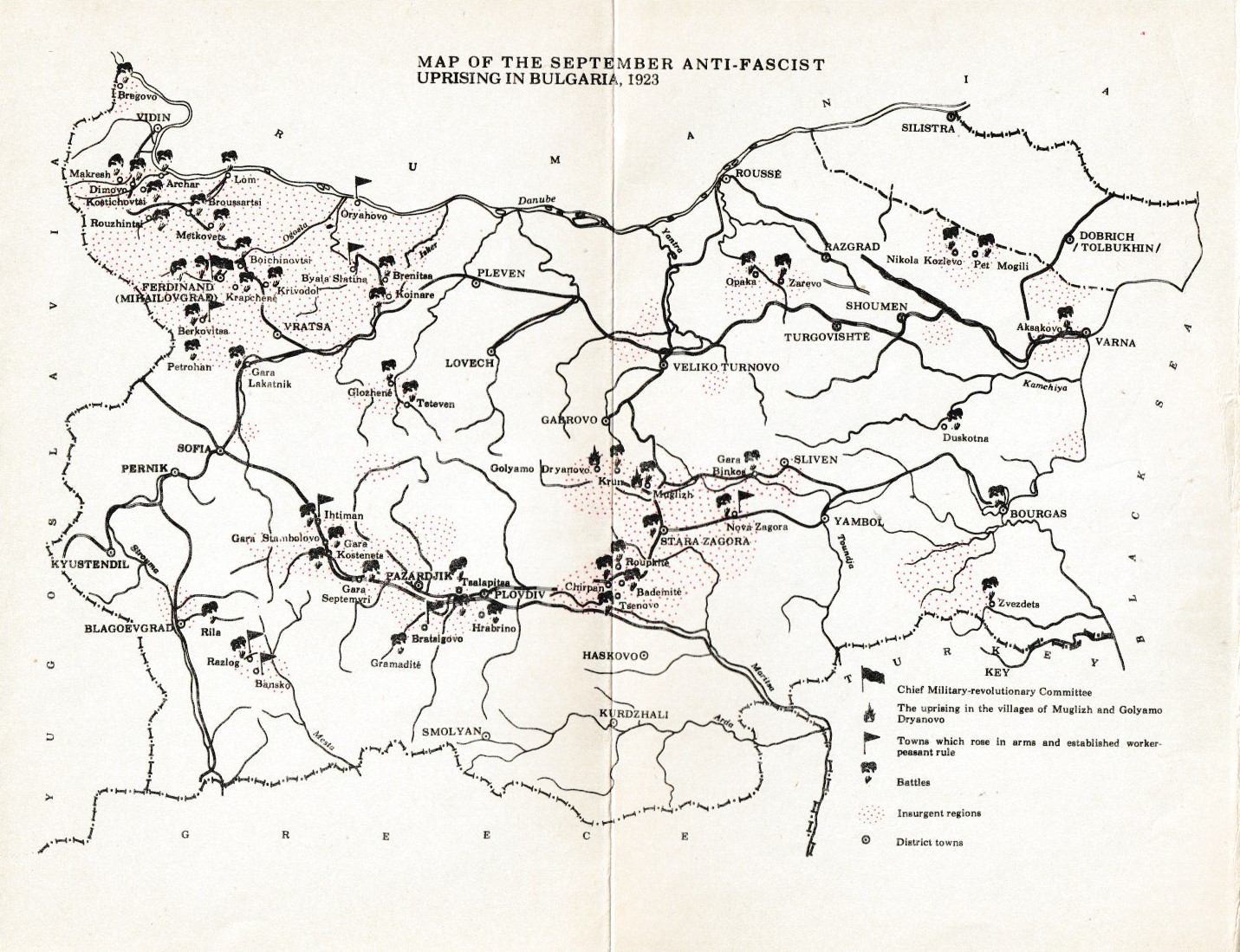
Europe’s first anti-fascist uprising. After the June, 1923 military right-wing coup against the Peasant’s League government of Bulgaria, the country roiled with instability. In early September, mass arrests took place as the League and Bulgaria’s largest parliamentary party, the Communist, were outlawed with the closure of unions and newspapers. In response an armed rising, the September Uprising, in several urban area broke out, before being pushed to the countryside in a brief civil war in which the working class and peasants fought heroically, but without coordination or cohesion and betrayed by the Social Democrats. The story below.
‘The Campaign of White Vengeance in Bulgaria’ by Armin from International Press Correspondence. Vol. 3 No. 70. November 8, 1923.
Sofia, October 1923. The military-bourgeois clique of conspirers which overthrew the Stambulisky Cabinet on June 9 by means of a putsch, and seized upon state power, constituted itself as a government of “national unity”. This government set itself the task of reestablishing and securing the unlimited rule of the capitalist bourgeoisie. For this purpose it was anxious to clear out of the way the two great political organizations of the working people: the Peasants’ League and the Communist Party. Its first act was to shatter the Peasants, League, and then to prepare for the attack on the much more dangerous enemy–the C.P. This action was systematically prepared by a campaign of savage agitation in the whole bourgeois press, including that of the Social Democrats. Even at this time it could be plainly foreseen that the C.P. would not be able, merely by a defensive struggle, to overcome this deliberate campaign for its destruction, for the government had had time to organize its forces. Unfortunately, just at this time conditions were so unfavorable for the C.P. that it could not carry on the struggle with any certainty of success. Our class enemies were well aware of this, and seized the opportunity for an open challenge. On September 12, the Minister for Internal Affairs, General Russev, ordered the arrest of many Communists in Sofia and all over the country. In this manner almost the whole of the Party and trade union leaders and functionaries and all active comrades in town and country, were put under lock and key; the workers’ clubs and cooperatives were closed, the Party and trade union press suppressed, and finally, all Communist literature and propaganda prohibited. In Sofia alone, over one thousand comrades were arrested, including D. Blagoev, one of the founders of the Party, now old and in failing health, and the General Secretary of the Party, Chr. Kabaktschieff. The arrest of these members of the Central Committee of the Party was followed by a wild hunt for Communists. The barracks and police station prisons were crowded. Here our comrades were subjected to the most frightful physical and mental tortures. Several of them were shot during the night, or succumbed to the brutal inquisition.
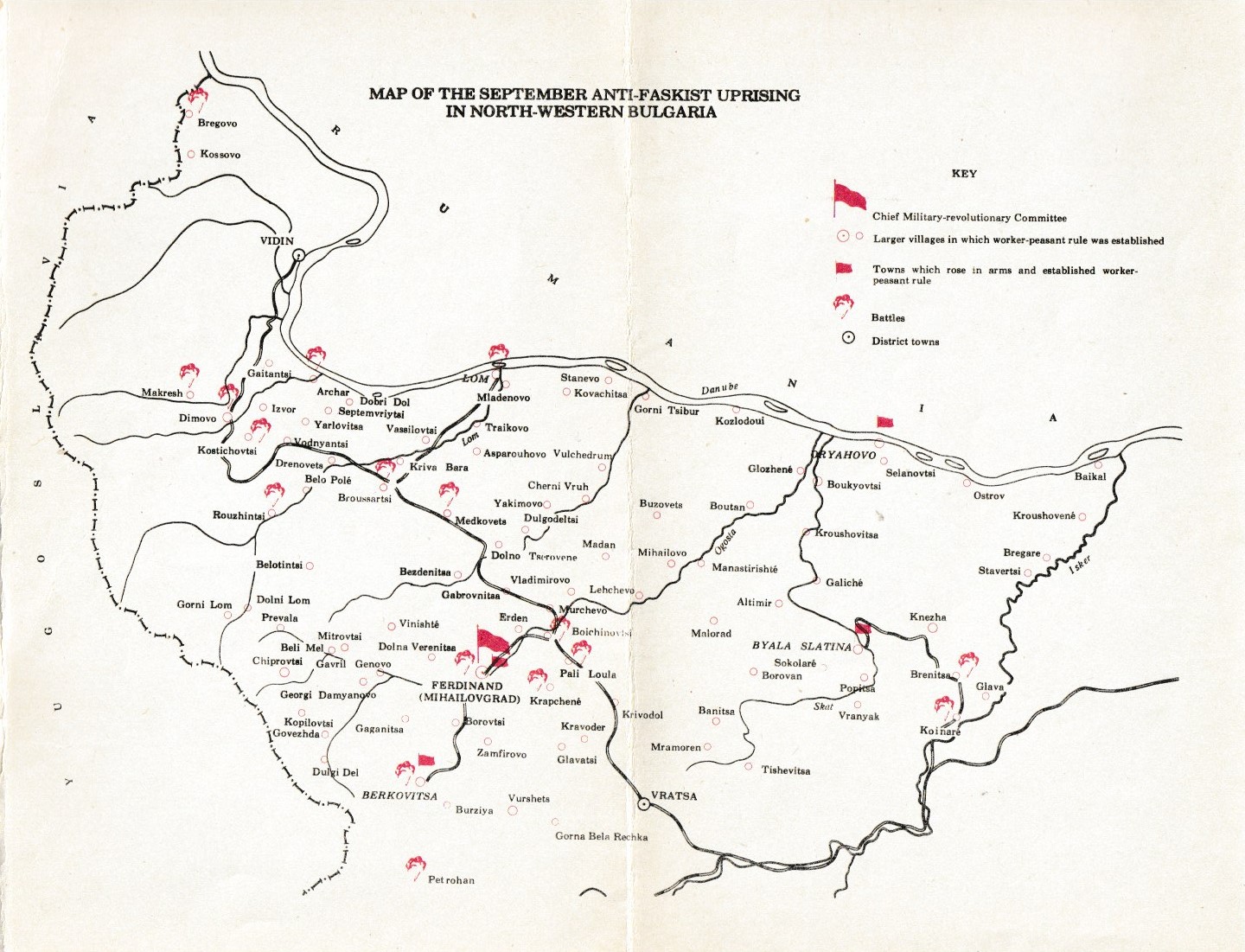
The profound excitement aroused among the communist inclined working class was first expressed by the spontaneous general strike which broke out in Sofia on September 14.; this did not however have any special effect, as it was not properly prepared, either from an organizatory or a propagandist standpoint. It was not until five days later, in the night from 19 to 20 September, that an armed insurrection broke out in the Stara-Zagora district. Communists and members of the Peasants’ League at once seized the village municipalities, united with the groups of insurgent peasants from the neighbouring villages, and formed troops of several hundred men each, which then proceeded together against the nearest district towns of Stara Zagora, Nova Zagora, Kazanlik and Tschirpan, and attempted–with the aid of the workers in these towns–to take the towns by storm. Despite the great heroism and self-sacrifice shown, the attempt failed however in the end, and not solely because the revolutionists were inadequately armed, but because they were betrayed. The insurgents then withdrew into the mountains, wither they could not be so easily pursued. During the days following, the rebellion movement extended to some country places in the adjacent districts of Burgas and Philippopel. On September 23 it extended further, to the North West of Bulgaria, to the Widdin and Wratza districts. A very considerable area, including the towns of Berkovitza, Ferdinand, and the large country places of Varhchetz, Lopuschna, Tschiprovizi, Brussarzi Boitschinovitzi and Alexandrovo, the last three railway stations, and the whole of the villages situated in this district, were in a state of insurrection. Unfortunately the masses here had neither the weapons nor the time which would have enabled them to be organized into troops capable of fighting. The arms carried by there insurgents consisted for the main part of pitch-forks and axes, or of rusty old muskets from the Russo-Turkish war (1877). When the insurgents took Ferdinand and Berkovitza, however, they succeeded in capturing two mountain cannon and six machine guns, as well as several hundred infantry rifles, and were able to employ these in the great fights following.
The situation of the government had become extremely critical. All reliable officers and sergeants of the reserve, as also the officials and employees of the state institutions, were hastily mobilized. Wrangel officers and soldiers, Fascist bourgeois elements, and every description of such shady personalities numbered among the “volunteers” forming the newly formed punitive battalions. Railway trains and motor cars, packed with these bloodthirsty heroes, laden with horses, artillery, and machine guns, were sent off daily from Sofia to the rebel regions.
Here many obstinate battles were fought, lasting 10 days. The insurrection was crushed in blood. “Order” was restored in the most horrible manner. No pardon was given, no prisoners made. Whole villages were reduced to ashes as punishment, the houses of leading communists and peasant League members, Communist Workers’ Homes were destroyed and Communist women and children brutally massacred. Especially frightful were the ravages of the Fascist bands in North West Bulgaria, in the Berkovitza Ferdinand-Verschezt-Tschiprovitzi district, where the insurgent masses fought most determinedly. Here there was a frightful massacre. Thousands fell in the fighting, thousands of prisoners were mown down by machine guns, or slaughtered with knives like sheep. Girls and women, among them Communist elementary school teachers, were first violated and then murdered. The long suffering Bulgarian people has only undergone such an experience under the Turkish yoke, when the blood-thirsty robber janitshar bands ravaged the country.
The workers’ quarter of the town of Lom, where obstinate fighting went on for three days, was completely destroyed, the wives and children of Communist workers slain. A tremendous fire broke out in the district town of Vratza, exploding the ammunition depot stocked with ammunition for crushing the rebellion, and reducing over 400 houses completely to ashes. With an insatiable lust for revenge, the raging Fascist beasts threw themselves everywhere upon the Communist youth fighting bravely in the front ranks. In the reconquered towns the youthful peasants were cut down in droves.
These bloody orgies were blessed and approved by the so-called “holy synod” even beforehand. During the civil war (September 26) this synod addressed a message, published in the press, to “the beloved sons of the Bulgarian people”, in which it damned on behalf of “mother church our brothers and sons,” “reared in unbelief and heartlessness” and “actuated and led by hate and malice against state order and law”. But when the men in the government were steeped to the neck in the streams of blood, then they began to be afraid. The bourgeois press began to shed crocodile’s tears over the “fratricidal war”. Days passed, but the butchery continued. The press controlled by the governmental parties continues to cry “Enough bloodshed!” The champions of state law and order–all of them democrats, radical democrats, and social democrats–are beginning to be terrified at this unheard of slaughter of Communists, workers, and peasants. In order to sooth excited spirits to a certain extent for the elections to parliament take place in a month!–the government now hastens to promise a speedy amnesty for the “misled” masses now languishing in the prisons. Only the “leaders”, the “ring-leaders”, and “executive elements are to be punished with the whole relentless severity of the law”. This last obviously refers to the most active Party and, trade union comrades, which means that over two thousand persons are threatened with the death sentence or to long terms of imprisonment. For the right capitalist press, down to the Social Democratic press, never cease to demand the complete extermination and annihilation of the Communist Party and the “communist pestilence”. Bulgarian Social Democracy celebrates its triumph. It participates to the utmost of its powers in the bloody campaign against the workers’ and peasants’ insurrection, and in the savage hunting down of Communists. The Social Democratic Minister of Traffic, Kazassov, is earnestly attempting to hold in the railwaymen and postal and telegraph employees under his authority. He publishes in the press an ordination calling upon them to aid in the “salvation of the fatherland” against the “betrayers of the people”, against the “paid agents of reign countries”, and to put their utmost services at the disposal of this cause.” The government grants them extra uses for this purpose. The committees of the Social Democratic Party, and of the Social Democratic unions of railwaymen post office employees, have also published similar appeals to their members. Social Democratic members take part, as volunteers in the Fascist punitive expeditions, And Social Democracy rejoices to see its wishes fulfilled and its goal achieved: The rebellion of the workers against the capitalist exploiter and the Fascist dictatorship has been bloodily crushed! This is placed to the “credit” of Social Democracy by not only Zankov’s government, but also by the whole bourgeois press. An electoral agreement applying to the whole country has been made with the government party, the so-called “Democratic Unity” (consisting of the military bourgeois Fascisti of the so-called National Unity”, of the Democratic Party of Malinov, of the Russophile Progressivist Party of Dr. Danev, of the conservative People’s Party of Geschev, and of the Radical Democratic Party), in view of the approaching election, which secures to the Social Democrats no fewer than 33 votes, whilst at the last election to parliament, in April of this year, they were not able to carry off a single seat! (The two parties of the opposition the Peasants League and the Communist Party–are outlawed; they are not permitted to take part in the election. The government is certain of obtaining 226 seats, and thus it is able to distribute these in advance!)
But all the sufferings now being endured by the Bulgarian workers and peasants will burn deeply into their minds, will cause them to think of the day when their oppressors are to be called to account, and also to prepare for that day. And this day will come, despite every thing, despite the severe defeat suffered by the Bulgarian revolutionary movement. The guarantee is given us by the heroic struggle which the Bulgarian workers and small holding peasants have fought together for two weeks, shoulder to shoulder, in the attempt to establish a workers’ and peasants’ government. They have lacked revolutionary experience and adequate preparation; and the conditions were unfavorable for them. As a result they were defeated in this unequal struggle. But they will learn the lessons it has taught, and will lead the coming fight to victory!
International Press Correspondence, widely known as”Inprecorr” was published by the Executive Committee of the Communist International (ECCI) regularly in German and English, occasionally in many other languages, beginning in 1921 and lasting in English until 1938. Inprecorr’s role was to supply translated articles to the English-speaking press of the International from the Comintern’s different sections, as well as news and statements from the ECCI. Many ‘Daily Worker’ and ‘Communist’ articles originated in Inprecorr, and it also published articles by American comrades for use in other countries. It was published at least weekly, and often thrice weekly.
PDF of full issue: https://www.marxists.org/history/international/comintern/inprecor/1923/v03n70[46]-nov-08-Inprecor-loc.pdf
 Revolution's Newsstand