Just as the ‘war against drugs’ today is a weapon wielded against the ‘dangerous classes’, so to the past prohibition of alcohol. Harrison George on the Klan’s embrace of a booze-free country in their war against immigrants, unions and the left.
‘The Volstead Fascisti’ by Harrison George from Labor Herald. Vol. 3 No. 2. April. 1924.
INTERNATIONAL Fascism is a chameleon. It changes its slogans and its shirts to conform to local conditions. When the cohorts of Mussolini marched on Rome, when the “black shirts” of Benito arrived triumphantly at power, they thanked no Protestant God and gave no reverence to sacred constitutional amendments. Rather did they make peace with the Pope and celebrate the burnings of Chambers of Labor and their murder of Communists over many goodly flagons of red wine. But the American Fascisti operate upon a different moral plane; wherefore, though the Italian “black shirts” may have their wine, and the Bavarian “grey shirts” their beer, the Episcopalian Ku Klux Klan, the “night shirts” of America, raise the slogan of cold water and the Volstead Act as a way to national and racial purity. They have adapted this slogan to fit into union wrecking and class terror.
Of course the preachments of the Klan against violators of the Volstead Act have nothing to do with the taste for strong drink on the part of the Klan leaders themselves. Prohibition talk is for public consumption as a cloak to cover raids on the homes of workers suspected of radical ideas. It is not for Kleagles and Grand Goblins.
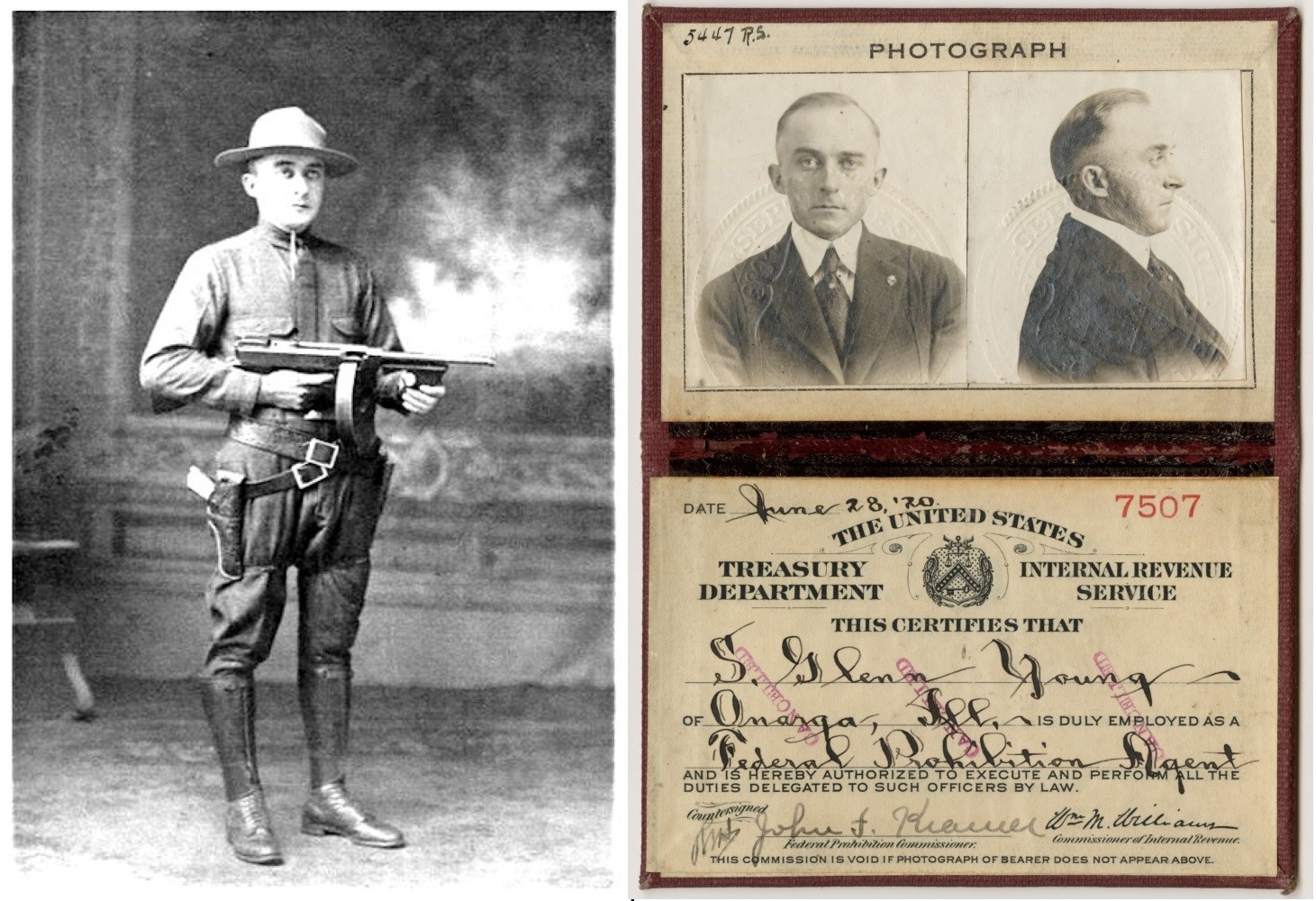
“Hell and Maria” Dawes, whose Pure Oil Company stock greased the hands of Daugherty in turn for unexplained favors, marshalled his first company of the “Minute Men of the Constitution” from among the wealthy citizens of Chicago’s exclusive “North Shore,” where well-stocked cellars inspire the most definite and most ruthless plans for violence against the workers. But when action is needed, a basis for operation is found in alleged “prohibition enforcement” campaigns. This is most glaringly illustrated by the sortie of violence directed by the Klan’s agent, Glenn S. Young, against the miners of Williamson County, Illinois.
This is not to say that the miners of Williamson County are the first to feel the blows of the Volstead Fascisti. During and after the Seattle General Strike, authorities made wide use of warrants authorizing a “search for liquor” to conduct raids upon the homes of radical workers. Once inside the house, a thorough ransacking for “seditious literature” was carried out. If such was found, trial for “criminal syndicalism,” or deportation of aliens, followed the “prohibition” raid. In Texas, where the Klan sets the price for cotton picking, it uses terror without, legal mask or moral disguise; but in Oklahoma the Klan has whipped revolting farmers of the Farm Labor Union which opposes the bankers and the Cotton Growers’ Association monopoly, pretending that the farmers were “boot-leggers and moonshiners.” Why is it that an extraordinary zeal for “prohibition enforcement” follows so closely upon any militant outbreak of exploited workers and farmers? Is it, for instance, because Williamson County, Illinois is an outstanding oasis of booze in the desert of what is supposed to be water-drinking and law-abiding America? By no manner of means is such the case.
Openly aided by police and “prohibition agents” every city in America is flooded with illegal liquor, while “home brew” is the topic of most conversation in middle and upper class houses. While the writer was in Leavenworth prison, a place surely supposed shut off from all worldly guile, whiskey could be purchased by prisoners for $12 per quart.
But what is more important, the Daugherty investigation has shown that the Department of Justice has issued orders “not to investigate” violations of the dry law, except where specifically ordered to do so. That such special orders were given only where Daugherty might stand to turn an honest penny for halting the prosecution, or where he could sell his services to some labor-baiting campaign of the great corporations is somewhat more than an inference. Certainly Daugherty was not moved by any puritanical consideration in making prosecutions or in stopping them. Witnesses have told of Daugherty’s touching and rather peculiar affair with Jess Smith, and how they transported great suit-cases of liquor from Washington to Ohio in violation of law and shared in the drinking of it.
The reason that Williamson County, Illinois, was selected as a place to “enforce prohibition,’ is not because it was wetter or because it was more “criminal” in other ways than other localities. Rear Admiral Charles P. Plunkett, commandant of Brooklyn navy yard, recently charged that Washington, D.C., was “the wettest city in the United States.” Extending the field, a congressman claims that it is “wetter than Paris and more murderous than London.” This seems in timely corroboration to the shooting down of another congressman on the Washington streets by someone supposed to be chasing boot-leggers.
In addition, Major Daniel Sullivan, superintendent of police for the city of Washington, reports that crime in the national capital has increased 107 per cent over the record of 1910; that crimes “against morality, crimes of murder, manslaughter and thieving” are growing in great bounds and that arrests for drunkenness have increased 121 per cent over the record of 1910. Why pick on Williamson County, Illinois? Why not send Glenn S. Young, “hillbillie” bad man of the Klan, to clean up the national capitol?
The answer may be found in the fact that while Major Sullivan reports that in Washington the “new type of criminal created by prohibition has the support of persons in highest society,” the miners of Williamson County are only working-men; and, besides that, they are organized workers who dared to defend themselves with arms against the brutalities and assaults of gunmen of the coal operators two years ago at Herrin.
Immediately following the battle fought around the Lester strip mine at Herrin in June, 1922, which battle arose over the murder of miners by gunmen and resulted in a score or so of these gunmen being incontinently hastened to rest in Abraham’s bosom, the Illinois Chamber of Commerce raised a fund of $50,000. to “wipe out the spot.” By this they meant to convict members and local officers of the U.M.W. of A. on charges of murder; they wanted to wreck the Illinois District which is the heart of the U.M.W. of A., just as the U.M.W. of A. is the center of the A.F. of L. Throughout the country the capitalist press began baying for the blood of the Illinois coal miners. Capitalist editors who simply couldn’t remember Ludlow, moralized endlessly about the “Herrin Massacre.” They demanded in chorus that Williamson County be punished.
But in spite of all the fury of the bourgeois press, in spite of the detectives and costly lawyers sent into Williamson County by the Chamber of Commerce, juries would not convict. Immediately arose the cry in the press, particularly the Chicago Tribune, for “other means” of revenge against what was termed “Bloody Williamson County.” An economic boycott was agitated, tried and failed, for the same reason that it often fails as a weapon of labor-material interests of some elements broke class solidarity.
As soon as legal efforts were proven futile, Glenn S. Young, a federal government raider with a record as a man-killer, was taken over by the Ku Klux Klan, strongest and most secret of the American Fascist organizations and unofficial suppressor of discontented workers. After many shady “trips” to Washington” and conferences with Klan chiefs and prohibition officials, Young swung into action in Williamson County at the head and in pay of the Klan. With a 44 six- shooter in each hand he led mobs of hundreds of Klansmen in raid after raid upon homes of union men, native and foreign-born alike. He was “searching for booze,” but if none was found that fact did not save the miners’ families. They were beaten, kicked, robbed of their money and valuables. Men were kidnaped and taken away from their frightened families. Pregnant women were beaten by the chivalrous Klan’s sluggers, and houses were burned to the ground if inhabitants showed resistance.
While some of the workers had the customary bottle or so of home-made wine, those whose homes were raided swear that Young brought along his evidence to “find” on the premises as justification of the raid. Many testify that these crusaders drank the whiskey they confiscated. In any case the poor victims were hailed into court and made to spend their life’s savings to defend themselves against those who had assaulted and robbed them in the name of law.
Williamson County miners are not radicals and no “seditious literature” could be discovered, in spite of the lurid lies of Ellis Searles in the official organ of the U.M.W. of A., published in suspicious concurrence with the frontal attack of Young’s Fascisti. The tales of Searles and Lewis that the 1922 gunmen were slain by, or by order of, Communists were published in timely assistance to Young, but they were too fanciful to be credited.
Resistance arising to Young’s bands, a spontaneous growth of an anti-klan organization took place. The Knights of the Flaming Circle became very prominent, began counter-demonstrations and followed the naive and natural idea of armed defense. City businessmen, and hence the city police, were pro-klan. Miners of the coal camps scattered about the county are generally anti-klan, therefore they elected an anti-klan sheriff who appointed deputies of like tendency. Both sides armed and civil war opened.
Questions arose as to Young’s authority. The French Consul, asking protection for French subjects who had been terrorized, demanded of Washington to know by what authorization Young was engaged. Prohibition Director Haynes denied Young represented Washington. But the federal prohibition agents in Chicago, in charge over the State of Illinois, said that Young held a commission from Washington, that he worked directly from Washington and was out of their control. By conspiracy between official and unofficial tools of vindictive capitalism, the miners of “Bloody Williamson County” were being punished by “other means.”
Young’s Klansmen started to “clean out” a meeting of the Circle. A Klansman was killed and an anti-klansman wounded. Reinforcements came for both sides and battle raged for hours in Herrin. Young, though not a citizen of Williamson County, seized the county government, arrested the sheriff and fortified the court-house. State troops came in with martial law and ousted Young–but permitted the Klan to keep it arms.
Under rule of the troops a sort of coalition government was set up, ninety-nine indictments were returned in the county courts, among them many against Young charging assault with intent to murder, conspiracy, kidnapping and false imprisonment. But Young maintains his nest of Klansmen guarded with machine guns. He fondles his “44-s” in front of admiring capitalist reporters and photographers in Chicago, and after submitting to arrest at his own convenience, he takes “trips to Washington” with the same mystery and frequency as oily cabinet officers do when they go to Florida. Meanwhile, in addition to the staggering sums previously paid for dry law enforcement, a recent federal appropriation of $50,000,000 gives more power to–the Volstead Fascisti.
The Labor Herald was the monthly publication of the Trade Union Educational League (TUEL), in immensely important link between the IWW of the 1910s and the CIO of the 1930s. It was begun by veteran labor organizer and Communist leader William Z. Foster in 1920 as an attempt to unite militants within various unions while continuing the industrial unionism tradition of the IWW, though it was opposed to “dual unionism” and favored the formation of a Labor Party. Although it would become financially supported by the Communist International and Communist Party of America, it remained autonomous, was a network and not a membership organization, and included many radicals outside the Communist Party. In 1924 Labor Herald was folded into Workers Monthly, an explicitly Party organ and in 1927 ‘Labor Unity’ became the organ of a now CP dominated TUEL. In 1929 and the turn towards Red Unions in the Third Period, TUEL was wound up and replaced by the Trade Union Unity League, a section of the Red International of Labor Unions (Profitern) and continued to publish Labor Unity until 1935. Labor Herald remains an important labor-orientated journal by revolutionaries in US left history and would be referenced by activists, along with TUEL, along after it’s heyday.
PDF of full issue: https://www.marxists.org/history/usa/pubs/laborherald/v3n02-apr-1924.pdf
 Revolution's Newsstand