
Report on the work of the All-Russian Extraordinary Commission for the Liquidation of Illiteracy.
‘The Liquidation of Illiteracy in Soviet Russia’ by K. Kurskaja from International Press Correspondence. Vol. 3 No. 58. August 30, 1923.
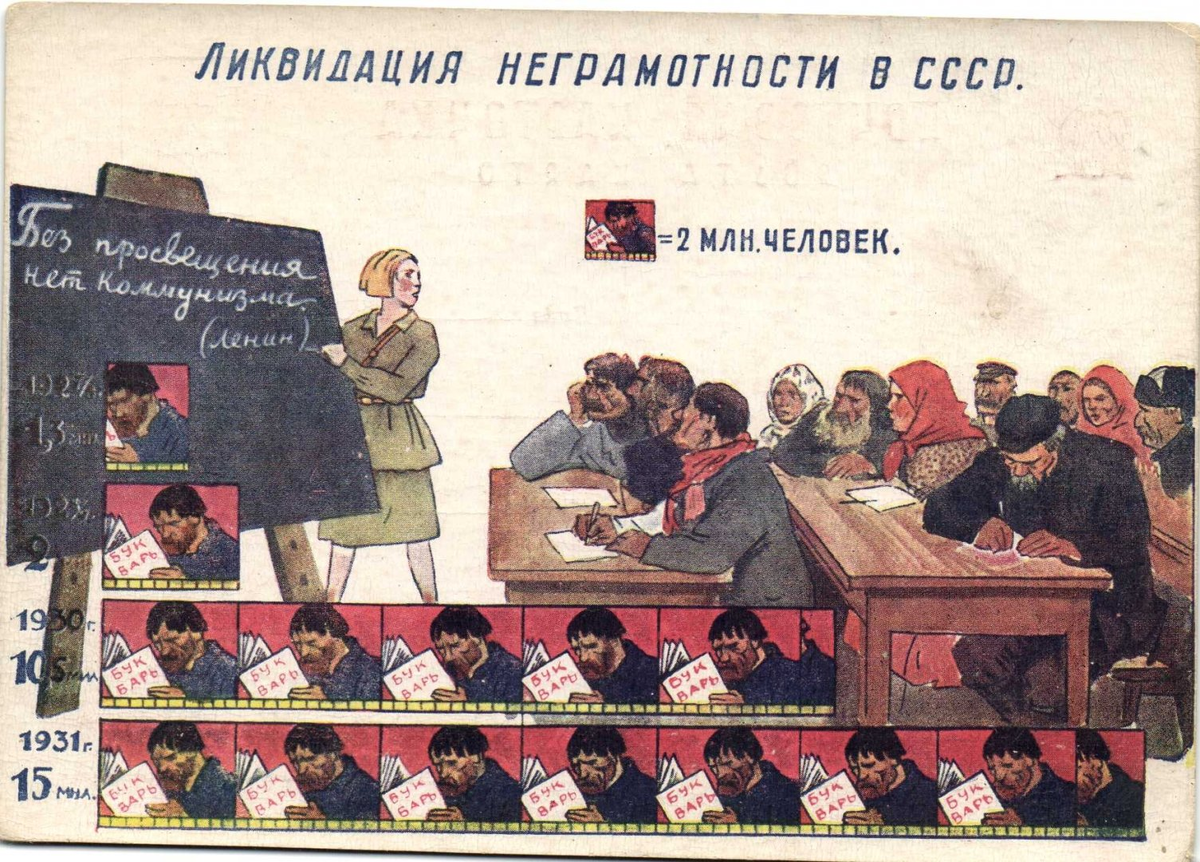
On December 26, 1919, the Council of People’s Commissaries issued a decree imposing the duty of learning to read and write on all inhabitants of the Republic, between the ages of 8 and 50 years, who did not already know how to read and write. The execution of this decree encountered great difficulties, not only on account of the lack of material means, but on account of the fact that it was an extremely difficult task to bring enormous masses of the adult population, especially the older people, into the schools. Besides that, there was no previous mass experience in teaching adults, so that new methods had to be worked out for this, adapted to the psychological peculiarities of these new learners; new categories of teachers had to be trained for this work.
For the purpose of performing all these tasks, the Commissariat for Public Education appointed in June, 1920, an All-Russian Extraordinary Commission for the Liquidation of Illiteracy (A.E.C.L.I.); like commissions were formed in the provincial towns, municipalities and rural districts.
It was the task of the A.E.C.L.I to work out, jointly with a large number of Soviet, Party and trade union organizations, a detailed plan for the liquidation campaign. The Commission succeeded through the agency of the executive committees of the Soviets, and through the agency of the trade unions, in devising a number of stimulative and compulsory measures for inducing the illiterate to learn reading and writing; for instance, by the exemption from work for two hours of those who cannot read and write, etc. Instruction was declared to be obligatory. The People’s Commissariat for Public Education and its organ were given the right to call upon such of the population as can read and write to take part in the instruction of the illiterate, this compulsion being exercised on the basis of the law respecting the obligation to work. The economic organs were placed under the obligation of supplying suitable rooms for instruction, and of equipping these with means of instruction and other furnishings; the means for the administrative apparatus of the A.C., and for the payment of the teachers, were supplied by the state. In this way the local organizations of the A.C. received, up to the end of 1921, over 24 milliard roubles in cash, about 44,000 pud of paper, 1200 dozen pens and pencils, over 6 million reading books, and about 200,000 other school appliances.
All this has permitted the liquidation campaign to be conducted on the grand scale. Special “Days” and “Weeks” have been organized for the struggle against illiteracy, and meetings, concerts, theatrical performances, etc., have been arranged for totally and partially illiterate persons. Some places (as, for instance, Petrograd and Saratov) have also supplemented the mass agitation by individual agitation, which has yielded excellent results.
Groups of A.C. instructors were formed in all public educational departments. Every town, every district, was divided into several parts, each of which received a special instructor for the purpose of ascertaining the number of illiterate persons, and for organizing a series of liquidation centres.
By the year 1921 Russia was completely covered with a network of schools for the liquidation of illiteracy; a rough calculation proves 5 millions of totally illiterate persons to have learnt reading and writing in these schools in the course of a year. Besides the public school teachers themselves, those workers and peasants already able to read and write were frequently induced to help in the work of instruction, and received a short course of instruction in teaching for this purpose. The teachers thus available for the liquidation campaign formed an army of 140,000.
The work thus done on so extensive a scale brought us comprehensive experience in organization and method. With respect to the liquidation of illiteracy we have been able, during the course of one and a half years, to discover the best methods of teaching, and so to arrive at the most rapid and certain results.
After the autumn of 1921, however, when the unfavorable economic situation of the state compelled us to base the activity of the A.C. on local means, there was a resultant rapid diminution of the liquidation centres (schools), their numbers falling from 48,000 to 12,000. The delay thus caused in the continuation of the liquidation campaign was employed by the A.C. to further work out the methods of teaching, and for the utilization of the experience gained during the first years of the liquidation campaign. At the first All-Russian Congress of Functionaries of the A.C. held in February, 1922, programs and syllabi were submitted and adopted in relation to the organization of liquidation centres and schools for the semi-illiterate. At the All-Russian Methodological Conference (in September, 1922) problems of method which had arisen were solved by the conclusion that, in the first place, adult instruction requires different reading books and different methods to the instruction of children, and that, in the second place, the attainment of reading and writing must be accompanied by the liquidation of political and mathematical ignorance, best accomplished by the arrangement of lectures and discussions dealing with questions of current political life, etc.
All these methodological questions were declared to be extremely important, experience having shown that, when incorrect methods are used, the scholars are not able to pass rapidly from the reader to a book or newspaper, a factor which naturally, much increases the danger of a relapse into illiteracy.
While the experts of the A.C. were occupied with questions of method, and the teachers themselves were also busy finding solutions to the same questions, the activity of the A.C. gradually increased in many districts, especially in the industrial ones. The educational departments of the trade unions commenced energetic struggle against illiteracy among their members, at their own expense. Many executive committees and Soviets began to put means out of the local revenues at the disposal of the struggle against illiteracy.
At the same time the A.C. entered into close connection with the military organizations, which had received orders from Trotzky to carry out the liquidation of illiteracy in the Red Army with the utmost speed. It has thus been possible to teach 50,000 Red Army soldiers to read and write in the course of a year, and to liquidate illiteracy in the Red Army. During this same period illiteracy has also almost completely vanished from the militia.
From the beginning of 1923 onwards there has been greatly increased activity against illiteracy in the great trade unions–in the miners’, railwaymen’s, textile workers’ unions, etc. agreement was reached by the All-Russian Trade Union Central. and the A.C., according to which the trade unions undertake an energetic campaign against illiteracy, to be concluded by May 1, 1923. Similar agreements were made with different central executives of the trade union executives.
This increased activity for the liquidation of illiteracy has made it possible to decide that, if pressure is exercised by the party and trade union organs, and if the Soviet power lends material support, we shall be able to arrange a systematic development of the activity of the A.C. during the next few years, in view of which it is necessary to decide upon which classes of the population are to be successively instructed. In consideration of the total number of illiterate persons in the republic, and of the difficulty experienced in getting them into the schools–the majority of them being women–and, further, in consideration of the fact that the state is not in a position to set aside large sums for the purpose of the campaign against illiteracy, the A.E.C.L.I. has worked out a general plan by which the whole of the population ignorant of reading and writing in the Union of Soviet Republics between the ages of 18 and 35 years, will have learnt to read and write by the 10th anniversary of the October Revolution, that is, by November, 1927. According to this plan the whole attention of the A.E.C.L.I. will be devoted to the organized proletariat during the first two years, and to the masses of the peasant population during the two years following. The plan provides for having 17 million persons taught reading and writing in the R.S.F.S.R., 4 million men and 13 million women. During the first school year (1923-24) 2 millions are to be taught, including 500,000 trade union members (about one half of the illiterate among the trade union members) and 600,000 members of the military organization of the youth.
This plan was adopted by the II. All-Russian Congress held in May, 1923. The resolutions passed by this congress indicate in detail the lines to be followed in further carrying out the plan of campaign.
The A.E.C.L.I. and its local organs are now confronted by the difficult and responsible task of raising adequate means for the contemplated instruction of 17 million illiterate persons. While the cost of maintaining the teachers, and of covering the economic outlay, are provided by the local executive committees, the means required for publishing readers must be given by the centre. The calculation made by a special budget commission working at the Congress shows that about 3.75 gold roubles are required for the instruction of one person in reading and writing. Thus over 70 million gold roubles will be necessary in the first year. These costs will be apportioned among the local executive committees, trade union organizations, cooperative organizations, and, finally, the centre. But not only the financial side of the campaign is to be apportioned among the organizations desirous of the liquidation of illiteracy among their members, but also the organization and control work of this campaign. The organizations participating most immediately in the campaign are the trade unions and the women’s sections. The participation of the latter in this work is of especial value in the country, where the trade unions are weak. They help the organs commissioned with the liquidation of illiteracy to conduct an agitation to induce the working and peasant women ignorant of reading and writing to enter the schools; they take part in the liquidation commissions; have instructive talks with those who have passed through the course of study provided by the liquidation centre; distribute literature among them, etc. Without the closest connections between the women’s sections and the organs commissioned with the liquidation of literacy, it is impossible to liquidate the illiteracy of so many millions of women.
The C.Y.U. is also interested in the liquidation of illiteracy among its members, although here the number of those who cannot read or write is comparatively small (about 10%). At the present time the C.Y.U., conjointly with the “Vsevobutch” (General Military Training), and the military organizations, is energetically engaged in the liquidation of illiteracy in the military organizations of the youth, whose members are to learn reading and writing before entering the Red Army.
During the current year over 500,000 members of the youth military organizations, hitherto ignorant of reading and writing, are to be instructed. In many districts illiterate members of these organizations have already been induced to visit the meeting place and receive instruction. The A.E.C.L.I. is preparing to publish one and a half million reading books for the instruction of 2 million Illiterates. The contents of these reading books are to be closely bound up with the problems of economic and political reconstruction of the Soviet state. Besides this, the people not yet very familiar with reading and writing are to be supplied with small libraries, almanacs, agitation placards with revolutionary contents, etc., to the number of 100,000 copies.
The campaign for the liquidation of illiteracy in our backward country will demand great efforts and huge expense. But the revolutionary energy of the working class now ruling, its iron will and perseverance, will overcome even this most difficult of tasks, and will lead the population of Russia, out of the centuries of darkness in which it has been held by its former rulers, into the light.
International Press Correspondence, widely known as”Inprecorr” was published by the Executive Committee of the Communist International (ECCI) regularly in German and English, occasionally in many other languages, beginning in 1921 and lasting in English until 1938. Inprecorr’s role was to supply translated articles to the English-speaking press of the International from the Comintern’s different sections, as well as news and statements from the ECCI. Many ‘Daily Worker’ and ‘Communist’ articles originated in Inprecorr, and it also published articles by American comrades for use in other countries. It was published at least weekly, and often thrice weekly.
PDF of full issue: https://www.marxists.org/history/international/comintern/inprecor/1923/v03n58[36]-aug-30-1923-Inprecor-stan.pdf
 Revolution's Newsstand