
Ben H. Williams was one of a number of talented activists of the Socialist Labor Party who remained with the I.W.W. when the S.L.P. split in 1908. Williams would go on to be a major figure in the wobblies as editor of Solidarity from 1910-1917. Here is a fascinating account of his three-month tour through the mining camps and desert towns of Arizona, wearing both his I.W.W. and S.L.P. hats.
‘Agitational Tour Through Arizona’ by B.H. Williams from the Weekly People. Vol. 16 No. 23. September 1, 1906.
WILLIAMS’ TOUR–SOCIALIST LABOR PARTY ORGANIZER RENDERS GOOD REPORT.
Effective Work Done in Promoting Industrial Unionism and Revolutionary Socialism–California Now Being Agitated for the Same Purpose.
Los Angeles, Cal., August 13. Having recently completed a three months agitation tour of the principal industrial and other centers of Arizona, it is In order to inform the readers of The People of my work in that territory, and of impressions gathered from different sections.
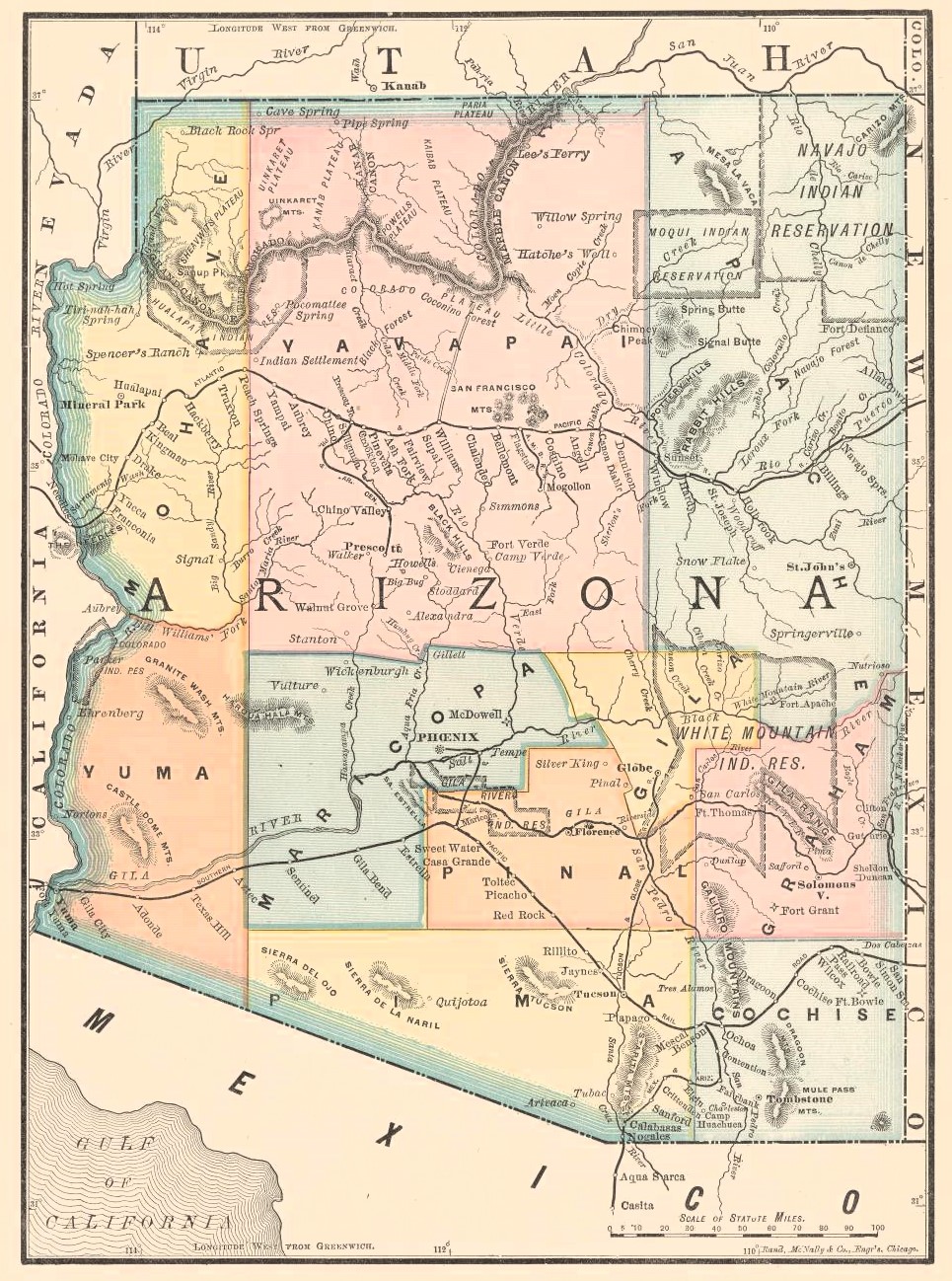
The name Arizona suggests at once the common appellation of that whole section “The Desert.” With an area considerably greater than that of the three States of New York, Pennsylvania and New Jersey combined, Arizona contains less than one hundred thousand inhabitants. Naturally, in so vast a territory, with such a scattered population, one may not expect to find many large cities or densely populated farming communities. In fact, although three Arizona towns claim the honor of being the metropolis of that territory, none of the three has more than 15,000 people; and as for the rest of the, Territory, one may travel for hours in succession over broad plateaus or through fertile valleys covered with sage brush and cacti alone. Millions of acres of fine soil in Arizona await reclamation by irrigation and other scientific means. One of the biggest irrigation projects ever undertaken by the United States government is now under way at Roosevelt, in the. Salt River canyon, midway between Phoenix and Globe. The estimated cost of the project is between $3,000,000 and $4,000,000, and the number of acres to be reclaimed about 250,000. The northern half of the Territory has extensive forest areas, the bulk of which has been absorbed by big capitalists. Mining is the dominant industry of Arizona, and in the matter of copper production that Territory ranks next to Montana, and bids fair eventually to surpass the northern State. The mineral resources of Arizona are vast in extent and as yet only partially exploited.
My first stop in the Territory was at Jerome. This mining camp of 3,000. inhabitants is usually spoken of as “the property of Senator Wm. A. Clark of Montana.” Here is the United Verde copper mine, one of the largest in the world. Clark obtained possession of the prospect a good many years ago, paying about $150,000 for the same. So valuable has it become that the Senator is said to have recently refused a $75,000,000 offer for the mine. I was informed that more than $100,000,000 of ore is already in sight in the United Verde, while diamond, drill tests follow the rich lead of copper for hundreds of feet farther underground. Between 600 and 700 men are employed in and around the mine and some 400 more at the United Verde smelter. A large proportion of these workers are Mexicans. There are also many Austrians and Italians, Wages of Jerome miners and smeltermen average a little lower than in most mining camps of Arizona, ranging from $2.50 to $4. Conditions in the mine are said to be the worst in the territory. Men suffer from heat and wet. As a consequence, Jerome has come to be renown generally as a transient or “ten day” camp, where miners remain only long enough to get means to travel elsewhere, Jerome Miners’ Union, W.F.M., has been battling against such conditions for years and in spite of the difficulties of foreign tongues and transient workers, has succeeded in building up an organisation, embracing about one-third of all the men employed in the camp. The secretary of the Jerome Union, Albert Ryan, is awake to the supreme necessity of working class education, both inside and outside the ranks of his organization. Accordingly, Secretary Ryan lent his assistance to my work in Jerome, among other things, arranging week’s series of afternoon and evening meetings at which the principles of Industrial Unionism were thoroughly explained. Some of the evening meetings in particular were well attended; considerable literature was disposed of and quite a few readers of The People obtained.
From Jerome, I went to Prescott, where I met Marion Moore of the Executive Board of the W.F.M. He accompanied me to McCabe, a small mining camp thirty miles east of Prescott. Here are about 150 men, working in two small mines, and living, most of them, in tents or small cabins in the midst of the sage brush. Conditions in McCabe, as to work and wages, accounted among the best in Arizona. McCabe Miners’ Union is the second largest in the Territory, a good part of its membership being made up of miners from a number of small camps adjoining McCabe. Attendance at union meetings is proportionately large, and the efficiency of the organization kept up to the highest standard. The Miners’ Magazine, Weekly People and Industrial Worker extensively circulate in the little camp. I held meetings for a week, twice a day, in Miners’ Union Hall, speaking to good crowds, who showed much interest, as evidenced by numerous questions and discussions following the meetings. A large amount of literature was disposed of, and as a result of the meetings and the efforts of the two members of the S.L.P. a few days after I left, about twenty-five names were added to the list of Weekly People readers in McCabe.
I also had an opportunity to explain the principles of the I.W.W. to a body of smeltermen at Humboldt, three miles from McCabe. A meeting was called for the purpose of organizing a Smeltermen’s Union. About 50 men joined the new organization, which has since considerably increased its membership.

Returning from McCabe to Prescott, I held two street meetings in that town. The only class of workers to be reached here are “floaters,” from the mining camps, for which Prescott Is a distributing center. It is not an industrial town. An attempt was made to organize a local of the I.W.W. at a meeting held for that purpose several signatures to an application were obtained, a few others were added later; but on my second visit to Prescott, two months afterward, I found only one of the signers left in town.
At Phoenix, my next stop, I encountered conditions similar to those of Prescott. The Territorial capital geographically is a sort of “oasis” in the desert, much of the surrounding basin having been reclaimed by irrigation. There are no industries of any consequence in Phoenix. It may be truthfully said that the city is “one big sanitarium for consumptives.” Victims of the “white plague” are everywhere in evidence. I was told that seventy-five per cent of Phoenix’s merchants came to town on account of “lung troubles”; and the city parks are always full of similarly emaciated unfortunates of the working class, as well as of “worn out” wage slaves who have passed the “age limit.”
Agitation meetings were held for a week in Phoenix, under the auspices of the mixed I.W.W. local, and some interest in Industrial Unionism awakened. Since then the local has been holding regular agitation meetings and adding considerably to its membership. On my second visit to Phoenix, I put in another week of street meetings, assisted by several local speakers,
From Phoenix I took a two days’ stage ride across country to Globe, one of the larger mining camps of Arizona. On arrival there I found preparations going on for the big May Day celebration, which was reported at the time for The People. In this ranch the Detroit Copper Co., operates the biggest mine, and altogether the mines and smelters of Globe furnish employment for about 2,000 men. Globe Miners’ Union is the largest in the Territory, having a membership of about 1,200. Besides the miners’ organization there are three I.W.W. locals–laundry workers, clerks and bartenders. The clerks, backed by the miners, recently enforced a six o’clock closing rule, much to the chagrin of the masters. There are several small A.F. of L. locals, such as barbers, printers and carpenters, quite strongly imbued with the I.W.W. spirit. All joined in the great parade on May Day. After that event, street and hall meetings were held for several nights in succession, with excellent results in literature sales. At these meetings I was assisted by all I.W.W. elements regardless of political affiliations. The Territorial secretary of the Socialist Party sold I.W.W. literature at my meetings. The question of Socialist unity was discussed at a meeting of the Socialist Pary local, and a majority of the members expressed themselves as favorable to unity on the basis of the I.W.W. I embraced the opportunity to supply each member present with a copy of the New Jersey “Proceedings.” Globe Miners’ Union keeps on hand a large supply of revolutionary papers and pamphlets for free distribution to their members, and the activity in that direction of some of the officers and of the rank and file is especially obnoxious to the parasites of Globe.
Clifton, near the eastern boundary of the Territory, is a smelter town, with a population of 7,000, the bulk of whom are Mexicans. An Independent Scotch company owns the smelter and concentrater, which treat ore from mines located six miles up the canyon at Metcalf. The Clifton men are unorganised, but I was informed that the Mexicans have been talking organization for some time.
Morenci, seven miles from Clifton, has about the same population. There too, most of the miners and smeltermen are Mexicans. Two companies–the Detroit Copper Mining Co. and the Arizona Copper Mining Co-dominate the situation in that camp. The former is the company that owns the Old Dominion Mine in Globe and the Copper Queen Mines in Bisbee. While in Globe the miners have protected themselves by a strong organization, in Morenci and Bisbee they are unorganized art at the mercy of the company. In both places the Detroit Copper Co, owns surface as well as mineral rights to the land, and rents ground to wage slaves who wish to build homes thereon. Thus these slaves are kept docile and submissive to their masters.

A feature of all Arizona mining camps is the company store which overshadows all competitors, and which sees to it that in the end the worker’s share in his product is as little as is compatible with existence. The companies also maintain hotels and boarding houses, and even dispensaries for “booze.” At Morenci there are several imposing company structures designed for the various purposes named. The spy system is in vogue. Numerous spotters and “gum shoe” thugs shadow the movements of the workers and report the least whisperings of discontent. A militia company in Morenci is also ready for service at a moment’s notice. Notwithstanding such efforts at “protection” by the masters, the slaves occasionally break out in rebellion. Three years ago a large body of Mexicans struck for certain concessions, and in a few days Morenci was turned into an armed camp, the regular troops being brought in to suppress the strike, That strike was lost. About two months ago another strike took place In the A.C. smelter. This time the demands of the striking Mexicans were granted by the company. The leaven of Industrial Unionism is beginning to work throughout this whole section, and results will be forthcoming in due time. I held several good meetings in Clifton, with excellent results in literature sales.
In my ten days’ stop in Bisbee, I was more than surprised at the evidence of widespread union sentiment in that big mining camp. It will be remembered that some months ago between 400 and 500 men were discharged in a body by the Copper Queen Co. for attempting to form a union of the Western Federation of Miners. A more thorough system of espionage was established; all “radical” elements were weeded out as fast as detected, and the “pedigree” system, by which each applicant’s “working record” for several years back is investigated, was put in complete operation. These restrictions and the “knocking” of the 400 discharged men, had the effect of keeping miners away from Bisbee, and the Copper Queen soon found itself short of men. The Frisco earthquake was taken advantage of by many miners from other parts; who came to Bisbee, announced themselves as earthquake refugees, and were accepted without investigation, investigation being of course impossible on the assumption that they came from San Francisco. Among these “refugees” were many members of the Western Federation of Miners, and although more or less veiled methods of agitation have been necessary, that agitation goes on without interruption. My Bisbee meetings were well attended and resulted in placing a large amount of literature among the miners of that camp. Section Bisbee, Socialist Labor Party, was reorganized, several new members taken in, and an effective plan of agitation outlined, which is now being carried out with success. I left Bisbee feeling that the future is bright for organization in that big camp of 5,000 miners.
From Bisbee I journeyed southeast to Douglas, near the Mexican line. Here in a broad basin in the center of a rich and only partially developed mining district are located the great smelters of the Copper Queen and the Calumet & Arizona Mining companies, and also the shops of the El Paso & Southwestern Railroad Co. About 2,500 men are employed in the smelters and shops. Mexicans predominate among the more common grades of workmen. The smelters also employ many Austrians. With the exception of some of the skilled trades, such as machinists, boilermakers, carpenters, etc., Douglas is unorganized. A small mixed local of the I.W.W. was formed there some months before my arrival, but several of its members who were employed in the smelters were promptly “spotted” and discharged by the Copper Queen, which practically resulted in breaking up the local. In spite of the terroristic methods employed by the Douglas capitalists, I found the workers of all nationalities restless under the conditions obtaining there, and was convinced that Douglas will soon furnish an excellent opportunity for an organizer of the Mining Department of the I.W.W. I held four street meetings In Douglas, the first of which was a decided success. The others were more or less interfered with by the excitement over the Cananea strike. Many American workingmen expressed open sympathy with the striking Mexicans, and only a few blockheads in Douglas were ready to cross the border and risk their lives for Colonel Greene and the rest of the brigand capitalists responsible for the trouble. Quite a quantity of good literature was left in Douglas.
My next stop was at Tucson, where I encountered a spell of excessively hot weather, the thermometer registering more than a hundred in the shade every day while I was there. Tucson is the only town in Arizona where craft unions have any hold. The Southern Pacific has shops in Tucson and practically all the railroad brotherhoods are in evidence. Several building trades are also organized. Unskilled workers are mostly Mexicans. Whether on account of the excessively hot weather or the craft spirit of indifference, my street meetings in Tucson were poorly attended. Still considerable literature was sold at the meetings through the able assistance of two S.L.P. comrades, and a few applicants obtained for membership in the I.W.W. local.
After leaving. Tucson I again visited Phoenix, Prescott, McCabe and Jerome, holding meetings and selling literature winding up the Arizona tour with a week’s vacation amid the wonders of the Grand Canyon. Returning to California, I held successful meetings at Barstow, San Bernardino, Redlands and Riverside before arriving in Los Angeles. This week I am to move north again, to cover much of the territory previously gone over in California.
A summary of the visible results of this Arizona tour shows among other things total literature sales of $96.85, mostly in five-cent pamphlets. Among these were more than 300 copies of De Leon’s “Preamble” address; about the same number of Debs pamphlets on Industrial Unionism, and a good assortment of other educational literature. About 75 of the “Proceedings of the New Jersey Socialist Unity Conference” were sold, copies of this valuable work being left in every place in Arizona that I visited. Nearly 90 names were added to the list of Weekly People readers. My agitation speeches aimed to cover the groundwork of S.L.P. and I.W.W. principles and tactics, with due regard for the “non-affiliation” clause in the I.W.W. preamble. I had a number of opportunities to address meetings of the Western Federation of Miners organizations, and took advantage of all such opportunities to urge the necessity of energetic methods of education among the miners.
Altogether, I feel free to say that the Arizona tour has justified the plan of the Pacific Coast circuit, and now that the California S.E.C. is taking steps to follow up my work by putting a good canvasser in the field, comrades and sympathizers everywhere along the line are urged to contribute liberally for this purpose. Send all money for the Pacific Coast Circuit Fund to L.C. Haller, 409 East Seventh street, Los Angeles, California.
B. H. Williams. Organizer Socialist Labor Party.
New York Labor News Publishing belonged to the Socialist Labor Party and produced books, pamphlets and The People. The People was the official paper of the Socialist Labor Party of America (SLP), established in New York City in 1891 as a weekly. The New York SLP, and The People, were dominated Daniel DeLeon and his supporters, the dominant ideological leader of the SLP from the 1890s until the time of his death. The People became a daily in 1900. It’s first editor was the French socialist Lucien Sanial who was quickly replaced by DeLeon who held the position until his death in 1914. After De Leon’s death the editor of The People became Edmund Seidel, who favored unity with the Socialist Party. He was replaced in 1918 by Olive M. Johnson, who held the post until 1938.
PDF of full issue: https://www.marxists.org/history/usa/pubs/the-people-slp/060901-weeklypeople-v16n23.pdf
 Revolution's Newsstand