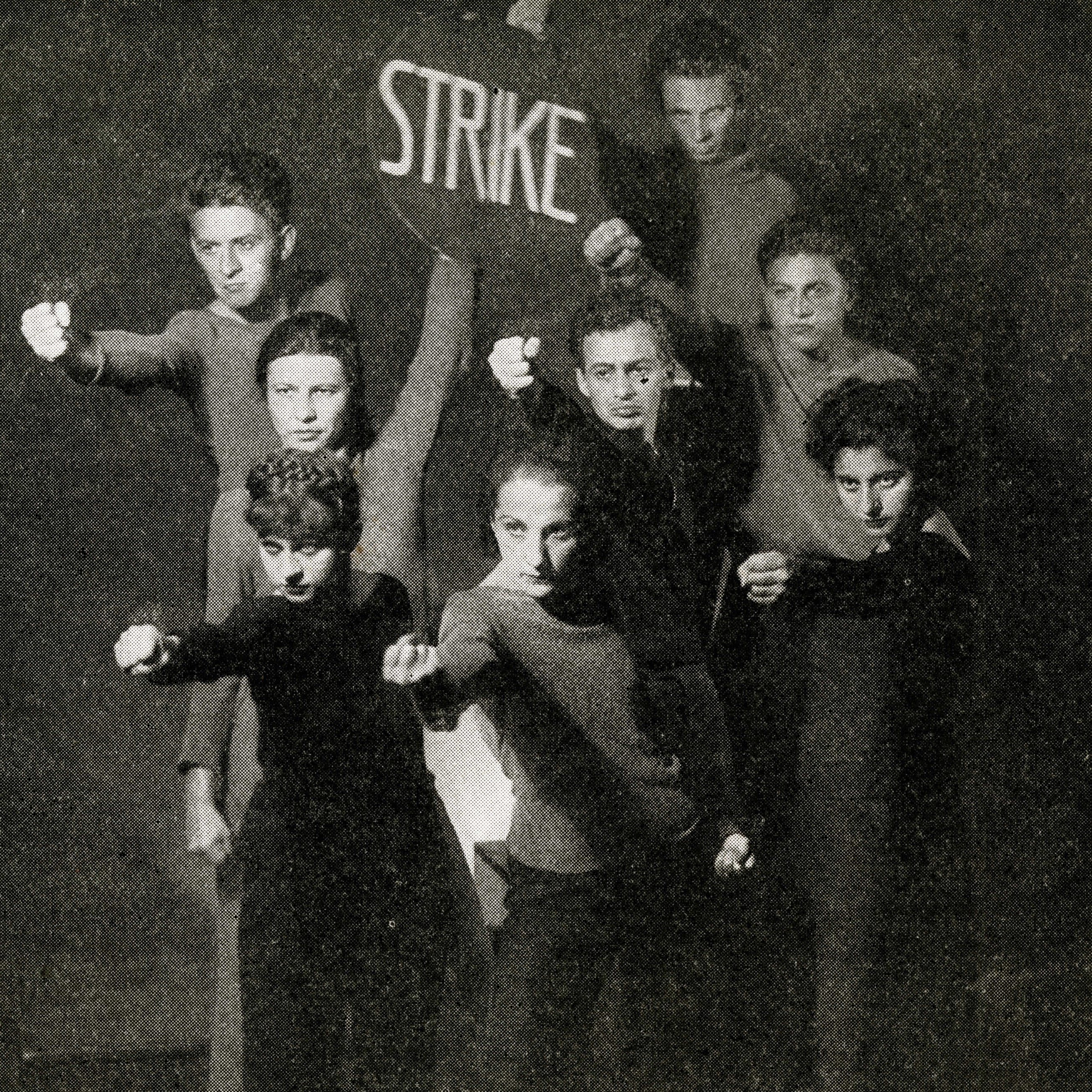
They lived communally, studied Marxism and acting, wrote revolutionary scenes, had little sleep or food and no money, all to perform guerilla theater on the streets of New York for tens of thousands during the Great Depression. Meet the Shock Troupe of the Workers’ Laboratory Theatre.
‘Shock Troupe In Action’ by Richard Pack from New Theatre. Vol. 1 No. 10. November, 1934.
“They’re gonna feed us slops, they’re gonna water our soup, they’re gonna give us food that aint fit for a dog, until we organize and demand our rights!” A member of the Marine Workers Industrial Union is speaking at an open-air meeting on the New York waterfront. He exposes the wretched lodging house the city provides for unemployed seamen–“doghouse” the sailors call it. He outlines a method of action. As he finishes, a sandy-haired youth springs to the platform. “And now, fellow workers,” he announces, “The Shock Troupe of the Workers Laboratory Theatre presents a little skit, Dr. Miremup!” A show! The news spreads up and down the docks. A show! The word is a magnet. Soon where there were forty, there are three hundred seamen. When the audience is large enough, the show begins. No house-lights dim; no curtain rises. This is theatre in its first form under the sky.
The sailors eat it up. No movie hokum this. It’s their show. It’s about them. Their problems. What to do about those problems. Lustily, they boo Dr. Mixemup, the misleader who claims the “doghouse” is really beneficial, and they laugh and cheer when the hero exposes the double-crossing “Doc.” “Swell stuff, boy,” one husky sailor yells, “Swell stuff!”
In humorous, dramatic fashion the carefully prepared script has repeated the points made by the M.W.I.U. speaker, has clarified them, has driven them home-and to a larger audience.
One hour later on a crowded slum street on the lower East Side, five young toughs watch in anticipation as the weekly street meeting of the Y.C.L. gets under way. For the past four weeks these hoodlums have heckled every meeting, and they’re not going to be denied their fun tonight. But, hell–what’s this? No speaker. Instead, there’s a quartet on the platform. First they sing a song about “Union Card” and then one about “N.R.A.” Catchy songs, too. A few of the boys begin humming the tunes.
And now the crowd is getting larger. Up and down the street, windows open. Heads pop out. They watch the show from their “balcony seats.” Soon, the audience in the street and in the windows joins in the singing. Then, a girl explains the purpose of the Workers Laboratory Theatre. “We’re going to put on a little sketch now,” she says, “Will you help us make room”
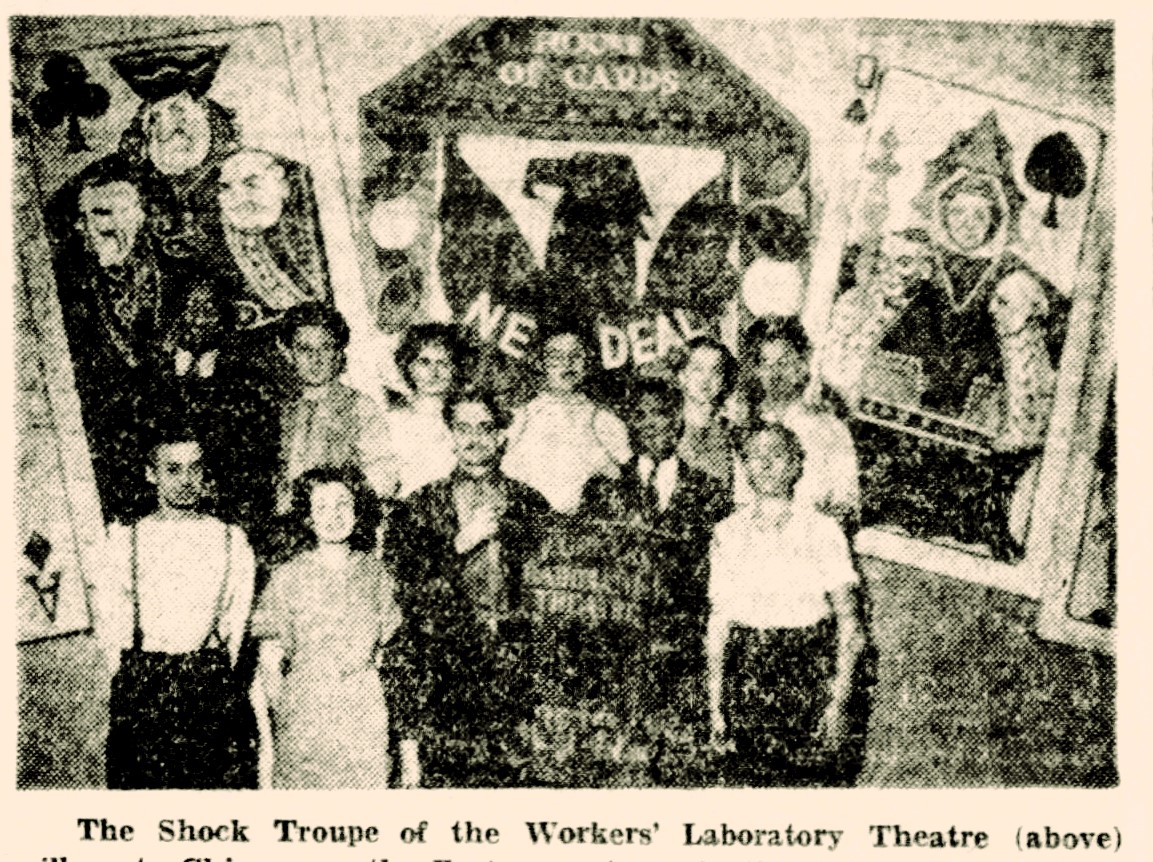
The same toughs who shortly before were ready to break up the meeting help keep the crowd back while space is cleared and boxes are set up for higher levels. The players have their backs to a building, and now the crowd closes in again, surrounding them on three sides. Then the announcement, “The Workers Laboratory Theatre presents Free Thaelmann,” and the show is on.
THE audience pays careful attention. They are impressed by the sincerity of the actors and the nature of the theme. When the sketch is over, they discuss among themselves their dislike of Hitler made more real by the performance they have just witnessed. As they go home, you hear some of them singing the songs about “N.R.A. she cut my pay” and “Make me out my Union Card,” etc.
Sixty thousand New York workers have witnessed similar Shock Troupe performances during the past year. In dozens of Union halls, workers centers, and on many streets “The Workers Laboratory Theatre Presents” have become familiar and welcome words.
The Shock Troupe was organized last Fall when, with the beginning of the strike. wave and with the intensification of the crisis, the W.L.T. was flooded with calls from the field of action. Workers all over the city demanded performances.
“We just couldn’t meet all the calls,” says Al Saxe, one of the directors of the Troupe, “Most of the W.L.T. members work during the day and can only give one or two nights a week to the theatre. That doesn’t give enough time for rehearsals and performances. We had to organize a fulltime production unit which would be ready to play anywhere at any time.
“With the swiftness of events today,” Saxe declares, “the shock troupe becomes political as well as an artistic necessity. Shock troupes should be built wherever possible–in dance and film groups, too.”
Not only has the Shock Troupe greatly intensified participation by the W.L.T. in the day-to-day struggles of the working class, but it has advanced the theatre artistically. More time for rehearsal and study has resulted in performances vastly more expert and finished. The Shock Troupe has also had time to experiment with new form of revolutionary theatre and to adapt the forms and technique of the bourgeois theatre to skits and plays of proletarian content. It was the W.L.T. Shock Troupe which collectively conceived Newsboy.
“We try to take into consideration,” says Will Lee, another of the Shock Troupe directors, “that we play before a larger number of workers, and must therefore use a form than can be understood by the greatest majority, so that its contents should not be politically over their heads and so that its forms will be easily recognized…forms that the workers are in the habit of seeing in bourgeois theatre–vaudeville skits, popular songs, monologues and dialogues based on famous radio and movie characters.
THE Shock Troupe is composed of the “cream” of the W.L.T., artistically and politically. Most of the members came to the Shock Troupe with previous academic training and professional experience. Al Saxe acted in vaudeville and stock and studied at the University of Wisconsin Experimental College. Will Lee taught dramatics at summer camps and directed Harry Alan Potamkin’s children’s operetta Strike Me Red. Greta Karnot was with the Fokine Ballet at one time and studied with Wigman and with Charles Weidman. Her husband, Stephen Karnot, a former scenic designer, appeared with the International Theatre in Moscow and studied with Meyerhold. Harry Lessin was a scholarship student at the University of De Pauw Dramatic School and appeared with Fritz Lieber’s company. One of the Troupe was with Jasper Deeter. Another taught dramatics at a well-known women’s college, etc.
ALTHOUGH it pays no salaries, the W.L.T. now provides the members of the Shock Troupe with food and lodging. The Troupe lives in a collective apartment in an old tenement on the East Side–the twelve of them in a five-room flat. When they moved in last January, they slept on the floor for a week, until friends managed to round up enough old furniture to stock the apartment. During the summer nights when the flat was oven-like, everyone slept on the roof. They had no ice-box this summer. But that wasn’t a problem. “You see,” ex- plains Greta Karnot, “we never had enough food to keep in an ice-box anyway.”
Food was–and still is–the greatest domestic problem of the Shock Troupe, since they are dependent mainly on the contributions of friends and sympathizers. Ten dollars a week, or roughly about thirteen cents per person a day, is the average expenditure for food. They eat no luncheon.
A SENSE of humor, intense devotion to a common cause, and a policy of frequent self-criticism has enabled the Shock Troupe to live amicably in their crowded quarters. They meet once a week for an hour of self-criticism.
Each Shock Trouper must adhere to a rigid schedule. Everyone rises at eight sharp and breakfasts at nine.
A typical Shock Troupe work day is as follows:
11-11:15–Bio-Mechanics—voice and body train.
1:15-12–Meeting–discussion of bookings, repertoire.
12-2–Rehearsal of repertoire: Newsboy.
2-2:15–Rest period.
3-4—Rehearsal of satiric skit: Hollywood Goes
4-5–Song practise.
5-6–Dinner.
7-8–Waterfront performance: Dr. Fixemup.
9-10–Needle Workers Industrial Union Hall: Free Thaelmann.
“Playing out in the street is a rich performance for the actor,” they say, “There is a powerful reciprocity between actor and audience. There is no barrier between us. We’re so close to each other that the feeling of acting disappears. We can’t pretend or fake. We’ve got to give it all we’ve got.”
As we go to press the Shock Troupe is taking an active part in the Communist Party election campaign, in addition to their regular concentration work on the docks.
The Shock Troupe is making theatre a sharper weapon!
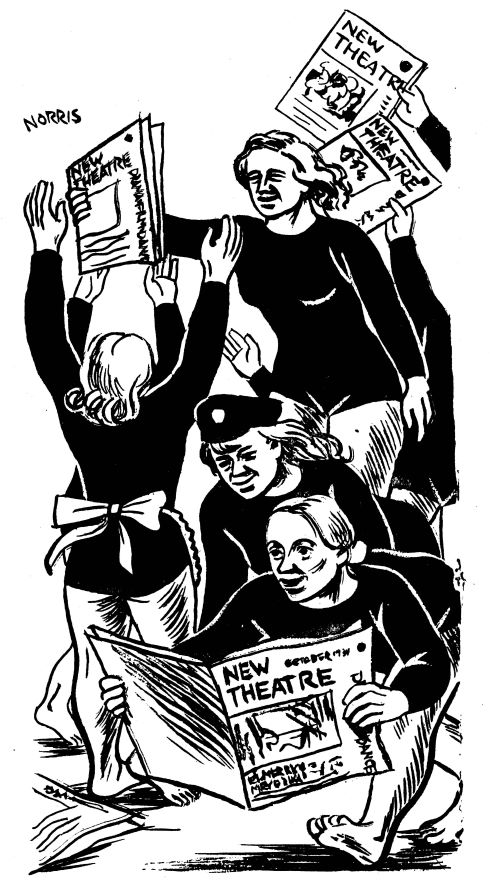
The New Theater continued Workers Theater. Workers Theater began in New York City in 1931 as the publication of The Workers Laboratory Theater collective, an agitprop group associated with Workers International Relief, becoming the League of Workers Theaters, section of the International Union of Revolutionary Theater of the Comintern. The rough production values of the first years were replaced by a color magazine as it became primarily associated with the New Theater. It contains a wealth of left cultural history and ideas. Published roughly monthly were Workers Theater from April 1931-July/Aug 1933, New Theater from Sept/Oct 1933-November 1937, New Theater and Film from April and March of 1937, (only two issues).
PDF of full issue: https://www.marxists.org/history/usa/pubs/workers-theatre/v1n10-nov-1934-New-Theatre-NYPL-mfilm.pdf
 Revolution's Newsstand