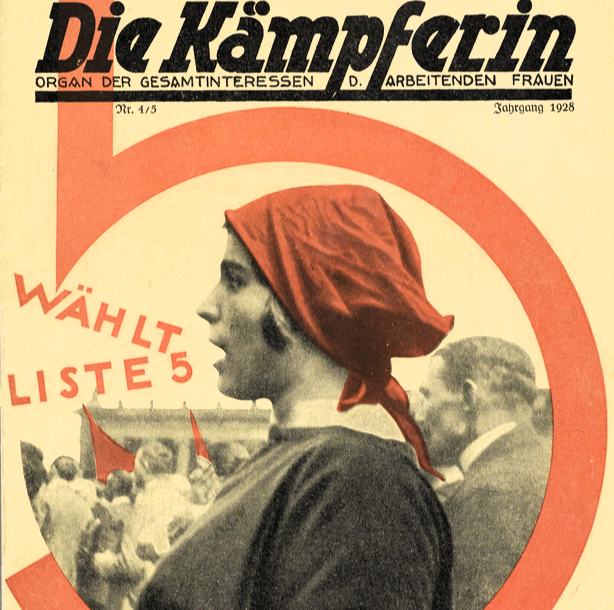
The central document from the Fourth International Conference of Work Among Women held in Moscow during May and June, 1926.
‘Report of the Women’s Department of the E.C.C.I. and Immediate Tasks cCnnected with Work among Women’ from International Press Correspondence. Vol. 6 No. 69. October 26, 1926.
INTRODUCTION
The present situation presents a picture of serious crises and convulsion of capitalism. Developments during the last few months show very clearly the instability and inner-weakness of the relative stabilisation of capitalism. The mighty struggle of the British miners against the coal magnates which developed with elemental force into a general strike against the bourgeoisie and the government of the British Empire, introduces a new epoch in the liberation struggle of the international working class. It demonstrates that capitalism, even in one of its strongholds, the mighty and victorious state of Great Britain is already so sick that it can no longer keep its economic system going except at the expense of the impoverishment of its wage slaves. It demonstrates that in the struggle between labour and capital even the presumably most democratic government of the world becomes inevitably the representative of the profit and domination interests of the capitalists and the inexorable, open enemy of the working class. Through this experience the British working class begins to form part of the united front of the international proletariat against capitalism and imperialism. The Locarno collapse, Pilsudski’s coup d’etat ling Poland, a country whose economic system is shattered and whose population is discontented and in a state of ferment, the ever-growing acuteness of the financial government crisis in France, the popular movement for the expropriation of the ex-Ruling Houses in Germany, caused by the impudent aggressiveness of monarchism, the growth of fascism in Czechoslovakia, the new wave of fascism in Italy, the raging White Terror in the Balkans, Poland, Esthonia, etc. all these phenomena taken separately and in conjunction herald the advent of a new wave of most acute class struggles. The colonial wars in Morocco and Syria, the smouldering discontent in the Eastern countries which again and again breaks into a flame, but above all the great national-revolutionary liberation struggle in China are a serious menace to capitalism in one of its last and strongest positions–the East, through the great conflict with the oppressed colonial and semi-colonial peoples which is imminent.
In all these struggles working women are called upon to play an important role.
They, who represent one half of all the oppressed and exploited, suffer doubly and trebly under the capitalist offensive and the tyranny of the bourgeoisie. It would seem that there is every reason for them to march at the head of the liberation struggle of the proletariat. And indeed all the struggles, including the very recent ones, are a testimony of the class consciousness and the revolutionary activity of large sections of working women. Women have not only been active in the struggle for immediate economic and social political demands, in the defence of their children’s daily bread, in the struggle for employment, higher wages, and mother and child care, against high prices and the burden of taxation, they have also done their share bravely in the political campaigns, in the struggle against war and fascism, in the big popular movements for the expropriation of the ex-Ruling Houses in Germany, for the extension of peoples’ rights through the Constituent Assembly in China.
However, none of these movements have embraced the female masses to a sufficient extent. It is true that Communists temporarily succeeded in bringing working women on the occasion of almost all bigger actions into the struggle for definite class demands. But it is also true that the influence which they had gained over the working women soon waned after the movement had died down. Time after time the female masses threw themselves spontaneously into the movement in a truly revolutionary fashion in places where the Party was too weak to lead and dominate the action. But in many cases Communist influence was not even strong enough to get away any appreciable number of working women from the influence and leadership of the bourgeoisie. The results of parliamentary elections in Great Britain, Germany and Czechoslovakia where the Conservatives, nationals, and clericals owe their great successes to the female vote, the number of women members in the Communist Parties compared with the number of working women and also with the number of women members of the Social Democratic Party and even of bourgeois parties, all this combined is convincing proof that the influence of our opponents on working women is still much stronger than Communist influence.
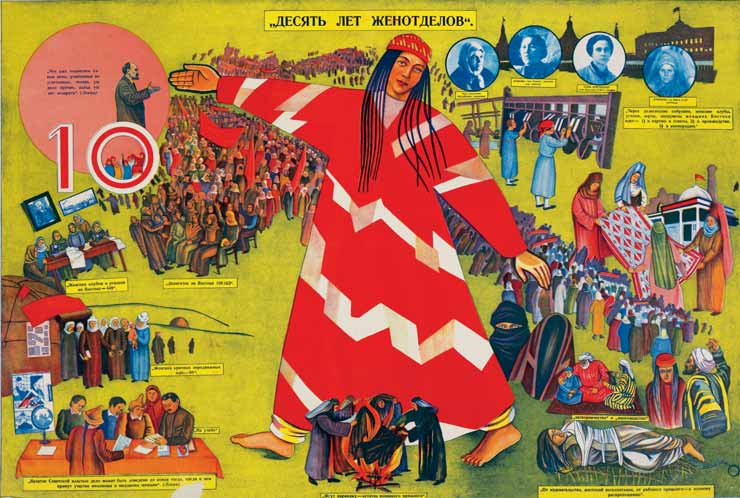
The bourgeoisie is fully aware of the importance of an alliance with the working women to the preservation of its class domination. Every means is good enough for the bourgeoisie and its lackeys, the Social Democrats, to deceive working women as to their true interests, and to alienate them from their own class. Just lately there has been in this respect a certain change in bourgeois tactics. Whilst formerly the enemies of the working class endeavoured to keep women away from politics and public life, they realise today more and more the impossibility to keep women out of politics in view of the growing politisation of the working class in general and the growing acuteness of the class struggles in particular. Having come to the conclusion that the revolutionisation of the masses cannot stop short at the working women, the bourgeoisie prefers to take upon itself the initiative for women’s politisation. By such means they reckon to divert this process into channels where instead of being a menace to them it might temporarily strengthen the bourgeois position to the detriment of the working class. The less enlightened the mass of working women, the more suitable they are in the eyes of the bourgeoisie to do its counter-revolutionary jobs.
In this period the struggle for the capture of the women is one of the characteristic features of the concentration of forces in the camp of the bourgeoisie. It is not enough for the bourgeoisie that bourgeois women join the parties and organisations of their class and take an active part in their policy, it makes systematic efforts to capture and misuse the women of the working class in the interests of its own policy.
This is the explanation for the coqueting of the bourgeoisie and particularly of the clericals with women’s franchise, for instance in France and Belgium, also for the introduction. of a limited women’s franchise in Italy by Mussolini, on the one hand for propertied women and on the other hand for “nationally-minded” women. By such means fascism works among women in favour of recognised strike-breaking organisations.
Similar symptoms are Flora Drummond’s “Women’s Empire Guild” in Great Britain which weeks before the outbreak of the British strike mobilised against strikes bourgeois women together with miners’ wives for a big demonstration “for economic peace”, and also the “Women’s United Front” in Norway for which bourgeois elements together with the Social Democrats have drawn up a programme of action for women.
Adopting other forms, but pursuing the same aims as the bourgeoisie, the Social Democrats endeavour to impede the revolutionisation process among women or to divert it into other channels. After the II. International had dropped the once revolutionary demands and methods for the politisation of working women which were on its programme for decades, it has recently begun to intensify its political activity among women. The International Women’s Conference in Hamburg in 1923 was the first step and that of Marseilles the second and still more deliberate step in this direction. The formation of a Women’s Committee in the Executive of the II. International, the re-introduction of the International Women’s Day after the ten-years pause, parallel with it the foundation and activisation of an International Women’s Committee in the Amsterdam Trade Union Federation, the establishment of the International Women’s Co-operative Guild through the reformist London Co-operative Alliance, are all of them manoeuvres to prevent by sham actions and sham successes the female masses who are beginning to show signs of activity from going over into the camp of consistent class struggle, of revolution and Communism.
The Communist International must fully realise the political importance of these phenomena and must arrange its tactics accordingly. If the Comintern means to capture the bourgeois positions among the female masses, if it wants to prevent the enemies of the working class gaining new ground, it will have to adopt for its activity among working women more active, clear-cut systematic and clever methods than hitherto, in order to bring the female masses into the revolutionary united front under Communist leadership, and in order to make them an active force of the revolution instead of an impediment to it.
Activity of the Women’s Department of the E.C.C.I. and of the Sections and its Results.
1. The Third International Communist Women’s Conference issued two main directions: firstly, the Sections and the E.C.C.I. were to endeavour to make Communist work among women not only the business of the women comrades, but also the business of the Parties as a whole. In connection with this, war was to be made on the traditions of isolating the work among women, and this work was to be closely linked up with the general Party work and the tasks of the working class.
Secondly, in connection with the reorganisation of the Parties on a factory nucleus basis, the sections were to transfer their work among the female masses concentrating on the capture of the most important sections among them the working women in the factories and trade unions
The resolution of the Org. Bureau of the E.C.C.I., May, 1925, supplemented former decisions by minute instructions for the adequate organisational construction of the Party apparatus for work among women and for organisational forms and methods for the capture of the masses.
Inner Party Results.
2. Since the V. World Congress considerable progress was made in almost all the sections with the construction, development and reorganisation of the Party apparatus for work among women. Retrogression was noticeable only in the Balkans and in the Border States as a result of White Terror. Leadership and control, of the work through the Party executives was more effective and the result of this was satisfactory, as shown particularly in this year’s Women’s Day Campaign for which millions of working women in town and country were mobilised in 16 Western and some Eastern countries.

3. The greatest impediment to successful work on a large scale was after all the relics of backward petty-bourgeois ideology with which large Party circles from the bottom and right to the top–are still afflicted, an ideology according to which women ought not to have anything to do with politics. The result of such backward ideas is lack of understanding for the necessity of political work among women. Ideological confusion, however in another form, was a wrong interpretation of the instruction re the definite linking up for the work among women with the general Party work. Thus, for instance, in Germany, during the period following the Frankfurt Party Congress, the idea prevailed in many districts that special work among women and special organs for this work are superfluous and harmful. In some places this led even to the complete disbandment of the existing women’s agitation commissions. Similar moods and tendencies made their appearance also in the C.P. of Czechoslovakia in the national Women’s Committee and in the Reichenberg district in connection with the Party crisis. Almost everywhere the absence of a clear attitude based on principle resulted in indifference and passivity. In many sections this was one of the causes of the inadequacy of efforts and successes with respect to the capture of the working women in the factories.
The Political Mobilisation of the Female Masses within the Framework of the Tasks of the Party as a Whole.
4. The E.C.C.I. and the sections paid more attention than before to the capture of the female masses. In the course of numerous important campaigns it was possible to mobilise large sections of women for the slogans of the Party, as for instance in Great Britain during the present mass strike, in Germany in connection with the ex-ruling houses expropriation campaign, in France in connection with the Douarnenez strike, the Municipal elections and the struggle against the Morocco war, in Czechoslovakia in connection with the campaign against protective tariffs and heavy taxes, in Italy in connection with the struggle against Fascism, in Sweden and Norway in connection with the gigantic lockouts, in China in connection with the struggle against imperialist intervention and for independence, in Japan in connection with the campaign for a change in the constitution in favour of women’s franchise. On all these occasions the demands of the women were connected with the general interests of the working class, and a united front was practically established by cleverly linking up these demands with other pressing needs.
5. In various countries successful organisational forms of the united front were adopted, be it in the direction of bringing working women into closer contact with their male fellow workers, as for instance in France where working women and working men’s wives as well as peasant women, were drawn into the workers and peasants congresses against the Morocco War, or as in Germany where women took an active part in the unity committees for the expropriation of the ex-ruling houses, or in the direction of rallying working women of various tendencies in non-Party women’s organisations or organs for the struggle carried on under class slogans. Such examples are the women’s departments in the British Minority Movement, the Widows and Mothers Committees against War in France, the Red Women’s and Girls League in Germany, the Housewives Leagues in Norway, etc., but above all the initiation of women’s ‘delegate meetings in Germany, Great Britain and Finland.
6. In a few cases attempts were made towards a united front with female masses under opponent leadership for the purpose of carrying out definite campaigns for instance in France for the struggle against the Morocco war and in connection with the Women’s Conference of the II. International in Marseilles, in China in the liberation struggle against the imperialist front, in Switzerland in the campaign for women’s franchise, in Czechoslovakia and Great Britain for joint celebration of the International Women’s Day. But only in Great Britain it was possible, thanks to preliminary work among the masses, to induce Women’s Co-operative Guilds and Local Women’s Sections of the Labour Party to joint action with the Communists.

7. On the other hand there were many cases when the sections showed their incapacity to utilise big international and national campaigns for the mobilisation of the female masses. Thus, for instance, not a single section has been able to make the fullest possible use of the slogan of international trade union unity for the initiation of a broad movement among the mass of working women. Careful observation of the policy and the methods of our opponents and systematic reaction to them were rare. Attempts to link up everyday slogans with the ultimate aims of the Communists were not always successful and it frequently happened that the Parties had not enough political and organisational forces to make use of favourable situations for the extension and consolidation of their influence over the female masses. Above all the sections hardly ever succeeded in keeping in touch with the female masses they had mobilised for some definite action and in securing permanent leadership over them. Thus, for instance the C.P. Cz. which utilised the indignation of the women folk in the movement against high prices, did not use this advantage systematically and did not develop it into an organised action. Although in France much sympathy accrued to the Communist Party among large sections of women in connection with the big strikes and important political campaigns, the Party did not have sufficient forces to attach to itself organisationally the women whom it had aroused. The C.P. of Germany suffered a serious setback at the Hindenburg election when the mass of petty bourgeois but also part of the proletarian women went into the nationalist camp because the Party, as a result of its utterly erroneous tactics, also failed to understand the importance of the capture of the female masses, and did not take the necessary political and organisational measures for this.
Capturing Working Women in the Factories and Trade Unions.
8. The question of capturing working women in the factories as the most important section of working women, which since the V. World Congress should have been the main feature of Party work, is still its weakest point. Today there is hardly a section prepared to question the enormous importance of the task with respect to connecting the Party with the female masses in the process of production where they form a natural united front with the men of their class. Nevertheless this theoretical recognition has not yet expressed itself to a sufficient extent in practice in the form of purposeful, systematic activity and successes worth mentioning in the factories. Because of inadequate collaboration between the Women’s Department and the Org and Trade Union Departments the general Party forces and particularly the factory nucleus executives were not sufficiently utilised also for the mobilisation of working women. On the other hand the Women’s Departments themselves lacked frequently the necessary initiative and activity as organs of the Party to make definite practical tasks, included in the general organisational plan of the Party, penetrate into big enterprises employing women’s labour.
Consequently the reorganisation of the Parties on a factory nucleus basis has had as yet little effect on the reorganisation of work among women. This work has not yet fully divested itself of its “housewife character”, particularly in the weaker Parties. It is true that in various countries such as Germany, Great Britain, France, Italy, Poland, also Austria, in some districts, industries and enterprises an energetic factory nucleus activity was developed among the working women, which resulted in the numerical growth of the factory newspapers and in the development of the working women correspondents’ movement. This work however is as yet quite unsystematic and its organisational successes are but small.
Most Sections failed to appoint–as planned out– women’s organisers in the factory nuclei. Neither did they issue to the nuclei practical instructions for work among the masses. Only in Italy and Poland there are in the factories circles of sympathising working women, attached to the nuclei for the purpose of spreading Party influence among the masses.
9. Trade Union work, the paramount importance of which for the capture of the majority of the working class was for a long time not fully recognised by many Parties and which even now is not estimated everywhere at its full value in spite of the important role played by the slogan of international trade union unity within the framework of the entire work of the Comintern, has been practically neglected with respect to working women. There was hardly anywhere systematic work for the organisation and proper instruction of Communist fraction work in the trade unions. Not even in the Red Trade Unions (France, Czechoslovakia), was this work taken in hand systematically and according to a definite programme. In Germany there have been just a few cases of Communists penetrating into the widespread trade union working women’s commissions and gaining influence there.
In Great Britain alone, where the movement for trade union unity originated and was given expression in the Anglo-Russian Unity Committee, the Party succeeded to ensure considerable active support on the part of the working women for the slogan of International Trade Union Unity. Within the framework of the trade union Minority Movement efforts were made to form Women’s departments and to establish collaboration with the Women’s Co-operative Guilds. A big recruiting campaign for women’s inclusion into trade unions was initiated and working women were mobilised for union with Soviet Russia, fraternisation with the Colonial peoples and for international trade union unity.
10. The general weakness of the work in factories and trade unions finds a reflex in the poor response to the women’s campaigns conducted by the Party in factories and trade unions, in inadequate participation of working women in the delegations to Soviet Russia and also in the small number and influx of working women members in the C.P.
Organisational co-ordination and Leadership of Big Masses.
11. In this period the first big and successful attempt was made to consolidate organisationally the political influence of the Party over large sections of women.
The most important and characteristic achievement in this sphere is the initiation of women delegate meetings outside the Soviet Union, viz. in Germany, Great Britain and Finland. Although these beginnings had still many defects, although they did not as yet rest on the factories and did not develop periodical activity, they nevertheless were a testimony of the Party’s capacity to expend its organisational and political leadership to ever-growing circles of women, rallying them around the Communist fighting slogans.
12. In a number of countries, new forms of organisation. were adopted for the capture of larger sections of women. These new forms include the formation of loose circles of sympathisers around factory, street or village nuclei in Italy and Poland, the Widows and Mothers Committees against war in France, the Women Friends of Women’s periodicals in several countries, all of which were a fruitful ground for Communist educational work and for the recruitment of new members.
13. The existing non-Party mass organisations, such as Co-operatives, Red Aid, Workers Relief, etc. were in some countries, especially Great Britain, utilised in a more systematic manner than before for the activisation of women, although not to the extent justified by their importance. Apart from England the importance of work in the co-operatives was not taken sufficiently into account.
14. A new sphere of work was the utilisation of existing non-Party women’s organisations, which was very successful particularly in Great Britain and Canada, as was also the formation of sympathising women’s organisations, above all, the Red Women’s and Girl’s League in Germany, and the Housewives’ Leagues in Norway which offer many opportunities for successful work, but are also fraught with many sources of danger if ideological clarity and purposeful leadership are lacking.
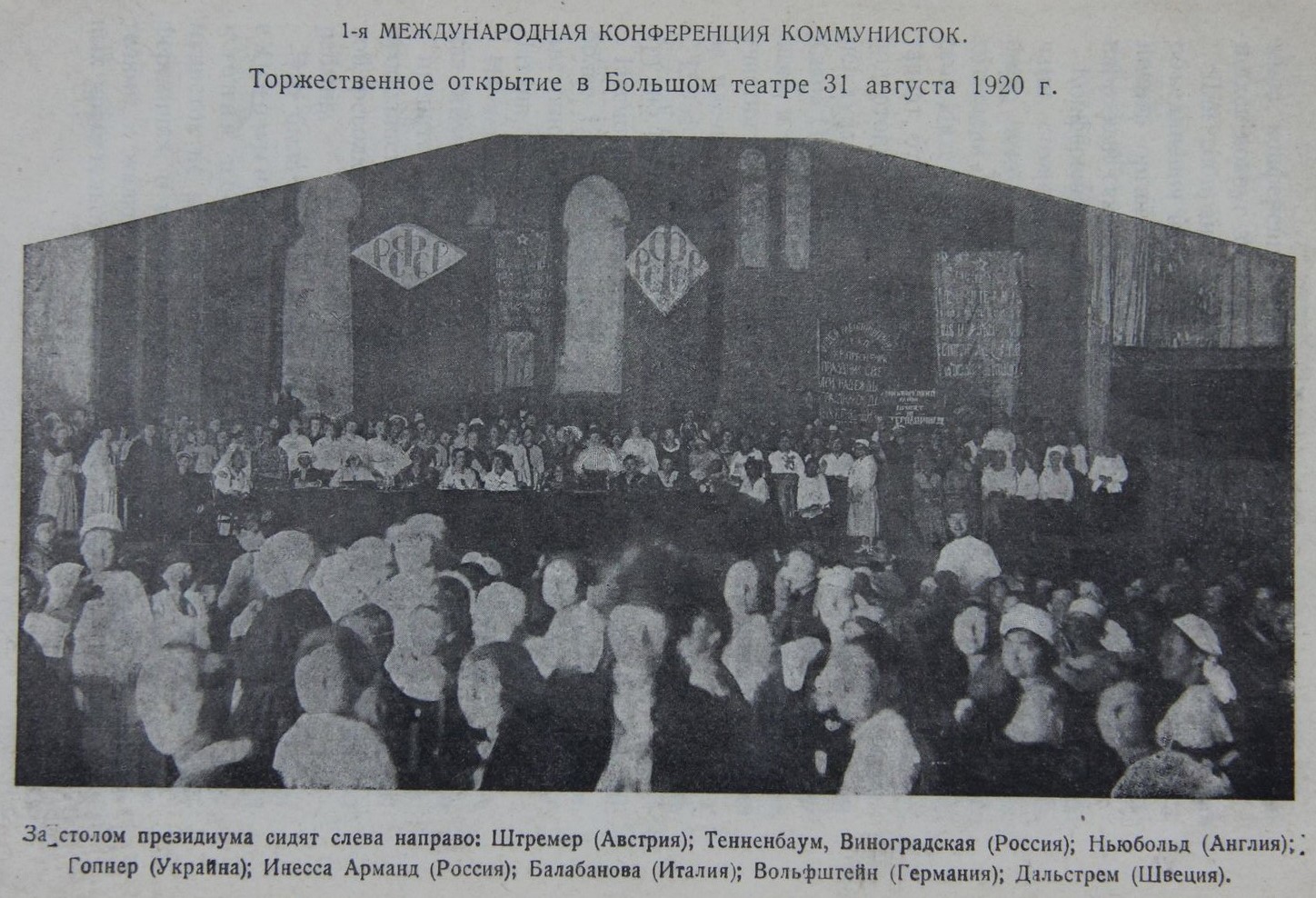
15. The Women’s press too acted as collective organiser. The number of printed and written women’s periodicals had grown, their circulation has increased, they have at their disposal a staff of house to house distributors, women friends and correspondents.
Immediate Tasks.
16. The experiences of the period just elapsed have shown that the practical tasks based on the international decisions on work among women were put forward correctly. The course of the work adopted by the E.C.C.I. and its Women’s Department was generally speaking correctly pursued by the Sections. In as far as the successes achieved were not yet satisfactory greater efforts must be made to enforce this course. In this connection the main task confronting the Comintern is the inclusion of large sections of women into the united front of the working class for the struggle against capitalism. In order to be able to solve this task successfully the Comintern must during this period take up a definite attitude and must concentrate its forces systematically on three particularly important tasks which permeate the entire Party work and must determine its course. Firstly, there must be ideological and practical recognition that work among women must be considered by the Parties as an important partial task in connection with the capture of the majority of the working class. Secondly, activity among the masses must be concentrated on the capture of the working women in the factories and trade unions. Thirdly, an energetic beginning must be made with the preparation and organisation of women delegate meetings.
17. In order to create not only in the Party, but also in the entire working class an ideologically clear recognition of the necessity of political work among women, a systematic continuous campaign must be carried on in the course of which it must be conclusively shown on the strength of classical experience and concrete examples taken from the everyday class struggle how important is the role of working women in strengthening or weakening the position of the working class. In connection with this the Russian experiences should be fully utilised.
In order to include not only in theory but in practice the mobilisation of women into the general work of the C.P. and the tasks of the working class, the Party must be able to show clearly the close relation of all Party slogans to the interests of working women, making this the strongest point of its argument. Moreover the struggle for demands which more directly concern Women must be linked up with all the campaigns of the working class.
In the present situation the following slogans and campaigns, the international importance of which should be emphasised, occupy the forefront.
National and international trade union unity, in connection with the capitalist offensive, wages and working hours, protection for working women and unemployment.
Struggle against war, fascism and white terror—in some countries, also the national question in connection with which national pacifist and other anti-working class influences on women are to be systematically and concretely paralysed.
Solidarity with the oppressed peoples of the East.
As to specific questions suitable for the mobilisation of even politically undeveloped sections of women, they are today in most of the countries as follows: high prices, protective tariffs, and heavy taxes, reorganisation and reduction of legislation for the protection of working women, unemployment, precarious position of men and women civil servants, wages struggles, housing crisis, worsened provisions for social insurance, particularly for the care of mother and child, class justice against abortions, increased exploitation of home industry workers, exploitation of children and child misery, worse schooling facilities and school reaction.
All the campaigns on all these questions must lead up to extensive propaganda for Soviet Russia, as the live example of proletarian dictatorship, in the course of which campaigns the everyday needs of working women should be used to show up the incapacity of capitalism to solve these problems, pointing out and proving by examples that the only right solution is the proletarian solution through the Soviet System. Sympathy for Soviet Russia and solidarity are to be strengthened by the fullest utilisation of the reports of the Workers Delegations, by extensive participation of working women in any further ‘delegations and by a systematic and extensive press campaign in all Party and labour organs. In connection with this, news, other press material, and letters dealing with the life of working and peasant women and children in the Soviet Union must be utilised, not only to describe the achievements of the Soviet Government with respect to women, but also from the viewpoint of creative activity on the part of the female masses themselves, In the conquest of power and the construction of socialism. In connection with the press campaigns working women must be encouraged to express themselves about the character of the workers’ and peasants’ State in comparison with their own ‘position in the capitalist State, in the form of press correspondence and letters to the Russian working and peasant women.
The organisational results of all campaigns must be inclusion of new sections of working women into all the organisations and organs of the working class and the small peasantry for the defence of their class interests. In this respect too recruiting for the trade unions occupies first place.
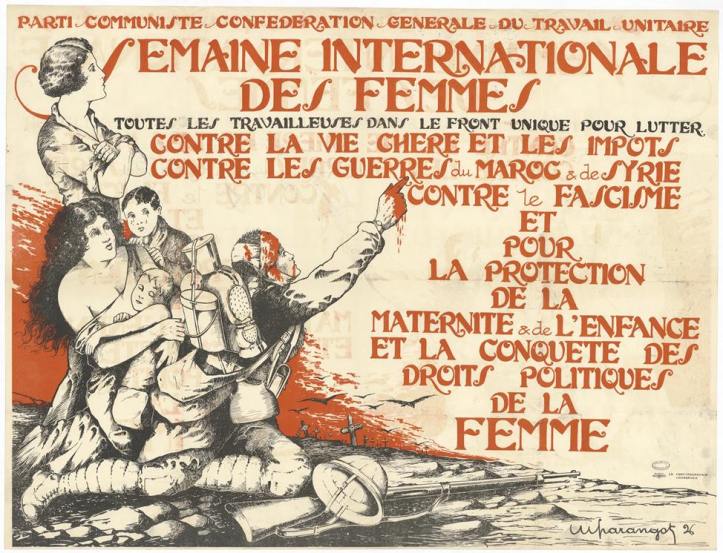
18. The activity of the capture of working women in the factories and trade unions must be carried on more systematically and intensively than before. For this purpose the Parties must draw up concrete plans of work, including a programme of the most important everyday slogans, and also organisational measures for the carrying out of this programme. Care should be taken that women Party members be carefully registered according to the place of their employment and the trade union to which they belong. Women organisers are to be appointed to all nuclei, particularly in big enterprises employing many women. The cadres of active Party members in factories and trade unions are to be systematically instructed with respect to activity among working women. In connection with this, maximum encouragement is to be given to initiative and self-activity in the nuclei and fractions with respect to the utilisation of all possibilities and application of all possible methods for the mobilisation of working women.
For the thorough study of the experiences of this as yet new work a temporary concentration of forces in definite districts, localities, factories or branches of industry where conditions are favourable will prove expedient.
The entire propagandist activity must be accompanied by a communist systematic recruitment of working women for the trade unions and the Party. The influx of working women into the Party and any fluctuations in the social composition of the female Party membership must be carefully registered and studied.
19. Women delegate meetings represent a specific method for the organisational coordination of large sections of women, for their systematic education and activisation in the spirit of class struggle and Communism. They are a special form of work among women employed in factories, as far as they rest first and foremost on delegates from the factories. But inasfar as they also bring together for common action working class housewives, women home industry and office workers, domestic servants, etc. in the towns and peasant women and women agricultural labourers in the rural districts they must be considered a broader form of united front and must be utilised accordingly. As most sections have at least made a beginning with the construction of factory nuclei, they must now pursue on this basis the development of this work with the object of organising women delegate meetings, which must be their immediate practical task. The organisation and carrying out of women delegate meetings is to give impetus to the development and concentration of the Party apparatus for this task. Parallel with a broad inner Party propaganda and instruction with respect to women delegate meetings, efforts must be made to provide the necessary support for these women delegate meetings above all in factories, but also in street nuclei, in the rural districts and in proletarian mass organisations. Delegate meetings must also form the basis for educational work on a large scale among the masses. They must receive the slogans of the Party, must propagate them and work for them, acting thereby as a lever for drawing ever-growing masses into action. They must endeavour to enlist new members for trade unions and co-operatives, etc. and must draw the most advanced working women into the Party.
20. One of the most important premises for a successful solution of the main tasks and also for carrying out the work in all other spheres is a well-constructed and well-functioning Party apparatus for work among women. Therefore, one of the most pressing tasks confronting all sections is to build up the women’s departments from the C.C. of the Party down to the Section executives throughout the country according to the directions of the Comintern, seeing to it that they be organised in a manner which will enable them to link up large sections of women with all the campaigns of the Party and the working class under the leadership of the Party Executive and in close collaboration with other departments of the Party, particularly, the Org, Agitprop and trade union departments.
21. But attention to the main tasks of the immediate future must not make the Parties lose sight of and neglect other possibilities for successful work.
Side by side with the factories and trade unions, and apart from the women delegate meetings, other existing mass organisations also serve for the organisational consolidation of our influence among the masses, first and foremost the co-operatives and also Red Aid, householders, war victims, International Workers’ Relief, sport, peasant, organisations, etc.
22. The Parties must use in the same manner the existing non-Party women’s organisations, i.e. they must penetrate into them, must form fractions and carry on a systematic activity in order to get influence over the women organised there.
23. As yet, work among peasant women and women agricultural labourers, has not produced any successes or experiences. But it must be taken in hand immediately. Work in this sphere must be initiated by studying the position of these sections of women, their needs and demands, in order to create a basis for experimental practical work in the most suitable places where favourable opportunities exist. Peasant countries and regions (France, Italy, Germany, Poland, Slovakia, the Balkans and the East) will have to lead the way in this respect.
24. In order to counteract the activity of our opponents among the working women and to alienate from them the masses who are still following them, the sections must study more systematically and carefully than before the policy and methods of Parties and of organisations with a big following of women and particularly proletarian women, such as the Social Democrats, clericals and nationals. The sections must take up a definite attitude to the programmes, slogans and actions of these Parties and organisations, and must react energetically to all their measures. They must expose before the eyes of the masses the political meaning of our opponents, their manoeuvres, all the lies, half-heartedness and treachery of the false leaders, in order to point out to the masses their true interests and show them the way to an effective representation of these interests under the leadership of the Communist Parties.

25. To cope successfully with the big political and organisational tasks connected with activity among women, special attention must be paid to the formation of a cadre of well-trained women functionaries, and functionaries for work among women. This can be done by systematic Party school work in the development of which, the women’s departments must take an active part. This will help to clarify the attitude of the Party towards the work among women. The lower Party organs and rank and file members will show more understanding for the instructions of the Party Executive, they will carry them out with more precision and will develop more initiative, activity and political leadership with respect to all questions which the everyday class struggle makes imperative.
26. In order to further international exchange of experiences and to give a lead to activity in all spheres, the Women’s Department of the E.C.C.I. must help and encourage the sections by placing at their disposal the experiences of our various sections and above all, those of the C.P.S.U. This necessitates the perpetuation and consolidation of the regular connections of the Women’s Department of the E.C.C.I. with the various sections. Up and above this, exchange of experiences among the Sections must be better organised than before. But above all, the Women’s Department of the E.C.C.I. must make accessible to the Sections systematically, comprehensively, and the least possible delay, the practical experiences of the various countries, any new questions which might arise and actual events in the sphere of women’s work in our own and also in the opponent camp, in order that all this material may be used by the Sections for general Party purposes or for the press. Systematic supply of such material to the international press and the establishment of an international bulletin for work among women through the Women’s Department of the E.C.C.I. under the active collaboration of the sections, is an important means for the guidance, consolidation and international linking up of this work.
International Press Correspondence, widely known as”Inprecorr” was published by the Executive Committee of the Communist International (ECCI) regularly in German and English, occasionally in many other languages, beginning in 1921 and lasting in English until 1938. Inprecorr’s role was to supply translated articles to the English-speaking press of the International from the Comintern’s different sections, as well as news and statements from the ECCI. Many ‘Daily Worker’ and ‘Communist’ articles originated in Inprecorr, and it also published articles by American comrades for use in other countries. It was published at least weekly, and often thrice weekly. The ECCI also published the magazine ‘Communist International’ edited by Zinoviev and Karl Radek from 1919 until 1926 monthly in German, French, Russian, and English. Unlike, Inprecorr, CI contained long-form articles by the leading figures of the International as well as proceedings, statements, and notices of the Comintern. No complete run of Communist International is available in English. Both were largely published outside of Soviet territory, with Communist International printed in London, to facilitate distribution and both were major contributors to the Communist press in the U.S. Communist International and Inprecorr are an invaluable English-language source on the history of the Communist International and its sections.
PDF of full issue: https://www.marxists.org/history/international/comintern/inprecor/1926/v06n69-oct-26-1926-inprecor.pdf
 Revolution's Newsstand