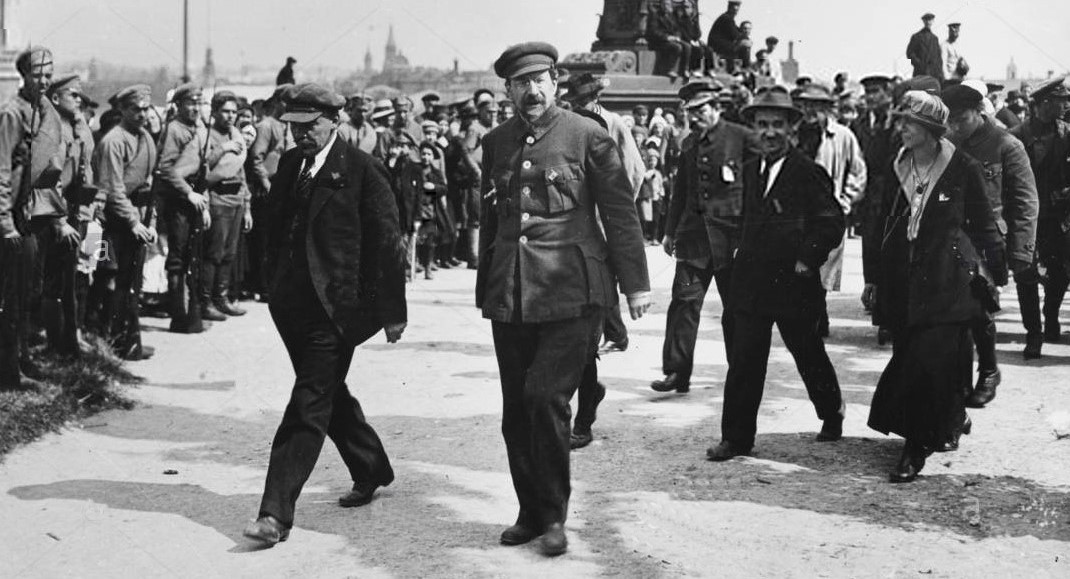
Speech of Commissar of Education Anatoly Lunacharsky to a special meeting of the Central Executive Committee of the Soviet Union celebrating the revolution’s tenth anniversary.
‘Cultural Development in Ten Years’ by Anatoly Lunacharsky from International Press Correspondence. Vol. 7 No. 62. November 3, 1927.
The subject of this report, the cultural development of the past ten years, is a very extensive one, and can scarcely be fully dealt with under the heading of the education of the people.
POLITICS, ECONOMICS, AND EDUCATION ARE INDIVISIBLE.
Lenin was right when he asserted that political achievements can only be secured by raising the cultural level of the masses. In his essay on the co-operatives on the co-operatives he writes as follows:
“The Soviet power once established, all we need is culture among the masses, in order to realise socialism.”
This method of treating the question accords due importance to the cultural development of the country.
The enthusiasm for economic and cultural progress, to which Comrade Rykov referred in his report, is observable everywhere. But this enthusiasm is not only peculiar to the present stage of our cultural and economic development. This enthusiasm could be seen at the very beginning of the October revolution. Our network of schools extended enormously in 1917, 1918, and 1919. We witnessed an elementary growth of the number of universities. This increase in the number of schools and colleges during the initial stage of the October revolution expressed indeed our wishes and strivings towards education, but it was little in accord with out material possibilities. This continued until 1921. At this time we fell short of means enabling us to realise our wishes, and many of the schools had to be closed again.
In 1923 the foundation was laid for the education of the people in the R.S.F.S.R. In the other republics of the Union this foundation was laid somewhat later in accordance with the establishment of their education commissaries. In 1923 the positions on the field of education were permanently reconquered. The enthusiasm of the masses for education grows from year to year, and the material basis for the realisation of these strivings is becoming more and more secure.
Above all, the population of the Union is thirsting for a general elementary education. The grant by the government of the Union of 15 million roubles for schools on the occasion of the tenth anniversary of the October revolution, as proclaimed in the manifesto, will therefore be welcomed with special appreciation by the population. The population is however equally demanding that more second grade schools be established. The slogan of the masses is: “Give us schools!”
We observe a great urge of the people for education. This urge is moving millions of workers and peasants.
THE STRUGGLE TO STAMP OUT ILLITERACY; EDUCATION.
The latest data issued by the Statistic Central Administration show incontestable progress in stamping out illiteracy in our country. In 1920, in the European part of the R.S.F.S.R., there were 355 persons of both sexes, out of every thousand, who were able to read and write; today this number has increased to 445 out of every thousand of the population. During the last five years we can record a general progress of about 28 to 29 per cent.
The women are behind the men in knowledge of reading and writing. During these last five years, however, the number of men learning to read and write has increased by 25%, and that of the women by 32%. These figures refer to the R.S.F.R.S., with the exception of a few gouvernements.
On the basis of this fundamental knowledge a many-sided cultural building is rising. To this belong the higher Soviet schools of every description, the technical schools. the colleges.
Another branch of these efforts is the widely ramified education of the population by means of the political enlightenment afforded by the reading huts, libraries, and clubs. We are further occupied with the science of working out the fresh problems of science, of spreading the knowledge won, and of applying science to actual practice. And here we have art, which is being made more and more accessible to the masses as we advance towards the realisation of socialism.
THE FINANCIAL BASIS OF EDUCATION.
In 1913 the total sum granted by the state and local budgets for the education of the people was 276.1 million pre-war roubles. In 1925/26 the sum total of the grants for educational purpose drawn from the state and local budgets, and from the resources of the people’s Commissary for traffic service (for purposes of education in transport service), amounted to 302.6 million pre-war roubles. In the year just passed, 1926/27 the grants for the education of the people, drawn from these same budgets, amounted to 396.2 million pre-war roubles.
In 1913 the grants for education amounted to 7.76 per cent of the total state budget; in 1925/26 to 10.88 per cent, and in 1926/27 to 10.63 per cent.
The budget has not yet been completely drawn up for the current year, but the grants for the education of the people will be increased all over the Union, both absolutely and relatively.
The expenditure for education per head of the population, in the years above mentioned, is as follows: 1913 2 roubles 8 copecks; 1925/26 3 roubles 86 copecks, and 1926/27 4 roubles 79 copecks.
THE ELEMENTARY SCHOOL, FIRST GRADE.
Before the war, in 1914, the number of schools totalled something over 104,000. During the period of tempestuous increase of educational institutions, immediately after the October revolution, the total number of elementary schools rose to 114,000. In 1923 the number of schools sank to 87,500, rising again by 1926/27 to 108,000, a plus of 3.6 per cent. as compared with 1914. In 1914 the number of scholars was 7.2 million, during the period of rapid extension of the school network 9.2 million, and finally, during the past year, 9.9 million, in the elementary schools of the first grade.
At the present time 65 to 70 per cent. of our children attend our schools. The Soviet government have set themselves the enormous task of extending the network of schools until, by 1933, all children of school age will be attending school.
Qualitatively, our schools still leave much to be desired; the financial support is insufficient, the equipment inadequate, the education of the teachers frequently imperfect.
The schools with four years’ course of instruction can however lately record rapid progress. New programmes are being taken up everywhere; there is no doubt that much is being achieved here.
The system of instruction in our schools has been highly approved by foreign pedagogic authorities and scholars who have visited the Soviet Union. This appreciation pronounced by foreigners who are far away from communism shows that the Soviet schools are the leading educational laboratories of the world.
THE REORGANISATION OF THE SCHOOLS ON THE BASIS OF THE NATIONAL LANGUAGES.
The most important factor in the education of the people is the reorganisation of all schools for the respective national languages. For the first classes of the elementary schools this reorganisation is compulsory, even for the nationalities possessing but little culture. This reorganisation of schools for instruction in national languages is an exceedingly difficult task, for before the war such schools did not exist at all, or dragged on a miserable existence. But despite the enormous difficulties of the undertaking, considerable progress can be recorded.
In Ukraine, for instance, the number of schools conducted in the national language increases from year to year. On 1st January 1924 the number of these schools amounted to 66 per cent of all schools, on 1st January 1925 to 77 per cent, and on 1st January 1926 to more than 79. The same increase in the number of schools teaching in the national languages may be observed in the other republics and autonomous provinces of the Union.
THE EDUCATION OF THE CHILDREN BEFORE THE SCHOOL AGE.
The education of the children before the school age has made noticeable progress in the Soviet Union since the October revolution.
A gigantic extension of the pre-school institutions was observable in the years immediately following the revolution. In 1920/21, for instance, there were 4723 kindergartens and nurseries, accommodating over 245,000 children. When these preschool institutions ceased to receive state support, and became dependent on the local finances, their number diminished for the time being, but they have increased again in recent years. Whilst there were 1139 kindergarten and nurseries in 1924/25, the number rose to 1364 in the following year, and to 1629 in 1926/27. The number of children increases correspondingly.
The great increase in the network of children’s playgrounds in recent years is especially conspicuous. These increased from 1500 in 1924/25 to 4000 in 1926/27. At the present time 200,000 children spend their time in these playgrounds.
THE STRUGGLE AGAINST DESTITUTION.
The struggle against destitution among children is being carried on in various ways. This evil is diminishing gradually. The number of homeless and uncared for children is diminishing, as also the number of children living in children’s homes at the expense of the state. The children are being better prepared for life, and take their places in the process of production as young workers.
The peasantry has done much to reduce the number of homeless children, taking many of these children to be brought up in their own families.
THE MIDDLE GRADE SCHOOL.
The chief defect of the middle grade schools is that their network does not extend far enough. They do not reach more than one tenth of the children who have passed through the first grade schools. And yet it is a fact that the Soviet Union has gone, far beyond the wretched inheritance bequeathed it by the bourgeois social order. As early as 1923 the number of pupils attending middle grade schools exceeded the number in 1914, and at present the number of children in these schools is already more than 4 per cent. above the prewar figure.
In connection with the middle grade schools it must be pointed out that the system pursued by these schools in the R.S.F.S.R. differs essentially from that in the Ukraine Socialist Soviet Republic. In the R.S.F.S.R. there are two types of school, a second grade school with a five year course and a second grade school with a seven year course. In the Ukraine there is one uniform middle grade school with a seven year course. To this school belongs further the so-called “professional” school with a three year course. The professional school is followed by college.
The existence of two systems of middle grade schools is naturally undesirable. Both types will however have to be maintained for a certain period, in order that experience may show which system best serves the interests of the development of the country.
THE SCHOOLS FOR YOUNG PEASANTS.
A special type of the middle grade schools in the Soviet Union are the schools for “young peasants”. The instruction given by these schools is making the peasant an educated man with co-operative knowledge.
The following data give an idea of the development of the schools for peasant youth: In 1924/25 these schools numbered 229, the number of scholars over 20,000; in 1925/26 the number of schools had risen to 491, the number of scholars to more than 36,000; in 1926/27 the schools numbered 686, the scholars approximately 50,000.
THE FACTORY SCHOOLS.
The factory schools are to be classified with the middle grade schools.
We frequently hear the opinion expressed that the factory schools have become superfluous, since the advancement of the industrialisation of the country tends to reduce the work of the qualified worker to the mere superintendence of a machine. This standpoint is wrong. The factory school has every prospect of successful development. This is demonstrated by the expansion of its network of schools, and by the enormous increase in the number of scholars. Whilst there were only 789 factory schools in the Soviet Union in 1923/24, 1678 could be counted in 1926/27. During this period the number of students rose from 60,000 to 110,000.
VOCATIONAL EDUCATION.
The industrialisation of the country renders vocational education one of the most important departments of our culture. Here a very close co-operation is necessary between economics and the people’s commissaries representing them on the one hand, and the people’s commissaries for education on the other.
This co-operation does not however exist in reality as yet, and for this reason the work done towards the organisation of professional education is not yet entirely satisfactory. The lower professional schools especially are at a disadvantage. There are but few schools, and these not well adapted to practical needs. Once more a legacy from the Russia of the Tsar. And yet the lower professional schools are essential for the instruction of properly qualified country workers, of which there is a great shortage. Many complaints come from the provinces on the lack of smiths, saddlers, joiners, etc.
THE TECHNICAL SCHOOL’S.
The network of technical schools, like that of the professional schools, has been taken over by us to a great extent from old Russia. Neither their number nor their structure correspond to the character of the various districts of our Union and their economic needs. The opening of a large number of new technical schools is contemplated for the near future, and this will do much to improve matters in this line.
The expansion of the technical school network and the increase in the number of students are enormous. During the period from 1920/21 to 1926/27 the number of technical schools has risen from 585 to 1017, or almost doubled, whilst the number of scholars has increased from 70,000 to 180,000, or more than 21/2 times the number.
COLLEGES AND WORKERS’ FACULTIES.
Tsarist Russia has here left us an inheritance which requires much remodeling. The syllabus of instruction and the college system have had to be changed, and above all the country has been faced by the highly important task of proletarising these higher schools.
At the present time the colleges are predominantly workers’ and peasants’ colleges. This is due in no small measure to the workers’ faculties, which act as preparatory schools bringing the more talented of the young workers and peasants into the colleges.
At present all possible steps are being taken to improve the instruction in the workers’ faculties, without interrupting the connection of the worker students with production. For this reason the people’s Commissary for Education arranges the instruction for the evenings.
Our task is not the increase in the number of colleges, but the improvement of the instruction which they give. The period of the rapid increase of colleges in our country is ended, and has been succeeded by a period of selection of the best colleges, and of improved instruction. The present network of colleges comprises 160,000 more students than that of the prewar colleges.
The following figures show the social strata from which the students are recruited. As compared with 1924, the proportion of workers studying in the colleges has risen from 10% to over 25%, the proportion of peasants from 22 per cent. to 26 per cent.
In spite of the higher demands made by the syllabus, the percentage of Party members and young workers enrolling at the colleges has greatly increased. The students differ from those of former years by taking a profound interest in the subjects of their study. The teaching staff is adapting itself gradually to the modern conditions of teaching, and to the activity of the youth. Young scientifically educated teachers are being prepared to take up this work in place of the older professors.
POLITICAL ENLIGHTENMENT.
The organs of the People’s Commissariat for education, both central and local, are working with the intensest energy in the field of political enlightenment.
The first step in this direction is the abolition of illiteracy among adults. A comprehensive network of centres for liquidation of illiteracy has been created. The number of these centres has increased from 41,000 in 1921 to almost 47,000 at the present moment, whilst the number of pupils has risen from 1 million to 11/2 millions. During the last seven years about 7 million adults have been taught reading and writing.
The general public takes an active part in the struggle against illiteracy. At present the association. “Away with illiteracy!” comprises about 27,000 nuclei, reaching 1.2 million men and women, of whom about 65 per cent belong to the country and 35 per cent to the towns.
The general educational institutions (schools, courses, etc.) must also be classified under political enlightenment. Whilst in 1921 there were 780 such institutions, the present number is 866, the number of students about 100,000. Parallel with this runs the extension of the network of workers’ universities. At the present time we posses 31 workers’ universities with 7868 students, who are at the same time working at the bench.
Apart from these general educational institutions, an eminent role is played by the men and women workers teaching in the reading huts in the country. This army of young workers gives instruction in 22,000 reading huts.
The workers’ clubs find their sphere of activity in drawing the working masses into centres in which it is possible for them to pass their leisure hours in the clubs. It happens at times that the club functionaries rather overdo in activity of instruction and organisation, providing a superfluity of general courses of instruction, sections, etc., and thereby frightening away from the clubs many of the workers, too tired for such exertions after their day’s work. These clubs must be made into real places of recreation and sensible entertainment for the workers. The women must take a leading part in this work, in which they have proved the best organisers and leaders.
The cause of political enlightenment has lately found a mighty ally in the radio. Only four years ago very few people had any clear idea of the wireless, and the reports from America sounded like fairy tales that the wireless could be simply switched in at any time, and concerts, lectures, etc. heard at will. Today almost every house in the towns has its wireless set. There are 47 broadcasting stations, supplying almost one quarter of the population of the whole Union.
The cinema has developed with equal rapidity.
Before the revolution 75 per cent of the films were imported from abroad whilst the other 25 per cent was fairly worthless stuff. At present our production and quality have reached a high level, and the foreign films are being gradually ousted.
PRESS.
Clear witness of our cultural progress is borne by the data referring to our press and publishing works. We issue 556 newspapers, the total of their editions running to 8 million copies. This greatly exceeds the pre-war standard in newspaper circulation. As compared with the time before the war, the influence exercised over the masses has increased immeasurably.
The publication of scientific works has made equal progress. The number of editions published of scientific works, as also various other data, show an undoubted increase of interest in the population for the scientific book. Whilst the year 1910, an especially favourable year for this type of publication, brought 464 new publications, this year’s assortment of new publications numbers 945.
SCIENCE.
The status of science is of immense importance for the building up of socialism. The advancement of scientific work in the Soviet Union synchronises, as we are informed by the Secretary of the Academy of Sciences of the Soviet Union, S. F. Olderburg, with the founding of the central committee for the improvement of the material position of the scientists, in 1920. Since this time science has been enabled to develop on systematic lines. The scientists work not only in the colleges and scientific institutions, but to a considerable extent in the state institutions, beginning with the Commission for Planned Economics of the Union. They are thus incontestably able to contribute greatly to the progress of the construction of socialism.
The growth of Marxism in our science is of paramount importance. Here we must emphasise the increased publication of the works of great Marxists, the development of general Marxist literature and journalist work, and on the other hand the rapprochement of various leading scientists and entire scientific institutes to the principles of the Marxist standpoint.
The first place is here occupied by the Marxist institutions established by the revolution, for instance the Marx-Engels Institute, which can claim thanks to the leadership of Comrade Ryasanov to be, in its organisation and scientific labours, the leading institution of scientific Marxism in the world.
Mention must also be made of the enormous amount of work done by the Communist Academy, the Lenin Institute, and a great number of other scientific institutions, which are working indefatigably for the penetration of the Marxist principles into every department of scientific research.
The Academy of Science of the Soviet Union has increased its activities to a colossal extent during this period.
ART.
The public, the Party, and the authorities, are beginning to take an interest in art. We have been able to observe a general increase of creative artistic activity on the one hand, and a tendency in art to express our ideology on the other. A purely proletarian literature has sprung up, of which we have already some striking and beautiful examples, worthy of a permanent place in the history of our literature.
Our theatre, which we guarded carefully even during the hardest periods since the revolution, has been kept supplied with fresh forces, and at the present time is undoubtedly the best in the world, both with respect to management and acting. There is a strong tendency towards the representation of real life in our theatre, an impetus towards participation in the general trend of cultural development.
Just after the revolution our painters and sculptors lost. their heads slightly after being freed from the influence of their former patrons. During the first period most of the futuristic painters went over to our side, but failed to produce what the revolutionary proletariat was seeking. It is only just lately that painting and sculpture have struck the right note for the masses. The artist who succeeds in responding to the real needs of the people, whether by brush or chisel finds himself gratefully accepted by the masses.
The art of music can also record great progress.
NATIONAL CULTURE.
Whilst the Tsarist regime enforced the use of the Russian language in all national territories, the October revolution proclaimed absolutely equal rights for all the languages and dialects of the national minorities. At present the children in the backward national districts are being instructed in schools, vast amounts of work are being done for the distribution of national literature, and in training women for public Soviet work.
Human society can only be formed on the basis of harmonious reforms if we first ensure the cultural development of the national minorities, the development of national culture on the basis of the equal rights of all nations.
THE NEXT GENERATION.
One of the greatest levers of our cultural development is the Young Communist League, whose growth simultaneously signifies the enormous cultural growth of the whole Union.
This generation, already our most active collaborator, is being followed by the younger generation belonging to our Pioneer organisations. Here a powerful auxiliary is developing, a successor in whose hands we can place without fear the great cause of building up the new society of mankind.
The whole cultural development of the West European States is adapted for the gratification of egoistic interests, whilst our culture pursues the goal of the cultural advance and improved standard of life for the whole of mankind.
We are best made aware of this difference if we visit a foreign country. When we return from a rich foreign land to our poor Soviet Union, we feel a profound sensation of joy, the joy of work, the joy of our own cause in our Own country. (Enthusiastic applause.)
International Press Correspondence, widely known as”Inprecorr” was published by the Executive Committee of the Communist International (ECCI) regularly in German and English, occasionally in many other languages, beginning in 1921 and lasting in English until 1938. Inprecorr’s role was to supply translated articles to the English-speaking press of the International from the Comintern’s different sections, as well as news and statements from the ECCI. Many ‘Daily Worker’ and ‘Communist’ articles originated in Inprecorr, and it also published articles by American comrades for use in other countries. It was published at least weekly, and often thrice weekly. The ECCI also published the magazine ‘Communist International’ edited by Zinoviev and Karl Radek from 1919 until 1926 monthly in German, French, Russian, and English. Unlike, Inprecorr, CI contained long-form articles by the leading figures of the International as well as proceedings, statements, and notices of the Comintern. No complete run of Communist International is available in English. Both were largely published outside of Soviet territory, with Communist International printed in London, to facilitate distribution and both were major contributors to the Communist press in the U.S. Communist International and Inprecorr are an invaluable English-language source on the history of the Communist International and its sections.
PDF of full issue: https://www.marxists.org/history/international/comintern/inprecor/1927/v07n62-nov-03-1927-Inprecor-op.pdf
 Revolution's Newsstand