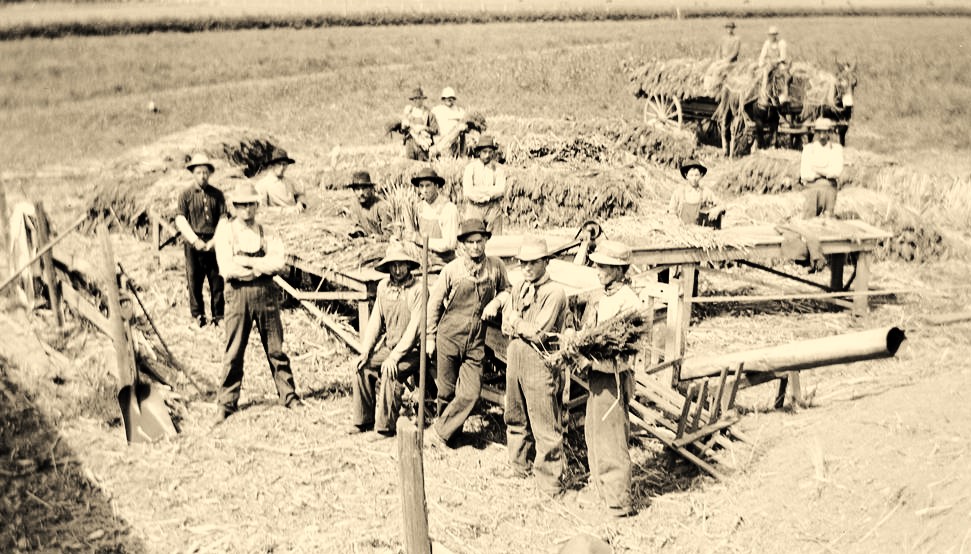
Who knew so much went into sweeping the kitchen floor.
‘The Broom Corn Industry’ by W.W. Pannell from International Socialist Review. Vol. 16 No. 12. June, 1916.
A COMPARATIVELY few years ago, and for centuries antedating, Brooms were made of the branches of trees, shrubbery of various kinds and even certain kinds of weeds bound together on long poles. The cave man probably used the same kind of a broom to sweep the cob-webs out of his cave that the peasants of Europe used a few years ago, and still use to some extent. However, the last few years has seen wonderful development in the production of the common broom. At first manufactured of any kind of material that came ready to hand, the broom has become a commercial product and is now manufactured exclusively as a product of the broom corn plant.
Broom corn, from which staple is manufactured the common broom of commerce, is grown extensively in Kansas, Oklahoma, Illinois and other states of the Southwest and Middle West. It is one of the family of sorghums, which also includes kaffir, milo, etc., and is grown exclusively for the “brush” that shoots out at the top of the stalk corresponding to the “head” of kaffir or milo. Two varieties are grown, the standard and dwarf, each of which requires a slightly different method of harvesting.
The methods of planting and cultivating broom corn are principally the same. as with the other members of the sorghum family. The seed is planted in rows about three feet and a half apart to admit of cultivation by machinery. The cultivation being the same as with Indian corn and other staple crops grown in rows.
The harvesting stage is the most important one in the production of the broom corn crop and upon the success of the time and methods of harvesting depend a large part of the price the farmer will get for his product. If the brush is harvested too green it does not have a firm “handle” or “color,” as the broom corn experts say, and if it gets too ripe it turns “red” or “rusts” thereby depreciating in monetary value. The ideal is a ‘brush” that is ripe enough to be firm and have a strong handle,” yet minus the “red” or rust color that accompanies the over ripe condition. Therefore harvesting is usually staged when the broom corn has reached the desirable degree of ripeness, and at the this time the farmers hire all the labor they can get for a few days in order that the work of harvesting may be carried on as expeditiously as possible.
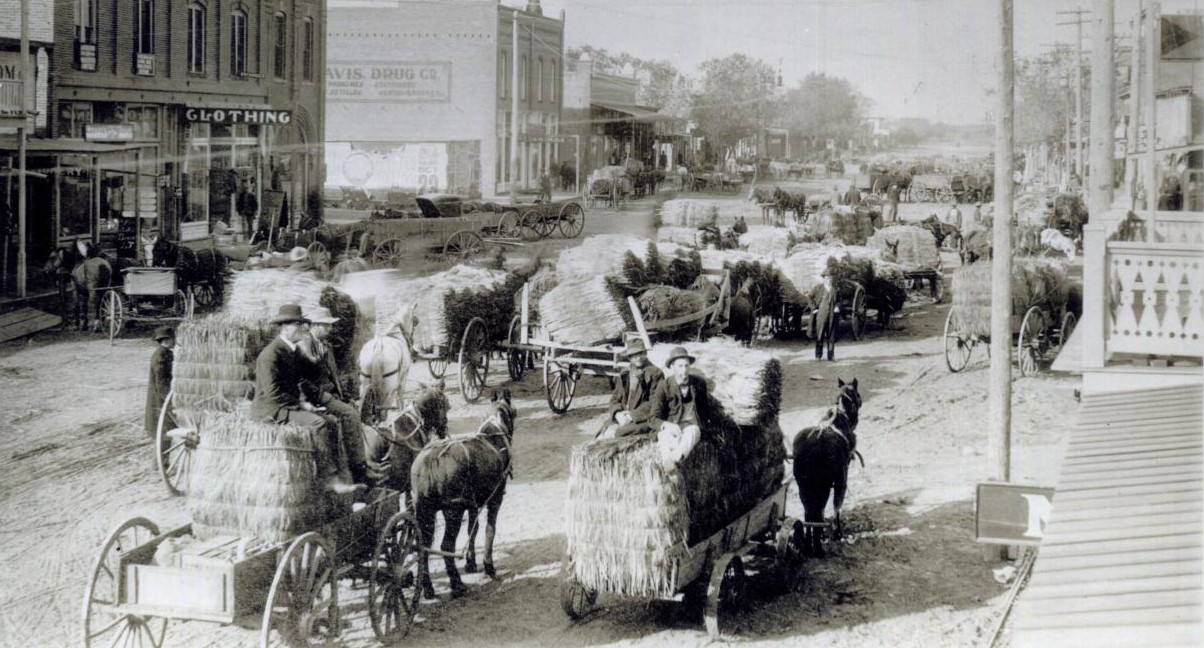
Dwarf broom corn is harvested by “pulling” or “jerking.” To do this the “brush” is grasped in one hand and the top leaf or “boot” in the other and the “brush” extracted by pulling outward and downward. The “brush” is then laid on the ground, or on broom corn stalks broken down for that purpose, being later loaded on wagons and hauled out of the field. The methods of harvesting standard broom corn are similar to those employed in harvesting the dwarf variety, with the exception that the stalks must be “cut” or “broke,” this being necessary on account of its great height and because of other characteristics.
There are two methods of “curing” broom corn and getting it ready for market. Either it is hauled out of the field immediately after it is “pulled” and “shedded,” or it is allowed to remain in the field until dry enough to “rick.” The first method is called “shed curing”; the latter “field curing.” The sheds are merely roofs under which the broom corn is laid in tiers on “poles” placed in the shed for that purpose. This allows the air to freely circulate through the broom corn, “curing” it without “weathering.” The most up-to-date farmers follow the “shed method” of curing broom corn and the prices of “shed cured” broom corn are higher than those on “field cured.”
The prevailing method of marketing broom corn is to sell to traveling representatives of factories or wholesale broom supply houses at a fixed price per ton for “brush” to be delivered at the nearest railway station. Numerous cooperative organizations have been formed to deal direct with the manufactures; however, the greater percent of the broom corn is still marketed through the middleman. In the future “direct selling” may revolutionize the entire broom corn market, but at present direct selling is the exception. and not the rule.
The prices paid for broom corn are based on a certain market standard which is known to broom corn planters and buyers as “the demands of the market.” The “demand of the market” is a medium sized brush of a greenish color, such as is used in the common household broom. Of course, whisk brooms and brushes of various kinds are manufactured of different qualities of broom corn and often sell comparatively higher than the standard broom; but as long as the manufacturer controls the broom corn market, the farmer will find it profitable to produce the article upon which the manufacturers base their market prices.
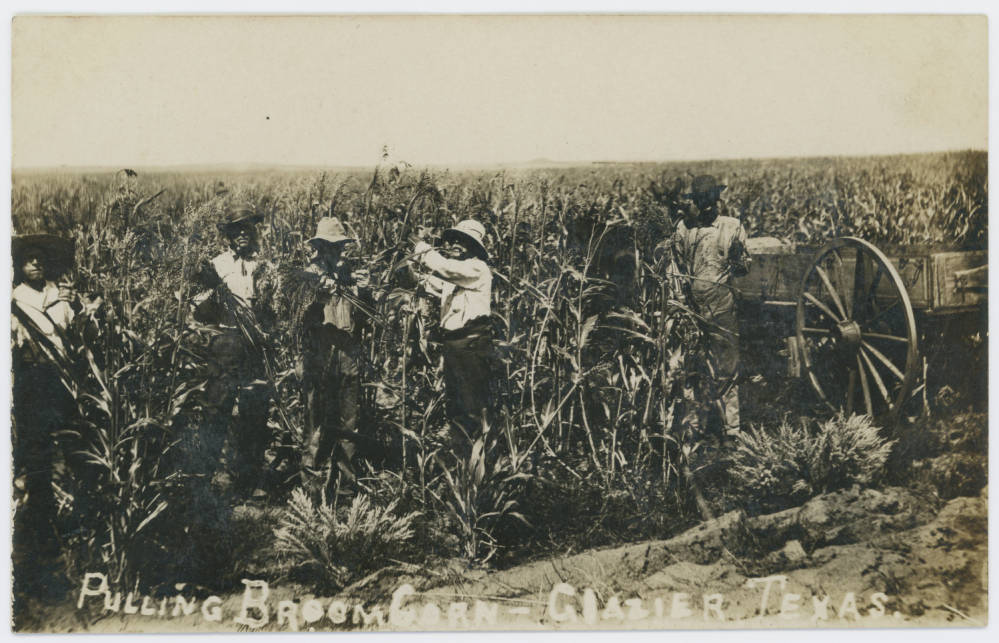
No article on the broom corn industry would be complete without mention of the great army of migratory “broom corn pullers” that depend on this industry for a livelihood. They are the same class of “down-and-outs” as the wheat harvesters, cotton pickers, etc. Unorganized, they accept whatever wages the farmers will pay them and although the farmer is exploited unmercifully by the banker-merchant-landlord class, for a great many of the broom corn farmers are renters, he in turn acts as a petty “lord” over the “broom corn pullers.”
Organization is one of the strongest weapons that the broom corn farmer can use in his own behalf. Fragmentary cooperative organizations have already shown the advantage of cooperative over competitive efforts in the marketing of farm products and hundreds of new organizations are being organized in the Southwest. With a federated organization of sufficient latitude to embrace the entire broom corn industry and control its products, the farmer will be enabled to receive at least a larger share than at present, of the profits accruing from the sale of the manufactured products of the broom corn plant.
As for the migratory worker, whom we are just now considering as a “broom corn puller,” organization is also the weapon that will enable him to wrest from the farmer a part of the profits that will be the results of collective marketing.
The International Socialist Review (ISR) was published monthly in Chicago from 1900 until 1918 by Charles H. Kerr and critically loyal to the Socialist Party of America. It is one of the essential publications in U.S. left history. During the editorship of A.M. Simons it was largely theoretical and moderate. In 1908, Charles H. Kerr took over as editor with strong influence from Mary E Marcy. The magazine became the foremost proponent of the SP’s left wing growing to tens of thousands of subscribers. It remained revolutionary in outlook and anti-militarist during World War One. It liberally used photographs and images, with news, theory, arts and organizing in its pages. It articles, reports and essays are an invaluable record of the U.S. class struggle and the development of Marxism in the decades before the Soviet experience. It was closed down in government repression in 1918.
PDF of full issue: https://www.marxists.org/history/usa/pubs/isr/v16n12-jun-1916-ISR-gog-ocr.pdf
 Revolution's Newsstand