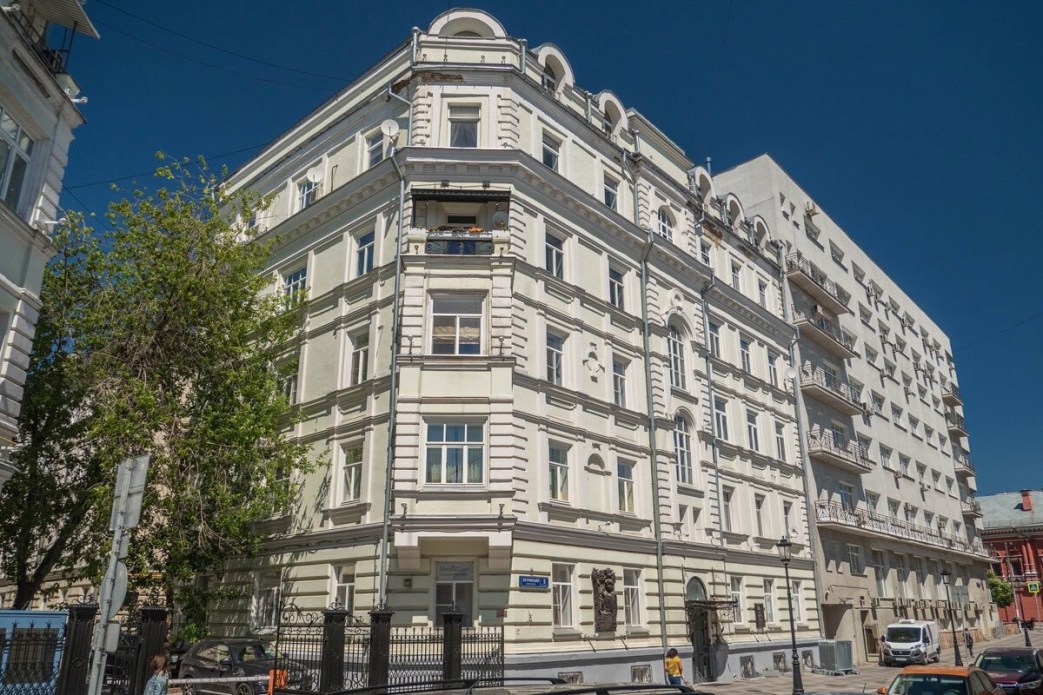
A group of Moscow food workers did not want to wait for Communism and took the the Petrovsky Lane building formerly owned by industrial capitalist A.A. Bakhrushin as the site of the First Moscow Workers’ Commune in 1920.
‘The First Workers’ Commune in Moscow’ from Soviet Russia (New York). Vol. 3 No. 9. September 4, 1920.
AMONG our proletariat, especially among the women, there is still to be found a deep-rooted dislike of social housekeeping. For this reason it is interesting to observe how there developed in the workers’ communes of Russia new forms of social organizations which are intended to replace our primitive, old fashioned ways of keeping house. The following article will give the reader a picture of the first workers’ commune in Moscow:
In the heart of the city is located Moscow’s first residence commune. It comprises a group of about twenty houses, four to five stories in height; this block of houses was well-known as the “Bakhru Houses” (so named after the former owner). Today they bear the proud title “First Moscow Workers’ Commune.”
At the beginning of the Revolution these houses were socialized by the city and turned over to the bakers’ union for their use. They in turn established the commune. All apartments, even those which were vacated by former tenants, are completely furnished. Tenants remaining in the building were assigned only as many rooms as they actually needed for their families. All superfluous rooms had to be vacated, together with all their furniture.
These vacant apartments and rooms were turned over to the bakers and other workers, as well as to Soviet officials and their families. The rent is proportionately low and evenly divided among all tenants; in fact, only enough is collected to cover the necessary expenses for the maintenance of the houses.
The commune is supervised by a house committee which is elected every six months at a meeting participated in by all the tenants. (Excepted are workers in technical branches.) Included in the house committee are an engineer, whose duty it is to see that the houses are properly maintained, and a physician who watches over sanitary conditions in the commune. A few men to make necessary repairs in the houses are also employed: mechanics, roofers, carpenters, etc., but no one receives pay.
In the commune are located a bakery and a store for the sale of foodstuffs, conducted in conjunction with the municipal consumers’ league. The house committee is represented in both organizations. The members of the commune also receive cards through the committee, which enable them to obtain various textile goods. These manufactured goods, clothing, shoes, hats, etc., are distributed through the warehouses of the municipal consumers’ league. Members are also entitled to written orders for the repair of shoes and clothing, as well as for the supply of fuel. Moreover all rooms have heat from a central heating plant, electric light, and gas.
There was also installed in the commune a large laundry, in which linen is carefully. washed at very low cost. A community kitchen, too, was established and is used in connection with a large dining room. If desired, families can call for their meals and carry them to their apartments. Needless to say the comfort of the commune’s children has not been overlooked; there are cribs for infants and little tots, and kindergartens for the bigger children. The women workers, away at their tasks during the day, need have no worry on account of their little ones; they know they are well taken care of.
The houses are placed in the center of a beautiful, scrupulously well-kept garden. Every Sunday a concert is given there, and occasionally lawn parties are arranged. Adjoining the garden is a theatre (in memory of a martyr of the Revolution called the “House of Peter Alexinsky”) in which plays are frequently given for the members of the commune, sometimes, too, performances for children, or lectures with and without stereopticon views; the weekly meetings likewise take place in this theatre.
The commune has established a comfortable reading room, and maintains a well stocked library. A dramatic and musical club is busily at work. The soul of the whole commune is of course the communist element, which has established it all and brought it to its present high standard, and which always calls on everybody for solidarity and a spirit of mutual assistance.
All members are obliged to maintain strict cleanliness and order. In the spring of the year, when the great masses of snow which have accumulated during the winter, begin to melt, all members are requested to lend a hand in the cleaning of yards and sidewalks. Cheerfully everybody grasps spade and broom, and it is a veritable pleasure to see how gaily and quickly the work is completed. All these people, performing their unaccustomed work in a spirit of so much cheerfulness, have the elevating consciousness that even these little tasks contribute to the common weal.
Soviet Russia began in the summer of 1919, published by the Bureau of Information of Soviet Russia and replaced The Weekly Bulletin of the Bureau of Information of Soviet Russia. In lieu of an Embassy the Russian Soviet Government Bureau was the official voice of the Soviets in the US. Soviet Russia was published as the official organ of the RSGB until February 1922 when Soviet Russia became to the official organ of The Friends of Soviet Russia, becoming Soviet Russia Pictorial in 1923. There is no better US-published source for information on the Soviet state at this time, and includes official statements, articles by prominent Bolsheviks, data on the Soviet economy, weekly reports on the wars for survival the Soviets were engaged in, as well as efforts to in the US to lift the blockade and begin trade with the emerging Soviet Union.
PDF of full issue: https://www.marxists.org/history/usa/pubs/srp/v3n17-oct-23-1920-soviet-russia.pdf
 Revolution's Newsstand