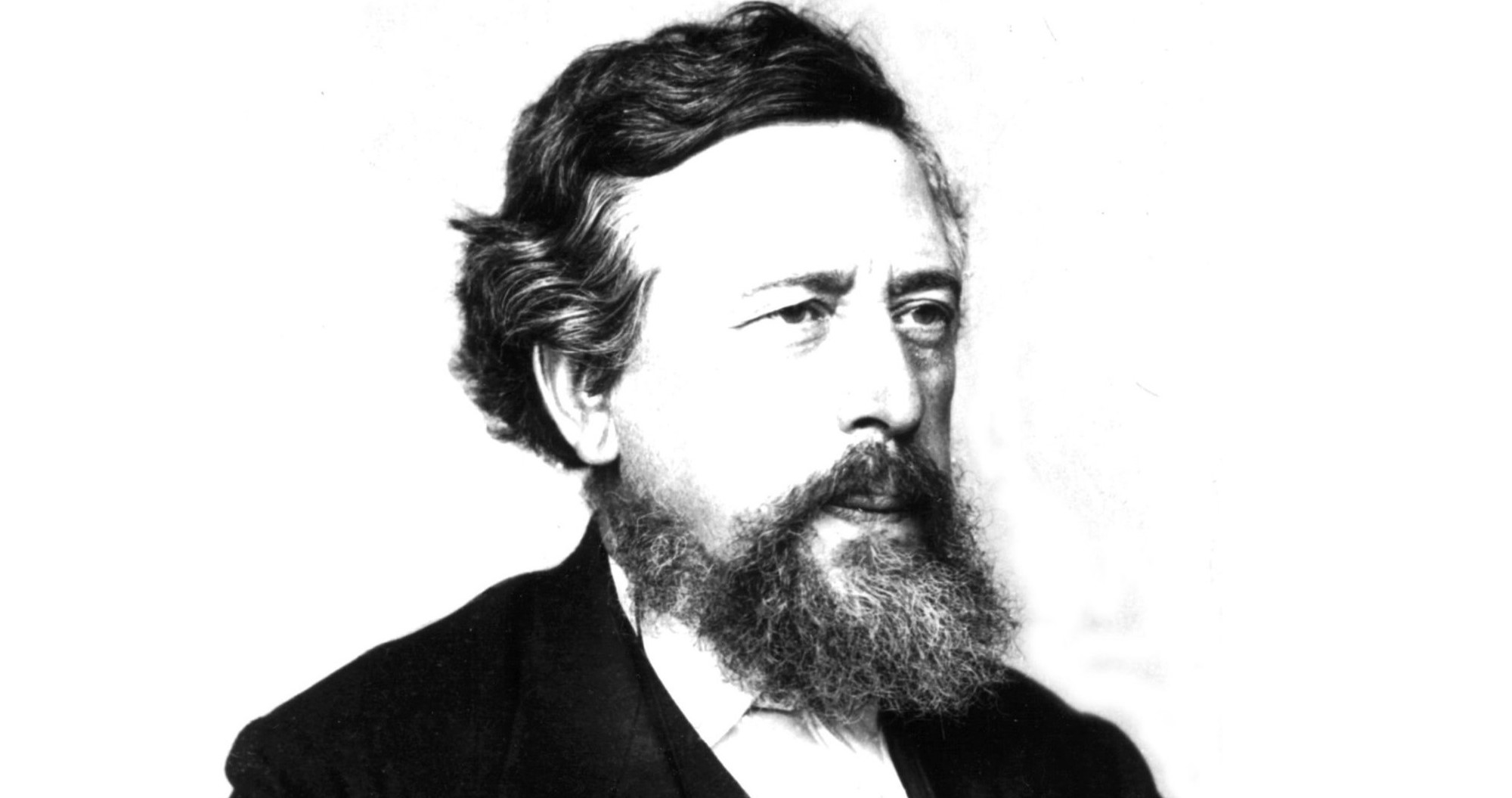
Beginning in November, 1870, during the Franco-Prussian War, German revolutionary and Social Democrat member of parliament Wilhelm Liebknecht began a column on European affairs for U.S. audiences in Chicago’s Workingmen’s Advocate. The Advocate was the paper of the National Labor Union, a constituent of the First International. Of obvious great value for the history of the Marxist and workers’ movements, these letters continued through December, 1871 and chronicle the fall of France, the rise of the Commune, and the bloody reaction that followed. As members of parliament the internationalists Liebknecht and Bebel voted against the war and were tried for treason. Each letter will be transcribed here in order of publishing. The first where Liebknecht introduces himself, without using his name, talks about the changing character of the war and the hypocritical treatment of the Franctireurs, below.
‘Letter from Leipzig’ by Wilhelm Liebknecht from The Workingman’s Advocate (Chicago). Vol. 7 No. 14. November 26, 1870.
OUR EUROPEAN CORRESPONDENT. In this week’s issue we present the first of a series of letters from one of the ripest scholars and profoundest thinkers in Europe–a gentleman who is also one of the most prominent members of the German Parliament, and who is eminently qualified to judge of the social and political changes now going on in that country. We bespeak for his communication a careful perusal.
LEIPZIG, Nov. 5, 1870.
To the Editor of the WORKINGMAN’S ADVOCATE.
In introducing myself to the readers of the WORKINGMAN’S ADVOCATE, I have to tell them that I am a German and a member of the Socialist-Democratic Party. The former I say not from any national feeling, to which I am quite a stranger, but simply to explain and excuse beforehand the Teutonism that will inevitably enter my letters to this paper. By mentioning the party to which I belong I have at once stated from which standing point I shall judge of and view men and things.
At any time I should have been happy to get an opportunity of addressing the workingmen of the New World and informing them of the struggles and sufferings and hopes of their brethren in the Old World, and especially in this central part of Europe, where, one day, in unity with free, republican France, the chains of the eastern hemisphere will be broken. But at the present moment I am doubly glad, because I know that the fearful crisis, into which an infamous dynastic policy has thrown the two leading peoples of our continent, has been systematically misrepresented by many organs of public opinion in your United States; and because it is now of the utmost importance to remove the terrible misunderstandings created by this war–misunderstandings which threaten our common work of universal international brotherhood.
You have, doubtless, heard that the German Workingmen, like those of France, opposed the war in the beginning; that in Germany, as well as in France, many demonstrations took place in favor of peace; that the two representatives of the Socialist-Democratic Party (Messrs. Rebel and Liebknecht.) in the North German Diet (Reichstags) refused to vote the supplies for a war which they branded as a purely dynastic one; and that, though after the declaration of war by the French Emperor the German workingmen were obliged to give up their opposition for a time, yet immediately after the catastrophe of Sedan and the proclamation of the Republic in France, they revived their call for peace, energetically protesting against the continuation of a war, the chief author of which had met with a well-deserved doom. Their call for peace was not to the taste of Count Bismarck and his companions in power; all leading members of our party on whom the Prussian government could lay their hands were arrested, and transported in chains to Lothzen, a little fortress near the Prussian frontier, where, with one single exception,1 they are still kept close prisoners. Of this act of scandalous oppression (carried out by Gen. Vogel von Falckenstein, one of those monarchical, model soldiers, whose brutality to those below him is only surpassed by their servility to those above them)–of this act of oppression the newspaper press, being almost exclusively the property of the privileged classes, has taken hardly any notice, and would have taken still less, had not the brave Democrat, Jacoby, who belongs to the middle class, been arrested, too, on the same grounds–a measure which created great excitement amongst our middle-classes and could not be passed over in silence by the middle-class papers.
As things stand at present, I may say without fear of being contradicted, there is not one workingman, who is able to think, in all Germany, that does not condemn the present war as a war carried on not for the country, but against it–as a war carried on by the enemies of liberty against democratic Germany just as well as against republican France. About this more by and by. Today I shall venture only upon the following short remarks:
There are two different phases to be distinguished in this unfortunate war, the one beginning on the 16th of August, the day of the French declaration of war, and ending on the 4th of September, the day of the proclamation of the Republic in France; the second phase beginning on the 4th of September and still continuing up to the day France cleared herself of the treacherous infamy of the Empire, the war was for Germany one of defense, and even we Democrats and Socialists could not deny this, though we knew very well that Count Bismarck was as guilty as Bonaparte, and that the war was only the necessary result of the grasping policy of Prussia, which had led Bismarck to seek Bonaparte’s alliance in Biarritz,1865, and then in the following year with the moral assistance of this same Bonaparte, to destroy the German Confederation, and to sever thirteen millions of Germans (inhabitants of Austria,) from the rest of Germany; in short the war of 1870 was only the unavoidable consequence of the war of 1866. However, some how or other, Bonaparte was forced to be the aggressor, and Germany had to defend herself.
But from the day Bonaparte’s government was overthrown by the French people, the war has changed its character; from a war of defence on the part of Germany, it has become a war of aggression and conquest, with the avowed aim of wrenching from France a part of her territory and the unavowed aim of destroying the newly founded Republic. Count Bismarck is an aristocrat, his power is founded on the immense standing army which Prussia has to uphold. If the French Republic survive the war and succeeds in founding democratic institutions, then the fall of absolutism in Prussia is only a matter of time. Bismarck in Prussia requires a despotic France; and despotism in France means the Empire. Therefore, we have now the strange spectacle that the Prussians who, at the outbreak of the war, declared by the mouth of the King, that the war was directed solely against the government, and not against the people of France, are now making war for the restoration of this very same government and against the French people.
The capitulation of Metz, with the circumstances that accompanied it, have dissipated every doubt which could still exist in that respect. Restoration of Bonaparte and the destruction of the Republic is the political programme of Count Bismarck.
Will he win the game? It is a question of power. It all depends upon the determination of the Frenchmen and the condition of the German armies. The latter is, according to all reports, a very unsatisfactory one. The “little war” is most destructive to our forces and diseases of all kinds are rapidly thinning their ranks. Daily 2,000–I write two thousand–sick and wounded German soldiers are being carried from France into Germany. How many are dying daily in France, and how many are not in a state to allow of their being transported–we do not know exactly, but we know that the number is fearful. In fact the sacrifice of human life is so great that the war cannot be continued much longer, and if the Frenchmen hold out long enough, the Republic is saved and Count Bismark and his system defeated.
One word about the French irregular troops, the Franctireurs, who are denied the right of soldiers by any troops, and shot when taken–a proceeding approved of by most of our “respectable” papers. My “patriotic” countrymen, who consider it their “national” duty to “eat Frenchmen” at breakfast, at dinner, at supper, and in the “Kneipe” (tavern), cannot understand that the Frenchmen have now the same right and duty to fight against the German invaders, which our German grandfathers had in the years 1813 1814, 1815, to fight against the French invaders and oppressors. Schill, Lutzem and his “black Jagers, who then combatted the Frenchmen, even in the midst of official peace, are described as heroes in our school books, and are considered such not only by every German, but by every impartial man that knows of their deeds; but the French Franctireurs, who now do exactly the same, and do it while their country is at war with Prussia, do it in a struggle upon the result of which the future–the welfare of their country depends, these French Franctireurs are represented and treated as mere robbers. This shows how difficult it is to be just. The plea that the Franctireurs are not properly uniformed, and therefore not easily to be distinguished from armed citizens, is totally ridiculous, and amounts to putting out of the law any soldier not belonging to a standing army; in fact, as great standing armies are the “peculiar institutions” of monarchies, it would amount to making warfare the privilege of kings and emperors, while forbidding the people to defend themselves.
Unfortunately Prussia was once in a similar position as France is now, and then the King of Prussia, Frederick William III, issued an “ordinance” for the organization of the Landsturm (all armed men not embodied in the regular army) which imposed as a holy duty on the Prussians to do all the Franctireurs are doing now.
The royal ordinance in question bears the date of April 21, 1813, and contains, amongst others, the following articles:
ART. 1. Every citizen is under obligation of repelling the enemy with whatever arms he can dispose of, to brave their means of defence, and so do harm by every means to their projects.
ART 2. In case of invasion, the Landsturm is to fight the enemy, in battle, or to disturb them in the war, and to eat off their communications. ART 4. The Landsturm is raised whenever the enemy may attempt to invade the Prussian territory.
ART. 7. As soon as the necessity of calling out the Landsturm has arisen, the struggle for which the Landsturm is destined, is a combat of legitimate defence, which justifies every means. The sharpest and most radical means are to be preferred, for they being met successfully and rapidly the sacred cause to a victorious issue.
ART 8. It is therefore the duty of the Landsturm to prevent the enemy from entering into or retreating from the national territory, to keep them constantly on the alert, to give them no breathing time, to cut off their supplies, and munition, couriers and recruits; to seize upon their hospitals, to carry out night surprises; in short, to disturb them, to torment them, not to allow them any sleep, to annihilate them singly and in troops wherever it may be possible; even were the enemy to penetrate into the heart of the country, and to advance as far as fifty miles (German miles, each of which is like five English miles); this will be but a slight advantage to them, if the line they occupy has no breadth, if they cannot venture upon sending out small detachments, as foraging and reconnoitering expeditions, without the certainty of their being exterminated, and if they can only advance in masses on the high roads. This has been proved by the experience of Spain and Prussia.
ART. 39. THE MEN OF THE LANDSTURN ARE NOT ALLOWED TO WEAR UNIFORM OR DRESSES ESPECIAL LY MADE FOR THEM, because that would render them recognisable and would expose them to he pursued by the enemy better than otherwise will be the case.
These excerpts are sufficient. They show that the Prussians, at the order of King William, are now shooting the French Franctireurs for doing what fifty seven years ago the Germans were ordered to do by King William’s father, Frederick William III.
In my next letter I shall write about the state of parties in Germany.
NOTE
1. Mr. von Bonhorst, Secretary to our Exective Committee, was set tree ten days ago, because he had the honor of being a Prussian “subject,” the King of Prussia having given the hypocritical order to open the prison doors to all those of his subjects that had been robbed of their liberty for political reasons and without any properly lawful reason, “in order that the impending elections for the Prussian Chamber of Deputies might not appear influenced by the Government,” as if the Prussian Government did not influence the elections enough already.
The Chicago Workingman’s Advocate in 1864 by the Chicago Typographical Union during a strike against the Chicago Times. An essential publication in the history of the U.S. workers’ movement, the Advocate though editor Andrew Cameron became the voice National Labor Union after the Civil War. It’s pages were often the first place the work of Marx, Engels, and the International were printed in English in the U.S. It lasted through 1874 with the demise of the N.L.U.
Access to PDF of issue: https://chroniclingamerica.loc.gov/lccn/sn89077510/1870-11-26/ed-1/seq-2/
 Revolution's Newsstand