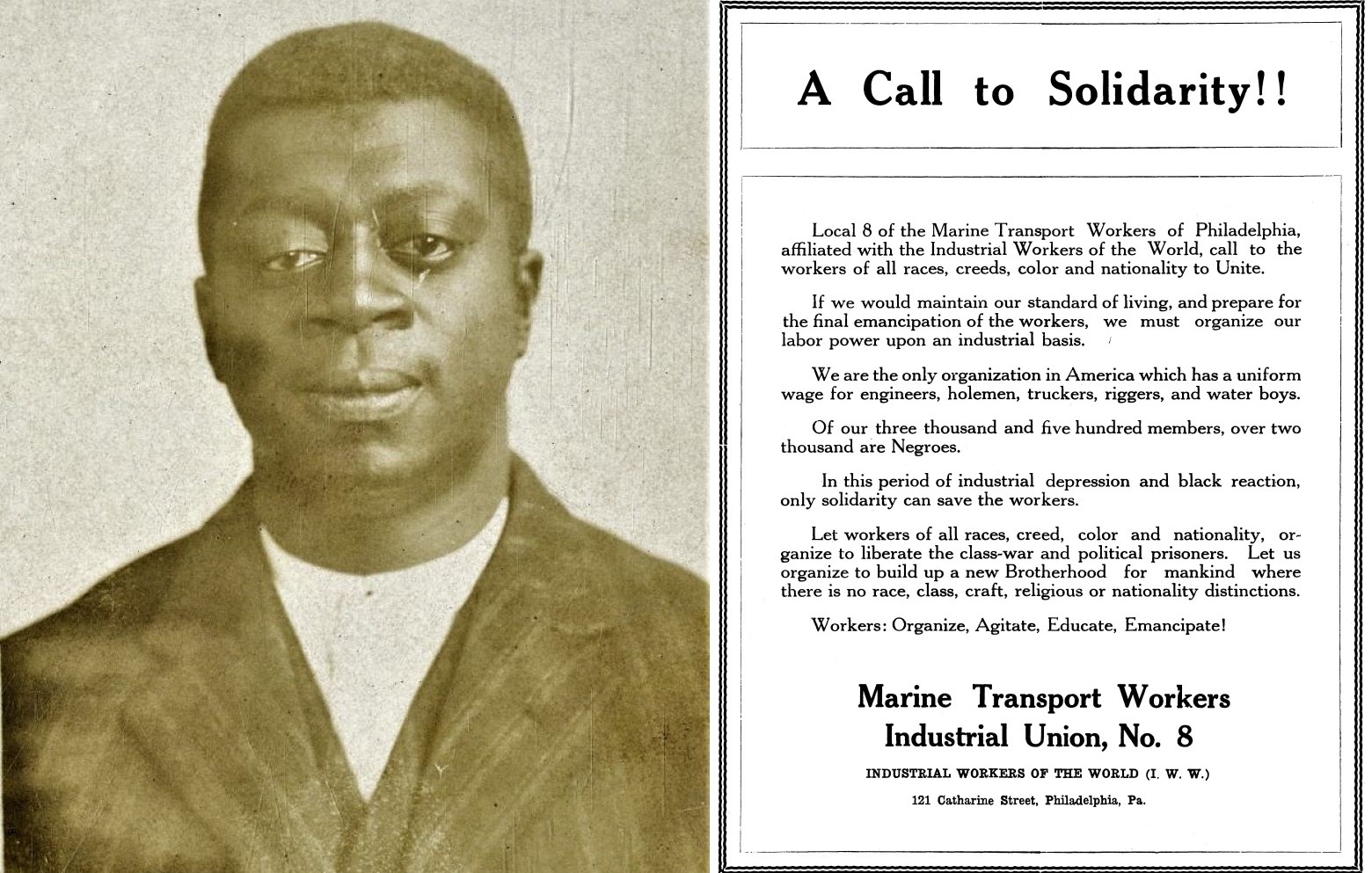
The Messenger reports on the efforts of Marine Transport Workers Industrial Union Local 8 to build inter-racial solidarity and workers’ education of the Philadelphia waterfront with weekly Friday night forums.
‘The Forum of Local 8’ from The Messenger. Vol. 3 No. 3. August, 1921.
THE meeting was called to order at 8:30 p.m. sharp.
Immediately the gavel sounded, a hall of six or seven hundred eager-eyed workers doffed their hats and sat up erect–a picture of attention, interest and enthusiasm. It was the beginning of an innovation among workers.
It was a conscious and deliberate effort of the Marine Transport Workers to conduct a systematic forum for self-education.
Rumors had been floating in the air about the rise of a dual union. It had been reported that agents of the I.L.A. were operating along the water front, seeking to sow the seeds of discord and dissention among the rank and file of the organization. Alleged Negro leaders masquerading in the guise of race loyalty, had been preaching the nefarious and dangerous doctrine of race segregation to the Negro members of Local 8. Negroes were made all sorts of fictitious and fraudulent promises about their receiving sick and death benefits. To these sugar-coated, empty and unsubstantial pledges, the militant, class-conscious. and intelligent Negro workers turned a deaf ear. They meted out to the self-styled and self-appointed I.L.A. saviors of the Negro workers, curses instead of blessings.
It was to reenforce and fortify the brains of Local 8 that this forum was organized. Only those men of the organization were deceived by the notorious misrepresentation of the paid agents of the bosses who were “strong in the back and weak in the head.” But always alert, active and conscious of its class interests, Local 8 proceeded to formulate plans to break down the insidious, anti-labor solidarity propaganda of the I.L.A.
The subject of the lecture of the first meeting was “The Relation of Organized Labor to Race Riots.”
The speaker attempted to show that inasmuch as labor fights race riots just as it fights the wars between nations, only labor could stop race riots. He pointed out that just as the bosses of the workers profit from national wars, so the bosses of the workers profit from race wars; that it was to the interest of the capitalists to keep the workers divided upon race lines so that they could rob them more easily and successfully. He stated that: “If the white and black working dogs are kept fighting over the bone of race prejudice, the artful, hypocritical yellow capitalist dog will steal up and grab the meat of profit.”
It was explained how race riots served the interests of the employers of labor, by keeping the workers divided, at daggers points. He indicated how the I.L.A. was serving the interests of the Stevedores and Shipping Interests by preaching a race-riot doctrine of segregation.
Brief, pointed and enthusiastic questions and discussions followed the lecture.
There was an evident passion to talk among the fellow workers. The forum afforded them an ideal opportunity to vent their grievances against the I.L.A. and the entire tribe of anti-labor forces in the country.
Although the verbs and nouns seldom lay down in harmony and peace, the clear economic thinking of the fellow workers was marvelous and evident to any one.
Each speaker deplored and condemned the Tulsa race riot in Oklahoma. With a sound working-class instinct they laid the cause of the Tulsa massacres at the door of the labor-hating, profiteering, conscienceless Ku Klux Klan, predatory business interests of the South.
Here, too, was a living example of the ability of white and black people to work, live and conduct their common affairs side by side. There were black and white men and black and white women in this meeting. No rapes, no lynchings, no race riots occurred! Isn’t it wonderful! Let the Southern press together with its northern, eastern and western journalistic kith and kin, bent upon their base, corrupt, wicked and hateful mission of poisoning the wells of public opinion with the virulent spleen of race prejudice, take note!
The second forum meeting discussed the interesting subject of “Labor Preparedness for the Next War.” “Industrial Unionism, the Only Hope of the Workers” provided an enthusiastic and lively discussion. John Barleycorn wormed his way into the stomach of one fellow and upset his head, thereby necessitating a discussion of the “Relation of Liquor to the Labor Movement.” Searching and discerning questions on the economics of the Prohibition Movement were hurled at the speaker. “Was the abolition of the liquor industry which increased unemployment to the interest of the workers?” was asked. The speaker answered that. “there was no more reason for advocating the sale of liquor, a recognized poison, on the ground that it afforded employment to workers than there was to advocate war, or the building of houses of prostitution on the grounds that such would afford employment to the workers.”
This meeting was followed by a lecture on the “Open Shop Campaign–the Remedy: Trades or Industrial Unionism:
The Forum meets every Friday evening in Philadelphia.
Here the workers are trying to democratize knowledge, for they, too, are learning that knowledge is power and that if the capitalists control all the knowledge, they will also control the world.
The Messenger was founded and published in New York City by A. Phillip Randolph and Chandler Owen in 1917 after they both joined the Socialist Party of America. The Messenger opposed World War I, conscription and supported the Bolshevik Revolution, though it remained loyal to the Socialist Party when the left split in 1919. It sought to promote a labor-orientated Black leadership, “New Crowd Negroes,” as explicitly opposed to the positions of both WEB DuBois and Booker T Washington at the time. Both Owen and Randolph were arrested under the Espionage Act in an attempt to disrupt The Messenger. Eventually, The Messenger became less political and more trade union focused. After the departure of and Owen, the focus again shifted to arts and culture. The Messenger ceased publishing in 1928. Its early issues contain invaluable articles on the early Black left.
PDF of full issue: https://www.marxists.org/history/usa/pubs/messenger/1921-08-aug-mess-RIAZ.pdf
 Revolution's Newsstand