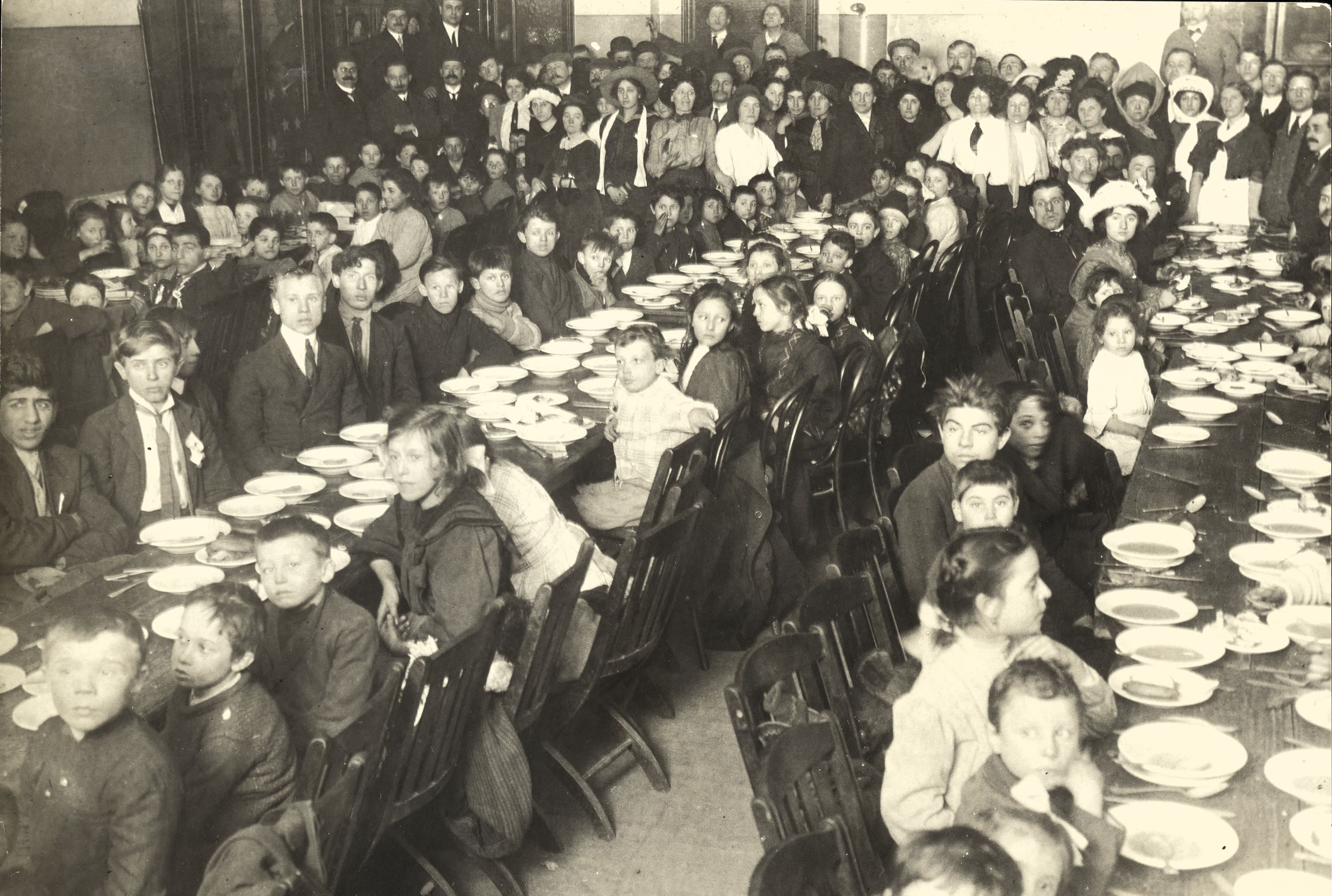
Russell visits a meeting of Local No. 20 of the National Industrial Union of Textile Workers during the ‘Bread and Roses’ strike in Lawrence, and sees the basis of a future free from capital.
‘Cells of the New Society’ by Phillips Russell from International Socialist Review. Vol. 13 No. 10. April, 1913.
NOT long ago I attended a meeting of the Central Committee of Local No. 20 of the National Industrial Union of Textile Workers at Lawrence. There were delegates present from each language branch of the local union.
I was much interested, not only because. I was curious to see what kind of an organization remained a year after the historic strike of the winter of 1912, but because it occurred to me at the time that I was watching the development of a cell of the new society.
Here were thirty or forty workingmen, comparative strangers to each other a short time before, more or less separated by differences in race, nationality, politics, religion and custom, who sat down in perfect amity to discuss their common interests as workers in an industry; to work out their problems as producers, to regulate as far as lay within their, as yet limited, power their conditions of toil and to provide for the good and welfare of all.
The Italian sat next the German, the Syrian next the Frenchman, the Pole next the Portuguese, the Lithuanian next the American, and an Irishman was chairman over all!
The Jew here was just the same as the Christian, the Catholic was just as good as the Protestant, the dyer’s voice was just as potent as the percher’s.
For Producers Only.
They had met to discuss not art or religion or science or politics, but industry. The scientist, the preacher, the lawyer, the politician, the college bred student of government, was useless to them now. They needed no guides, leaders or teachers. None of these could tell them anything about the problems of the worker in the textile industry. They were thrown entirely upon their own resources, must depend on their own knowledge, use their own brains. The most highly trained professor from Harvard or Heidelberg, the most skillful lawyer in the world, the most learned writer in the United States, could now tell them nothing about the proper manner to cope with a new machine, about the best way to adjust the work of the wool sorter with that of the spinner, about the right job to provide for a crippled worker. These were concrete problems of life and labor that only the worker who had gained experience in the industry could solve.
Here, then, was the future society in embryo. For the future society will be not so much concerned with the government of men as the administration of things.
Government at present is largely taken up with the regulation of the personal conduct of men and women. It tells a man he must not play baseball on Sunday or sell a friend a drink of whisky one minute after midnight on Saturday. It tells a woman she must not leave one man and marry another without obtaining the consent of the law. It tells a child it must not walk on the grass in the public parks.
Different in the Future
We will have no time for this sort of foolishness in the new society. Our time will be better employed. We won’t care whether a man takes a drink at 11:59 or 12:01. If a woman decides she likes one man more than another it will be her privilege to make her own choice. If a child wants to play on the green grass, there will be plenty for him to revel in.
Then, too, government as we have been made familiar with it, is much occupied with acting as a policeman for those who have all the good things of life against those who have none of them. You mustn’t walk across your neighbor’s field because that is his private property and you are committing trespass. You mustn’t take away from the factory a pair of shoes, which you have made, because they belong to your employer and you are committing theft. You mustn’t loaf out in the sunshine because that belongs to your betters–you ought to be at work piling up profits for an already rich man, and you are a vagrant anyhow. You mustn’t take a ride on the railroad train without paying a high price for the privilege because the railroad is owned by somebody else.
So laws and courts and policemen are provided to make you behave yourself and stay in your proper place–underneath. And every year or so white-collared men go from various states and districts to Washington and assemble into what they call Congress, for the purpose of making more laws and creating more institutions by which the accumulated property and ill-gotten gains of the owners of the earth may be protected and safeguarded.
That is a Political Congress. It is concerned with problems of politics, not the good and welfare of those who do the good and welfare of those who do the work of the world.
Unnecessary Acts.
But the new society will have no use for any such institution. There will be no need for a set of men to meet and fix the legal rate of interest at 6 per cent because there won’t be any more interest. There will be no need for laws regulating monopoly because there won’t be any more monopolies. There will be no need for appropriations of $10,000,000 each for battleships because there won’t be any more battleships. There won’t be any more sending of Federal troops to break strikes because there won’t be any more Federal troops or strikes either. There won’t be any further necessity for passing laws which say thou shalt not deprive a corporation of its private property without due process of law because there won’t be any more private property of that kind. There won’t be any need for laws which say you shan’t ship goods of a certain character from Ohio into Florida because there won’t be any more state lines.
The congress of the future will be an Industrial Congress. It will be an enlargement and extension of such central commit- tees as that at Lawrence. It will be composed of workingmen and working women, of those who perform some useful function in society, of those who produce something needed or demanded by the people as a whole. And there won’t be a lawyer, a real estate dealer, or a Wall street broker among them; though there may be doctors and dentists and even actors.
The Coming Congress.
This congress will discuss, not Politics, but Industry. And by this is meant industry in the larger sense. Safeguarding the public health and fighting disease is as much an industry, for example, as making steel.
The members of this congress will come not from New York or Texas, or from the tenth district in Kansas, or from Pike county, Arkansas, but from the textile industry, the transportation industry, the farm industry, the coal mining industry, and so on. The gold miner will meet there with the musician, the fisherman with the shoeworker, the wheat grower with the newspaperman, the stonemason with the shirtwaist maker. There they will work out their conditions of labor. There they will regulate production and arrange distribution.
They will discuss not men, but things. They will deal not with theories but work. They will be concerned not with politics, but humanity.
The International Socialist Review (ISR) was published monthly in Chicago from 1900 until 1918 by Charles H. Kerr and critically loyal to the Socialist Party of America. It is one of the essential publications in U.S. left history. During the editorship of A.M. Simons it was largely theoretical and moderate. In 1908, Charles H. Kerr took over as editor with strong influence from Mary E Marcy. The magazine became the foremost proponent of the SP’s left wing growing to tens of thousands of subscribers. It remained revolutionary in outlook and anti-militarist during World War One. It liberally used photographs and images, with news, theory, arts and organizing in its pages. It articles, reports and essays are an invaluable record of the U.S. class struggle and the development of Marxism in the decades before the Soviet experience. It was closed down in government repression in 1918.
PDF of full issue: https://www.marxists.org/history/usa/pubs/isr/v13n10-apr-1913-ISR-riaz-ocr.pdf
 Revolution's Newsstand