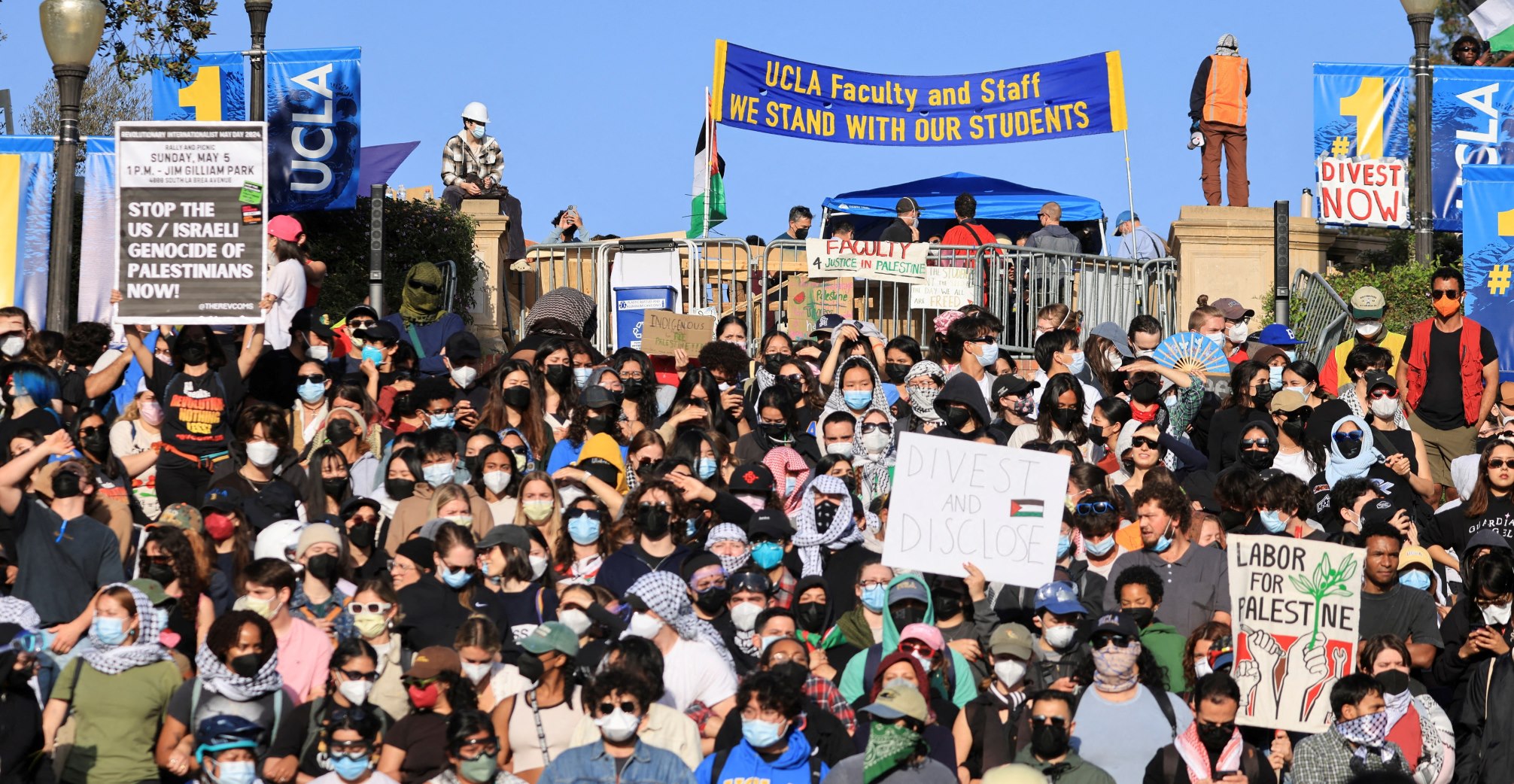
The National Student League published this 1901 Lenin article defending students against repression for a new generation of students radicals facing repression, this time on U.S. campuses. It deserves another reprint today.
‘The Tsar Suppresses Students’ (1901) by V.I. Lenin from Student Review. Vol. 2 No. 4. February, 1933.
THE newspapers of January 11 published the official announcement of the Ministry of Education concerning the drafting into the army of 183 students of the Kiev University as a punishment for “riotous assembly.” The Provisional Regulations of July 29, 1899–this menace to the student world and to society–are being put into execution less than eighteen months after their promulgation. And it seems as if the government hastens to excuse itself for applying this measure of unexampled severity by publishing an indictment in which the misdeeds of the students are painted in the blackest possible colors.
These misdeeds are worse than awful! A general students’ congress was convened in the summer in Odessa to discuss a plan to organize all Russian students for the purpose of protesting against the state of affairs in academic, public and political life. As a punishment for these criminal political designs all the student delegates were arrested and deprived of their documents. But the unrest does not subside–it grows and persists in breaking out in many higher educational institutions. The students desire to discuss and conduct their common affairs freely and independently. Their authorities–with the soulless formalism with which Russian officials have always distinguished themselves–retaliate by petty pin-pricks, and rouse the discontent of the students to the highest pitch, and automatically stimulate the thoughts of the youths who have not yet become submerged in the morass of bourgeois stagnation, to protest against the whole system of police and official tyranny.
The Kiev students demand the dismissal of a professor who took the place vacated by his colleague. The authorities resist, provoke students to convene “assemblies and demonstrations” and give way. The students call a meeting to discuss the despicable conduct of two undergraduates–scions of wealthy families–who (so rumor has it) together had outraged a young girl. The officials sentence the principal “culprits”–for convening a meeting–to solitary confinement in the students’ detention room. These refuse to submit. They are expelled. A crowd of students demonstratively accompany the expelled students to the railway station. A new meeting is called. The students remain until the evening and refuse to disperse until the rector arrives. The Vice-Governor and the chief of the gendarmerie come on the scene at the head of a detachment of troops, who surround the university and occupy the main hall. The rector is called. The students demand–a constitution perhaps? No. They demand the abolition of the punishment of solitary confinement, and the reinstatement of the expelled students. The names of the participators in the meeting are taken and then they are allowed to go home.
Ponder over this astonishing lack of proportion between the modesty and innocuousness of the demands put forward by the students and the panicky dismay of the government, which behaves as if the axe had already been laid to the pillars of the monarchy. Nothing so much exposes our “omnipotent” government as this display of consternation. By this it proves more convincingly than does any “criminal manifesto” to all those who have eyes to see and ears to hear that it realizes the complete instability of its position, and that it relies only on the bayonet and the knout to save it from the indignation of the people. Decades of experience has taught the government that it is surrounded by inflammable material and that a mere spark, a mere protest against solitary confinement, is sufficient to start a conflagration. That being the case, it is clear that the government had to make an example of the students; draft hundreds of students into the army! “Put the drill sergeant in place of Voltaire.”1 This formula has not become obsolete; on the contrary, the twentieth century is destined to see its complete application.
This new punitive measure, new in its attempt to revive the long-obsolete past, provokes many thoughts and comparisons. Three generations ago, in the reign of Nicholas I, drafting into the army was a natural punishment entirely in keeping with the whole system of Russian serf society. Aristocrats were sent to the army so as to be compelled to serve and win their officers’ spurs and in order to curb the liberties of the nobility. The peasants were drafted into the army as a form of punishment; it was a long term of servitude, where “Green Street”2 and other forms of inhuman treatment awaited them. It is now more than a quarter of a century since “universal” military service was introduced, which at the time was acclaimed as a great democratic reform. As a matter of fact, we have not and never had universal military service, because the privileges enjoyed by birth and wealth create innumerable exceptions. As a matter of fact, we have not and never had anything resembling equality of citizens in military service. On the contrary, the barracks are completely saturated with the spirit of most revolting tyranny…Some will break down under the heavy burden, will fall in combat with the military authorities; others the feeble and flabby–will be cowed into silence by the barracks. But there will be those whom it will harden, whose outlook will be broadened, who will be compelled to ponder over and test their aspirations towards liberty. They will experience the whole weight of tyranny and oppression on their own backs when their human dignity will be placed in the hands of a drill sergeant, who very frequently takes deliberate delight in tormenting the “educated”. They will see with their own eyes what the position of the common people is, their hearts will be rent by the seeings of tyranny and violence that they will be compelled to witness every day, and they will understand that the injustices and petty tyranny from which students suffer are mere flea-bites compared with the oppression which the people are compelled to suffer. Those who will understand this will, on leaving military service, take the vow of Hannibal to fight with the vanguard of the people, the working class, for the emancipation of the whole people from despotism…
The working class has already commenced the struggle for its emancipation. It must remember that this great struggle imposes a great duty upon it; that it cannot emancipate itself without emancipating the whole people from despotism; that it is its duty first and foremost to respond to every political protest, and render it every support. The best representatives of our educated classes have proved–and sealed the proof with the blood of thousands of revolutionaries, tortured to death by the government–their ability and readiness to shake from their feet the dust of bourgeois society, and march in the ranks of the Socialists. The worker who can look on indifferently while the government sends troops against the student youth is not worthy of the name of Socialist. The students came to the assistance of the workers–the workers must come to the aid of the students…
The people must not let the government’s announcement of its punishment of the students remain unanswered!
Iskra, Number 2, February 1901. V. I. LENIN.
NOTES
1. This is a quotation from one of the best-known comedies in the Russian. language, The Misfortune of Being Clever, by Griboyedov. Ed.
2. Running the gauntlet. Ed.
Emerging from the 1931 free speech struggle at City College of New York, the National Student League was founded in early 1932 during a rising student movement by Communist Party activists. The N.S.L. organized from High School on and would be the main C.P.-led student organization through the early 1930s. Publishing ‘Student Review’, the League grew to thousands of members and had a focus on anti-imperialism/anti-militarism, student welfare, workers’ organizing, and free speech. Eventually with the Popular Front the N.S.L. would merge with its main competitor, the Socialist Party’s Student League for Industrial Democracy in 1935 to form the American Student Union.
PDF of original issue: https://archive.org/download/student-review_1933-02_2_4/student-review_1933-02_2_4.pdf
 Revolution's Newsstand