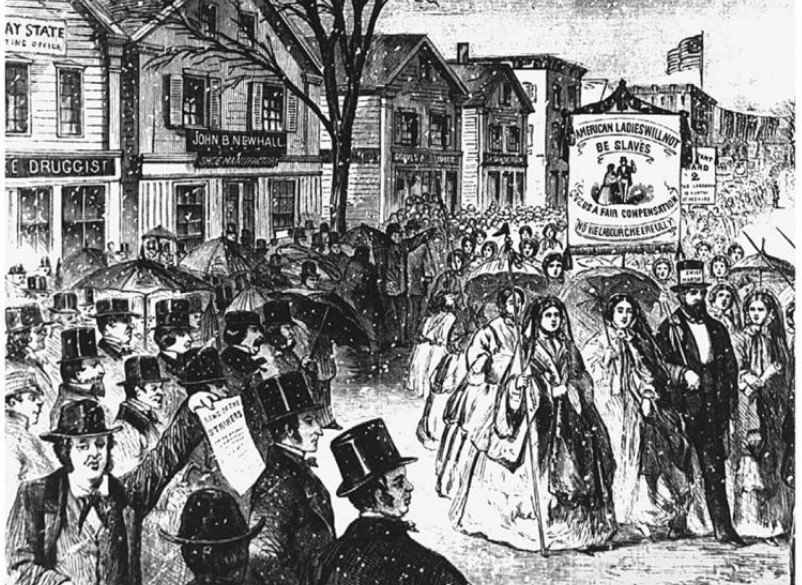
Ruth Delzell with the story of the first national women’s trade union in the U.S. written during the great upsurge in women textile worker strikes.
‘1869–The Daughters of St. Crispin’ by Ruth Delzell from Life and Labor (W.T.U.L.). Vol. 2 No. 10. October, 1912.
A most interesting strike, involving several hundred women shoe stitchers of Lynn, Mass., occurred during February and March, 1860. During a snow storm one day in March 5,000 men and 1,000 women formed a grand procession and marched with music and banners through the streets of the town. At once 100 special policemen were appointed and a detachment of police was sent from Boston, but as there was no rioting and as the people “only walked,” these historic upholders of the employers’ interpretation of law and order wisely withdrew.
Later, huge placards were posted on the walls of the city announcing a mass meeting of women and calling upon “those individuals who had no particular desire to become slaves to come forth, despite the storm, and meet their country-women in conclave.” Eighteen hundred women responded, and the overwhelming majority of these favored the protest, while the singing of the Song of the Shoemakers’ Strike added much to the enthusiasm of the hour. The strike resulted in a compromise with the manufacturers and in the formation of a Shoemakers’ Union.
The Daughters of St. Crispin, composed of women shoe workers, was the first woman’s trade union in the United States having a national organization. The first convention was held July 28, 1869, at Lynn, Mass., with 30 delegates present, representing the local lodges at Lynn, South Abington, Stoneham, Danvers, North Easton and North Bridgewater, Mass.; Auburn, Maine; Rochester, N.Y.; Philadelphia, Chicago and San Francisco.
The order had been initiated by the union men of the trade known as the Knights of St. Crispin in answer to a petition from some of the young women in the shoe factories. The convention was held to determine further principles and policies and to form the Grand Lodge. Miss Carrie Wilson, of Lynn, was elected temporary president and Miss Abbie Jaques, also of Lynn, was elected temporary secretary. By the end of that year the number of lodges reported was fourteen in Massachusetts and ten in the States of Maine, New Hampshire, New York, Pennsylvania, Ohio, Illinois, Wisconsin and California. The largest local was at Rochester, with about 400 members.
The second convention of the Order of St. Crispin was held at Stoneham, Mass., April 12 to 14, 1870. Thirty delegates were present from thirteen locals in six different States. The spirit of the women shoe workers may be seen in the following resolution which was unanimously adopted:
WHEREAS, the common idea among employers has been and still is that woman’s labor should receive a less remuneration, even though equally valuable and efficient, than is paid men even on the same qualities of work; and
WHEREAS, in every field of human effort the value and power of organization is fully recognized; therefore be it
RESOLVED by this National Grand Lodge of Daughters of St. Crispin, that we demand for our labor the same rate of compensation for equal skill displayed, or the same hours of toil, as is paid other laborers in the same branches of business; and we regard a denial of this right by anyone as a usurpation and a fraud.
RESOLVED, That we condemn and promptly veto one sister’s making a percentage on another sister’s labor.
RESOLVED, That we assure our fellow citizens that we only desire to so elevate and improve our condition as to better fit us for the discharge of those high social and moral duties which devolve upon every true woman.
The fellowship between this union and the Knights of St. Crispin was very close. We hear of their uniting in celebrations and processions, and we are told also that the Knights, both in Syracuse and Baltimore, went on strike in sympathy with the Daughters who were discharged for belonging to a trade union, a proof of real comradeship.
Life and Labor was the monthly journal of the Women’s Trade Union League (WTUL). The WTUL was founded by the American Federation of Labor, which it had a contentious relationship with, in 1903. Founded to encourage women to join the A.F. of L. and for the A.F. of L. to take organizing women seriously, along with labor and workplace issues, the WTUL was also instrumental in creating whatever alliance existed between the labor and suffrage movements. Begun near the peak of the WTUL’s influence in 1911, Life and Labor’s first editor was Alice Henry (1857-1943), an Australian-born feminist, journalist, and labor activists who emigrated to the United States in 1906 and became office secretary of the Women’s Trade Union League in Chicago. She later served as the WTUL’s field organizer and director of the education. Henry’s editorship was followed by Stella M. Franklin in 1915, Amy W. Fields in in 1916, and Margaret D. Robins until the closing of the journal in 1921. While never abandoning its early strike support and union organizing, the WTUL increasingly focused on regulation of workplaces and reform of labor law. The League’s close relationship with the Amalgamated Clothing Workers of America makes ‘Life and Labor’ the essential publication for students of that union, as well as for those interest in labor legislation, garment workers, suffrage, early 20th century immigrant workers, women workers, and many more topics covered and advocated by ‘Life and Labor.’
PDF of issue: https://books.google.com/books/download/Life_and_Labor.pdf?id=epBZAAAAYAAJ&output=pdf
 Revolution's Newsstand